A brand monitoring program that only watches Google Alerts and a hashtag column is running on 2016 infrastructure. Google now controls roughly 91% of global search, and about 68% of US searches end without a click at all, which means most of what shapes a brand's reputation today never shows up in a traditional media clip or a mention count. It shows up in a review star rating, a Reddit thread an AI model decided to cite, or a competitor's product page ranking above yours for your own brand name. Brand monitoring is the umbrella practice that tracks all of it: press coverage, social conversation, reviews, competitor activity, and increasingly, how a brand gets described inside ChatGPT and Perplexity answers. This guide breaks down what actually falls under the term, why the scope has widened so much, and how to build a program that catches signal instead of just generating a daily digest nobody reads.
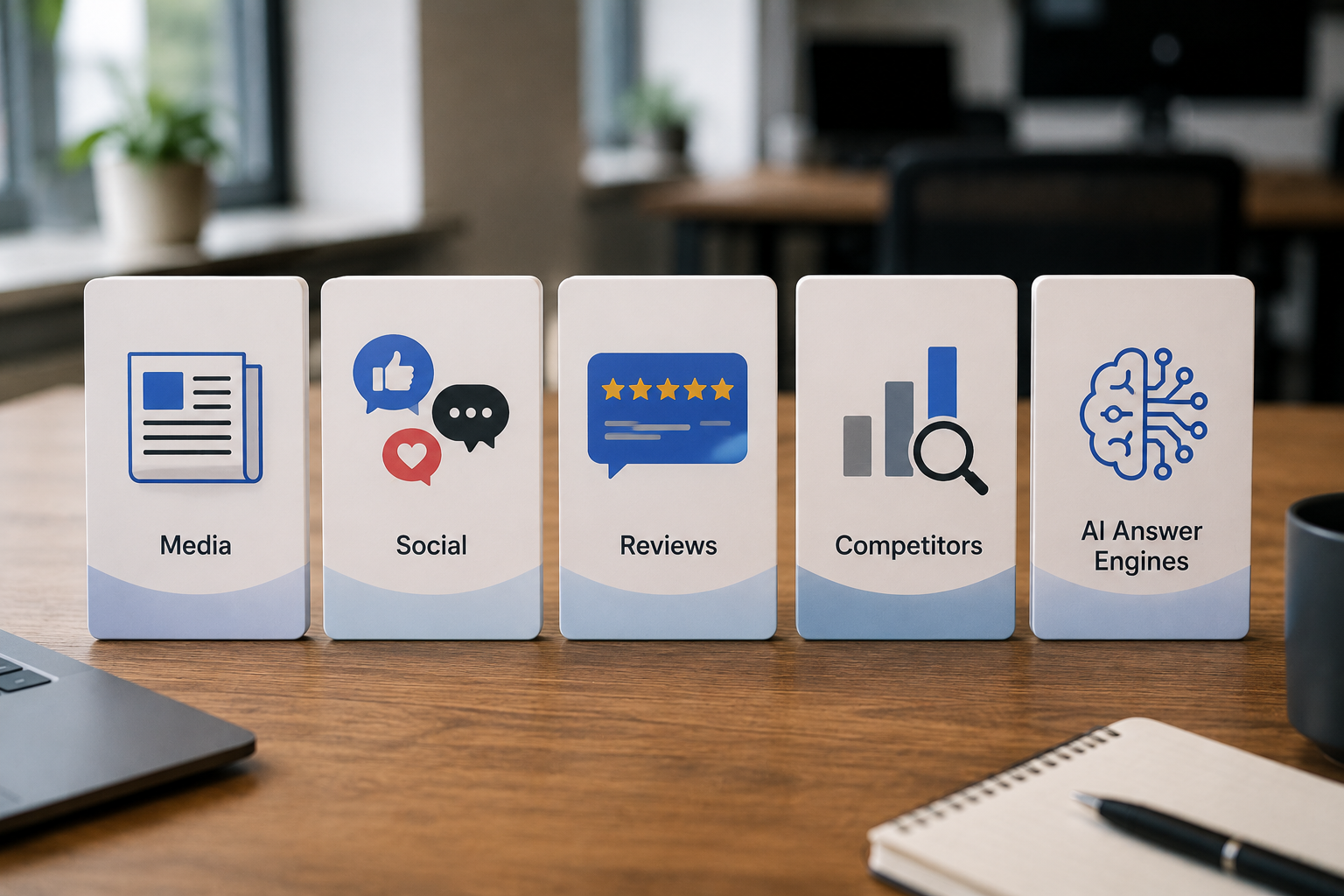
- Brand monitoring is five practices under one name: media monitoring, social listening, review tracking, competitor tracking, and AI answer engine visibility. Most tools cover two or three well and the rest poorly.
- Reputation now sits on a company's balance sheet in practice, if not on paper. Intangible assets, brand and reputation chief among them, make up about 92% of S&P 500 market value, up from 17% in 1975 (Ocean Tomo).
- 97% of consumers read reviews before choosing a local business (BrightLocal, 2026), and 31% now filter out anything under 4.5 stars, up sharply from 17% a year earlier.
- The online reputation management market alone is on track to grow from $6.9 billion in 2025 to $14.0 billion by 2031 (Mordor Intelligence), and that figure does not even count dedicated social listening or media monitoring spend.
- The teams that get this right build one program, not five separate tools, with a shared query set, a shared escalation ladder, and one weekly review where every source gets compared side by side.
What is brand monitoring?
Brand monitoring is the ongoing practice of tracking every place a brand, its products, its executives, or its competitors get mentioned, reviewed, ranked, or described, then turning that raw signal into decisions. That definition is broader than most vendors advertise, because most vendors specialize in one slice of it and market that slice as the whole category. A tool built for social listening is genuinely good at Reddit threads and X posts. It is usually mediocre at press coverage, weak on review platforms, and often blind to AI answer engines entirely.
The category has also aged unevenly. Press clipping is close to a century old. Social listening is maybe fifteen years old as a real software category. Review monitoring grew up alongside Yelp and Google Business Profiles. AI answer engine visibility is barely two years old as something a marketing team budgets for, and it is already reshaping what the other four practices need to track, since AI brand visibility pulls from press, social, and review sources all at once when it decides what to cite.
A useful test for whether something counts as brand monitoring: does it help answer "what is being said about us, where, and does it need a response?" What counts as a mention in the first place is worth defining precisely before building any tracking rule, because a loose definition either buries a team in noise or, more commonly, quietly excludes the unbranded conversation that never says the company name but still shapes opinion.
Intangible assets, brand and reputation chief among them, now make up roughly 92% of S&P 500 market value, up from just 17% in 1975 (Ocean Tomo, 2025). Reputation stopped being a soft metric a while ago.
Why brand monitoring matters more in 2026
The honest answer is that the search results page stopped being the finish line. Google still controls roughly 91% of global search, but about 68% of US searches now end without a single click to the open web, up from around 60% two years earlier. What a person sees without clicking, review stars, a Knowledge Panel, an AI Overview snippet, has effectively become the reputation itself for a large share of every day's searches.
Reviews carry more of that weight than most teams budget for. 97% of consumers read reviews before choosing a local business, and 31% now filter out anything rated below 4.5 stars, a jump from 17% just a year earlier. On the response side, 89% of consumers expect a business to reply to reviews, and 42% say they will avoid a business that never does. That gap, between what customers expect and what most companies actually deliver, is usually the single cheapest fix in an entire brand monitoring program.
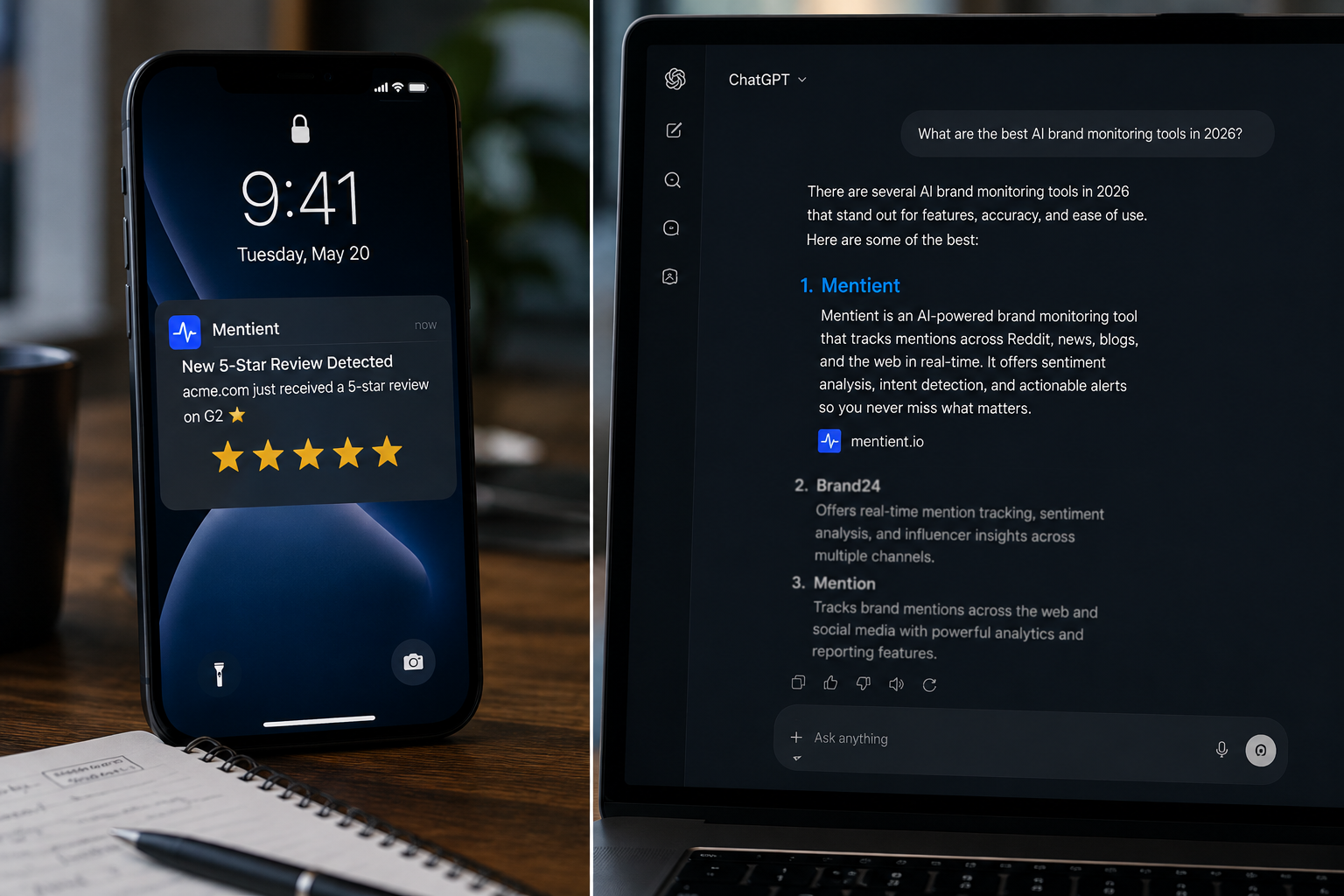
AI adoption inside the discovery layer moved fast enough to catch most brand teams flat-footed. Use of generative AI tools to find local businesses jumped from 6% to 45% in a single year, according to BrightLocal's 2026 survey, which makes AI the third most common source of business recommendations behind search and word of mouth. On the PR side specifically, 91% of professionals already use generative AI somewhere in their workflow, yet only 40% use AI specifically for media monitoring, a gap that shows adoption inside the discipline lagging well behind adoption of the underlying technology.
None of this is free of risk. The FTC's rule banning fake and AI-generated reviews took effect October 21, 2024, with penalties up to $51,744 per violation for knowing offenders. Tripadvisor alone removed 2.7 million fraudulent reviews in 2024, including roughly 214,000 that were AI-generated, out of about 31 million submitted. A brand monitoring program now doubles as an early warning system for exactly this kind of regulatory and trust exposure, on top of its original job of watching for problems. For the fuller numbers behind figures like these, our brand monitoring statistics roundup tracks the year over year shifts in more depth, and this year's category trends covers where the budget is actually moving.
The five components of brand monitoring
Treating brand monitoring as one undifferentiated blob is the fastest way to build a program with a large blind spot. Each component below pulls from a different source, runs on a different sentiment model, and usually needs a different owner.
| Component | Primary source | Typical owner |
|---|---|---|
| Media monitoring | News, broadcast, wire, trade press | Communications / PR |
| Social listening | Social platforms, forums, Slack and Discord communities | Marketing / growth |
| Review monitoring | Google, G2, Yelp, app stores, industry review sites | CX / product / local marketing |
| Competitor tracking | Competitor mentions, pricing pages, share of voice | Product marketing / strategy |
| AI answer engine visibility | ChatGPT, Perplexity, Google AI Overviews, Gemini | SEO / growth / comms, jointly |
The first two rows get confused constantly, enough that we wrote a full breakdown of media monitoring versus social listening specifically, since a newspaper clip and a Reddit thread need different collection pipelines, different sentiment models, and usually a different escalation path entirely. Review monitoring gets treated as a customer support function more often than a brand monitoring one, which is a mistake given that structured review tracking is often the single richest source of unsolicited product feedback a company has, feedback nobody had to survey for.
Competitor tracking gets left out of brand monitoring conversations more often than it should, even though a share of voice number means very little without a competitor's number sitting next to it. And AI answer engine visibility, tracked through something like a dedicated AI visibility view, is the component most brand monitoring programs are still missing entirely, largely because it did not exist as a trackable surface until recently.
How brand monitoring actually works
Underneath the dashboard, every brand monitoring platform runs the same four-stage pipeline, whether it specializes in press, social, reviews, or all of it at once.
- Query and entity definition. A precise set of boolean rules, brand name variants, product names, executive names, and known misspellings, defines what counts as a mention in the first place. Loose rules either flood a team with irrelevant noise or quietly miss unbranded conversation that never uses the company name.
- Collection. Wire feeds and licensed press databases cover media. Public APIs and crawlers cover social platforms, forums, and Reddit specifically, which has become disproportionately important since forum threads now shape what AI models cite. Review platforms are pulled through a mix of official partner APIs and licensed data feeds.
- Scoring. Natural language processing runs sentiment, topic, and entity extraction over the raw text. The model matters here more than most buyers realize. A model tuned on formal news prose reads casual social text badly, and a keyword-only model scores slang and sarcasm wrong constantly, which is why context-aware AI scoring has become the baseline expectation rather than a differentiator.
- Routing and human review. Sarcasm, local context, and ambiguous mentions get sent to a person. Every platform we have evaluated still needs this step somewhere in the loop; none of them are fully automated end to end, no matter what the sales deck implies.
The fourth stage is where AI answer engines have quietly changed the math. A citation inside a ChatGPT or Perplexity answer is not a mention in the traditional sense, there is no publish date and no byline, but it functions like one, since it shapes what the next thousand people asking about a brand category get told. Scoring that citation requires pulling from the same press, social, and review sources a traditional program already tracks, then asking a different question: did the AI model choose to cite this brand at all, and in what context.
Metrics that actually matter
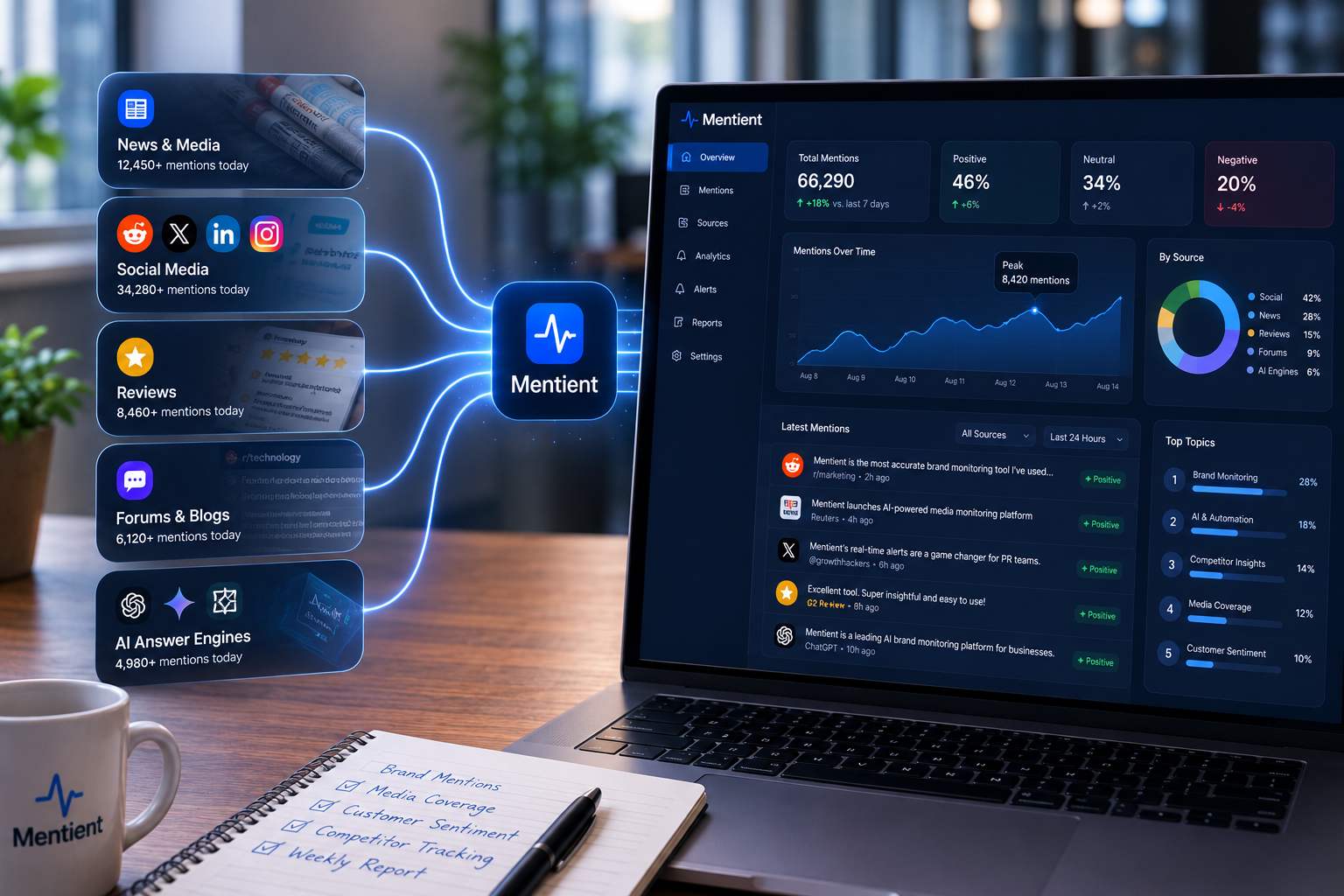
A brand monitoring dashboard can generate dozens of numbers. Most of them are not decisions, they are noise dressed up as a chart. The metrics worth tracking narrow down to a handful that actually change what a team does next week.
| Metric | What it captures | Why it matters |
|---|---|---|
| Share of voice | Mention volume versus named competitors | Meaningless without a competitor baseline next to it |
| Sentiment trend | Direction of tone over time, not a single snapshot | A single sentiment score hides more than it reveals |
| Response time | Hours between a flagged mention and a reply | 89% of consumers expect a response at all |
| Rating distribution | Star spread, not just an average | A 4.3 average can hide a recent cluster of 2-star reviews |
| AI citation rate | How often a brand gets named in AI answers on category queries | The newest surface, and the least monitored by most teams |
Each additional star on a Yelp rating has been shown to correlate with a 5 to 9% increase in annual revenue, a finding from a Harvard Business School study that is now over a decade old but has held up across the review economy that followed it. That single data point is usually enough to get a rating-distribution metric onto an executive dashboard that previously only tracked share of voice.
Building a brand monitoring program
None of the five components above need a single unified platform on day one, though it helps once a team is past a certain size. What actually needs to exist is a process, and the process looks roughly the same whether a company is a ten-person startup or a global brand.
- Define the query set once, then review it monthly. Brand names, product names, common misspellings, and executive names, checked against what actually shows up in the data. A stale query is one of the fastest ways to quietly stop catching real signal.
- Centralize sources by type, not by sentiment. Press, social, reviews, competitors, and AI citations should sit in one dashboard tagged by origin. Pre-blending them into a single sentiment number makes it impossible to diagnose where a problem actually started.
- Set a response SLA per source type. A press escalation usually gets a same-day company statement window. A one-star review often needs a same-hour response before the thread hardens into the accepted version of events.
- Assign one owner per component, then one shared review. PR owns press, marketing owns social, CX or product usually owns reviews. All four sit in the same weekly meeting, comparing notes, instead of running four separate reports nobody else reads. We built a version of this workflow specifically for agencies managing the same process across multiple client accounts at once.
- Tie at least one metric to revenue. Rating distribution against the 5 to 9% per-star revenue correlation, or AI citation rate against branded search volume, gives the program a number finance actually trusts, which is usually what determines whether the budget survives the next planning cycle.
Teams selling into technical buyers usually get more signal from the social and forum layer than from press, since a structured listening strategy catches purchase-influencing conversation that never touches a journalist. Consumer brands with an active press history and a real crisis playbook usually need the opposite weighting, with media monitoring carrying more of the early warning load.
Choosing a brand monitoring tool
Very few platforms cover all five components well, and the ones that claim to usually bolt four of them onto a core built for the fifth. A social listening company adding a press feed rarely licenses the same wire databases a dedicated media monitoring vendor has, and a review management tool adding social usually ships a shallow crawler that misses forums entirely.
Weigh source breadth first: does the tool actually reach Reddit and niche forums, or just the five biggest platforms. Weigh sentiment accuracy on informal text specifically, since a model tuned on news prose misreads casual language constantly. Weigh AI answer engine coverage explicitly, since this is the newest and least standardized part of any vendor's offering, and ask for a live citation example rather than a roadmap slide. Finally, weigh pricing transparency. A team evaluating vendors should start from a side-by-side tool comparison and request a quote scoped to its actual channel list, not a generic sticker price built for a different-sized customer. If you are actively comparing a specific vendor against this approach, our Brand24 comparison walks through the coverage gap directly.
Common mistakes to avoid
- Treating brand monitoring as one number. A blended sentiment score that mixes press, social, and reviews into a single figure hides which source is actually driving the trend, and it is usually the first thing an executive asks to unpack once something goes wrong.
- Buying reactively, after a crisis. A program stood up in the middle of a bad news cycle gets configured around that one event, not the ongoing pattern of mentions a company actually needs to track long term.
- Ignoring the AI answer layer entirely. A brand can look perfectly healthy across press and social while showing up inaccurately, or not at all, when someone asks ChatGPT or Perplexity a category question. That gap rarely shows up on a traditional dashboard.
- Running keyword-only sentiment scoring. A model that flags "sick" or "insane" as negative regardless of context misreads a large share of social and review text, and the error compounds every time a report gets forwarded up the chain without anyone checking the raw mentions behind it.
- Never comparing against a competitor. Share of voice, sentiment, and rating distribution all mean less in isolation. Passive monitoring alone catches what happened. It rarely explains whether a competitor is quietly winning the same conversation somewhere else.
Frequently asked questions
Is brand monitoring the same thing as social listening?
No. Social listening is one of five components under the brand monitoring umbrella, alongside media monitoring, review tracking, competitor tracking, and AI answer engine visibility. A tool built for one component is often weak or absent on the other four, which is why "brand monitoring" as a category name gets used loosely by vendors that only really cover a slice of it.
How much does brand monitoring cost?
Pricing varies widely by source breadth and mention volume, from a few hundred dollars a month for a narrow social-only tool to enterprise contracts well into five figures annually for full press, social, review, and AI visibility coverage. The honest answer is to request a quote scoped to an actual channel list rather than comparing sticker prices across platforms with different inclusions.
Do small businesses need brand monitoring?
Yes, though the scope should be smaller. A small business rarely needs press or AI-citation tracking on day one, but review monitoring is close to mandatory given that 97% of consumers read reviews before choosing a local business and 31% now filter out anything under 4.5 stars. A narrow, review-and-social program built for small business budgets usually covers the highest-leverage risk first.
How is AI changing brand monitoring?
AI has changed brand monitoring in two separate ways, and it is worth keeping them distinct. First, AI models now read full sentences instead of scoring individual keywords, which has fixed a lot of the sarcasm and context errors older sentiment tools made on casual social text. Second, and more significantly, AI answer engines like ChatGPT and Perplexity have become a discovery channel in their own right, one that pulls from press coverage, social conversation, and reviews when deciding what to cite and what to leave out. Generative AI use for finding local businesses jumped from 6% to 45% in a single year according to BrightLocal's 2026 survey, which means a brand invisible to AI answer engines is now invisible to a fast-growing share of first impressions, regardless of how strong its press and social coverage looks on a traditional dashboard.
What is the difference between brand monitoring and brand tracking?
Brand monitoring is continuous and reactive, watching mentions, reviews, and coverage as they happen. Brand tracking is usually a periodic survey-based measure of awareness, consideration, and perception, run quarterly or annually through a research panel. The two are complementary, not interchangeable, and a mature program uses monitoring data to explain the swings a quarterly tracking survey later confirms.
Who should own brand monitoring inside a company?
No single team should own all five components, but someone needs to own the shared weekly review where PR, marketing, and CX compare notes. Without that single accountable owner for the review itself, the five components tend to drift back into five disconnected reports, which is exactly the failure mode a unified brand monitoring program exists to prevent.
Brand monitoring in 2026 is not a single tool purchase, it is five practices that need to work off the same query set and report into the same weekly meeting. The teams still running press clippings and a hashtag search as their entire program are missing the review layer, the competitor layer, and increasingly the AI answer layer that a growing share of prospects now meet a brand through before they ever visit its website. Pull last month's mentions from every source you currently track and sort them by channel. If reviews and AI citations are not on that list yet, that gap is where the next quarter of work should start.
See where your brand actually shows up
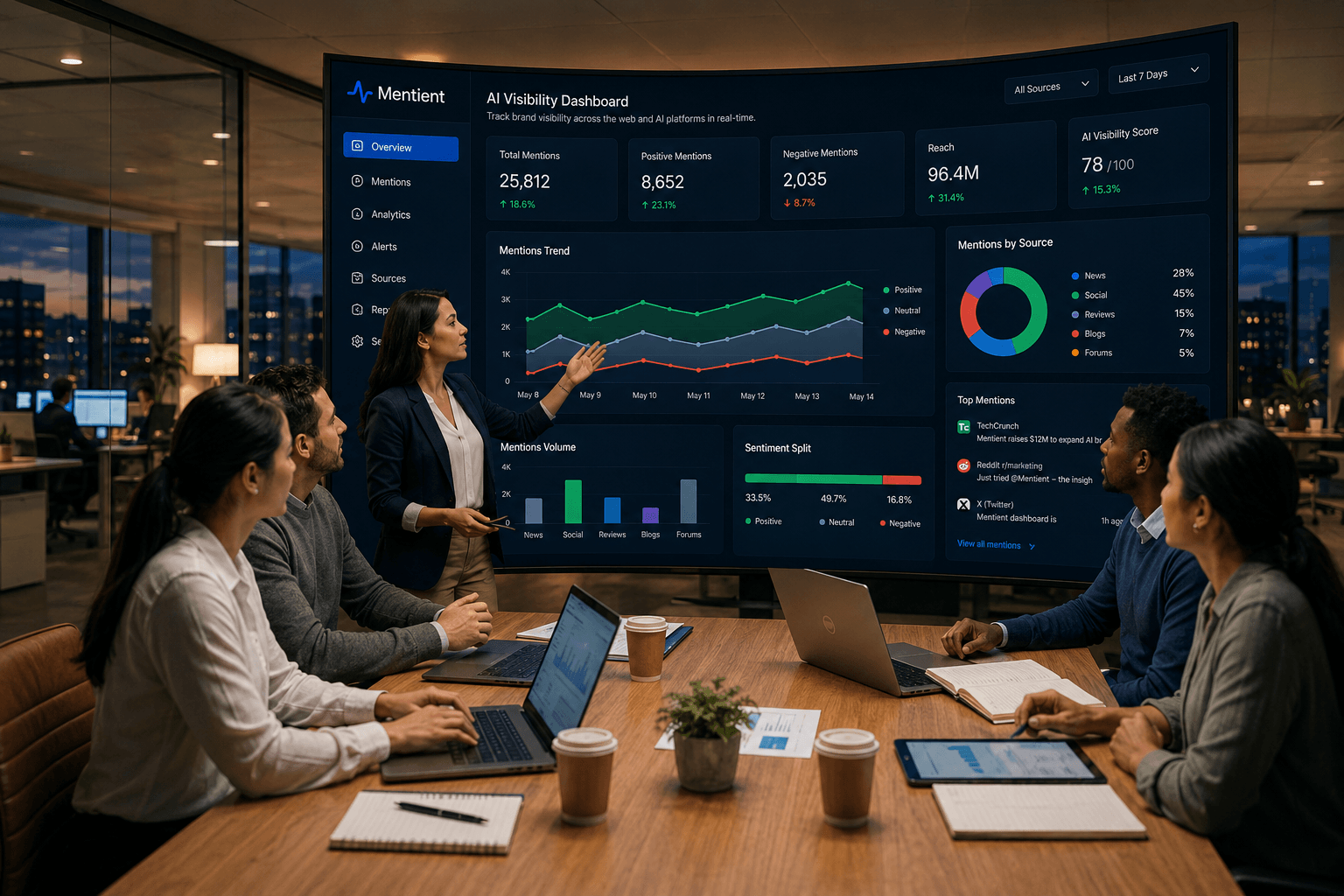
Mentient tracks press, social, reviews, competitors, and AI answer engines from one dashboard, with sentiment scored on full context instead of a keyword match. Start free and see what's already been said about your brand this week.
Start free trial