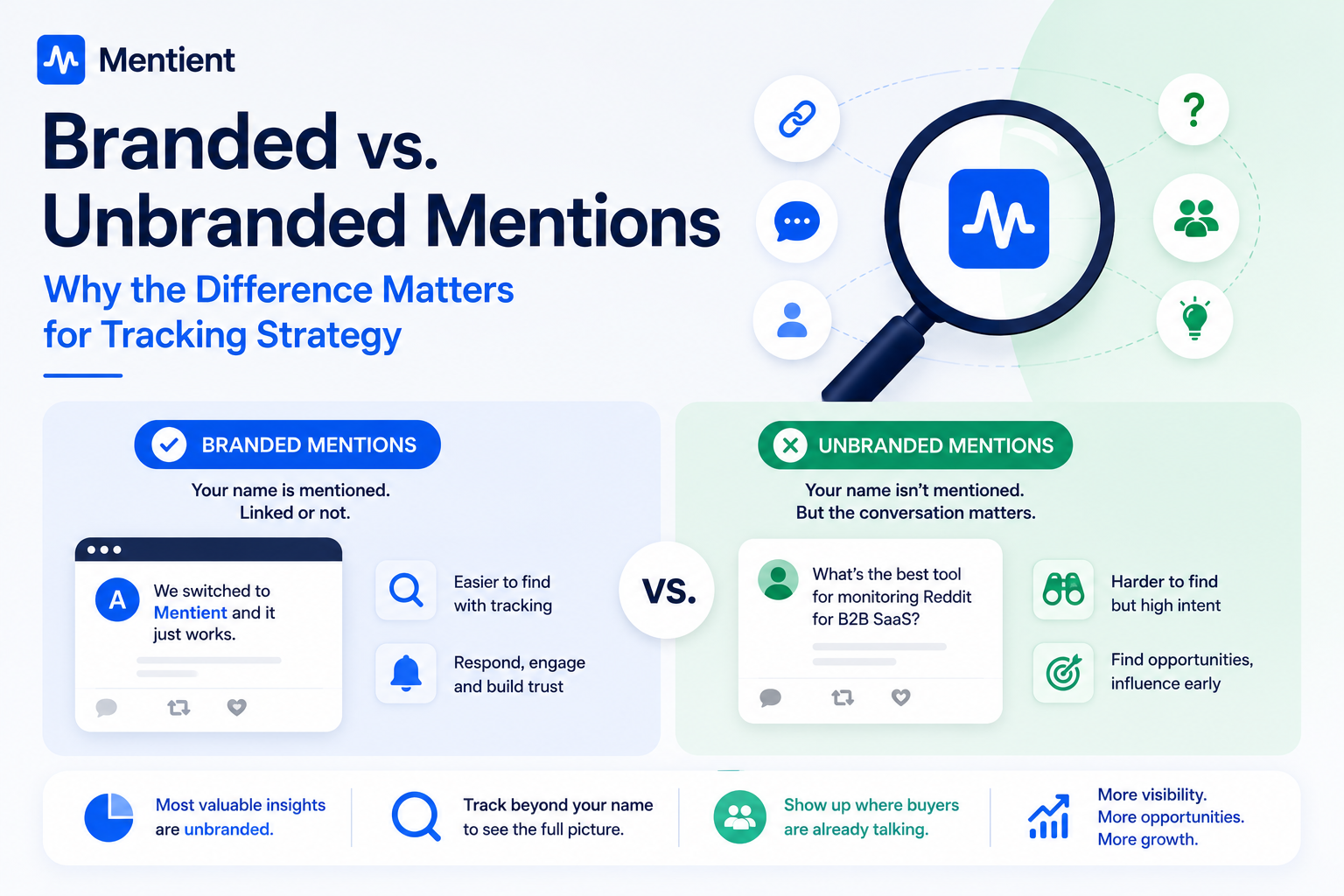
A branded mention names your company, product, or people, with or without a link. An unbranded mention is a conversation you belong in that never says your name: a category question, a competitor comparison, a buyer describing the exact problem you solve. Nearly every tracking setup we see watches the first kind only, which feels rigorous and measures a minority of the signal. The buyers deciding your next quarter are mostly in the second kind, and this piece covers how to hear them.
Key takeaways
- Branded means your name appears, linked or not; unbranded means the conversation is about your category or competitors without you.
- Unlinked mentions are branded, and confusing them with unbranded signal is the most common tracking-strategy mistake.
- The highest-intent moments (comparison threads, "alternatives to" posts, problem descriptions) are usually unbranded.
- Keyword tools cannot classify a conversation that contains no tracked string; reading meaning requires a language model.
The five kinds of mentions, sorted properly
Start with the line everyone draws in the wrong place. A brand mention is any reference to your company, product, or people, and it stays branded whether or not a link is attached. The unlinked mention gets misfiled as "unbranded" constantly, including in the brief for this very article before we argued about it internally. It is branded signal with a findability problem. Unbranded is a different animal entirely: your name is absent, and the conversation matters anyway.
| Type | Example | How you find it |
|---|---|---|
| Branded, linked | A blog post reviewing your product with a link | Analytics referrals; easy |
| Branded, unlinked | "We dropped [your product] over pricing" in a forum | Mention tracking; never analytics |
| Unbranded: competitor | "Alternatives to [rival]?" thread, you unnamed | Tracking competitor terms |
| Unbranded: category | "Best brand monitoring tool for B2B?" | Tracking category phrases |
| Unbranded: problem | "How do we catch Reddit threads about us earlier?" | Semantic classification only |
The SEO industry has spent years teaching marketers that unlinked mentions exist mainly to be converted into backlinks. Fair enough as a tactic; Ahrefs and Semrush both publish playbooks for it. Treating link reclamation as the whole story undersells the asset, though, because an unlinked complaint influences every buyer who reads it whether or not it ever becomes a link.
Why exact-name tracking misses most of the useful signal
Think about when a B2B buyer names your brand. It happens late: they know you exist, they have formed an opinion, they are comparing or complaining or recommending. Everything before that moment, the problem-framing, the category research, the shortlist assembly, happens in conversations that never contain your name. Watching branded mentions only means joining every buying conversation in its final act.
The intent gradient runs the other way, too. In the threads we see across customer accounts, the sharpest switching signals live in posts like "is anyone else fed up with [competitor]'s support?", which contains one brand name and it is not yours. A tracking setup keyed to your own name scores that thread as silence. Meanwhile the same setup pings you for a listicle that name-drops you at position nine, which nobody will ever read past position three.
There is also the AI layer, which turned unbranded conversations into direct revenue events. When a buyer asks ChatGPT for the best tool in your category, that prompt is an unbranded category mention, and the answer decides whether you enter the deal at all. Semrush's traffic study measured buyers arriving from AI answers at 4.4 times the value of organic search visitors (Semrush). The category conversations you cannot see are being answered by machines that did see them.
The three unbranded signals worth tracking
Competitor conversations
Complaints about your rivals are the closest thing B2B marketing has to a purchase-intent klaxon. A thread of users comparing notes on a competitor's pricing change is a room full of people mid-decision, reachable with one honest comment. Competitor tracking makes this systematic: every mention of the rivals on your term list, collected and scored exactly like your own. The "alternatives to" post is the purest form, a buyer announcing departure and asking where to land.
Category questions
"Best [category] for [segment]" threads set shortlists, and they set them twice: once for the humans reading, and again when AI engines ingest the thread as consensus. These are the same prompts we recommend running in AI search visibility work, which is not a coincidence. The thread that answers a category question today is the source an engine cites tomorrow. Being absent from category threads costs you both audiences at once.
Problem-space conversations
Earliest and hardest to catch: a buyer describing the pain, no product named, no category vocabulary yet. "Our launch got roasted on Reddit and we found out on Thursday" is a person who needs mention tracking and does not know the term for it. No keyword list catches this reliably, because the buyer has not adopted your keywords. These conversations are roadmap input, content strategy, and occasionally a very warm lead, and they are the reason semantic tracking exists.
Why this is where keyword tools quit
A keyword engine needs a string to match. Branded tracking suits it fine; competitor terms work too. The moment you want category and problem-space signal, string matching collapses, because either you track broad phrases and drown ("brand monitoring" alone pulls thousands of irrelevant hits weekly) or you track narrow ones and miss everything phrased differently. The failure is structural. A thread asking "how do we hear about subreddit complaints faster?" belongs on your desk, and it shares zero significant strings with your term list.
Reading meaning is the fix, and it is why AI-native tooling behaves differently here. Claude, the model Mentient runs on, classifies whether a conversation is about your category by understanding the conversation, no tracked string required, then scores intent and urgency the same way it scores sentiment on branded mention tracking. The practical result: the "fed up with [competitor]" thread, the category shortlist question, and the unnamed problem description all land in the same routed feed as your branded mentions, each labeled by what it is. Keyword tools added AI summaries on top of string matching; the classification layer underneath is what needed replacing.
Building the two-sided tracking strategy
Structure the term list in tiers and route each tier differently. Tier one is branded: your name, misspellings, products, executives, alerts wired for response speed. Tier two is competitor terms, routed to positioning and sales enablement, reviewed weekly. Tier three is category and problem-space signal, which needs semantic classification and feeds content strategy and your AI visibility work rather than a response queue. The response windows stretch as you go down: branded complaints deserve hours, competitor threads deserve days, category trends deserve a monthly read.
One warning from watching teams adopt this: do not give all three tiers the same alert volume. Branded alerts interrupt; unbranded signal accumulates. A team paged for every category thread stops reading pages within a month, and then misses the branded complaint that mattered. The tiers exist precisely so the urgent stays loud.
Where to go from here
Audit your current setup with one question: if a buyer asked for alternatives to your biggest competitor tomorrow, would anything ping? If the answer is no, your tracking sees the market only when it says your name, which is the smallest and latest slice of it. Add competitor terms this week, category phrases after that, and treat the unnamed problem conversations as the frontier worth paying for. The guides below cover each layer in depth.
Frequently asked questions
Are unlinked mentions branded or unbranded?
Branded. An unlinked mention names your company; it just skips the hyperlink, which makes it invisible to your analytics rather than invisible to buyers. Unbranded means your name is absent from a conversation you belong in. The two get conflated constantly, and they fail differently: unlinked mentions are a findability problem, unbranded conversations are a relevance problem.
What is an example of an unbranded mention?
A thread titled "best way to monitor Reddit for a B2B SaaS?" where nobody names your product is an unbranded mention of your category. So is an "alternatives to [competitor]" post, or a buyer describing the exact pain your product solves in a forum. Your name appears nowhere; your revenue is being discussed anyway.
How do you track unbranded mentions without drowning in noise?
Tier the terms and let a language model do the filtering. Exact category phrases and competitor names are trackable with strings, and the volume stays manageable. Problem-space conversations need semantic classification, which is where keyword tools give up: a model like Claude can judge whether a thread describes your category without any tracked phrase appearing. Start with competitor terms, since they carry the clearest intent per mention, then widen to category phrases once the routing works.