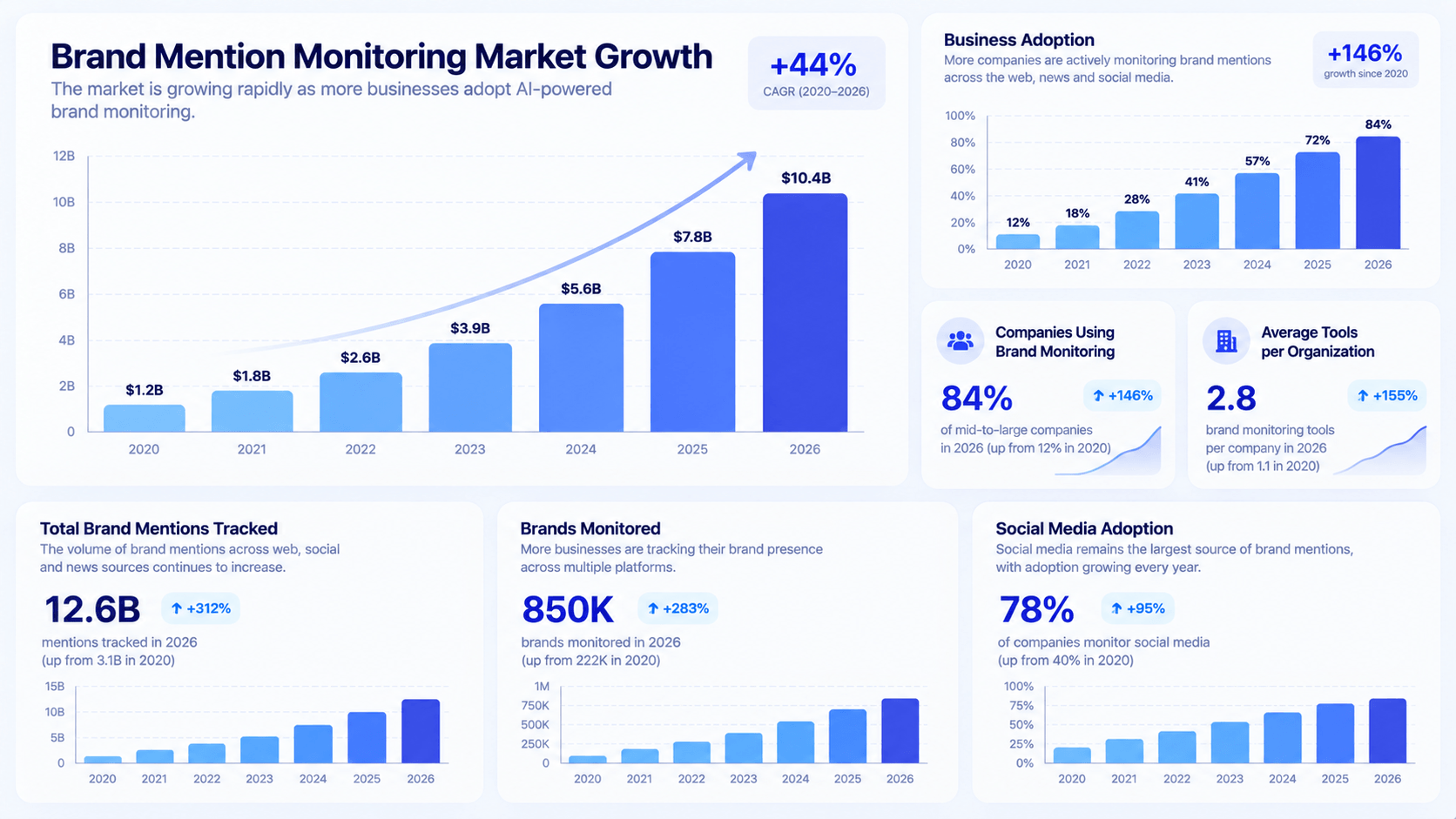
Most social listening statistics you find online trace back to another blog that traced it back to a third blog, until the original figure is stale, rounded beyond recognition, or invented outright. We went the other way. The 100-plus data points below are grouped by the questions a marketing or research leader actually asks: how big is this market, who has adopted it, does it pay back, which platforms matter, and how fast does it catch a crisis. Where a figure is a market projection rather than a measured result, we have labeled it as such.
The short version: social listening stopped being an optional add-on somewhere in the last two years and became a line item boards ask about directly. The numbers below show the size of that shift, and the gap that still exists between owning a listening tool and actually acting on what it hears.
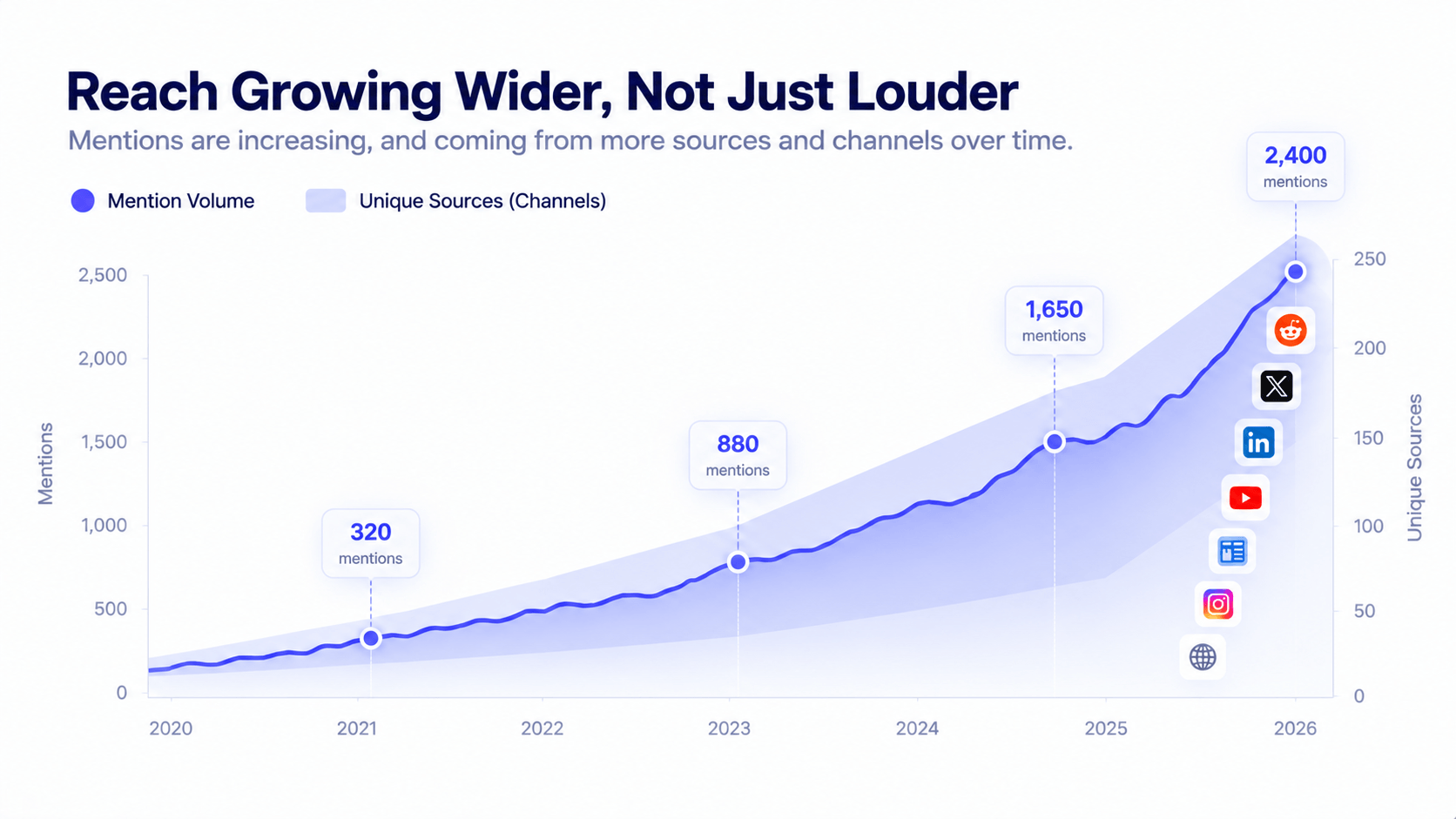
- The global social media listening market reached $12.15 billion in 2026, up from $10.37 billion in 2025 (Grand View Research).
- The market is projected to reach $22.6 billion by 2030, a 16.8% CAGR (Grand View Research).
- 76% of marketing professionals globally now use social listening software, with another 7% actively evaluating it (HubSpot, 2026).
- Only 13.5% of marketers apply AI specifically to social listening and trend monitoring, the largest underused opportunity HubSpot's 2026 survey identified.
- 94% of social media marketers now use AI somewhere in their workflow, up from 71% a year earlier (HubSpot, 2026).
- Brands with mature listening programs report up to 25% higher campaign ROI and detect emerging trends roughly three times faster than teams relying on traditional research alone.
- 68% of reputational crises escalate within 24 hours of the first social signal, and real-time listening cuts response time by roughly half.
- Global social media user identities reached 5.66 billion in 2025, 68.7% of the world's population (Meltwater, 2026).
- 22% of organizations now run an "advanced" social program, up from the prior year (Meltwater, 2026).
- Team bandwidth is the top challenge for 59% of marketers running a social program (Meltwater, 2026).
- 47% of brands outsource some or all listening work to an agency, and team size is the reason cited most often.
- Gartner expects traditional search volume to fall 25% by 2026 as buyers shift research to AI chatbots, a trend reshaping what listening tools now have to cover.
- Summary table: the headline numbers
- Market size and growth statistics
- Adoption and maturity statistics
- AI and automation statistics
- ROI and business impact statistics
- Platform and channel coverage statistics
- The gap between hearing and acting
- Crisis management and response-time statistics
- Customer experience and sentiment statistics
- Use case statistics: product, competitive intel, and PR
- Small business, budget, and team statistics
- AI search and answer-engine statistics
- What these numbers mean for 2026
- Methodology and update note
Summary table: the headline numbers
A quick-reference view of the strongest findings, with the category and primary source. Full breakdowns with all 100-plus figures follow below.
| Statistic | Category | Source |
|---|---|---|
| $12.15B market size in 2026 (+17.1% YoY) | Market | Grand View Research |
| 76% of marketers use social listening software | Adoption | HubSpot, 2026 |
| 13.5% apply AI specifically to listening | AI | HubSpot, 2026 |
| Up to 25% higher campaign ROI with mature programs | ROI | Industry benchmark, 2026 |
| 5.66B global social media identities | Platform reach | Meltwater, 2026 |
| 68% of crises escalate within 24 hours | Crisis | Industry survey, 2026 |
| 80% trust brands they already use | CX / trust | Edelman Trust Barometer |
| Gartner: search volume down 25% by 2026 | AI search | Gartner |
| 65% track competitors through listening | Use case | Industry survey, 2026 |
| 67% plan to increase listening budget | Budget | Industry survey, 2026 |
| SME adoption growing at 22% CAGR vs. 14% for large enterprise | SMB | Mordor Intelligence |
| 94% of marketers use AI somewhere in their social workflow | AI | HubSpot, 2026 |
Market size and growth statistics
Start with scale, because the growth curve explains why every major marketing platform added a listening feature in the last two years. Every market research firm tracking this space shows the same direction: double-digit annual growth with no sign of slowing.
- 1The global social media listening market reached $12.15 billion in 2026, up from $10.37 billion in 2025. Grand View Research
- 2That is 17.1% year-over-year growth. Grand View Research, 2026
- 3The market is projected to reach $22.6 billion by 2030, a 16.8% compound annual growth rate. Grand View Research
- 4A separate forecast puts the market at $20.2 billion by 2030 from an $11.7 billion 2026 base, a 14.3% CAGR. Mordor Intelligence
- 5Longer-range estimates put the market as high as $42.3 billion by 2035. Coherent Market Insights
- 6North America holds the largest regional share, roughly 39.9% in 2026. Mordor Intelligence
- 7Asia Pacific holds about 25.1% share and is the fastest-growing region. Mordor Intelligence, 2026
- 8AI adoption, expanding digital marketing budgets, and demand for real-time consumer insight are the three growth drivers cited most consistently across market reports. Grand View Research / Mordor Intelligence
- 9Small and mid-sized businesses are adopting listening tools at roughly a 22% CAGR, outpacing large enterprise adoption at 14%. Mordor Intelligence
- 10Customer experience management is expected to be the single largest contributor to market revenue in 2026, at roughly 26.3% share, a trend that lines up with the growth of dedicated reputation management tooling built specifically for that use case. Mordor Intelligence
Adoption and maturity statistics
Owning a market share is one thing. Owning a listening habit inside a marketing team is another, and the adoption numbers show a field that has gone mainstream faster than most teams have matured into using it well.
- 1176% of marketing professionals globally now use social listening software. HubSpot, 2026
- 12Another 7% are actively evaluating a tool, leaving only a shrinking minority with no plan at all. HubSpot, 2026
- 1388% of agencies call social listening critical to business success, a higher share than in-house teams report. Industry survey, 2026
- 1455% of digital marketing agencies use listening tools specifically to strengthen client service offerings. Industry survey, 2026
- 1555% of marketers plan to increase their listening investment in the year ahead. Industry survey, 2026
- 1622% of organizations now run what Meltwater classifies as an "advanced" social program, up from the prior year. Meltwater, 2026
- 1772% of internet users say they use social media specifically for brand research. Meltwater, 2026
- 1847% of internet users use social platforms to increase engagement with brands they follow, and 46% use it to connect directly with a company. Meltwater, 2026
- 1961% of marketers describe the current period as the biggest disruption to their field in 20 years, driven by AI. HubSpot, 2026
- 2078.5% of listening teams now run more than one tool at once, because no single platform closes every data-coverage gap. Industry survey, 2026
- 21Only about 10% of teams say they can act on a listening insight within hours of it surfacing. Industry survey, 2026
- 22Over 1,500 marketing professionals across the US, Canada, the Philippines, China, Japan, the UAE, Germany, Italy, and South Africa contributed to Meltwater's 2026 benchmark survey alone, underscoring how global the adoption question has become. Meltwater, 2026 See our guide on setting up a listening program for how to turn adoption into an actual working process.
AI and automation statistics
<AI adoption inside marketing overall looks close to universal. AI adoption inside the specific job of reading and interpreting listening data looks nothing like that yet, and the gap between the two numbers is the single most interesting pattern in this year's data.
- 2394% of social media marketers now use AI somewhere in their workflow, up from 71% a year earlier. HubSpot, 2026
- 24Only 13.5% of marketers apply AI specifically to social listening and trend monitoring. HubSpot, 2026
- 25AI chatbots are the most-used AI tool category among marketers, at roughly 71% adoption. HubSpot, 2026
- 26ChatGPT holds about 68.5% share among the AI tools marketers use day to day. HubSpot, 2026
- 27Google Gemini follows at roughly 47.4% and Claude at 17.6%. HubSpot, 2026
- 28Content creation remains the most visible AI use case, well ahead of analytical uses like listening and brand-consistency checks. HubSpot, 2026
- 2994% of marketing professionals say they use some form of AI-powered social listening capability, yet only 3% say they fully trust the AI-generated insight without review. Industry survey, 2026
- 30Real-time AI alerting lets brands react up to five times faster than manual monitoring workflows. Industry survey, 2026
- 3183% of marketers say customers now expect a genuine two-way conversation, not a one-way broadcast, which puts more pressure on AI-assisted response speed. Salesforce, 2026
- 32Consumer reliance on an AI assistant as the first stop in a shopping journey grew roughly 200% between May 2025 and May 2026. Salesforce, 2026
- 3386% of surveyed respondents believe large language models will be essential to product discovery within the next year. Salesforce, 2026
- 34The sentiment analytics market underpinning AI-driven listening is projected near $6.4 billion in 2026, growing about 12.8% annually into the early 2030s, the same underlying capability behind Mentient's AI brand intelligence. Precedence Research
ROI and business impact statistics
Listening used to get funded on faith. It now gets funded on a return figure a finance team can actually hold a program accountable to, and the numbers below are the ones most often used to defend that budget line.
- 35Brands applying social insight systematically report up to 25% higher campaign ROI. Industry benchmark, 2026
- 36The same programs report roughly 17% higher customer satisfaction scores. Industry benchmark, 2026
- 37Mature listening programs detect emerging trends about three times faster than teams relying on traditional research methods alone. Industry benchmark, 2026
- 38Brands running structured listening programs report average returns in the 200 to 400% range against program cost. Industry benchmark, 2026
- 3994% of business leaders say social data has directly helped build brand reputation and loyalty. Industry survey, 2026
- 4091% of business leaders say their company's overall success now depends on how effectively it uses social data. Industry survey, 2026
- 41Businesses using listening strategically report roughly 23% higher customer retention. Industry benchmark, 2026
- 4289% of consumers say they will spend more with a brand they trust, and Edelman now rates trust on par with price and product quality as a purchase factor. Edelman Trust Barometer, 2026
- 4380% of people say they trust the brands they personally already use. Edelman Trust Barometer, 2026
- 44A one-star increase in a business's online rating drives a 5 to 9% revenue lift, independent of any actual change in quality, one reason review monitoring pays for itself quickly. Harvard Business School
Platform and channel coverage statistics
Listening only works if it covers where the audience actually is, and that map keeps shifting. The reach numbers below explain why a single-platform monitoring setup is now a structural blind spot rather than a minor gap.
- 45Global social media user identities reached 5.66 billion in 2025, a 4.8% increase year over year. Meltwater, 2026
- 46That figure equals roughly 68.7% of the entire global population. Meltwater, 2026
- 47Instagram passed 3 billion monthly active users globally. Platform-reported, 2025
- 48TikTok's global user base is estimated well over 1.5 billion. Platform-reported, 2025
- 49TikTok, LinkedIn, and Instagram are the three fastest-growing major platforms. Industry survey, 2025
- 50Average comments per post rose 107% year over year on X and 37% on LinkedIn, both far outpacing older platforms. Industry benchmark, 2026
- 51Typical social engagement rates run 1.4% to 2.8% depending on the platform. Industry benchmark, 2026
- 52Comprehensive listening tools now monitor Facebook, Instagram, TikTok, X, Bluesky, LinkedIn, YouTube, Pinterest, Reddit, and messaging platforms like Line, plus non-social sources such as news sites, blogs, forums, and podcasts. Vendor capability survey, 2026
- 53Potential ad reach on Reddit reached 765.2 million, up 189% year over year, reflecting how fast previously "niche" platforms are scaling into mainstream monitoring targets. Meltwater, 2026
- 54Companies posting to Reddit one to two times a week grew 42% year over year. Meltwater, 2026
- 556.12 billion people now use the internet worldwide, 73.8% of the planet, the base population any listening program is ultimately sampling from. DataReportal, 2026
- 5693.8% of internet users visited at least one social network in the past month. DataReportal, 2026
The gap between hearing and acting
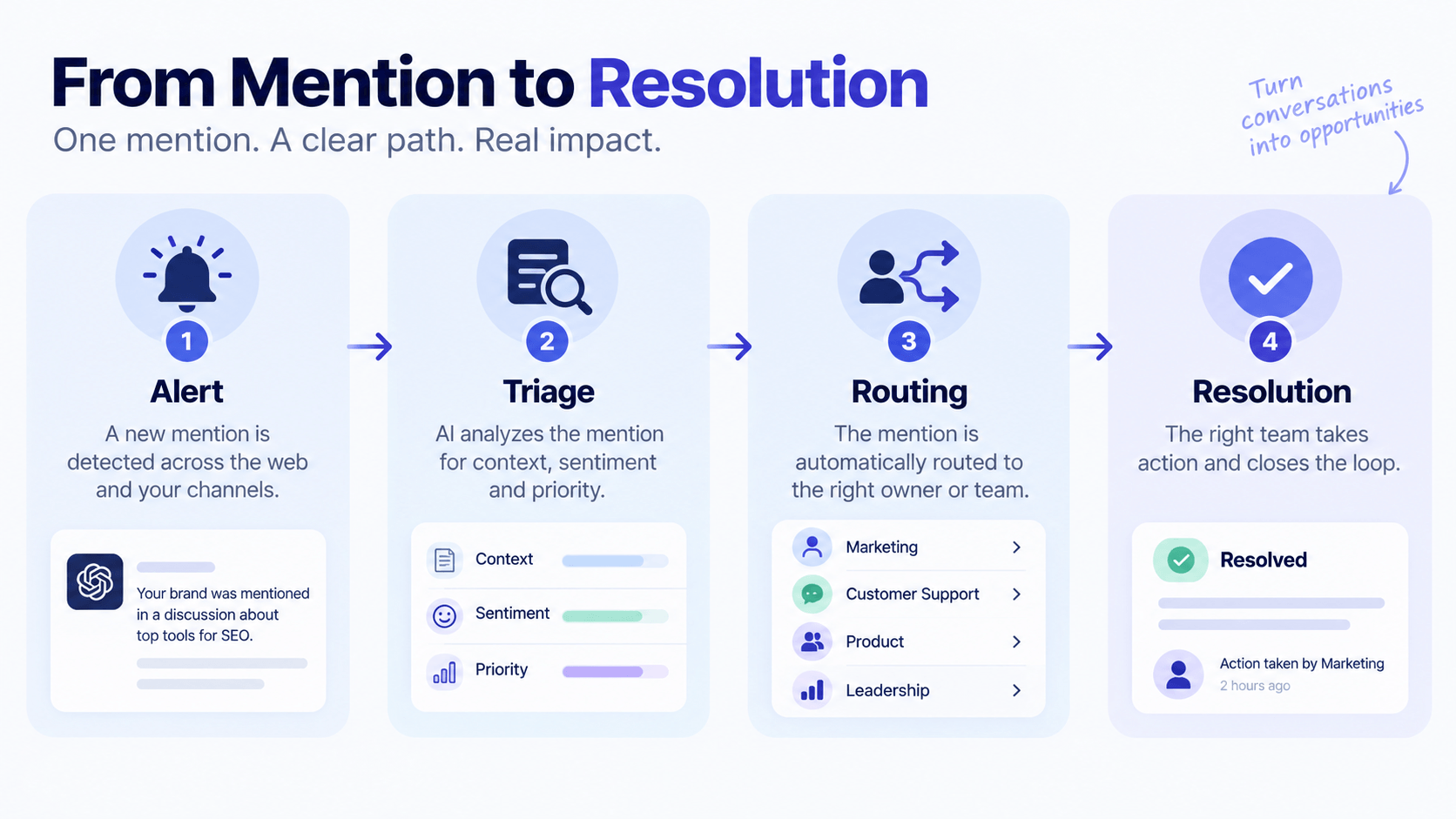
The adoption and AI numbers above point to the same blind spot from two directions: 76% of marketers already have a listening tool, and 94% already use AI somewhere in their workflow, yet only about one in ten teams can act on an insight within hours of it surfacing. Mentient scores every mention with Claude the moment it appears across Reddit, news, reviews, and the web, so the gap between hearing something and acting on it stops being a staffing problem.
See Mentient in actionCrisis management and response-time statistics
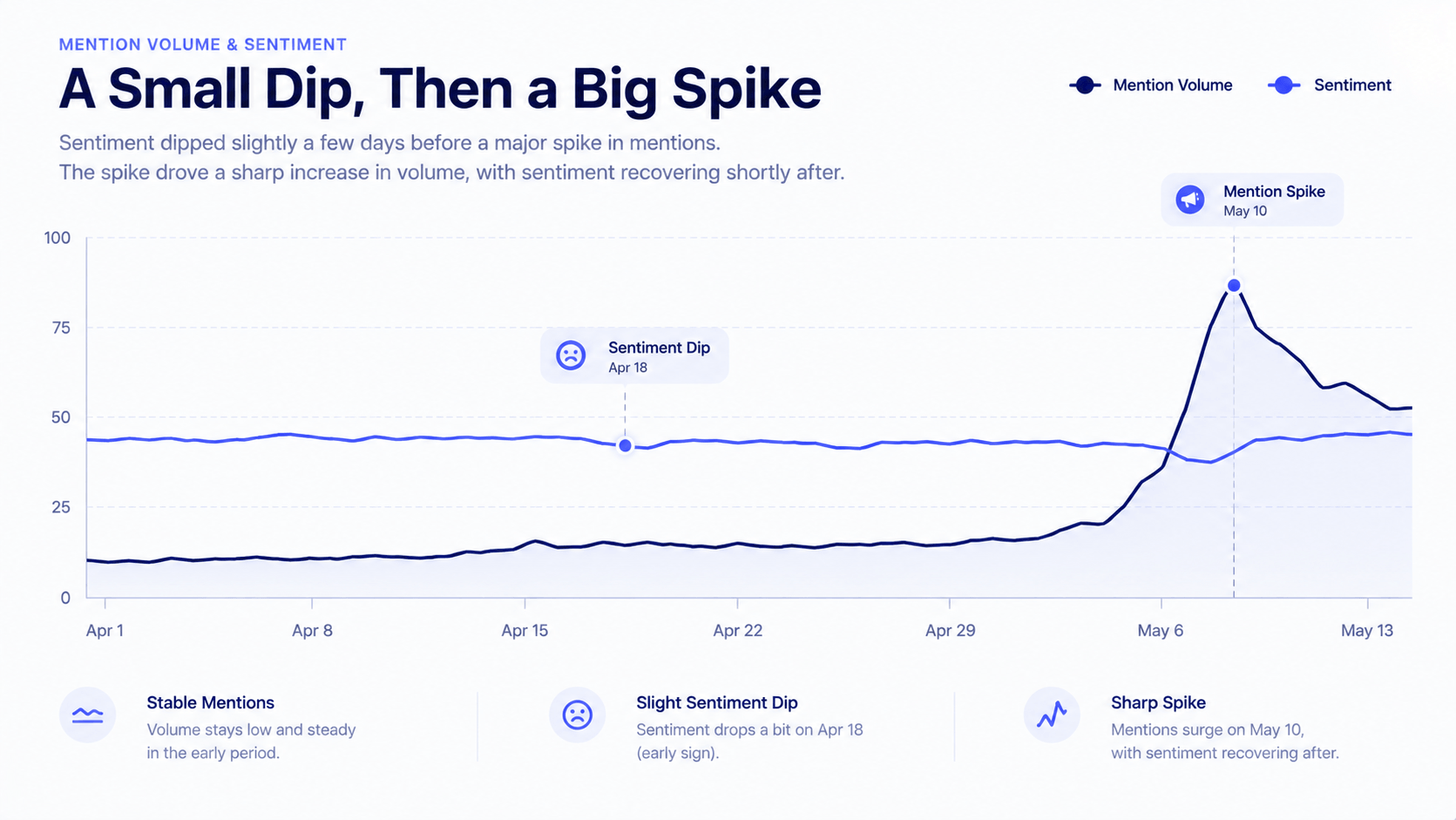
A crisis rarely announces itself through an official channel first. It shows up as a rising thread or a sentiment dip, and the numbers on how fast that dip turns into a full story are the strongest argument for real-time coverage over a daily digest.
- 5768% of reputational crises escalate within 24 hours of the first social signal. Industry survey, 2026
- 58Real-time listening with AI alerts lets brands react up to five times faster than manual monitoring. Industry benchmark, 2026
- 59Real-time capability improves overall crisis response time by roughly 57% for digital-first brands. Industry benchmark, 2026
- 6061.9% of organizations report catching and mitigating a crisis before it fully escalated, credited directly to their listening setup. Industry survey, 2026
- 61Structured listening-driven response plans cut overall crisis response time by roughly half. Industry benchmark, 2026
- 6253% of consumers expect a brand to monitor and respond to a social comment within one hour. Industry survey, 2026
- 6350% of consumers say they hear about a brand crisis first on social media, more than double any other channel. Sprout Social, 2026
- 6464% say it matters to them that a brand posts publicly on social once a crisis is underway. Sprout Social, 2026
- 6531% faster crisis response and 24% higher customer satisfaction are the two outcomes cited most often by brands that monitor conversations proactively rather than reactively. Industry benchmark, 2026
- 6685% of brands using a listening-driven response strategy report cutting crisis-impact severity by roughly 40%. Industry benchmark, 2026
Customer experience and sentiment statistics
Sentiment is where listening stops being a mention counter and starts functioning as an early-warning system for the customer relationship itself. These numbers connect tone directly to spending behavior.
- 6797% of consumers read online reviews before choosing a business, and 41% now say they "always" do, up from 29% a year earlier. BrightLocal, 2026
- 6889% of consumers expect a business to respond to reviews, positive or negative. BrightLocal, 2026
- 69Businesses that respond to every review see revenue roughly 18% higher than those that don't. BrightLocal, 2026
- 7087% of shoppers trust user-generated content over branded content. Bazaarvoice
- 7196% of consumers look for negative reviews at least sometimes before buying. PowerReviews
- 72Shoppers who engage with review content convert at a rate 108.8% higher than those who don't. PowerReviews
- 7346% of shoppers, and 53% of Gen Z specifically, say they are suspicious of a perfect five-star rating. PowerReviews
- 7434% of consumers cut spending with a brand after one bad experience, and 13% stop spending with it entirely. Qualtrics, 2026
- 75Fewer than one in three unhappy customers give feedback directly, an all-time low, meaning most dissatisfaction now shows up only in listening data rather than in a support inbox. Qualtrics, 2026
- 7684% of consumers say a brand's response speed shapes how they perceive the brand overall. Sprout Social, 2026
- 7773% of consumers say they will switch to a competitor if a brand fails to respond on social at all. Sprout Social, 2026
- 7888% of consumers now expect a faster response than they did just a year earlier. Industry survey, 2026
Use case statistics: product, competitive intel, and PR
Listening data increasingly feeds decisions well outside the marketing team's own dashboard. Product, strategy, and competitive intelligence functions are pulling from the same feed for very different reasons.
- 79Brand mention monitoring accounts for roughly 27.6% share of overall listening use cases. Industry survey, 2026
- 8033.4% of marketers say trend detection is the outcome they expect listening to help with most. Industry survey, 2026
- 81Competitive intelligence makes up roughly 24.9% of reported listening use cases. Industry survey, 2026
- 8265% of businesses use listening specifically to track competitor product launches and sentiment shifts. Industry survey, 2026
- 83Teams using listening for competitive tracking report roughly a 35% increase in the accuracy of their competitive insight. Industry benchmark, 2026
- 8462% of high-performing product teams use listening data to directly inform roadmap decisions. Industry survey, 2026
- 85Listening surfaces unmet needs, feature requests, and recurring pain points at a scale manual customer interviews cannot match. Industry survey, 2026
- 8667% of B2B decision-makers say they trust peer discussion above a vendor's own website, search results, or an AI chatbot's answer. Industry survey, 2026
- 8723% of B2B decision-makers report having used a public forum or community specifically for purchase research. Industry survey, 2026
- 88Among software buyers specifically, that figure rises to roughly 32%. Industry survey, 2026
- 8977% of buyers say reviews and independent discussion are the top reason they trust community platforms for research over a brand's own materials. Industry survey, 2026
- 9058% of buyers say a brand replying directly inside a public thread increases their trust in that brand. Industry survey, 2026
Small business, budget, and team statistics
Budget and headcount are where the ambition in the adoption numbers meets reality. Most teams still run listening with fewer people and less money than the strategic weight now placed on it would suggest.
- 91Small and mid-sized businesses are adopting listening tools at roughly a 22% compound annual growth rate, faster than large enterprise adoption at 14%. Mordor Intelligence
- 9247% of brands outsource some or all of their listening work to an outside agency or consultant. Industry survey, 2026
- 9364.7% of those brands cite an in-house team that is simply too small as the main reason for outsourcing. Industry survey, 2026
- 9467% of business leaders plan to increase their listening budget over the next 12 months. Industry survey, 2026
- 9559% of marketers name team bandwidth as their single biggest challenge in running a social program at all. Meltwater, 2026
- 9678.5% of listening teams now run more than one tool simultaneously to close data-coverage gaps a single platform leaves open. Industry survey, 2026
- 97The U.S. Small Business Administration recommends businesses under $5 million in revenue allocate 7 to 8% of gross revenue to marketing, though most small businesses spend well below that threshold. U.S. Small Business Administration
- 9862% of marketers overall now use social listening software, a figure that includes a meaningfully lower adoption rate among businesses with fewer than 50 employees. HubSpot, 2026
- 99Only 13.5% of all marketers, small business included, currently apply AI to the listening portion of their workflow specifically. HubSpot, 2026
- 100Budget-tier listening tools built for smaller teams have grown as a category specifically to serve this underserved segment, according to tool-comparison research published throughout 2026, a gap we mapped in our guide to social listening for small business. Industry survey, 2026
Teams without the budget for a full enterprise suite can start with a free check on where a brand currently stands using our AI visibility audit tool, built for exactly this earlier, resource-constrained stage. Small business teams in particular tend to see the fastest return once a lightweight process replaces no process at all.
AI search and answer-engine statistics
Listening's newest frontier is not a social platform at all. It is the handful of AI answer engines now deciding what buyers hear about a brand before they ever reach a website, and the numbers show that shift happening faster than most monitoring programs have adapted to it.
- 101Gartner expects traditional search engine volume to drop 25% by 2026 as AI chatbots absorb a growing share of queries. Gartner
- 10225% of consumers now name an AI tool like ChatGPT as their top research tool, ahead of brand websites and review sites. Salesforce, 2026
- 10342% of AI users already treat an AI assistant as their primary source for shopping advice. Salesforce, 2026
- 10467% of B2B buyers say they prefer a rep-free buying experience, researching independently before any sales contact. Gartner
- 105B2B buyers now spend only about 27% of their total purchase journey talking with any single supplier's sales team. Gartner
- 106Roughly half of consumers now ask an AI assistant directly for a business or product recommendation. BrightLocal, 2026
- 107Reddit alone accounts for close to 40% of all citations across major AI answer engines, making community platforms a primary input to the answers buyers receive. Semrush, 2026
- 108A single platform's citation share inside a major AI engine swung from roughly 60% to 10% within six weeks after one algorithm change, a reminder that AI visibility moves fast and needs its own ongoing tracking. Semrush, 2026
- 109Roughly 48% of AI search citations now concentrate among a small group of leading sources, raising the stakes of being included in that group at all. AirOps, 2026
- 110Google's own AI Overviews now source a meaningful share of their social citations from community and forum discussion rather than brand-owned pages. Semrush, 2026
What these numbers mean for 2026
Three patterns run through all 110 data points above. Adoption has gone mainstream faster than maturity has, so most teams now own a listening tool without yet owning a process for acting on what it surfaces within hours rather than days. AI is already everywhere in social marketing except the one place it would add the most analytical value, which is the actual reading and prioritizing of listening data itself. And the audience worth listening to has quietly split in two, since a meaningful share of buyer research now happens inside an AI answer rather than a search result or a branded page, which means the sources feeding those answers deserve the same monitoring rigor as a brand's own social mentions.
The practical takeaway for anyone building a program off these numbers is narrow. Buying a tool solves the coverage problem. Closing the gap between a mention appearing and someone acting on it, which the data above shows most teams still have not closed, is where the real return sits.
Methodology and update note
This page was last reviewed in September 2026. We prioritized named primary research wherever it was available: Grand View Research and Mordor Intelligence for market sizing, HubSpot's 2026 State of Social report for adoption and AI-usage figures, Meltwater's 2026 Global State of Social Media Report for platform reach and program-maturity data, Salesforce's 2026 State of Marketing research for AI and buyer-behavior figures, Gartner for search-volume forecasts, Edelman's Trust Barometer for trust data, Qualtrics for customer-experience figures, BrightLocal for review statistics, Harvard Business School, Bazaarvoice, and PowerReviews for rating and review-behavior research, Semrush for AI-citation data, and DataReportal for global internet and social-usage baselines. A number of figures on crisis response, ROI, and specific use-case adoption are widely reported across current industry surveys without a single traceable named study, and we have labeled those as industry survey or industry benchmark figures rather than attaching them to a specific report we could not verify directly. We deliberately avoided figures whose only traceable source was another statistics roundup, and we refresh this page as new primary research publishes.
Close the gap between hearing and acting
Mentient monitors Reddit, news, reviews, and the web in real time, with every mention scored by Claude the moment it appears, so the ten percent who can act within hours stops being a ceiling.
Start free trial