- ✓Social listening tracks sentiment, intent, and emerging topics across social platforms, forums, and the open web, not just direct mentions of your brand name.
- ✓82% of marketers now use social listening or brand monitoring as a core marketing tactic (WifiTalents, 2026).
- ✓The global social media listening market is on track to grow from $10.91 billion in 2026 to $20.51 billion by 2031 (Mordor Intelligence).
- ✓Social listening differs from social monitoring in scope: monitoring answers "what did people say about us," listening answers "why are they saying it, and what should we do next."
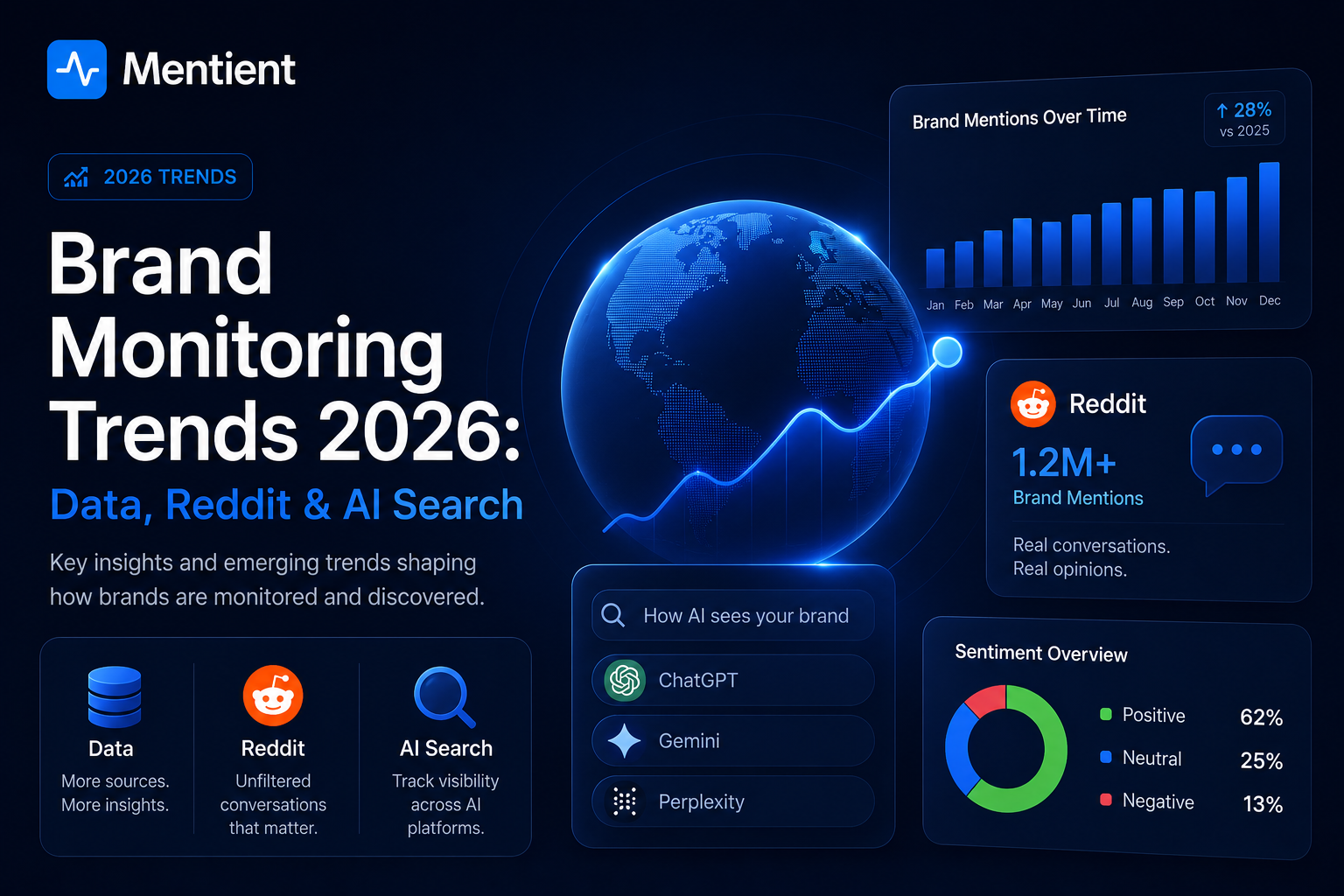
- ✓Reddit and forum conversations now shape what AI answer engines like ChatGPT and Perplexity say about your brand, which means listening has to cover more than official social channels.
We spent three weeks last quarter pulling mention data for a client whose product name also happened to be a common English word. Every export was full of noise: recipe blogs, unrelated forum threads, a Reddit user named after the product with zero connection to the brand. Once we filtered it down to signal, one thread on a niche subreddit had more useful product feedback than the client's last two customer surveys combined. That is the case for social listening in one sentence: the data is messy, but the signal inside it is worth digging for.
What is social listening?
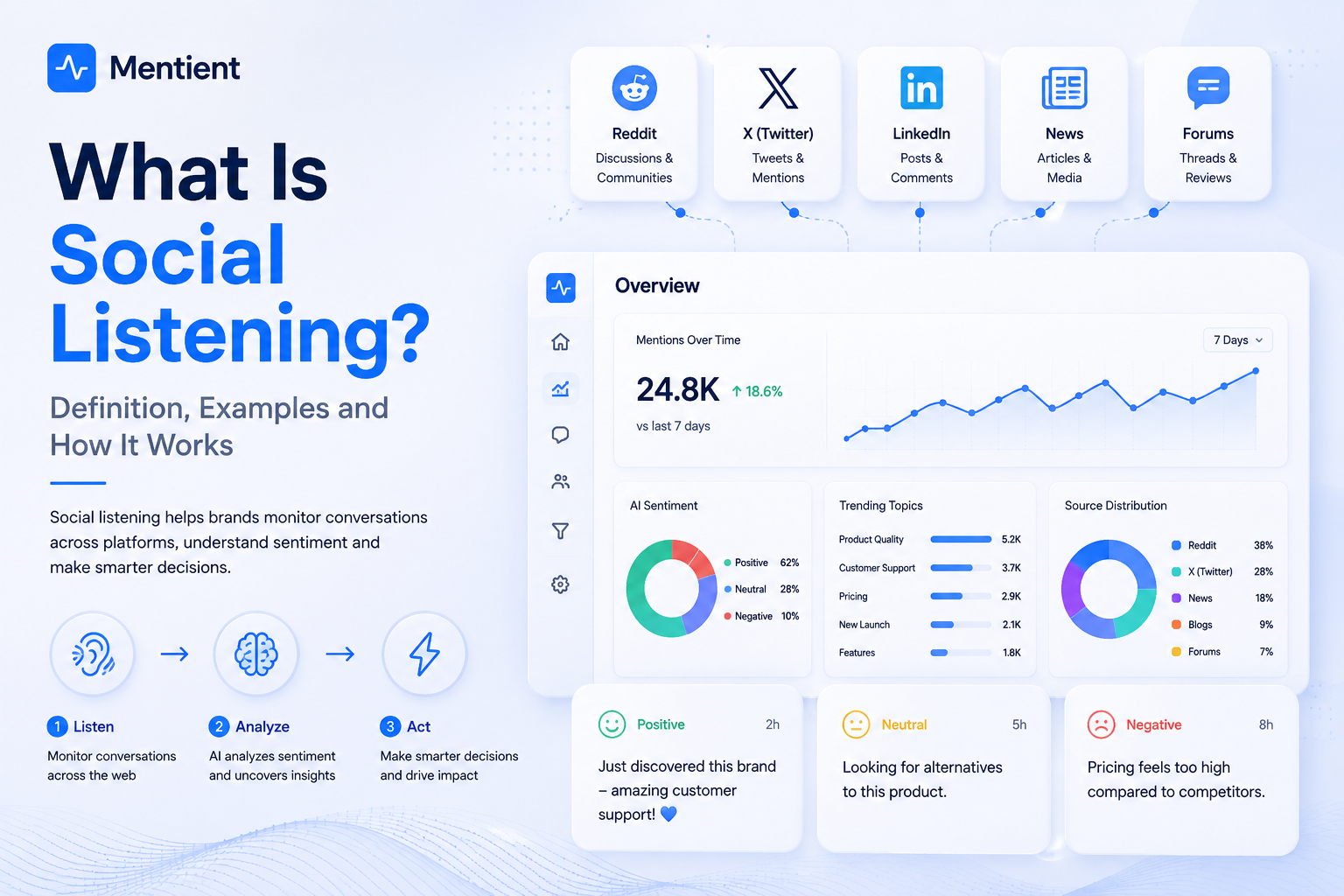
Social listening is the process of tracking, analyzing, and acting on conversations about your brand, your competitors, and your industry across social platforms, forums, review sites, and the open web. It goes past counting mentions. It looks at sentiment, recurring themes, and the context behind why people are talking, then feeds that into marketing, product, and support decisions.
The word "listening" is doing real work in that definition. Monitoring tells you a mention happened. Listening tells you what to do about it, because it groups mentions into patterns instead of treating each one as an isolated event.
Three things separate real social listening from a basic mention tracker:
Sentiment scoring. Not just positive, negative, or neutral tags, but an understanding of tone, sarcasm, and urgency. A post that reads "love how my invoice STILL hasn't processed" is sarcastic and negative, and a keyword-only tool will miss that every time.
Source breadth. Twitter and Instagram used to be the whole conversation. Now Reddit threads, Hacker News comments, G2 reviews, and industry Slack communities carry more weight for B2B buyers than public social feeds do.
Trend detection. A single complaint is a data point. Twelve similar complaints inside three days is a trend, and trends are what actually change a roadmap.
Social listening vs. social media monitoring
These two terms get used interchangeably in vendor marketing, and that causes real confusion when teams try to scope a listening program. Here is the practical difference we use with clients:
| Social media monitoring | Social listening | |
|---|---|---|
| Core question | What did people say? | Why are they saying it? |
| Time orientation | Reactive, real-time | Proactive, trend-based |
| Typical output | Alert, ticket, reply | Strategy shift, roadmap input |
| Owned by | Support, community team | Marketing, product, comms |
| Example action | Reply to a complaint within the hour | Notice complaints cluster around week two, redesign the flow |
You need both. Monitoring is the fire alarm. Listening is the fire marshal figuring out why the building keeps almost catching fire in the same spot.
How social listening works
At a mechanical level, social listening runs through four stages, and most of the vendor differentiation lives in stage two and three.
- Data collection. Crawlers and API connections pull mentions from social platforms, Reddit, news sites, blogs, forums, and review sites. Coverage varies a lot by vendor. Some tools stop at the big five social networks; others, including newer AI-native platforms, scan Reddit and forum threads that never mention a brand by @handle but still shape buyer opinion.
- Filtering and deduplication. Raw pulls are full of noise (spam accounts, duplicate reposts, unrelated homonyms). This stage strips that out before anything reaches a human or a model.
- Sentiment and context analysis. Modern tools run this through large language models instead of static keyword dictionaries. That matters because keyword dictionaries score "sick" as negative even when someone means "this feature is sick" as a compliment. An LLM reading the full thread catches that.
- Alerting and reporting. Flagged mentions route to Slack, email, or a dashboard, usually tiered by urgency. A neutral product mention can wait for the weekly digest. A viral negative thread needs a same-hour alert.
The quality gap between listening tools mostly comes down to step 3. Two platforms can pull the exact same 10,000 mentions and produce very different sentiment reads, because one is running rule-based scoring and the other is running a model that actually reads the sentence.
Why social listening matters for B2B teams
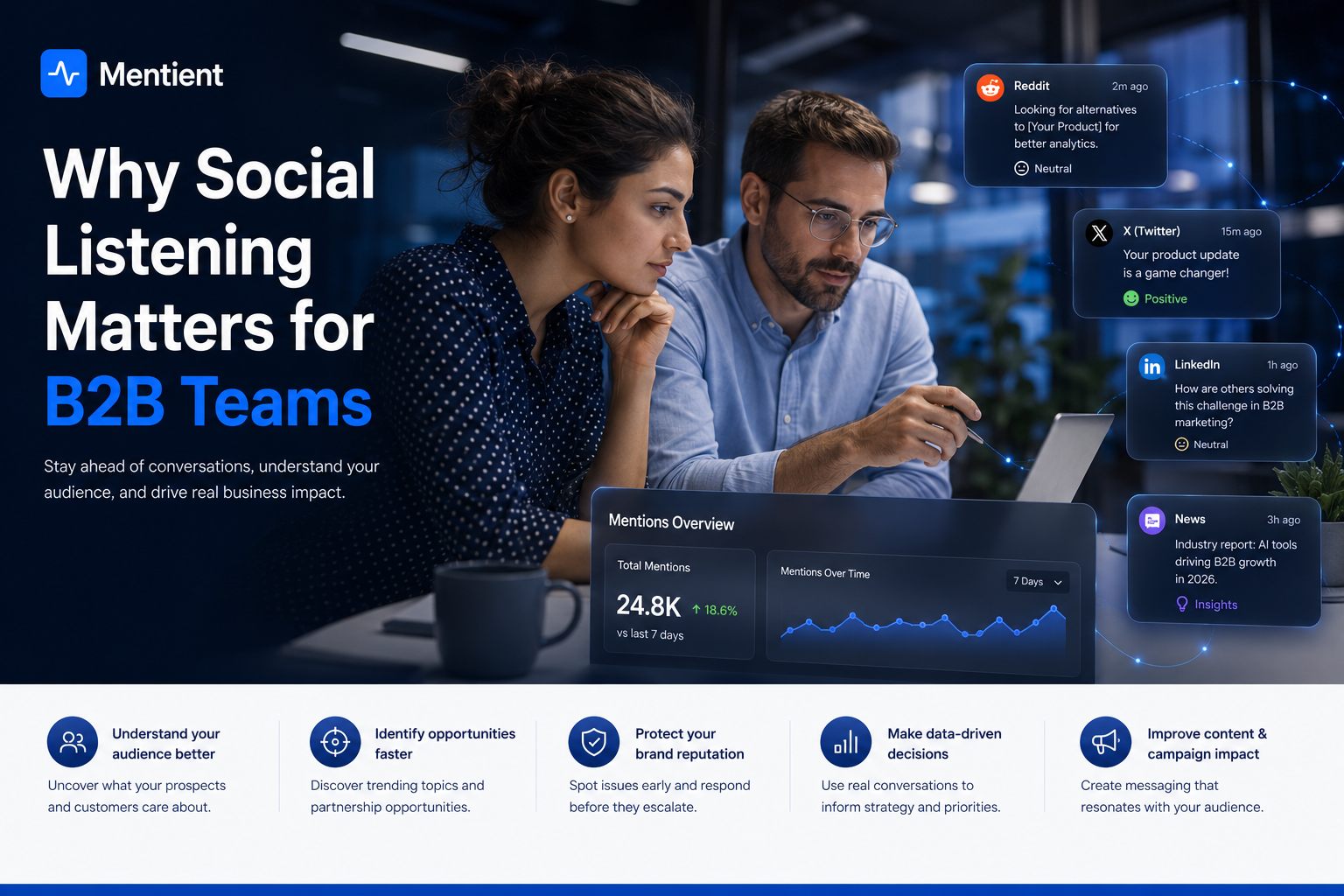
B2B marketers were slower to adopt social listening than consumer brands, mostly because the volume looked too small to justify the tooling. That assumption does not hold up anymore.
54% of consumers say they use social media to research products and services before buying (WifiTalents, 2026), and for B2B software specifically, a lot of that research happens on Reddit and in niche communities rather than on LinkedIn, where brands can control the narrative. Someone asking "anyone actually switched off [competitor]?" in r/SaaS carries more weight with a buyer than any piece of sponsored content, and most B2B marketing teams have no visibility into that thread at all.
There is a budget signal here too. Brand health tracking accounted for 32.53% of listening application spend in 2025, the largest single application category (Mordor Intelligence), which tells you where the market has already put its money even before the AI search angle changes the math further.
That AI search angle is the part most B2B teams still underestimate. When someone asks ChatGPT or Perplexity "what's the best [category] tool," the model draws heavily on exactly the forums and review sites social listening already tracks. Reddit threads, comparison posts, and community reviews increasingly feed the training and retrieval layer behind those answers. A brand with strong organic search rankings but zero Reddit presence can still lose the AI-generated recommendation entirely, and the only way to catch that early is to track the conversations feeding it. This is one reason a growing share of listening budgets is shifting toward tracking AI search visibility alongside traditional sentiment.
Teams also report a real efficiency gain once they consolidate: surveyed teams using dedicated listening tools report spending 60% less time on manual monitoring than teams still doing it by hand (WifiTalents, 2026). That is time that goes back into acting on what the data shows instead of collecting it.
Social listening examples
Abstract frameworks are easier to trust with real cases attached, so here are three that show the range of what listening catches.
Netflix and the #SaveLucifer campaign. When Fox canceled the show Lucifer, fans organized around the #SaveLucifer hashtag. Netflix's team, watching sentiment and volume on that tag rather than dismissing it as noise, picked up the show. It went on to become one of the platform's most-watched original series, a decision that started as a listening signal rather than a pitch deck.
Fitbit's "Reminder to Move" feature. Fitbit's product team noticed a recurring theme in social conversations and support forums: users wanted a nudge to stand up during long sedentary stretches, not just an end-of-day step count. That pattern, visible across enough posts to count as a trend rather than a one-off request, became a shipped feature.
A skincare brand tracking ingredient complaints. A common pattern in the beauty category: brands running listening on TikTok comments notice recurring mentions of "fragrance-free" or "for eczema" attached to specific product complaints, and use that to prioritize reformulation over guessing from survey data. The survey would have taken a quarter. The listening signal showed up in weeks.
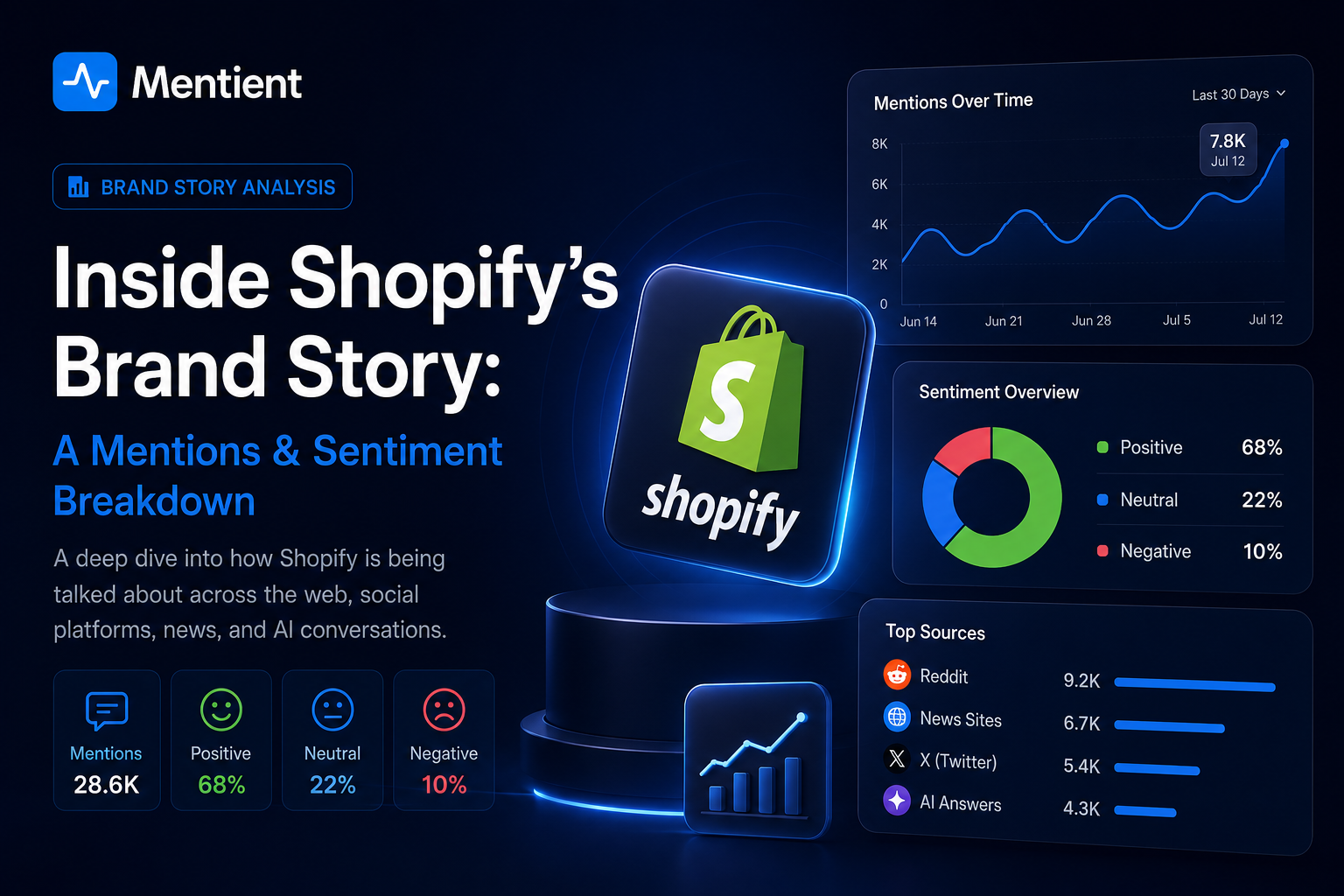
None of these three came from a scheduled report. They came from a team that had already set the listening net wide enough to catch conversations nobody was searching for by name. We ran a similar breakdown on how mention and sentiment data mapped a single company's public narrative over time, and the pattern held: the useful signal showed up in clusters, not single posts.
Core social listening metrics to track
Most teams start by tracking volume and stop there, which wastes the tool. Here is the set we actually build dashboards around:
| Metric | What it tells you | Watch for |
|---|---|---|
| Mention volume | Raw awareness trend | Spikes without context (bot wave, not real interest) |
| Sentiment ratio | Positive vs. negative split over time | A slow negative drift over weeks |
| Share of voice | Your mentions vs. named competitors | Rising competitor share even while yours holds steady |
| Source breakdown | Where conversations happen | A channel you're not monitoring becoming the loudest one |
| Response time | How fast your team reacts | Anything over 2 hours on a negative spike |
| Topic clusters | Recurring themes inside the mentions | The same complaint reappearing across unrelated threads |
Share of voice and topic clusters are the two most B2B teams skip, and they are usually the two that change a roadmap or a positioning line.
Where social listening data really comes from
The phrase "social listening" undersells how much of the useful data now comes from places that are not social networks in the traditional sense.
- Reddit. Deep, candid, and largely anonymous conversation, which makes it one of the highest-signal sources for honest product feedback. It is also one of the hardest to monitor manually because subreddit culture varies enormously and keyword search inside Reddit is weak.
- Review platforms. G2, Capterra, and Trustpilot carry structured sentiment (star ratings) alongside unstructured text, which makes them easier to quantify than open social feeds.
- News and blogs. Coverage volume and tone shift, especially around funding announcements, product launches, or incidents.
- Developer communities. Hacker News and Stack Overflow matter disproportionately for technical products, where a single well-upvoted critical comment can shape how an entire engineering audience perceives a tool.
- Traditional social platforms. X, LinkedIn, Instagram, TikTok. Still relevant, still the fastest-moving layer, but no longer the whole picture the way they were five years ago.
- AI engines themselves. ChatGPT, Perplexity, and Google's AI Overviews now generate brand-relevant text at scale, and tracking what those engines actually say about your brand is becoming its own listening category, distinct from but connected to traditional sentiment tracking.
Building a social listening workflow
Here is the version we use when a client asks us to stand up listening from zero, adapted so it runs on any tool with API access to Reddit, review sites, and standard social platforms.
- Define the tracked set. Brand name variants, product names, key executives, and 3-5 named competitors. Include common misspellings; we have seen brands miss 15-20% of relevant volume just from typo variants.
- Set exclusion rules. If the brand name is also a common word (a real problem for us with one client last year), build exclusion filters for the noisy unrelated context before the sentiment engine ever sees the data.
- Tier the alerts. Urgent (viral negative spike, executive mention, security concern) goes to Slack in real time. Routine mentions batch into a daily or weekly digest.
- Assign ownership by category. Support-flavored mentions route to support. Product feedback routes to product. Competitive mentions route to whoever owns positioning. Nothing sits in a shared inbox nobody checks.
- Review topic clusters monthly. Not daily. Daily review catches noise; monthly review catches the pattern that daily alerts miss because no single day looked alarming.
- Match the feature set to the workflow, not the other way around. Most vendors publish a full feature breakdown worth comparing line by line before step 1 locks in, since retrofitting a workflow to a tool's limitations later costs more than picking carefully up front.
- Close the loop. When a listening insight changes a decision (a feature ships, a positioning line changes, a pricing page gets rewritten) log it. That log is what proves the tool's value at renewal time, and it is the thing most teams forget to keep.
Common social listening mistakes
- Tracking only direct mentions. Missing the conversations that reference you indirectly ("that Reddit brand monitoring tool everyone uses") is one of the most common gaps we see, and it is often where the most honest feedback lives.
- Ignoring competitor mentions. Your own mention volume means little without a comparison point. A flat month can be a win if a competitor's volume dropped twice as much.
- Treating sentiment scores as final. Automated sentiment is a starting point, not a verdict. Sarcasm, industry jargon, and regional slang still trip up even strong models often enough that a human should spot-check anything flagged as strongly negative before it triggers a response.
- No response protocol. Catching a viral negative thread without a plan for who responds, in what tone, and within what window turns a fast catch into a slow, visible scramble.
- Reporting volume without context. A chart of mention counts going up means nothing on its own. Up because of what? Positive, negative, a single viral joke post? Volume without a sentiment and topic breakdown is a vanity metric dressed up as an insight.
Choosing a social listening tool
Feature checklists blur together fast in this category, so narrow the evaluation to what actually differentiates vendors:
| Criteria | Why it matters |
|---|---|
| Source coverage | Confirm Reddit and forum coverage specifically. Many "social" tools still stop at the big platforms. |
| Sentiment method | Ask whether sentiment runs on keyword rules or an LLM. The difference shows up on sarcastic or jargon-heavy posts. |
| Alert routing | Slack and email integration should be native, not a workaround through Zapier. |
| Historical data access | 90-day history is common; unlimited history matters for year-over-year comparisons. |
| Competitor tracking depth | Confirm how many competitors are included at your pricing tier, since this is a common upsell lever. |
| AI search visibility | A newer category, but worth asking about if ChatGPT and Perplexity recommendations matter to your pipeline. |
Run a two-week pilot against your own brand name before committing to an annual contract. The gap between a vendor's demo data and your actual mention volume shows up fast, usually inside the first 48 hours.
The bottom line
Social listening works when it is treated as an input to decisions, not a dashboard someone checks once a week out of habit. The teams getting real value out of it have exclusion rules tuned to their brand's specific noise, ownership assigned by mention category, and a habit of reviewing topic clusters monthly instead of drowning in daily alerts. Start narrow. Track your brand, your top three competitors, and one category term, then expand the tracked set once the workflow is actually running instead of trying to boil the ocean on day one.
FAQ
What is the difference between social listening and social media monitoring?
Monitoring reacts to direct mentions in real time. Listening looks for the pattern underneath a batch of mentions and feeds it into longer-term decisions. Most mature programs run both.
How much does social listening software cost?
Entry-level plans for small teams typically run $50-150 per month, while mid-market and enterprise platforms with deeper Reddit, forum, and competitor coverage range from $150 to over $1,000 monthly depending on mention volume and the number of tracked brands. Pricing usually scales with mentions tracked per month rather than seats, so get a volume estimate before comparing quotes across vendors.
Can social listening track mentions on Reddit?
Yes, though coverage varies widely by vendor. Reddit's structure (anonymous accounts, subreddit-specific culture, weak native search) makes it harder to track than X or Instagram, and plenty of "social" listening tools quietly skip it or cover it poorly. If Reddit visibility matters for your category, confirm coverage depth during a trial rather than taking a feature list at face value.
Is social listening only useful for large brands?
No. Smaller brands often get more actionable signal per mention because their volume is low enough that a human can actually read every flagged post instead of relying purely on automated summaries. The tooling cost has also dropped enough that a solo marketer at a 10-person startup can run a meaningful listening program on a modest monthly budget.
How is AI changing social listening?
Two ways, and they are pulling in different directions. On the analysis side, large language models replaced keyword-based sentiment scoring with something that reads context, tone, and sarcasm closer to the way a person would. That is the biggest accuracy jump the category has seen since it started, and it is the reason a sarcastic complaint no longer scores as a compliment just because it contains a positive word. On the demand side, AI answer engines like ChatGPT and Perplexity now generate brand recommendations by drawing on the same forums, comparison threads, and reviews that listening tools already track, which means the audience for a Reddit thread is no longer just the humans reading it. A model reading it later, and repeating a version of it to a buyer who never visits Reddit at all, is turning "AI search visibility" into a category of its own that sits right next to traditional sentiment tracking. We treat it as a related discipline rather than a replacement, mostly because the underlying data sources overlap so heavily that splitting them into separate tools would mean paying twice for the same crawl.