Social listening runs in two modes, and most teams only use one. Passive social listening is the always-on kind: you set your queries once and let mentions come to you. Active social listening is the on-demand kind, where you go out and dig for the answer to a specific question. This is the marketing sense of the terms; in psychology, active versus passive social media use describes posting against scrolling, which is a different topic. Knowing which mode you are in, and which your team actually needs, is the difference between a feed you skim and a system that answers real questions. This guide covers both, with examples and a straight recommendation.
- ✓Passive runs in the background; active chases a question. Passive surfaces mentions to you; active goes looking for answers.
- ✓Passive is your foundation. Every team needs an always-on safety net for mentions and crises.
- ✓Active answers specific questions. Reach for it during launches, research, and decisions.
- ✓The effort differs. Passive is low daily effort once set up; active is focused, project-based work.
- ✓Most teams need both. Start passive, then layer active when a question is worth digging into.
Active vs passive social listening: the short answer
Passive social listening is the always-on approach: you set up queries and alerts once, then let brand mentions, sentiment, and trends flow to you continuously. Active social listening is the on-demand approach: you go out and search for the answer to a specific question, run targeted queries, poll your audience, and engage in conversations directly. Passive keeps you aware in the background, while active digs for answers when you have a decision to make.
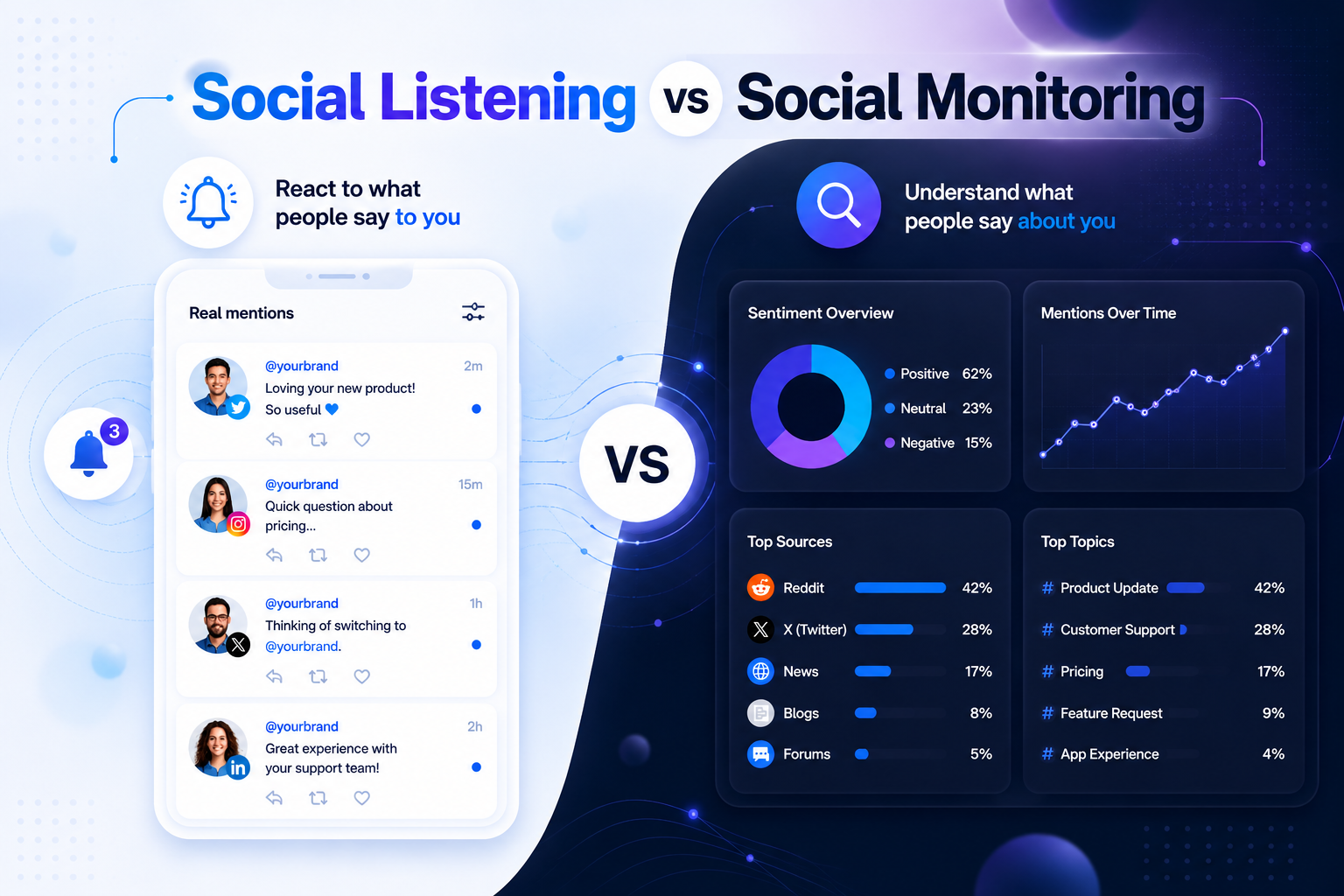
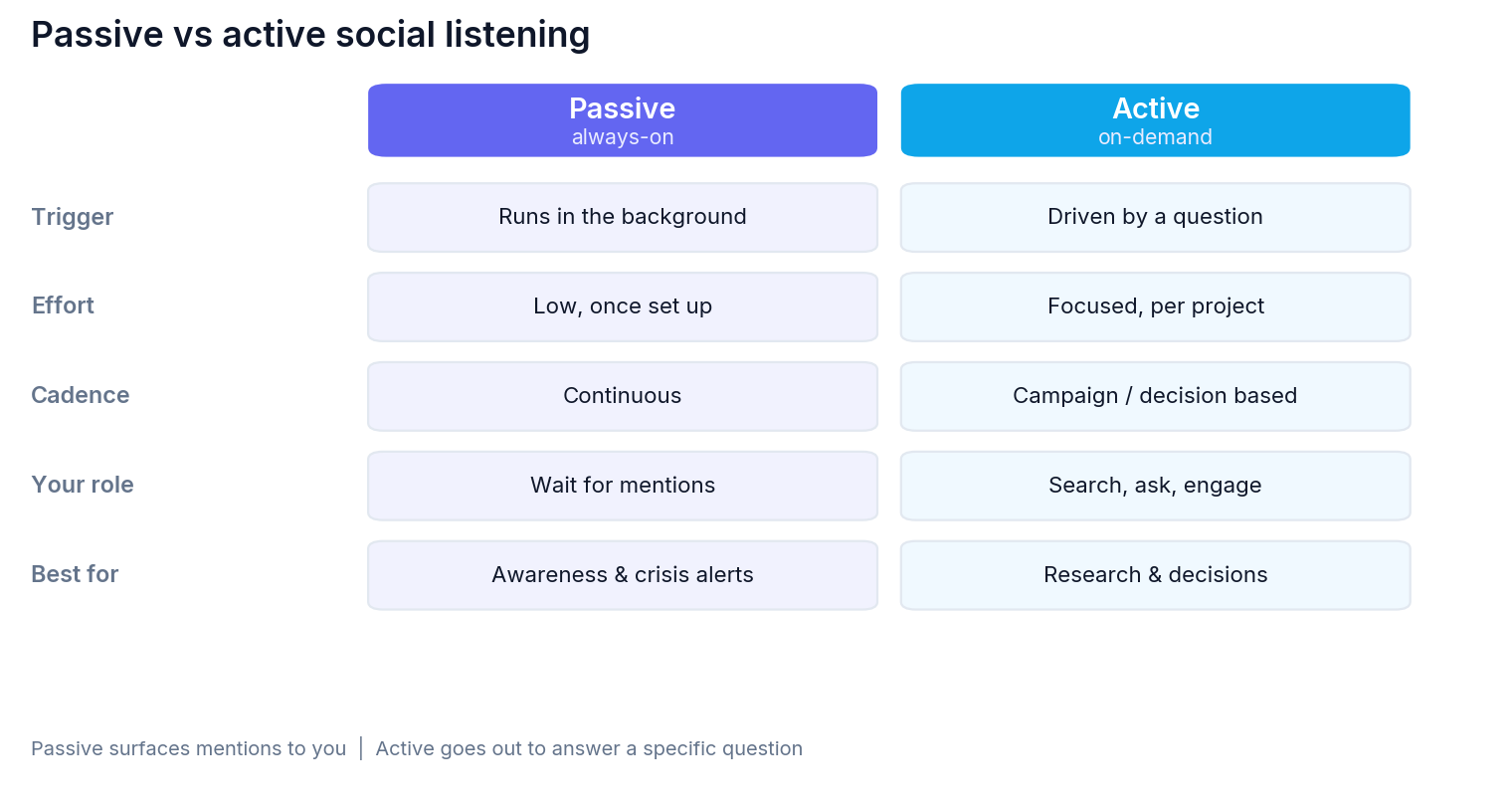
Note that this is a different cut than social listening vs social monitoring. That distinction is about scope, the whole conversation against direct mentions. Active versus passive is about effort and intent, whether the data comes to you or you go to it. Here is the split in one table.
| Dimension | Passive social listening | Active social listening |
|---|---|---|
| Trigger | Always-on, runs in the background | On-demand, driven by a question |
| Effort | Low daily effort once set up | Higher, focused effort per project |
| Cadence | Continuous | Project or campaign based |
| Your role | Wait for mentions to surface | Go search, ask, and engage |
| Best for | Baseline awareness and crisis early-warning | Research, launches, and specific decisions |
| Output | A steady feed of mentions and trends | Answers to a question, and conversations joined |
What is passive social listening?
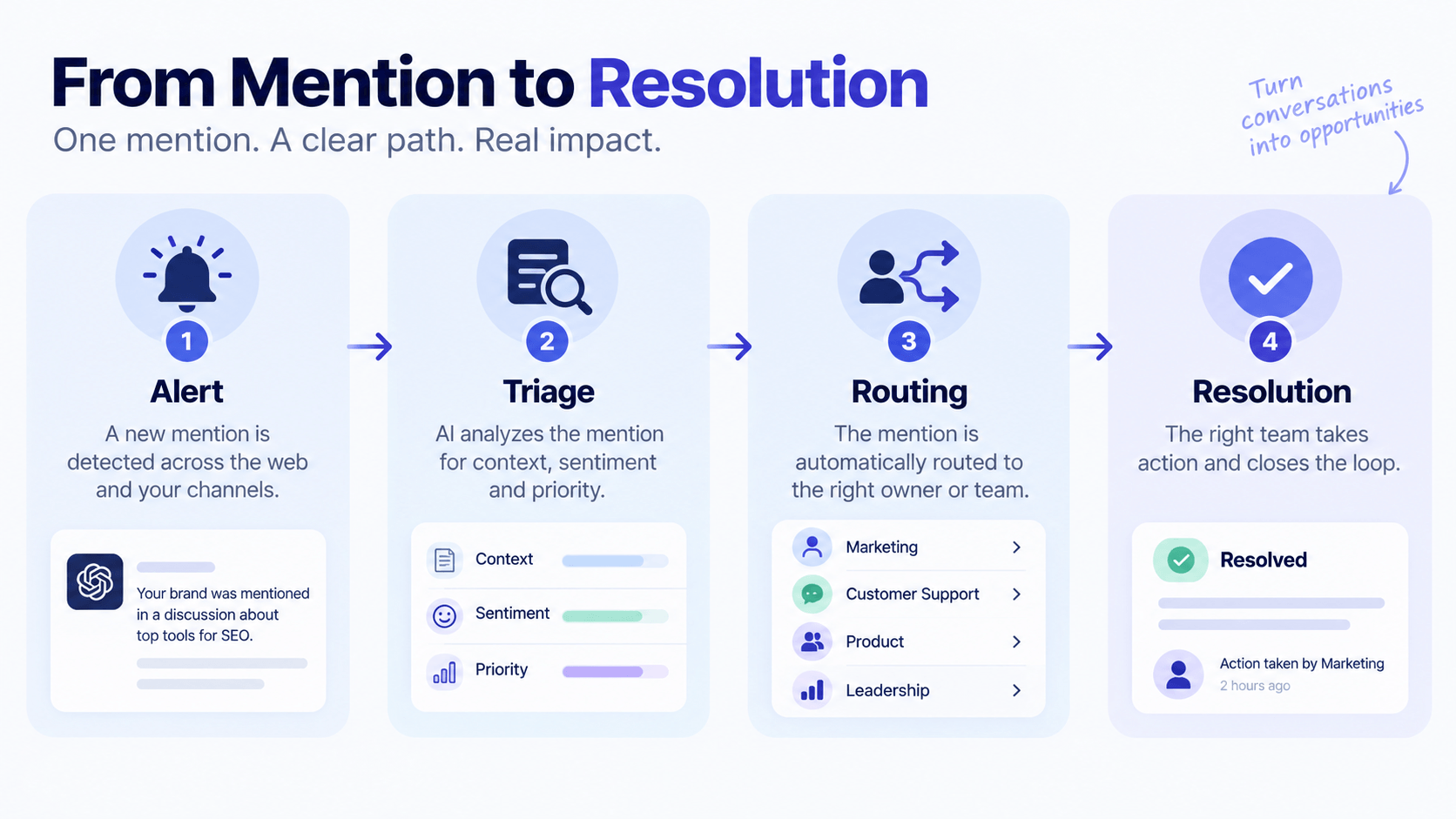
Passive social listening is the layer that never sleeps. You define your queries once, the tool watches every channel continuously, and mentions, sentiment shifts, and trends surface to you without you lifting a finger each day. It is the smoke detector of your social presence: quiet until something needs attention, then loud enough to catch it early.
The value is coverage you could not manage by hand. No one can search their brand, competitors, and category across social, Reddit, reviews, and news every hour, so passive listening does it for you and flags the exceptions. This is the always-on job that brand monitoring tools are built for, and it is where a clean query matters most, because the system runs on whatever you set up. Our guide to Boolean search for social listening covers how to build queries that surface the right mentions instead of noise.
The limit of passive listening is that it answers questions you thought to ask in advance. It catches what your queries were built to catch. When a genuinely new question comes up, you have to go looking, and that is active listening.
What is active social listening?
Active social listening is the deliberate, question-driven mode. You have a specific thing you need to know, so you go find it: you run a targeted search, read through the threads by hand, poll your audience, or join a conversation to ask a follow-up. Where passive listening waits, active listening hunts.
It also covers engagement. Reading a Reddit thread about your category and replying with a genuine answer is active listening in its fullest form, because you are both gathering insight and shaping the conversation. Communities reward that presence, which is why Reddit monitoring pairs naturally with active work. The mode is higher effort and it does not scale the way passive does, but it produces something passive cannot: a direct answer to the exact question you are holding. Sentiment models help you move fast once you have pulled the mentions, reaching 93% precision on binary sentiment tasks (Mordor Intelligence), so the manual part is the reading and the judgment, not the sorting.
The key differences
The table above is the summary. Underneath it, the split comes down to four things.
Who moves first. In passive listening, the data moves; it comes to you through alerts and a running feed. Active listening flips that: you move, going out to pull the answer. Everything else follows from that one difference.
Effort and scale. Passive listening is low effort per day once configured, and it scales to every channel at once. Active listening trades that reach for depth, spending concentrated effort on a single question with no real scale, which is fine because you use it deliberately.
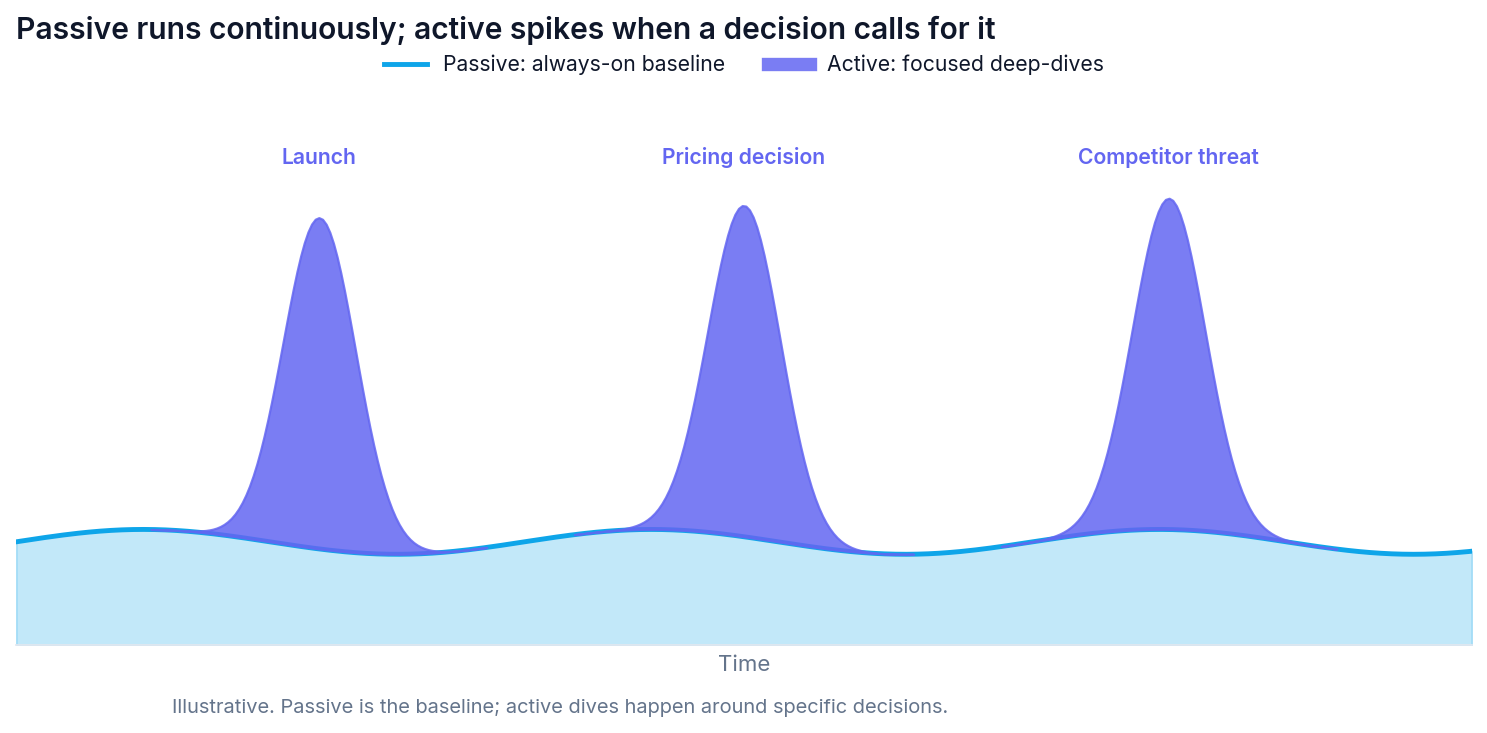
Timing. Passive listening is continuous and always current. Active listening comes and goes, spun up when a launch, a decision, or a surprising trend calls for it, then wound back down.
What you get. Passive listening produces awareness, a steady read on what is happening. What active listening gives you is answers, the specific finding you went in for. Our breakdown of social listening metrics that matter covers how to measure both without drowning in vanity numbers.
Active and passive social listening examples
The difference is clearest in practice.
Passive social listening in action:
- An alert fires when your brand mention volume spikes overnight, and you catch a brewing complaint before it trends.
- Your sentiment dashboard flags a slow decline over two weeks that no single mention would have revealed.
- A competitor's name shows up in your feed next to yours, surfacing a comparison you did not know was happening.
Active social listening in action:
- You are deciding on a pricing change, so you search and read every recent thread comparing your price to competitors, then summarize what you find.
- You run a poll in your community to test a feature idea before you build it.
- You find a Reddit thread full of questions about your category and answer them directly, learning the real objections while you help.
The tell is who started the search. Passive examples begin with the tool surfacing something; active examples begin with you asking a question and going to find the answer.
Which does your team need?
Both, eventually, but not in equal measure and not at the same time. The right starting point depends on your situation.
Start with passive if you have no always-on coverage yet. It is the foundation, the safety net that catches the crisis and the surprise while your team is busy with other work. A small team with limited hours gets the most from passive listening, because it delivers awareness at almost no daily cost. Our step-by-step social listening guide covers how to set that baseline up.
Lean into active if your pressing need is a decision or a relationship. Researching a launch, testing positioning, understanding why a segment churns, or building presence in a community are all active work, and no passive feed will do them for you. Teams that are product-led or community-led live in active mode more than most.
For most companies the honest answer is that passive comes first and active comes second, layered on once the baseline runs. You want the smoke detector installed before you start opening doors to investigate specific rooms.
How to run both together
The two modes reinforce each other. Passive listening tells you where to point active listening. A trend you spot in the always-on feed becomes the question you go dig into by hand, and the answer you find by hand often becomes a new passive query so the system watches for it from then on. It is a loop, not a choice.
In practice that means keeping a broad passive setup running at all times, then scheduling active deep-dives around the decisions on your calendar: a launch, a quarterly review, a competitive threat. Our framework for building a social listening strategy covers how to layer the two without doubling the workload, and it is the same plumbing underneath, so adding active work to a passive setup is mostly a matter of discipline rather than new tools.
Conclusion
Active and passive social listening are two speeds of the same practice. Passive is the always-on layer that keeps you aware and catches what you did not see coming. Active is what you reach for when you have a specific question and the will to go answer it. Nearly every team should run passive as the foundation, then add active deep-dives around the decisions that matter. If you have neither today, start passive: set up one broad, well-built query, let it run, and you will have your first active question within a week.
FAQ
What is the difference between active and passive social listening?
Passive social listening is always-on: you set queries once and let mentions, sentiment, and trends surface to you continuously. Active social listening is on-demand: you go out and search for the answer to a specific question, run targeted queries, poll your audience, or engage directly. Passive keeps you aware in the background; active digs for a specific answer when you need one. In short, passive is the smoke detector, and active is the flashlight you grab when you want to look at one specific room.
Is passive social listening the same as social monitoring?
They overlap but are not identical. Social monitoring focuses on catching and responding to direct mentions, while passive social listening is the always-on collection of the wider conversation, whether or not it tags you.
Which is better, active or passive social listening?
Neither is better; they do different jobs. Passive gives you constant awareness at low daily effort and is the right foundation for any team. Active gives you specific answers and real engagement but takes concentrated effort, so you use it deliberately. Most mature programs run passive continuously and active in focused bursts.
Can a small team do active social listening?
Yes, in short bursts. A small team should run passive listening as its always-on base, then set aside time for a focused active dive when a real question comes up, like researching a launch or reading through competitor complaints. The key is to treat active work as a scheduled project rather than a daily task you cannot sustain.
What tools do you need for active vs passive social listening?
Passive listening needs a tool that monitors continuously across social, Reddit, forums, news, and reviews and alerts you to changes. Active listening uses the same tool for targeted searches, plus lighter methods like polls and direct engagement in communities. Many platforms handle both, so the difference is more about how you use the tool than which one you buy.
Mentient runs always-on across Reddit, the web, and AI answers, and makes the deep-dives fast when you have a question.
Start free trial →