Ask a PR lead and a growth marketer to define "monitoring" and you will get two different answers, and neither one is wrong. PR means tracking what got published: the press hit, the broadcast segment, the wire pickup. Growth marketing means tracking what got said: the Reddit thread, the one-star review, the comment nobody on the team asked for. Media monitoring and social listening get lumped together as one thing. They shouldn't be. They measure different signals, pull from different sources, and usually report to different people in the org chart. We run both practices for clients every week, and the teams that treat them as interchangeable are the ones who end up missing half their coverage, often without noticing until a story breaks somewhere they weren't watching. This piece breaks down what each discipline tracks, where the two genuinely overlap, and how to build a workflow that covers both instead of buying whichever tool sales called first.
- Media monitoring tracks what got published, across news, broadcast, print, and wire services. Social listening tracks what people said, across social platforms, forums, and reviews. The scope is what separates them, not the goal.
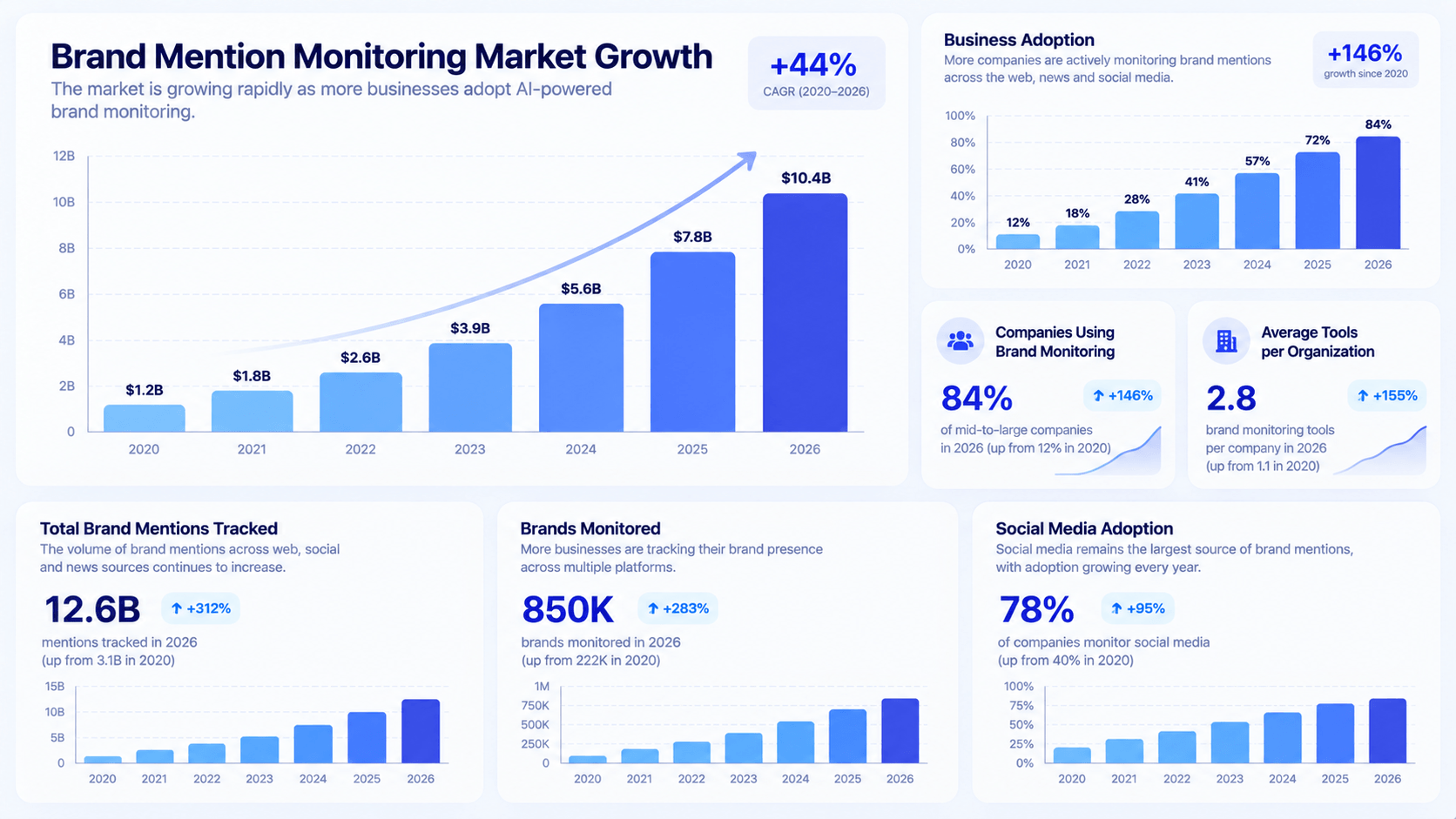
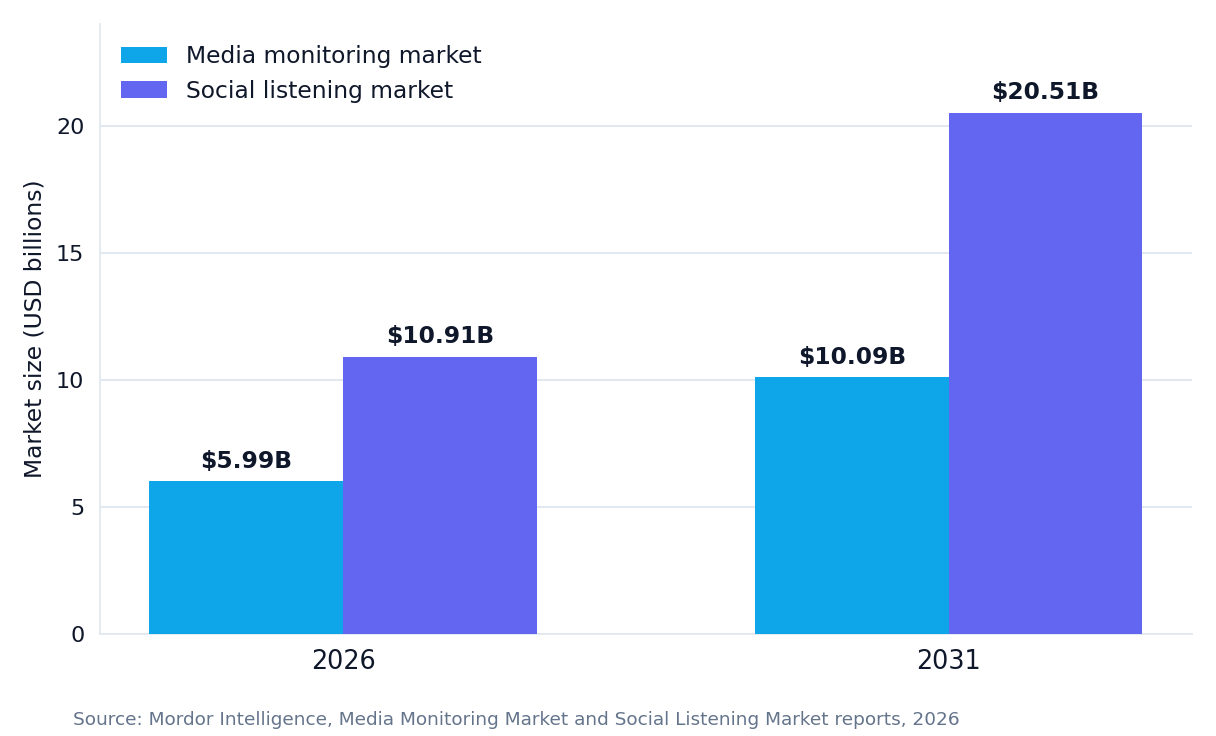
- The media monitoring market is on track to grow from $5.99 billion in 2026 to $10.09 billion by 2031, while the social listening market is already larger and growing faster still (Mordor Intelligence).
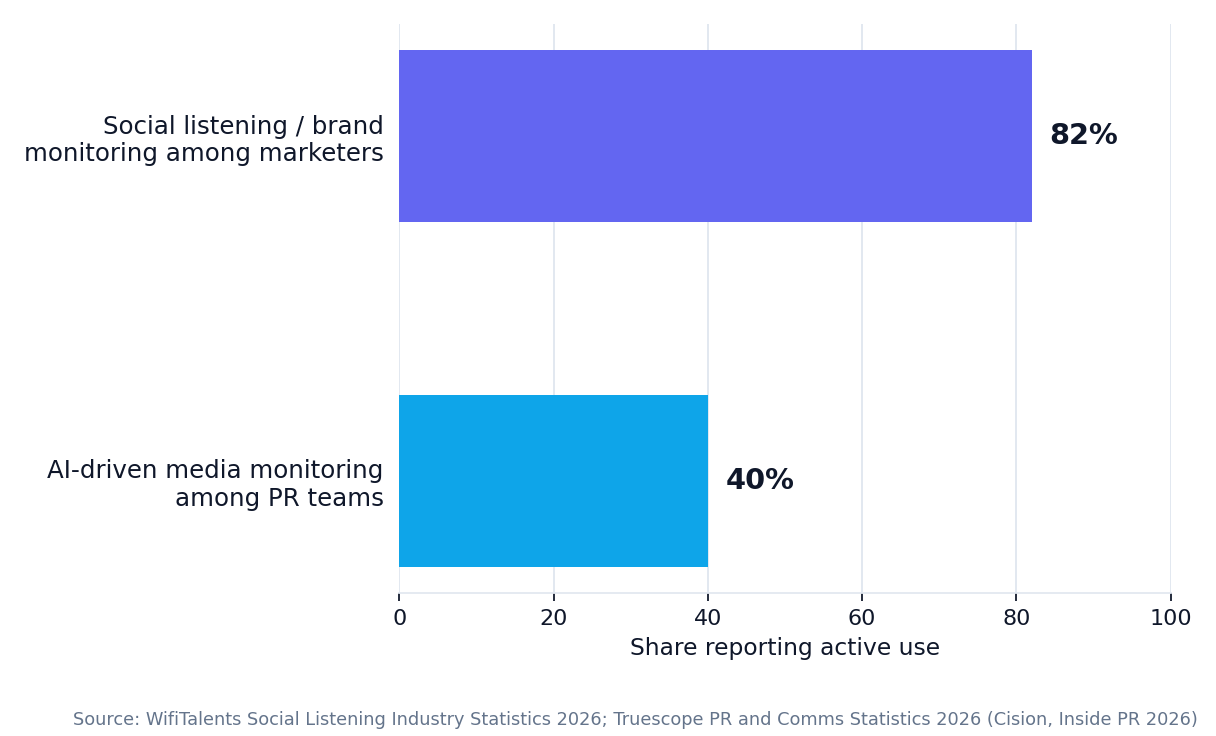
- Only 40% of PR teams use AI-driven media monitoring, while 82% of marketers already run some form of social listening, a gap that shows how unevenly the two disciplines have been adopted across departments.
- A newspaper clip and a Reddit thread need different collection methods, different sentiment models, and usually a different owner. Buying one tool to cover both is the most common budgeting mistake we see.
- Teams that get the most value run both practices side by side, routing press coverage and social sentiment into the same weekly report instead of two disconnected ones.
- What is media monitoring?
- What is social listening?
- Media monitoring vs. social listening: the core differences
- Where the data for each actually comes from
- Why PR and marketing teams need both
- Building a workflow that covers both
- Common mistakes teams make mixing the two up
- Choosing tools for each discipline
- FAQ
What is media monitoring?
Media monitoring is the practice of tracking, collecting, and analyzing coverage of your brand, competitors, or industry across news outlets, broadcast, print, and wire services. It answers one question: what ran, where, and how far did it travel. The output is usually a clip report, a share-of-voice number, or a sentiment score attached to a specific published piece, not a raw social post.
The category grew out of newspaper clipping services, literally people with scissors and a subscription to every regional paper that might mention a client. It still carries that DNA. A hit in a national outlet and a hit in a regional trade blog get weighted differently in most reports, because the publication's reach and authority shape the number as much as the words used in the story.
That has not stopped the category from modernizing fast. Forty percent of PR teams already run AI-driven media monitoring, according to Cision's Inside PR 2026 survey, up from a manual, once-a-day clip review that was still standard practice five years ago. The global media monitoring market reflects the same shift: Mordor Intelligence puts it at $5.99 billion in 2026, growing to $10.09 billion by 2031, a compound annual rate just under 11%.
Speed matters more here than it used to. Sixty-three percent of PR professionals say an issue only becomes a genuine crisis once it lands on the CEO's radar, according to Agility PR Solutions and PR News. Media monitoring is usually what gets it there first. A wire pickup or a broadcast segment moves through the news cycle faster than most internal escalation chains, which is exactly why the category still earns its budget line even in an org that has also invested heavily in social tools.
What is social listening?
Social listening is the practice of tracking, analyzing, and acting on conversations about your brand, competitors, or industry across social platforms, forums, review sites, and the open web. It tracks sentiment and raw opinion, the kind that never touches a journalist or an editor. A Reddit thread complaining about a pricing change carries no byline and no wire distribution, but it still shapes what the next 200 people searching your brand name will read.
Eighty-two percent of marketers already run some form of social listening or brand monitoring as a core tactic, according to WifiTalents' 2026 industry report, and 54% of consumers say they use social media specifically to research products and services before buying. That adoption number undersells how much the source mix behind our social listening definition has shifted. Twitter and Instagram used to carry the whole conversation. Now Reddit threads and forum comments shape purchase decisions in categories that never used to show up in a listening report, and forum threads now shape what ChatGPT and Perplexity say about a brand before a person ever reads the original post.
That last layer is a separate problem most listening tools were never built to cover. We built a dedicated AI visibility view rather than bolt it onto a standard social dashboard, because the source citations an LLM pulls from rarely match the platforms a classic social listening tool was designed to crawl in 2018.
Media monitoring vs. social listening: the core differences
A media monitoring report can confirm that a story ran in three outlets and reached a defined audience. It says nothing about whether those readers believed the story, forwarded it, or vented about it on X an hour later. That gap is exactly what social listening exists to close, and it is also why the two categories keep getting confused: they often sit on the same dashboard shelf even though they answer different questions.
| Dimension | Media monitoring | Social listening |
|---|---|---|
| Primary source | News, broadcast, print, wire, trade press | Social platforms, forums, reviews, open web |
| Core question | What ran, and how far did it travel | What people actually think, and why |
| Typical owner | Communications / PR | Marketing / growth / CX |
| Output | Clip report, share of voice, reach | Sentiment trend, theme cluster, volume spike |
| Response trigger | A published story, segment, or wire pickup | A conversation spike, published or not |
Eighty-five percent of consumers weigh third-party media mentions before they buy, according to Marketing Insider Group. That is the exact coverage media monitoring exists to catch. It has almost nothing to say about the comment thread underneath the article, where a reader talks themselves out of the purchase the story just talked them into.
Where the data for each actually comes from
The two categories look similar from a distance, dashboards, alerts, sentiment scores, but the pipelines feeding them are built differently.
- Wire services and press databases. Media monitoring platforms ingest structured feeds from press wires, broadcast transcription services, and licensed news databases, the same infrastructure that let PR teams track coverage before the tools got AI-native.
- Crawlers across social and forums. Social listening platforms crawl public APIs, Reddit, review sites, and increasingly Slack communities and Discord servers where B2B conversation actually happens now.
- NLP-driven sentiment scoring. Both categories run natural language processing over raw text, but the training data differs. Media monitoring models are tuned on formal news prose. Social listening models are tuned on the shorter, messier grammar of a comment or a review.
- Human review at the edges. Neither category is fully automated. Sarcasm, local context, and ambiguous mentions still get routed to a person, and the teams that skip this step usually end up with a sentiment score nobody on the exec team actually trusts.
One consequence of that split worth calling out on its own: a keyword-only sentiment model will score "sick" as negative even when a commenter means "this feature is sick" as a compliment, and that failure mode shows up far more often in social text than in edited news copy.
Why PR and marketing teams need both
The global PR industry is projected to reach $114.17 billion in 2026, up from $106.63 billion the year before, and the fastest-growing slice of that is digital and social PR, expanding at a 9.8% compound annual rate through 2030 (Mordor Intelligence, cited by Truescope). Digital and social PR sitting inside the same market forecast as traditional PR says something on its own: the two disciplines were sold as separate software categories long after the actual work had already started overlapping.
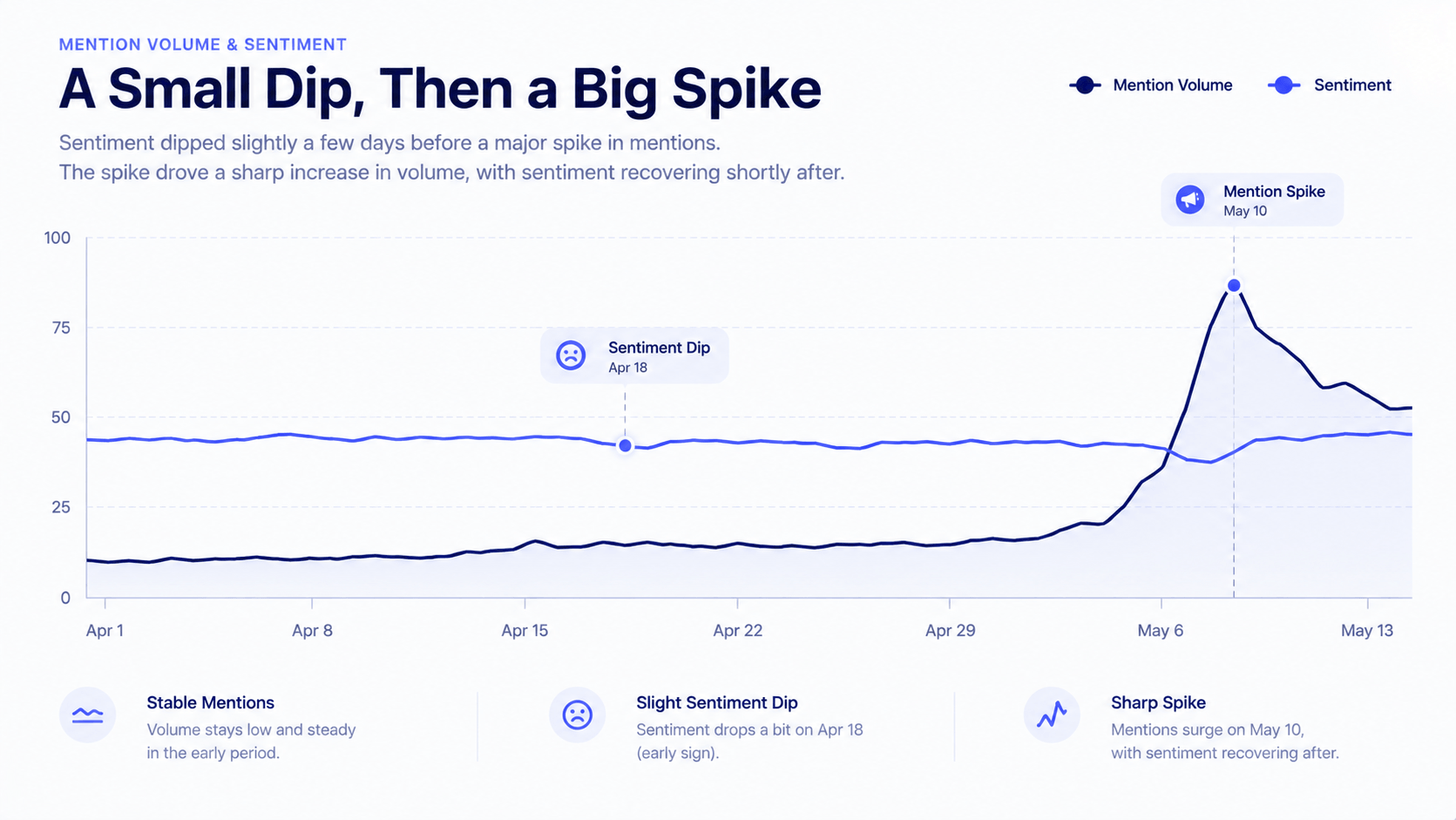
We have watched this play out with clients directly. A negative story runs in a trade outlet at 9am. Media monitoring flags it within the hour. By noon, the same narrative is already spreading across Reddit and X in language nobody in comms wrote, and a listening tool tuned for negative-spike detection is usually the only thing that catches the drift before it becomes the story customer support has to answer for. A fully developed crisis plan, paired with a fast and transparent response, can cut brand reputation recovery time by up to 50%, according to PRSA. Media monitoring alone gets you the first signal. Social listening alone gets you the second. You need both signals on the same clock, not two teams checking two dashboards on two different schedules.
Building a workflow that covers both
None of this requires a single unified platform on day one, though it helps. What it requires is a process that treats press coverage and social conversation as two inputs into the same decision, not two separate reports that get read by two separate teams.
- Centralize both feeds in one dashboard, tagged by source type, press versus social, rather than sorted only by sentiment. You lose the ability to diagnose where a problem started if the two feeds are pre-blended.
- Route press hits and social spikes through the same escalation ladder. A wire pickup and a Reddit spike should trigger the same "who gets pinged" logic instead of two separate ones that were never designed to talk to each other.
- Score share of voice against competitors using both channels. A share-of-voice number built from press mentions alone misses a competitor that is winning the actual conversation on Reddit and G2 while staying quiet in the press.
- Set different response SLAs for each. Press escalations usually get a 24-hour company statement window. Social spikes often need a same-hour response before the thread hardens into the accepted version of events.
- Review both datasets in the same weekly meeting, not two separate ones that never get compared side by side. Query rules get reviewed in that same meeting, since a stale rule is one of the fastest ways to quietly stop catching unbranded conversation, the mentions that never say your name but still belong in the report.
Common mistakes teams make mixing the two up
- Buying a media monitoring tool to cover social listening. Press-focused platforms often bolt on a basic social feed. The sentiment model underneath was tuned on news prose, not comment threads, and it misreads tone constantly.
- Treating share of voice as one number. A share-of-voice score that blends press mentions and social mentions into a single figure hides which channel is actually driving the trend. It works better as one tracked metric among several, not the only number in the report.
- Letting PR and marketing run separate escalation processes. A crisis rarely stays in one lane. When the two teams alert independently, the same story gets discovered twice, an hour apart, by two different people scrambling for the same information.
- Ignoring forums and Slack communities because they are "not social media." A lot of B2B buying conversation happens somewhere a classic listening tool never crawls, and a classic media monitoring tool never looks at all.
- Reviewing coverage weekly and sentiment monthly. Different cadences on the same brand story usually mean someone in the room is always working from stale data, and nobody notices until the numbers stop matching.
Choosing tools for each discipline
Media monitoring buyers should weigh wire and broadcast coverage depth, licensing agreements with the major press databases, and how the tool calculates reach. Social listening buyers should weigh source breadth (does it actually reach Reddit and niche forums, beyond the five biggest platforms), sentiment accuracy on informal text, and alert speed once a spike starts.
Very few platforms do both well, which is exactly why a structured mention tracking process beats trusting one vendor's demo to cover everything your team needs to watch. What counts as a mention in the first place is a good filter question to ask a vendor before the contract, since some platforms quietly narrow that definition to keep their volume numbers manageable.
Frequently asked questions
Is media monitoring the same as social listening?
No. Media monitoring tracks published news, broadcast, and wire coverage. Social listening tracks conversation and sentiment across social platforms, forums, and reviews. They frequently get bundled into one product category, but the sources, the models, and usually the team that owns each one are different.
Which one should a small team start with?
Start with whichever channel actually drives your risk or your leads today. A B2B company selling into technical buyers usually gets more signal from social listening, since Reddit and forum research shape those purchase decisions more than press coverage does. A consumer brand with active press relationships and a real crisis history should start with media monitoring instead.
Do PR and marketing teams need separate tools for this?
Not necessarily, but they almost always need separate views into a shared dataset. PR cares about outlet authority, share of voice, and wire pickup speed. Marketing cares about sentiment trend, theme clustering, and where a conversation is spreading in real time. A platform that forces both teams into one identical dashboard usually ends up satisfying neither, which is why the better setups keep one data layer underneath and two purpose-built views on top, one tuned for press escalation and one tuned for conversation tracking, with a shared alert layer so nobody discovers the same story twice.
How is AI changing media monitoring and social listening?
AI models now read full sentences instead of scoring keywords, which fixes a lot of the sarcasm and context errors older tools made. It has also added a third layer neither discipline originally covered: how a brand shows up inside AI answer engines like ChatGPT and Perplexity, which pull from both press coverage and social conversation when they generate an answer.
What counts as "media" in media monitoring today?
News sites, broadcast transcripts, print, wire service pickups, and trade publications, plus a growing list of independent newsletters and podcasts that function like traditional press but rarely show up in older monitoring tools built before that shift happened.
Media monitoring and social listening solve different problems, and the fastest way to lose budget for either one is to keep pretending they solve the same problem with two different logins. Run the comparison table above against your own stack this week. If you can only answer "what ran" or "what people think," not both, you are missing half the picture your competitors are already watching.
See where your brand shows up, in the press and everywhere else
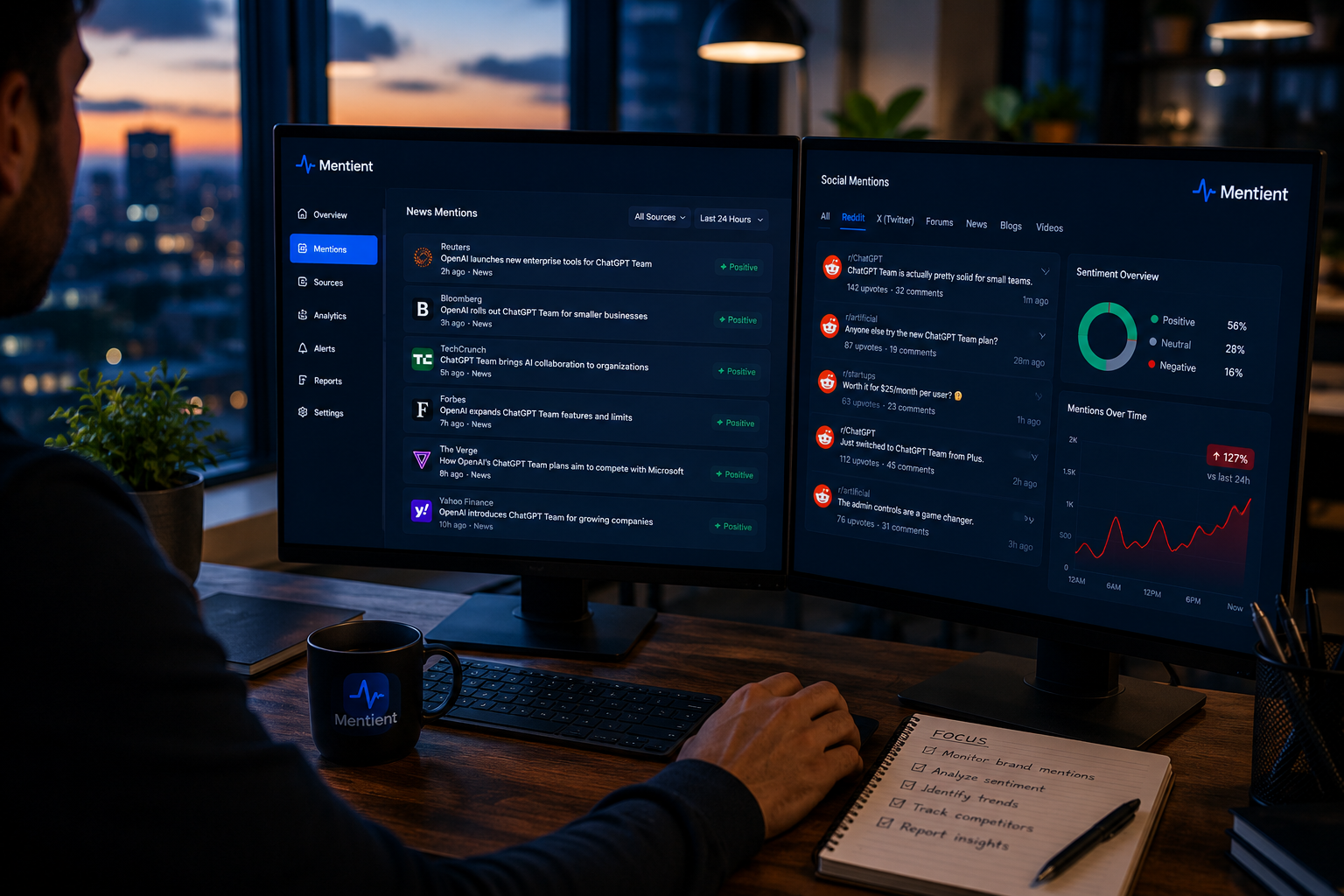
Mentient tracks news, broadcast mentions, Reddit, and the open web from one dashboard, with sentiment scored on full context instead of a keyword match. Start free and see what's already been said about your brand this week.
Start free trial