- ✓Start from a decision, not a dashboard. If you cannot name the choice the data will inform, do not build the query yet.
- ✓Software adoption jumped fast. The share of organizations running social listening on dedicated software went from 44% in 2024 to 78% in 2025 (Archive.com). Spreadsheet tracking stopped scaling.
- ✓Coverage beats cleverness. Your keyword taxonomy and source list decide 80% of the quality. The sentiment model decides the rest.
- ✓One owner, one cadence. A strategy with no named owner and no reporting rhythm is a hobby, not a program.
- ✓Close the loop or lose the budget. Brands that act on social insights report up to 25% higher campaign ROI (Influencer Marketing Hub). The gap is not the listening. It is the acting.
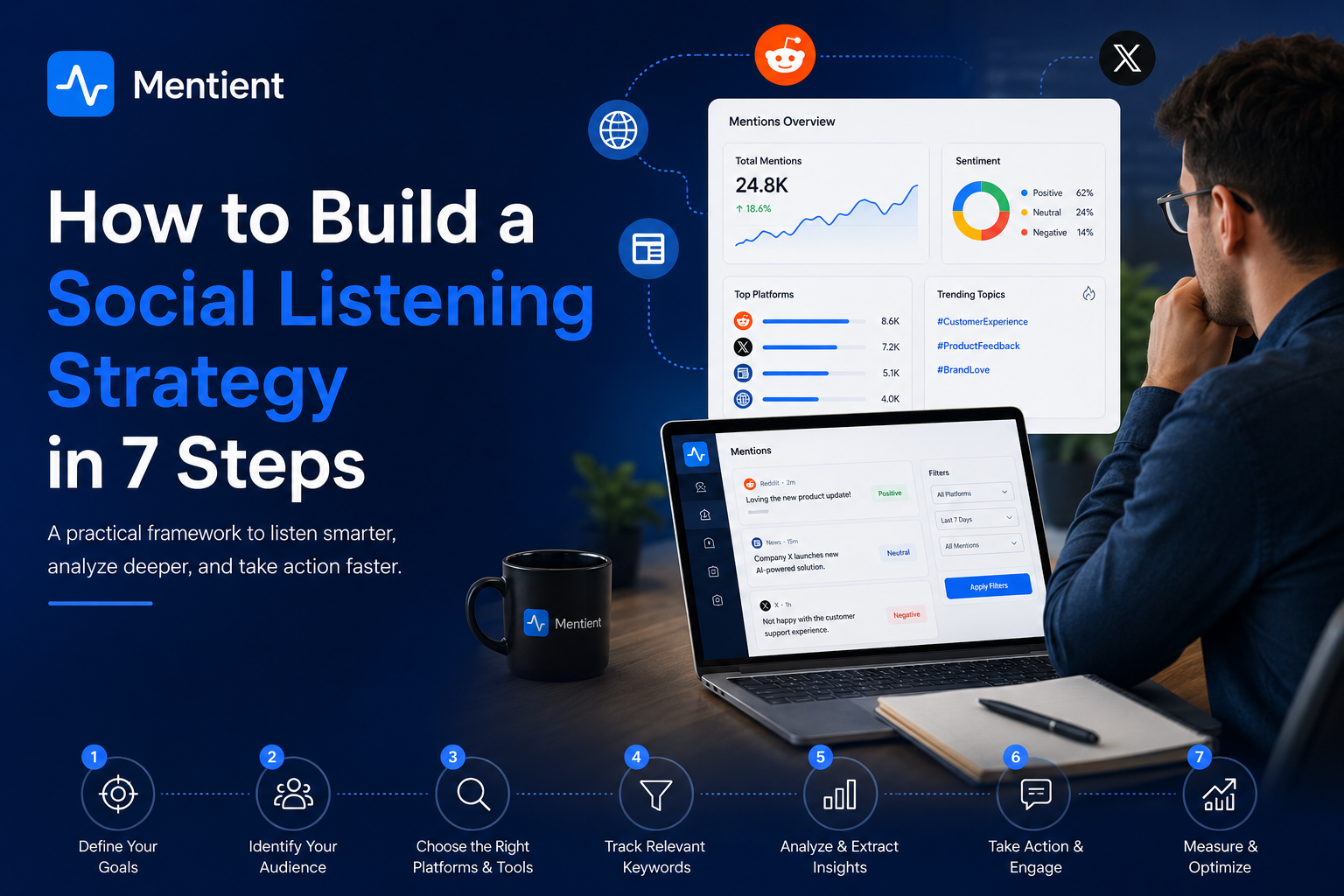
A social listening strategy is only worth building if it changes a decision you already have to make. That is the test we run before we set up a single query. Most strategies fail this test. They collect mentions, chart sentiment, and produce a monthly slide that nobody acts on. The version that works starts from a decision, works backward to the data, and ends with someone changing what they ship. This guide walks through the seven steps we use to build a social listening program that survives its first quarterly review, with the queries, the tool criteria, and the metrics that tell you whether it is working.
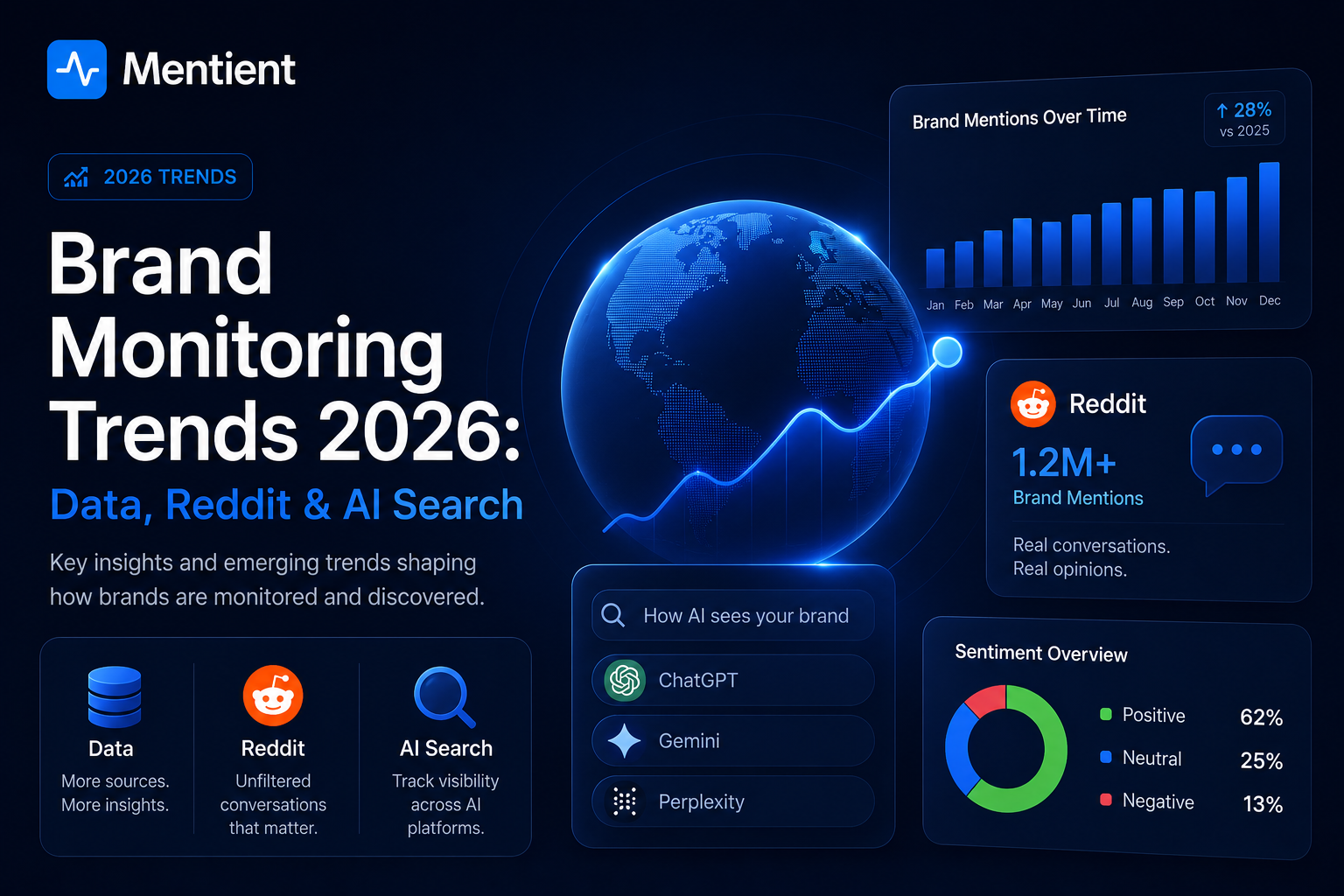
The money is following the same logic. Grand View Research puts the social media listening market at $10.32 billion in 2025, growing to $20.18 billion by 2030 at a 14.3% CAGR (Grand View Research). Spend is doubling because the teams running these programs are pulling decisions out of them, not decks.
What a social listening strategy is
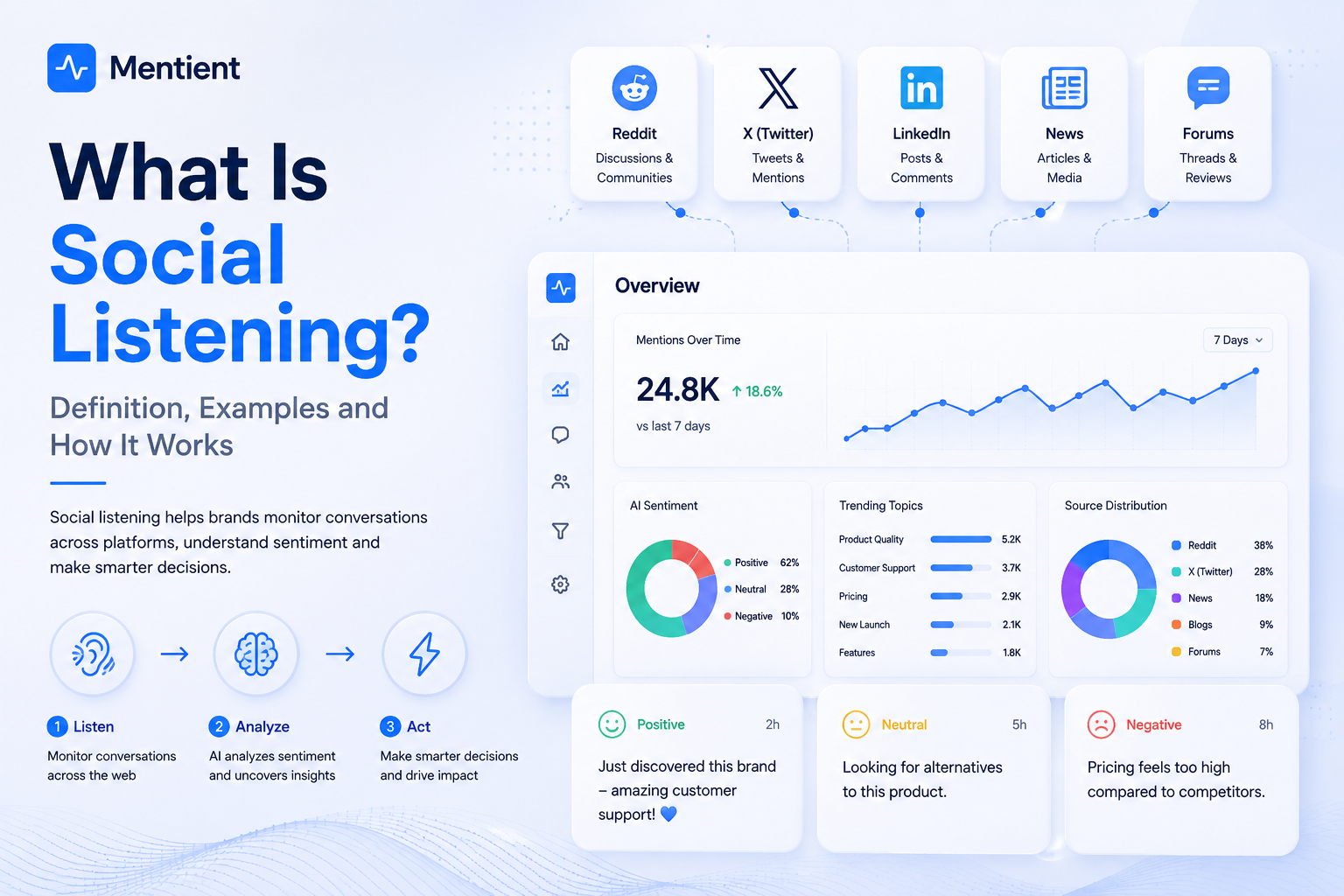
Social listening is the practice of collecting public conversations about your brand, your competitors, and your category, then analyzing them to inform a decision. The listening part is data collection. The strategy part is what you do with it. If you want the full definition and the difference between listening and monitoring, we covered that in our guide on what social listening is. Here we assume you know the concept and want the operating plan.
The distinction that matters in practice is between monitoring and listening. Monitoring answers "what are people saying about us right now," which is a reactive, alert-driven job. Listening answers "what should we change based on the pattern," which is an analytical job that runs on a slower clock. Both belong in a mature program. Most teams buy a tool for the first and never build the second, which is why the program stalls around month four.
A working strategy has five parts, and we build them in this order: a decision to inform, a query taxonomy, a source list, a tagging model, and a reporting cadence. The next seven steps map onto those parts. Skip a part and the whole thing gets shakier the longer it runs.
Step 1: Anchor the strategy to one decision
Before any tooling, write down the single decision this program exists to inform. Not three. One, to start. Our default play here is to phrase it as a sentence a director would actually say in a meeting: "We need to know whether our new pricing is landing badly before the quarterly review," or "We need to catch product complaints about the mobile app within 24 hours so support can get ahead of them."
That one sentence does more work than any feature list. It tells you which conversations to collect, how fast you need them, and what a good outcome looks like. A pricing-perception decision needs Reddit and review sites more than it needs volume charts. A crisis-response decision needs speed and alerting more than it needs historical trend analysis. The decision picks the architecture.
Here is what the data showed us across the programs we have set up. The ones that named a decision in week one were still running a year later. The ones that started with "let's see what's out there" quietly died, usually right after the person who set them up changed roles. Curiosity is a fine reason to open a tool. It is a bad reason to fund a program.
Write the decision. Tape it to the top of the brief. Everything downstream serves it.
Step 2: Build your query and keyword taxonomy
The query taxonomy is where most of the quality lives, and it is the part teams rush. Your queries decide what enters the system, and no amount of clever analysis fixes a query that misses half the conversation or drowns in noise.
We build the taxonomy in four buckets:
- Brand terms. Your name, product names, common misspellings, handles, and shortened forms. If your brand is "Mentient," you also track "mentiant," "mentient io," and the bare @handle. People do not spell your name the way your logo does.
- Competitor terms. The same treatment for your top three to five competitors. This is where comparison and switching conversations live, and it is usually the highest-value bucket for product and sales.
- Category terms. The problem your product solves, phrased the way customers phrase it. Not "brand intelligence platform." More like "what do people say about my company," typed into a search bar.
- Campaign and moment terms. Hashtags, slogans, event names, and anything time-boxed. These turn on and off, so keep them in a separate bucket you can archive without touching the always-on queries.
For each bucket, write the query with Boolean operators and, this is the part people skip, an exclusion list. A query for "Apple" the brand without excluding "apple pie," "apple orchard," and a dozen fruit contexts returns garbage. We usually spend three to four hours on exclusions alone for a mid-size brand, and it is the highest-impact three hours in the whole build.
Test every query against a week of historical data before you trust it. Read 50 sample mentions per query by hand. If more than a handful are irrelevant, tighten the exclusions and run it again. Boring work. It is also the difference between a dataset you believe and one you argue with.
Step 3: Choose your sources and set coverage
Coverage is a strategic choice, not a default. Every platform you add increases both signal and cost, and the right set depends entirely on the decision from Step 1. A B2B software brand gets more from Reddit, LinkedIn, and G2 than from TikTok. A consumer beauty brand inverts that completely.
The reason coverage matters more every year is that conversation is fragmenting across formats. Video analytics is the fastest-growing segment in the whole category, expanding at an 18.05% CAGR and outpacing every other listening capability (Influencer Marketing Hub). If your customers are talking about you in YouTube comments and TikTok replies and your tool only reads text posts, you are missing a growing share of the truth.
Coverage is also creeping into new territory. A growing share of brand conversation now happens inside AI answers rather than public posts, which is why listening programs increasingly track AI brand visibility alongside social mentions. Reddit deserves a specific callout because the conversations there are longer, more candid, and more decision-relevant than almost anywhere else. We dug into why in our Reddit statistics breakdown, and the short version is that Reddit threads are where people go to be honest about products when they think no brand is watching.
| Source | Best for | Watch out for |
|---|---|---|
| Candid product feedback, switching intent | Sarcasm wrecks sentiment scoring | |
| X (Twitter) | Real-time reaction, crisis speed | High noise, bot volume |
| B2B sentiment, decision-maker views | Thin API access, lower volume | |
| Review sites (G2, Trustpilot) | Feature complaints, competitor gaps | Slower, more curated |
| YouTube and TikTok | Emerging format, younger audience | Needs video-capable analytics |
Set coverage to match the decision, then revisit it every quarter. Sources drift. The place your customers complained last year is not always the place they complain now.
Step 4: Pick a tool and wire up the data
By now the shift to software has already been made for you. Running this on spreadsheets stopped being viable once 78% of organizations moved to dedicated tooling in 2025 (Archive.com), and the reason is simple: manual tracking cannot keep pace with the volume across five or six platforms. The question is not whether to use a tool. It is which one, and how to wire it.
Evaluate tools against the decision, not the feature grid. We score every option on five things: source coverage that matches your list from Step 3, historical data depth (can it backfill 12 months so you can test queries against real history), API access for exporting into your own warehouse, alerting speed for time-sensitive decisions, and analysis depth beyond volume and sentiment. A tool that charts mention volume beautifully but cannot export a CSV is a reporting toy, not a listening platform.
For brand-focused programs, purpose-built brand monitoring usually beats a general social suite, because the workflows are shaped around reputation and response rather than content scheduling. The general suites bundle listening as one tab among ten, and it shows.
Wire the data so it flows to where decisions get made. If your Step 1 decision lives with the support team, the alerts route to their queue, not to a marketing dashboard nobody on support has access to. We have watched good data die in the wrong inbox more than once. The plumbing is unglamorous and it decides whether anyone acts.
Step 5: Build the tagging and sentiment layer
Raw mentions are not insight. The tagging layer turns a pile of posts into something you can slice by theme, and it is the second-highest-impact part of the build after the query taxonomy.
Start with a tag schema tied to your decision. If you are tracking product complaints, your tags are the product areas: onboarding, billing, mobile app, performance, support experience. If you are tracking competitive switching, your tags are the reasons people switch: price, feature gap, reliability, service. Keep the first version to eight or ten tags. A 40-tag schema looks thorough and gets applied inconsistently within two weeks.
Sentiment needs a reality check before you trust it. Out-of-the-box sentiment scoring is right maybe 70 to 80% of the time, and it falls apart on sarcasm, industry jargon, and mixed messages ("love the product, hate the new price"). Audit it. Pull 100 scored mentions, read them, and mark where the tool got it wrong. If accuracy is under 80%, either retrain it on your data or treat sentiment as a rough directional signal rather than a precise number. We lean on the second option more than tool vendors would like.
The reputation stakes here are real, and they are rising. Sprout Social's 2025 Index found that 93% of consumers expect brands to keep up with online culture (Sprout Social), which raises the cost of misreading sentiment well past a bad chart. Get it wrong and you respond wrong, in public, to a conversation you misunderstood.
Step 6: Set metrics and a reporting cadence
Metrics are where strategies quietly turn into vanity exercises. Share of voice and mention volume feel like progress and rarely inform anything. Tie every metric back to the Step 1 decision, and drop the ones that do not.
Here is the set we report, and why each one earns its place:
| Metric | What it tells you | Decision it informs |
|---|---|---|
| Sentiment trend by theme | Which product areas are getting worse | Where to send the roadmap |
| Emerging theme velocity | New complaint or topic gaining speed | When to intervene early |
| Response time on flagged issues | How fast you catch and act | Crisis and support staffing |
| Competitor switching mentions | Why people leave rivals for you | Sales and positioning |
| Insight-to-action count | How many changes shipped from listening | Whether the program is worth funding |
If you want a wider set of benchmarks to sanity-check your own numbers against, we keep a running set of brand monitoring statistics for exactly this. That last row is the one nobody tracks and everybody should. Count the concrete changes your program caused this quarter. A pricing page edit, a support macro, a roadmap reprioritization. If the count is zero, the strategy is not working, no matter how clean the sentiment chart looks.
On cadence: run a fast daily or real-time alert loop for anything time-sensitive, and a slower monthly analysis loop for pattern-finding. The two clocks serve different decisions and should not be collapsed into one weekly report that does neither job well. Brands with mature programs catch and respond to issues far faster than peers still working off manual monitoring, and the speed comes from separating the alert loop from the analysis loop.
Step 7: Close the loop from insight to action
This is the step that separates a program from a subscription. Every listening strategy that lasts has a defined path from "we noticed something" to "we changed something," with an owner and a deadline attached.
Build a simple routing rule. When an insight crosses a threshold you set in advance, it becomes a ticket assigned to a named person. A spike in billing complaints goes to the product owner for billing with a 48-hour review window. A competitor's outage that is driving switching conversation goes to sales with a same-day flag. The threshold and the owner are decided once, up front, so nobody debates whether a given signal "counts" while the moment passes.
The payoff for closing the loop is measurable, and it is why we push clients hard on this step. Beyond the 25% campaign ROI lift, the teams that act on insights detect emerging trends roughly 3x faster than teams relying on traditional research (Influencer Marketing Hub). Speed is the whole advantage. A trend you spot three weeks late is a press release you write about someone else's move.
Review the loop itself every quarter. Which insights turned into action, which got stuck, and where. The programs that keep getting budget are the ones that can point to a shipped change and say "this came from listening." Run the same audit on your own program and see how many changes you can name.
Tool comparison: what to weigh before you buy
Tool selection tends to happen backward, starting from a demo instead of from the decision. Run it the other way. Take your Step 1 decision, your Step 3 source list, and your Step 5 tagging needs, and score each option against them. The table below is the scoring frame we hand clients, not a ranking, because the right tool genuinely depends on what you are trying to decide.
| What to weigh | Why it matters | Question to ask the vendor |
|---|---|---|
| Source coverage | Missed sources mean a blind program | Do you index Reddit, YouTube, and TikTok, beyond X |
| Historical backfill | You need history to test queries | How many months can you query on day one |
| Export and API | Trapped data cannot feed decisions | Can you pull a full CSV and hit an API |
| Alert speed | Time-sensitive decisions need it | What is the lag from post to alert |
| Analysis depth | Volume charts are not insight | Can you tag by custom theme and slice by it |
One caution from experience. The prettiest dashboard is often the weakest platform underneath, because the vendor spent the engineering budget on the demo. Ask for a trial with your real queries and your real sources. Read the mentions it returns. The tool that surfaces the conversation you did not know about is the one worth paying for.
Frequently asked questions
How long does it take to build a social listening strategy?
A working first version takes two to three weeks: a few days to lock the decision and query taxonomy, a week to test queries against historical data, and a week to wire tagging and reporting. The build is fast. The tuning is ongoing. We revisit queries and tags every quarter because the conversation keeps moving, and a taxonomy you set in January is stale by June.
What is the difference between social listening and social monitoring?
Monitoring is reactive and alert-driven: it tells you what people are saying right now. Listening is analytical and pattern-driven: it tells you what to change based on the trend. Monitoring catches the fire. Listening tells you why fires keep starting in the same room. A mature program runs both on different clocks, one fast and one slow.
Which metrics matter most for social listening?
Sentiment trend by theme, emerging theme velocity, and insight-to-action count. Skip raw mention volume and share of voice as primary metrics; they feel like progress and rarely inform a decision. The one metric almost nobody tracks is how many concrete changes your program caused. Count that number every quarter. If it is zero, the strategy is not doing its job.
Do you need a paid tool, or can you start manually?
You can prototype the decision and query taxonomy on free search and a spreadsheet for a week. For an ongoing program, manual tracking breaks down fast, which is why 78% of organizations moved to dedicated software in 2025. The volume across five or six platforms outruns human tracking within days. Start manual to test your thinking, then move to a tool before you scale.
How do you measure ROI on social listening?
Tie it to the decision from Step 1 and the actions it produced. Track the changes shipped from insights, the cost avoided by catching issues early, and campaign performance lift where you acted on what you heard. Brands acting on social insights report up to 25% higher campaign ROI, but that number only shows up when you close the loop between insight and action.
What sources should a B2B brand prioritize?
Reddit, LinkedIn, and review sites like G2 and Trustpilot, in that order for most B2B software. That is where switching intent, feature complaints, and candid comparison live. Consumer brands weight toward Instagram, TikTok, and YouTube instead. The rule holds across both: follow your customers to where they talk honestly, not to the platform with the biggest headline numbers.