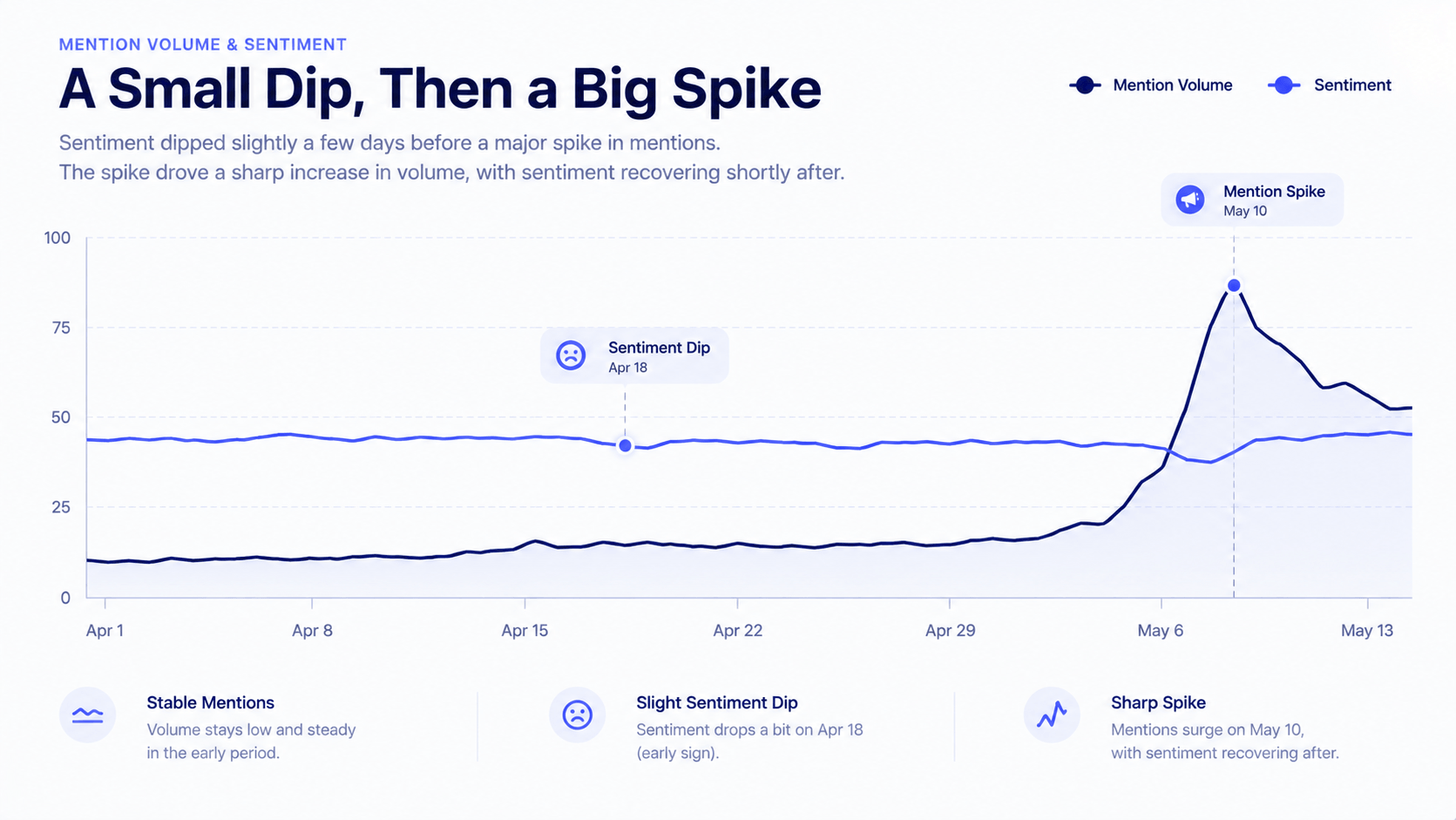
A share of voice number tells you how your brand's mentions stack up against named competitors. A sentiment score tells you whether those mentions lean positive or negative. Neither one answers a simpler, earlier question: are more people, across more places, encountering and talking about your brand than they were six months ago, regardless of what your competitors are doing or how anyone feels about it. That is awareness, and it needs its own measurement approach built from the same mention data you are probably already collecting. This guide covers the proxy metrics that turn raw mention data into an awareness signal, how to build a baseline worth tracking, and where mention data reaches its limit and a survey has to fill the gap.
- Awareness measures reach and recognition, not competitive ratio or tone. A brand can lead on share of voice, sentiment, or awareness in any combination, and conflating the three produces a report that answers the wrong question.
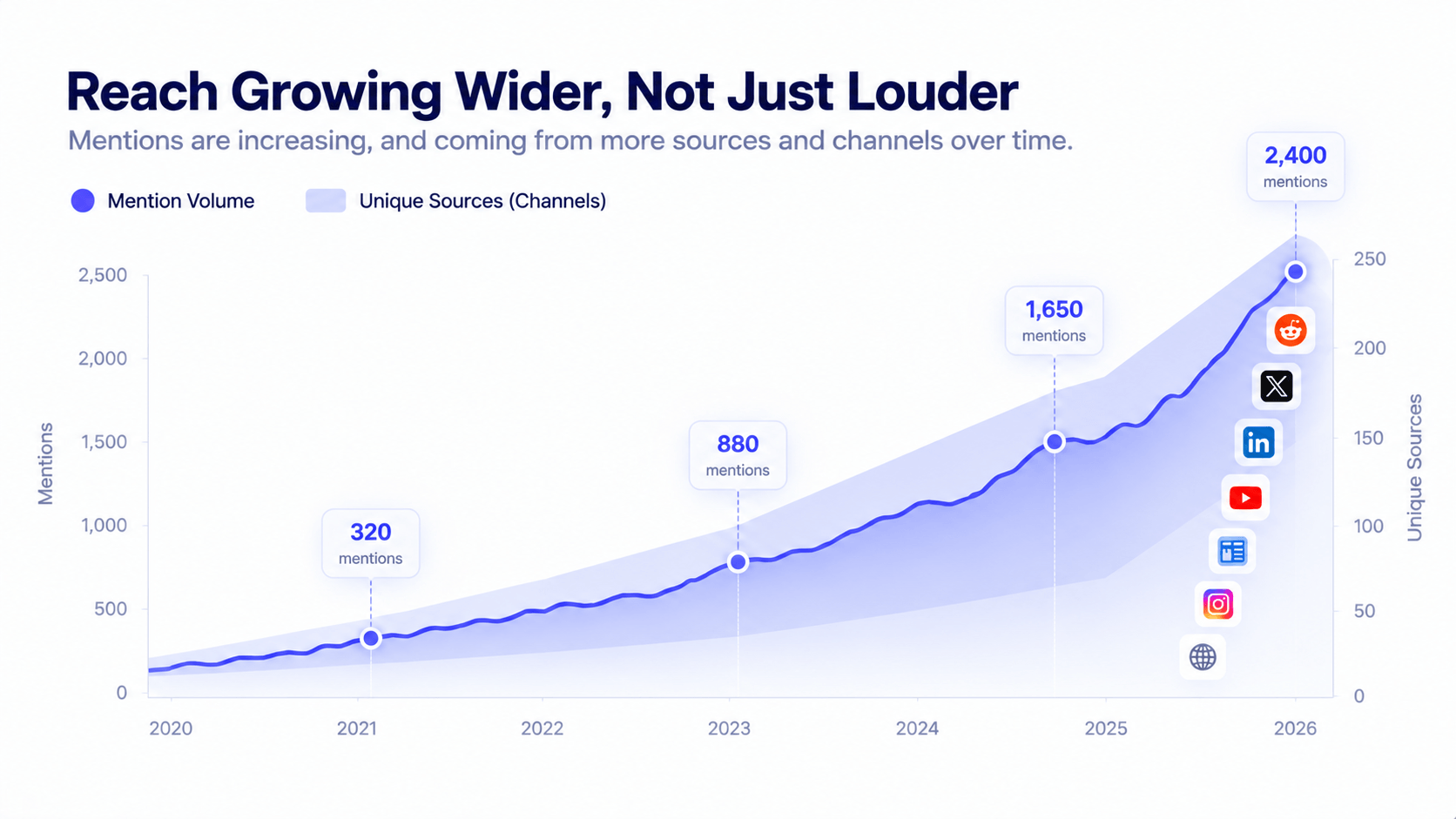
- Raw mention volume alone is a weak awareness proxy. Unique source count, the unbranded-to-branded ratio, and spontaneous mention rate each capture something volume misses on its own.
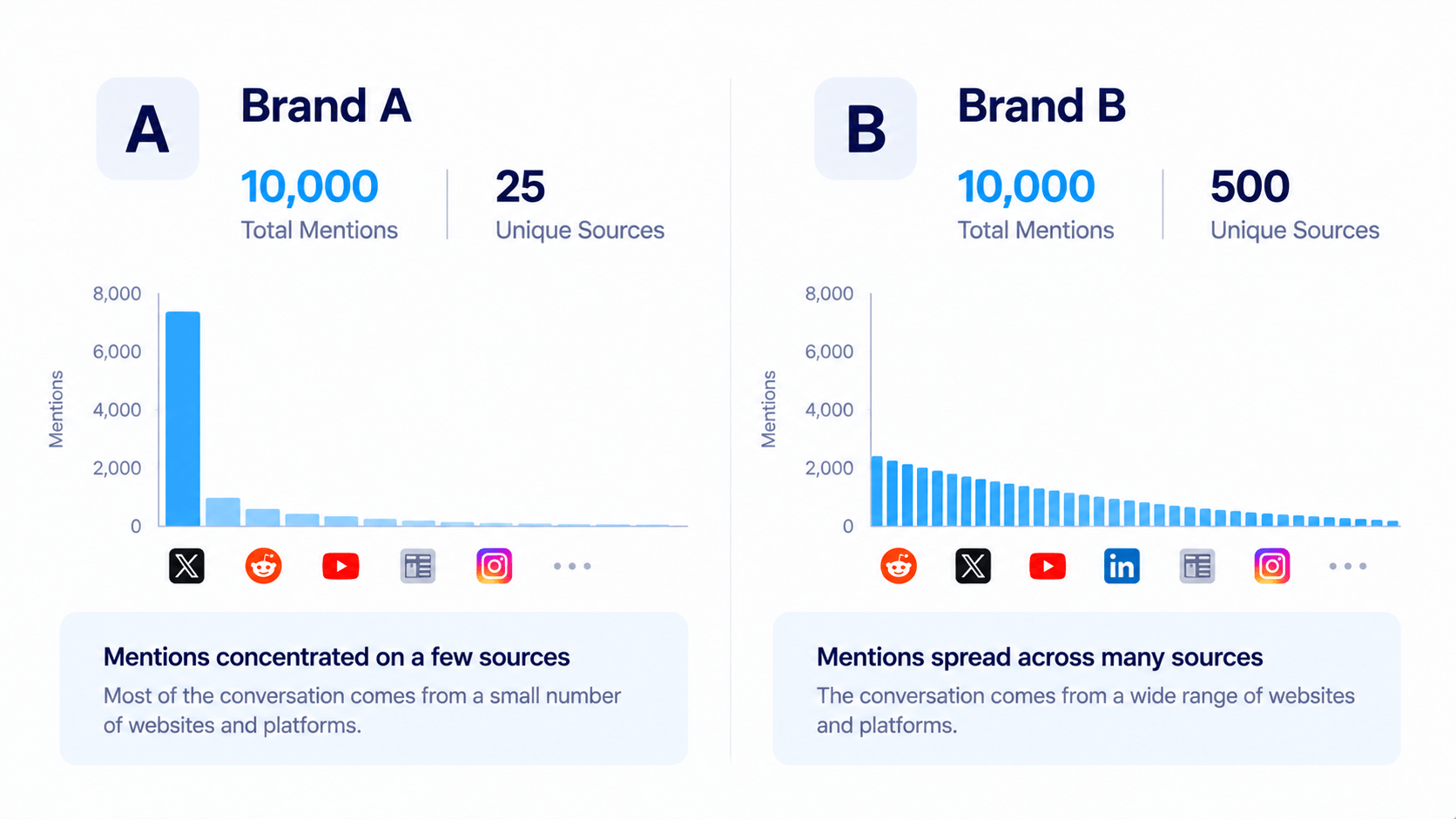
- Channel and platform breadth matters as much as total count. A brand mentioned 500 times on one forum has a narrower footprint than one mentioned 200 times spread across a dozen distinct communities.
- AI answer engines add a new awareness surface. Being named in an unprompted category answer is a recognition signal that behaves differently from being named because someone searched for you directly.
- Mention data proxies unaided recall well and can't fully replace it. A quarterly or biannual survey remains the honest source for whether a category buyer names your brand from memory with no prompt at all.
Why awareness needs a metric of its own
Three mention-based questions get asked in nearly every brand review, and they get treated as one question far too often. How much are we talked about relative to competitors is a share of voice question. How do people feel when they talk about us is a sentiment question. How many people, across how many places, are even aware we exist to talk about is an awareness question, and it stands apart from the other two on purpose.
A small, sharply positioned challenger brand can post a strong share of voice within a narrow niche while still having low overall awareness outside that niche, because the denominator in a share of voice calculation is the competitive category, not the addressable market. A brand recovering from a rough product launch can carry weak sentiment while awareness keeps climbing, because more people are talking about it, just not always kindly. Treating these as one blended "brand health" number hides exactly the kind of divergence a team needs to see to know which lever to pull. A growth team staring at flat pipeline needs to know whether the problem is that too few people know the brand exists, or that the people who do know it have an unresolved complaint. Mention volume and reach answer the first question. Sentiment answers the second. They are rarely the same fix.
Mention data is not a replacement for a proper brand awareness survey, and this guide does not claim it is. What it offers instead is a continuously updating proxy, measured weekly or monthly instead of once or twice a year, that tells a team directionally whether the addressable audience talking about the category is including their brand more or less often than it used to.
Four mention-data proxies for awareness
Total mention count on its own is the weakest version of this measurement, since a single viral thread can spike volume for a week without reflecting any real change in how widely known the brand actually is. Four proxies, used together, give a fuller picture.
1. Unique source count. Count distinct authors, publications, or accounts mentioning the brand in a period, alongside total mentions. A hundred mentions from forty unique people signals broader reach than a hundred mentions from six people posting repeatedly in the same thread. This single adjustment catches the most common way raw volume misleads: a small, engaged group talking a lot looks identical to broad awareness in a total-count view and looks completely different once counted by unique source.
2. Unbranded to branded mention ratio. Unbranded mentions describe the problem or category without naming any specific brand ("looking for a tool that tracks what people say about us online"). Branded mentions name a specific company. Tracking how often unbranded category conversation eventually turns branded, and specifically how often it turns into a mention of your brand rather than a competitor's, is a more honest awareness signal than branded volume alone, because it shows the brand entering conversations that did not start out about anyone in particular. See branded versus unbranded mention tracking for how to set up this classification.
3. Spontaneous mention rate. A spontaneous mention is one that happens without the brand prompting it: nobody ran an ad, nobody sent an email, nobody posted asking for recommendations and got the brand named in a reply thread that started as something else entirely. Filter out mentions that are direct replies to owned content or paid placements, and what remains is closer to genuine unaided recall than any other mention-based number, since it captures someone reaching for the brand name on their own rather than in response to being shown it.
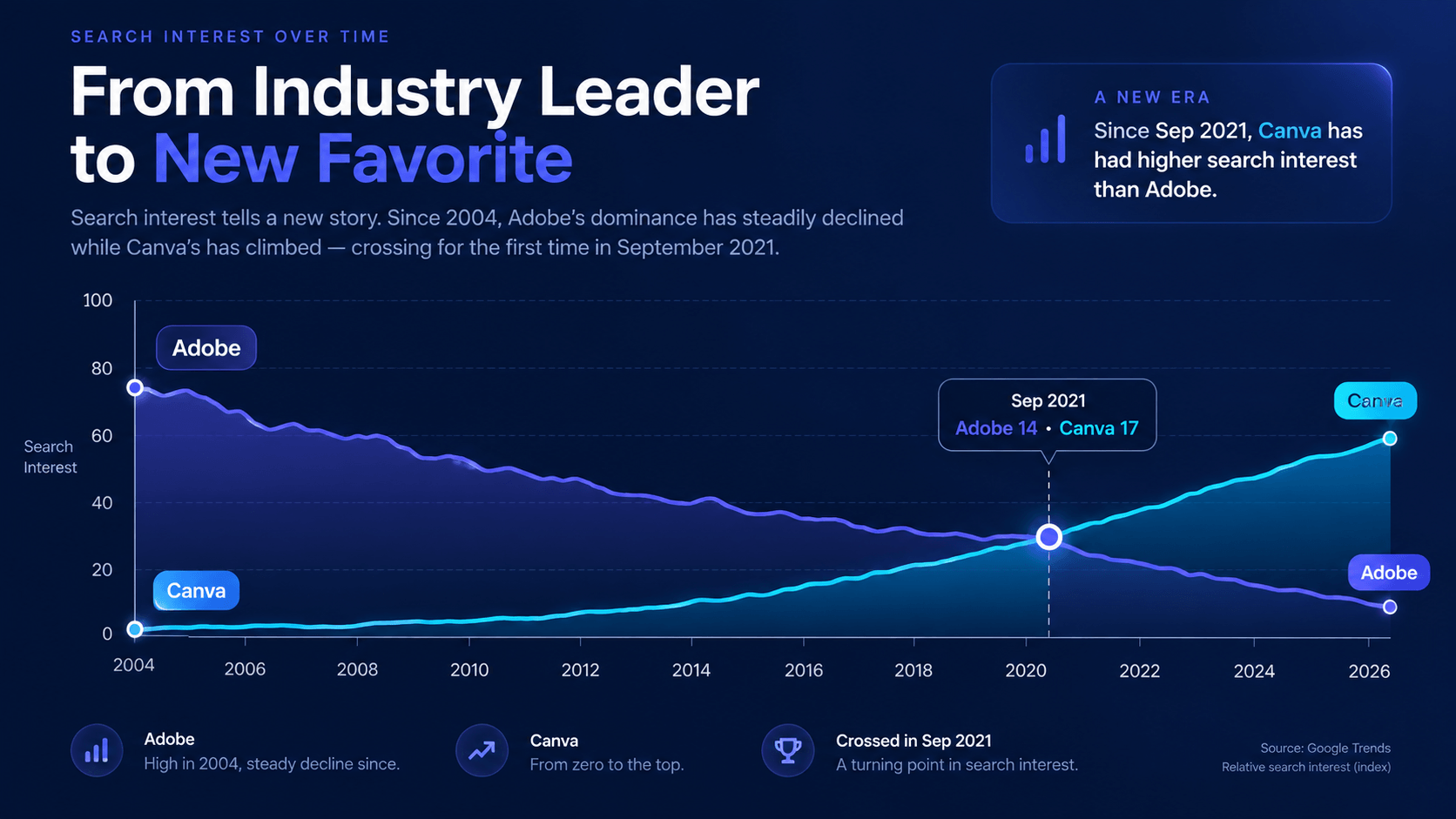
4. Share of search. Branded search volume, tracked over time through a tool like Google Trends, moves closely with real-world awareness because searching a brand name by itself is one of the purest unprompted awareness signals available at scale. Share of search compares your branded search volume against the combined branded search volume of named competitors, using the same category-total logic as share of voice but applied to search interest instead of mention counts. A rising share of search alongside rising unique source count is one of the stronger combined awareness signals mention data can produce without running a survey.
| Proxy | What it catches that volume misses | Best cadence |
|---|---|---|
| Unique source count | A small group posting repeatedly, versus real breadth of reach | Monthly |
| Unbranded to branded ratio | Whether category conversation is starting to include the brand by name | Quarterly |
| Spontaneous mention rate | Mentions triggered by owned content, versus genuinely unprompted recall | Monthly |
| Share of search | Passive attention that never produces a public mention at all | Monthly |
A hundred mentions from forty different people is a wider footprint than a hundred mentions from six people, and total volume alone cannot tell the two apart.
A worked example across two quarters
A mid-market project management tool pulls its Q1 and Q2 mention data to check whether a new content push actually moved awareness rather than just mention volume. Q1: 1,800 total mentions, 620 unique sources, 340 unbranded-to-branded conversions, and a spontaneous mention rate of 41%. Q2: 2,100 total mentions, 950 unique sources, 510 unbranded-to-branded conversions, and a spontaneous mention rate of 52%.
Total volume grew a modest 17% quarter over quarter, a number that alone would read as decent but unremarkable. Unique source count grew 53%, unbranded-to-branded conversions grew 50%, and the spontaneous share of all mentions grew 11 percentage points. Read together, the volume figure understates what actually happened: the brand got talked about by a meaningfully wider set of people, beyond simply being mentioned slightly more, more often without being prompted, and more often as the answer to an open-ended category question. That is a real awareness gain that a volume-only report would have significantly undersold.
The same data would tell a different story if unique sources had stayed flat while total volume rose 17%, which would point instead toward a smaller, more engaged group posting more, a sign worth investigating rather than celebrating, since it can mean the same handful of advocates carrying more of the conversation rather than the audience actually widening.
Building a baseline worth tracking
Pick a fixed lookback window, a full quarter works well for awareness specifically since month-to-month swings in unique source count are noisier than share of voice or sentiment tend to be, and hold that window constant every time the four proxies get pulled. Running the first quarter's numbers alone establishes nothing; the value shows up starting with the second comparison point, and compounds from there.
Decide which name variants count before the first pull, exact brand name, common misspellings, and any product names people use interchangeably with the brand, and apply that same list every quarter. A baseline built on an incomplete name list in quarter one and a corrected list in quarter two will show an awareness jump that is really just a measurement fix, which is one of the more common false positives a team runs into with this kind of tracking.
Segment the baseline by individual platform where volume allows it. A brand growing unique sources on Reddit and forums while staying flat on X or news coverage has a specific, actionable awareness story: the growth is coming from community-driven discovery rather than press or paid reach, and that distinction should shape where the next quarter's investment goes. Early-stage teams in particular benefit from this segmentation, since awareness at that stage is almost always concentrated in one or two channels rather than spread evenly, and a blended total number hides exactly where the real traction is.
Where AI answer engines fit
A growing share of category research now happens inside a ChatGPT, Gemini, or Perplexity conversation instead of a traditional search results page, and being named in one of those answers without the user asking for the brand by name is a distinct awareness signal worth tracking separately from web mentions. The mechanics differ meaningfully from a standard mention: an answer engine response can name one brand, several, or none, and the same open-ended category question run today and run again next month can return a different set of brands entirely as the underlying models update.
Run a fixed set of unprompted category questions, ones that never mention any brand by name, through the major engines on a consistent schedule and track how often your brand appears unprompted in the response. This is functionally the AI-era version of unaided recall: a real buyer typing "best tools for tracking what people say about my company" into an AI assistant and getting your brand named back without ever having searched for it directly is about as close to genuine unprompted awareness as mention data gets. AI visibility tracking automates this specific pull, since running the same query set by hand across three engines every month is not a realistic ongoing process for most teams. For the mechanics of getting picked up in these answers in the first place, see how to get mentioned by ChatGPT. Run the same query set through the free AI visibility audit tool to see where the brand currently stands before setting up ongoing tracking.
Where mention data reaches its limit
Mention data only captures people who said something publicly, and the overwhelming majority of people who know a brand and could name it if asked never post about it at all. A category buyer who recognizes your logo, has seen your ads, and would list your brand third if asked to name every tool in the space leaves no trace in mention data whatsoever unless they happen to post about it, which most people never do for most brands they know.
This is the honest gap between a mention-based proxy and true survey-measured awareness, and it is not a gap mention data can close on its own no matter how many proxies get layered on top of it. A quarterly or twice-yearly unaided and aided recall survey, run against a sample of real category buyers, remains the most direct way to measure what mention data can only approximate. The two are complementary rather than substitutes: mention data gives a continuously updating directional read between survey waves, and the survey periodically corrects and grounds whatever the mention-based proxies have been suggesting.
Frequently asked questions
Is share of search a good substitute for a full awareness survey?
No, though it is one of the stronger single proxies available. Share of search captures active, deliberate lookups and tends to move closely with real awareness trends over time, but it misses the large group of people who recognize a brand passively, through an ad, a friend's recommendation, or a logo seen in passing, without ever typing the name into a search bar. Use it as a leading indicator between survey waves, not as the final word on where awareness stands.
How often should these four proxies actually be pulled and reviewed?
Monthly for unique source count, spontaneous mention rate, and share of search, since all three have enough natural volume to move meaningfully within a single month for most mid-size and larger brands. Quarterly for the unbranded-to-branded ratio, since that classification requires more manual review per mention and produces a steadier, more reliable read when measured over a longer window rather than chased on a monthly basis. Smaller brands with lower overall mention volume should default to quarterly across all four to avoid reading real signal into what is often just normal month-to-month noise.
What counts as a spontaneous mention versus a prompted one?
A spontaneous mention happens inside a conversation that did not start out about the brand. A prompted mention is a direct reply to the brand's own content, ad, or outreach. Spontaneous mentions come closest to genuine unaided recall.
Does a high mention volume with a low unique source count mean anything bad?
Not automatically, but it is worth investigating rather than reporting as a win. It often means a small, genuinely engaged community talking about the brand often, which is valuable in its own right, particularly early on. The risk is presenting that pattern as broad awareness growth when it is really depth within a narrow group. Reporting both numbers side by side, rather than volume alone, keeps that distinction visible to whoever is reading the results.
How does this awareness tracking connect to a broader brand monitoring program?
The four proxies in this guide sit on top of the same underlying mention feed a team already needs for general brand monitoring, sentiment tracking, and competitor comparisons, so building awareness measurement does not require a separate data collection effort. What it requires instead is classifying and grouping the existing feed differently: by unique source, by branded-versus-unbranded framing, by whether a mention was prompted, and by search interest pulled from a separate source entirely. A team already running a structured social listening program can typically add awareness tracking as a new report against data it is already collecting rather than standing up a new pipeline from scratch. Teams still building that foundational program should start there first, since awareness measurement without a solid mention-collection process underneath it is measuring noise.
Awareness is a reach and recognition question, and it deserves numbers built to answer exactly that, separate from how those mentions compare to competitors and separate from their tone. Pull unique source count, the unbranded-to-branded ratio, spontaneous mention rate, and share of search on a fixed cadence this quarter, and treat unprompted AI answer mentions as a fifth proxy worth watching as that surface keeps growing. Layer a periodic survey on top when the budget allows it, and the mention-data proxies in between will keep the trend line current without waiting a year to check it.
Track awareness the way this guide describes, automatically
Mentient tracks unique sources, unbranded-to-branded conversion, and AI answer engine mentions in one place, so the proxies in this guide update themselves every month.
Start free trial