Brand monitoring used to mean watching your own turf. You set a Google Alert, checked X a few times a day, and skimmed the review sites once a week. That model is done. In 2026 the conversation that decides your reputation happens in rooms you do not own, and most of it never touches a page you can see in your analytics. AI answers summarize you before a buyer visits your site. Reddit threads rank for your brand name. The single most useful brand monitoring trend to understand this year is that the surface most teams still track has become the least representative one.
Here is what the data showed when we mapped where brand conversations live now, and what it means for the way you measure them.
- ✓Search interest in "brand monitoring" rose roughly 20x from early 2024 to mid-2026, and "generative engine optimization" went from a term almost nobody searched to a mainstream query, per Google Trends data via DataForSEO.
- ✓Reddit is now the most-cited source across ChatGPT, Google AI Overviews, Gemini, and Perplexity, according to a Semrush study of AI citations. If you are not tracking community threads, you are missing the layer AI reads from.
- ✓73% of B2B decision-makers trust peers over vendor sites, search engines, and AI chatbots, based on SurveyMonkey and Reddit research covering 1,202 buyers.
- ✓92% of marketers plan to optimize for AI search, yet only 40.6% do it today and just 16% systematically track it, per Omnibound's GEO statistics. The measurement gap is the real story.
- ✓The social listening market sits near $11.9 billion in 2026 and is on track to roughly double by 2031 (Mordor Intelligence), even as the phrase "social listening" loses search volume.
What brand monitoring means in 2026
Brand monitoring is the practice of tracking every public reference to your company, product, or executives across the open web, and turning those references into something you can act on. It overlaps with three neighbors worth separating cleanly. Social listening looks at aggregate conversation and mood across social platforms. Brand mentions are the individual data points, a single Reddit comment or news line. Share of voice compares your volume of conversation against named competitors over a set window.
The definitions have not changed much. Where the mentions live has changed a lot.
For a decade the assumption held that most brand conversation happened on the big social networks and could be caught with keyword rules. Two shifts broke that. Public posting migrated into semi-private communities and forums, and a new reader entered the picture: large language models that summarize the web for people who never click through. So a modern brand monitoring stack has to watch Reddit, niche forums, news, blogs, and the answers that ChatGPT, Perplexity, and Google's AI Overviews generate about you.
The search demand for the category tells the story on its own. Interest in "brand monitoring" as a query was essentially flat for four years, then re-rated sharply from mid-2025 as AI search forced the issue.
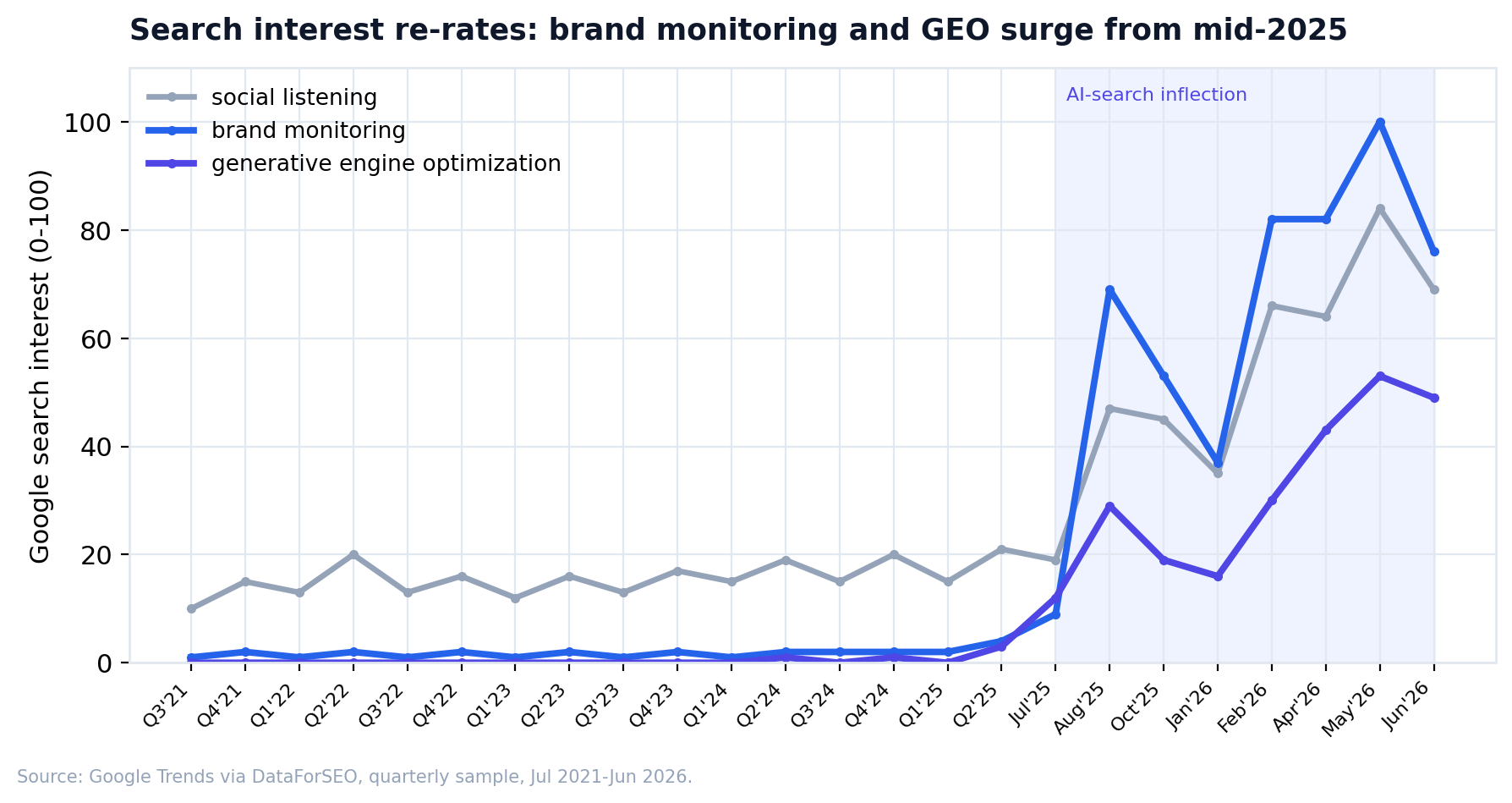
That inflection is not a coincidence of timing. It lines up with the quarter AI search became a daily habit rather than a novelty, which is where the first trend starts.
Trend 1: The conversation moved into AI answers
The biggest change to brand monitoring in 2026 is that a machine now reads about your brand and answers on your behalf. ChatGPT passed 900 million weekly active users in early 2026. Around 37% of consumers now begin a search with an AI tool rather than a traditional engine, and Google's AI Overviews show up on an estimated 30 to 40% of all search queries. When someone asks "what's the best brand monitoring tool for a B2B team," the answer they read is assembled by a model, from sources you may never have audited.
This gave rise to generative engine optimization, or GEO, the work of getting your brand cited accurately inside AI-generated answers. GEO diverges from SEO in a way you can measure. The overlap between the pages that rank in Google's top organic results and the sources AI engines cite has dropped from about 70% to below 20%. Four out of five sources feeding the AI answer about your category are not the pages you optimized for classic search.
AI-referred sessions were up 527% year over year heading into 2026. The traffic is small today and growing faster than any channel we track.
There is a monitoring problem hiding inside the marketing opportunity. If a model tells thousands of buyers something outdated or wrong about your pricing, your security posture, or a discontinued product, that is a reputation event with no notification attached. Traditional tools never see it, because nothing was published and nobody linked to you. Watching how ChatGPT, Perplexity, Claude, and AI Overviews describe your brand, and how that description shifts month to month, is now part of the job.
Trend 2: Reddit and communities became the discovery layer
Ask why AI answers matter so much and you land on Reddit. Across ChatGPT, Google AI Mode, Gemini, Perplexity, and AI Overviews, Reddit is the most-cited source, with YouTube, LinkedIn, Wikipedia, and Forbes filling out the top five. In Google's AI Overviews specifically, the top five domains account for 38% of all citations, and Reddit sits near the top because it captures unscripted user experience the models treat as trustworthy.
Buyers moved the same direction the models did. In the SurveyMonkey and Reddit study of 1,202 US decision-makers, 73% said they trust peers above vendor websites, search engines, review sites, and AI chatbots. Reddit specifically pulled 23% of decision-makers into research, rising to 32% among software buyers.
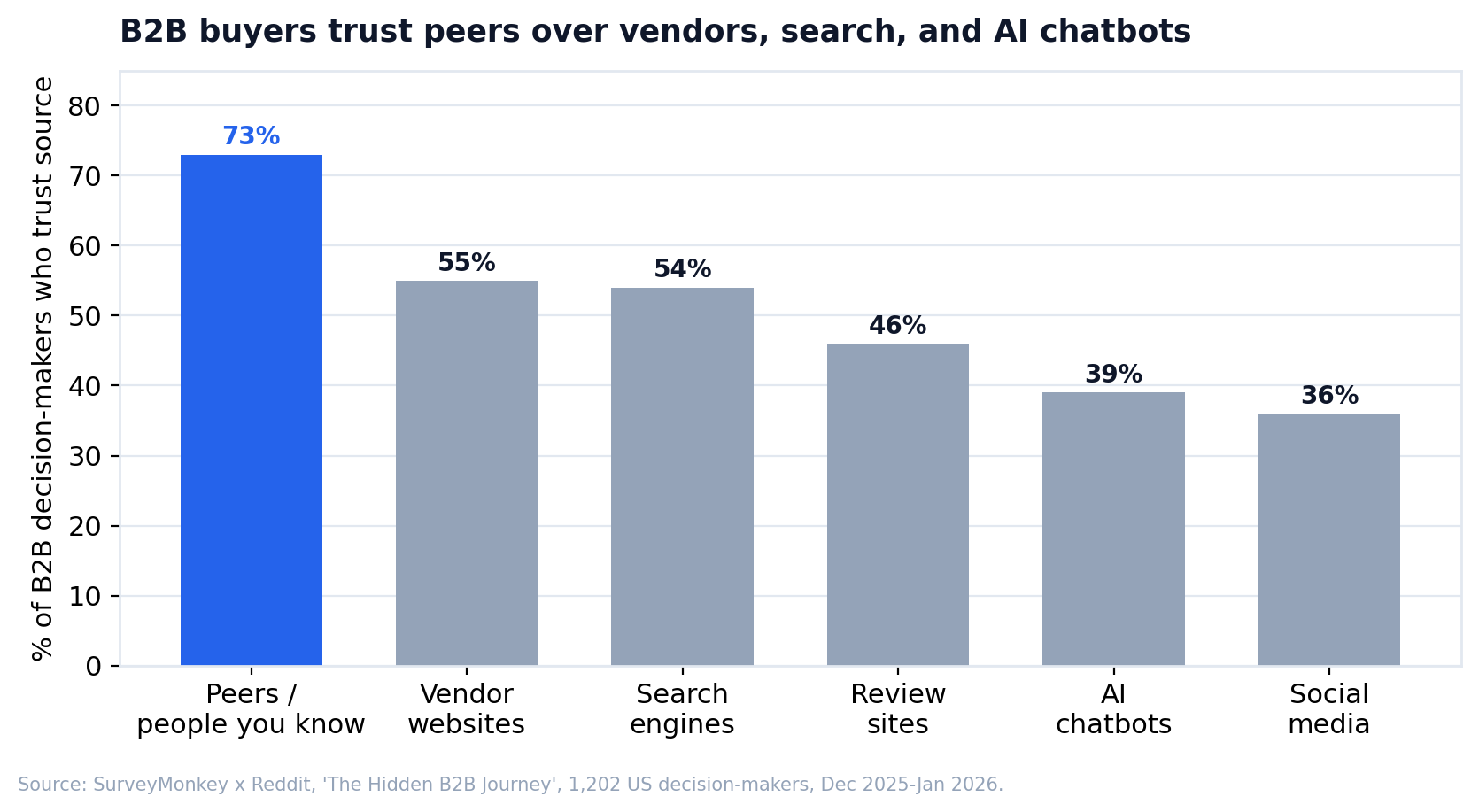
The pattern under those numbers is the one that should reshape your monitoring coverage. 83% of decision-makers complete their research through peer communities and self-directed search before they ever talk to your sales team. By the time a lead fills out a form, the opinion is mostly formed, and it was formed in threads you were not reading. A brand monitoring program that covers X and news but skips Reddit and niche forums is watching the smaller half of the room.
Coverage of communities is harder than it sounds. Reddit alone runs tens of thousands of active subreddits, and the mention that matters is often a buried comment rather than a titled post. This is where automated crawling across every subreddit, not a hand-picked few, stops being a nice-to-have.
Trend 3: Sentiment analysis grew up
Older sentiment scoring counted words. A post with "not bad, solved our problem in a day" would get flagged negative for the word "not," and a sarcastic "oh great, another outage" would sail through as positive. For years that noise was tolerated because nothing better scaled.
Language models changed the accuracy ceiling. Modern sentiment analysis reads a mention the way a person would, weighing context, sarcasm, and intent instead of matching a lexicon. A tool built on a model like Anthropic's Claude can tell the difference between a customer venting mid-crisis and a competitor's astroturf, and it can flag the one comment in a calm thread that signals a churn risk. That precision matters most in the moment a story is about to break, when a five-minute head start on a negative spike is the difference between a quiet fix and a public one.
Two capabilities separate a 2026 sentiment stack from a 2020 one. It has to score nuance rather than keywords, and it has to escalate the urgent mention automatically instead of burying it in a weekly digest. Crisis detection, the automatic monitoring of negative spikes, is now a standard expectation rather than an enterprise add-on.
Trend 4: The measurement gap nobody is closing
The number that surprised us was this one. Intent to adapt is nearly universal, and execution is not close. 92% of marketers say they plan to optimize for AI search, but only 40.6% are doing it, and just 16% systematically track their AI-search performance, drawing on Omnibound's data and McKinsey's 2025 CMO survey.
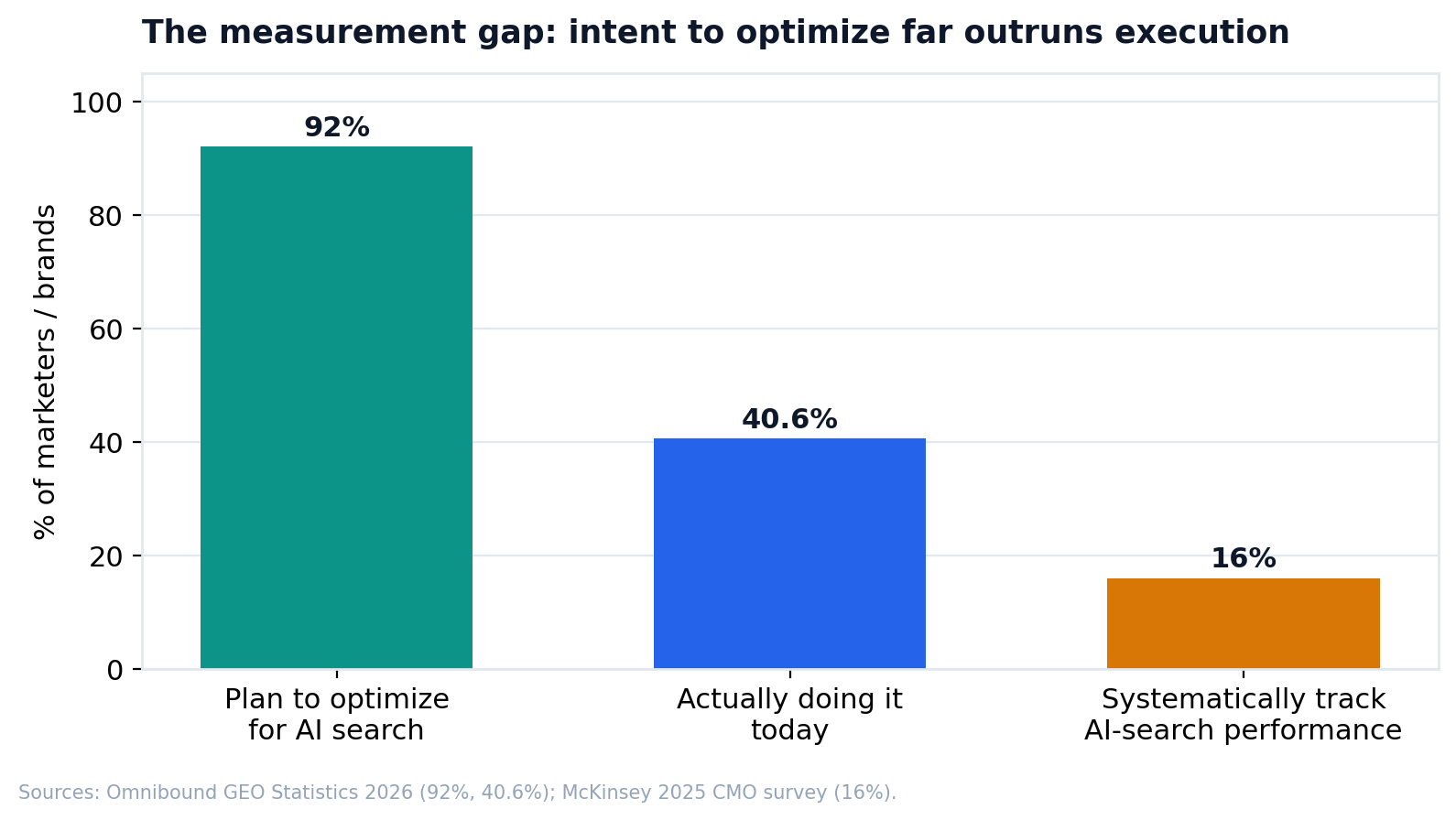
A gap this wide is a competitive opening. The teams that build a measurement loop now, tracking how often and how accurately AI engines cite them against named competitors, will have a year of baseline data before the laggards start. The teams that wait will be optimizing blind, guessing at whether a content change moved their standing inside ChatGPT because they never recorded where they began.
Measurement is also the part buyers quietly reward. In the same B2B research, the top obstacles buyers named were finding real user testimonials and parsing vendor-provided information. A brand that knows exactly what the communities and the models are saying about it can answer those doubts with specifics. A brand that is guessing cannot.
Trend 5: The market doubles while the old label fades
The category is growing even as its most familiar name loses ground. The global social listening market sits near $11.9 billion in 2026 and is forecast to roughly double by the early 2030s, with Research and Markets putting it around $22.6 billion by 2030 on a mid-teens growth rate.
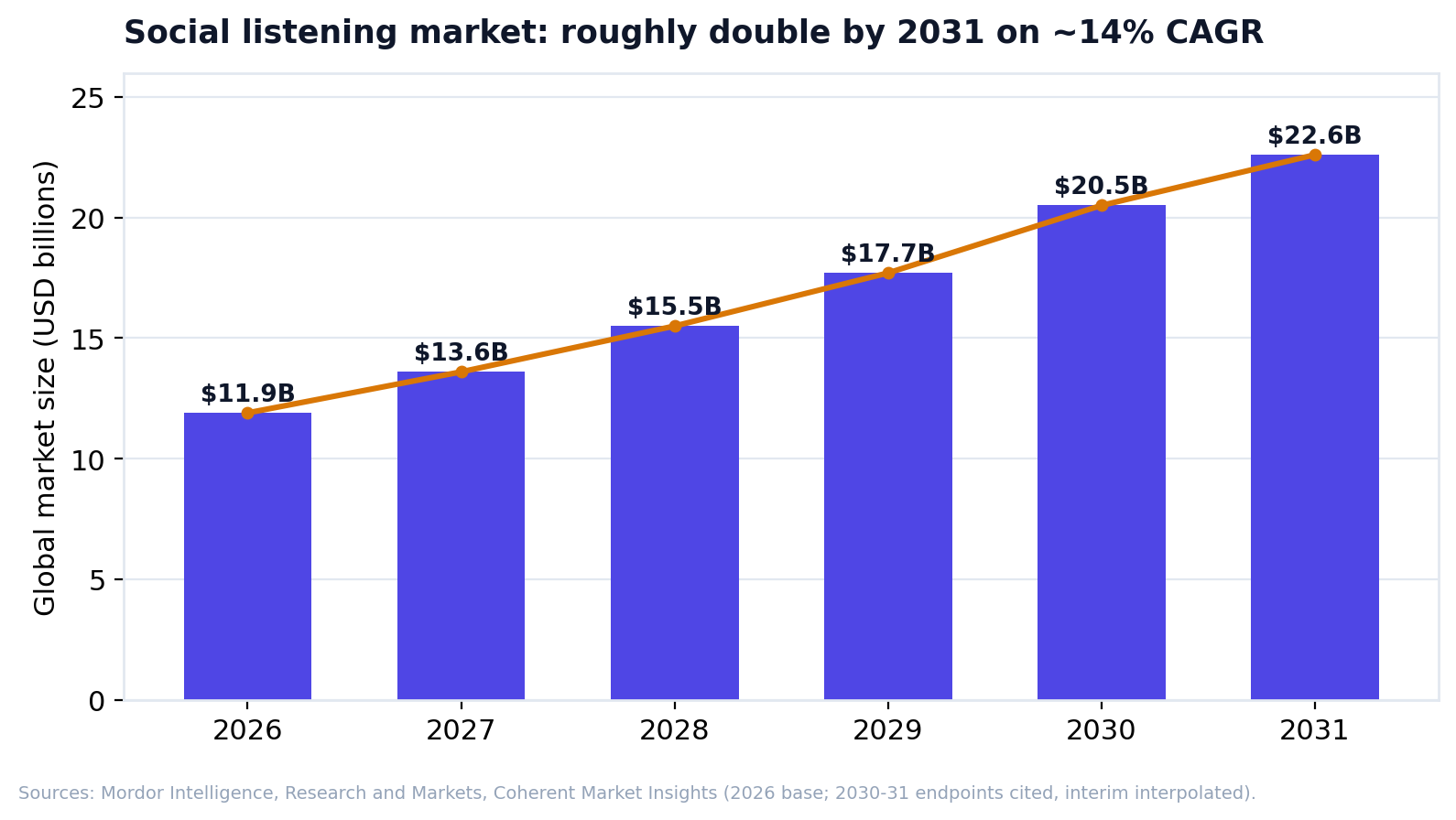
Search demand for the old label is moving the other way. "Social listening tools" as a query is down more than half year over year in our DataForSEO pull, while "ai brand visibility" is up several hundred percent off a small base. The spend is rising and the vocabulary is shifting toward AI, monitoring, and visibility. If you are budgeting against a category called social listening, you may be underfunding the part of it, AI answer tracking, that is growing fastest.
The US market for GEO specifically is projected to reach $365.4 million in 2026 at a 42.9% growth rate. That is a new line item most 2024 budgets did not have.
What to run on Monday
You do not need a new department to respond to this. You need to widen coverage and add one measurement loop. Our default play here has four moves.
First, extend monitoring past social and news into Reddit and the forums where your category argues. Track your brand, your top three competitors, and the two or three problem phrases your buyers use before they know your name.
Second, run a monthly AI-visibility check. Ask ChatGPT, Perplexity, Gemini, and Google's AI Overviews the ten questions a buyer would ask in your category, record whether you appear, in what context, and against whom, and save the answers. The delta month over month is your GEO scoreboard.
Third, route sentiment through a model that reads context, and wire the urgent negatives to a channel a human watches, not a report nobody opens until Friday.
The table below sets the old approach against the one the data now supports.
| Dimension | Brand monitoring, 2020 | Brand monitoring, 2026 |
|---|---|---|
| Primary surface | Owned social, review sites | Reddit, forums, AI answers |
| Who reads about you | People on your channels | People, plus AI models citing sources |
| Sentiment method | Keyword and lexicon scoring | Context-aware model scoring |
| Discovery timing | After publication | Before the buyer contacts sales |
| Key metric | Mention volume, share of voice | AI citation rate and accuracy vs competitors |
| Biggest blind spot | Missed platforms | Untracked AI answers |
Run the AI-visibility check against your own category this week and compare where you land versus the competitor you worry about most. The gap you find is your roadmap.
FAQ
What is the difference between brand monitoring and social listening in 2026?
Brand monitoring tracks individual references to your brand across the whole web and turns them into alerts you act on. Social listening reads the aggregate mood and themes across social conversation. In practice most teams need both, plus a newer layer, AI answer tracking, that neither term originally covered.
Why does Reddit matter so much for brand monitoring now?
Reddit is the most-cited source across the major AI engines, per Semrush, and 32% of software buyers use it directly for research. That makes Reddit both a place buyers form opinions and a place AI models pull from when they answer questions about you. Skipping it leaves a real hole.
What is generative engine optimization, and is it just SEO?
GEO is the work of getting your brand cited accurately in AI-generated answers from tools like ChatGPT and Perplexity. It diverges from SEO in practice. The overlap between top Google rankings and AI-cited sources has fallen below 20%, so the pages that win classic search often are not the ones the models quote.
How do you track what AI engines say about your brand?
Pick the ten questions a buyer asks in your category, run them through ChatGPT, Perplexity, Gemini, and Google's AI Overviews on a set schedule, and log whether you appear, in what context, and against which competitors. Save every answer so you can measure the change after you publish new content. A tool that automates this saves the manual re-checking.
Is AI-driven sentiment analysis accurate enough to trust?
It is far better than the keyword scoring it replaced, because a language model reads sarcasm and context instead of matching words. It is not perfect, so the sensible setup uses model scoring to triage and prioritize, then puts a human on the small set of flagged high-stakes mentions. That combination catches a negative spike early without drowning the team in false alarms.
How much should a mid-market team budget for this in 2026?
The category is growing fast, and the new spend is concentrated in AI visibility rather than legacy social tooling. Most mid-market teams can start with one monitoring platform that covers Reddit, web, and AI answers together, rather than stitching three tools. Fund the AI-answer tracking piece deliberately, since that is the surface growing fastest and the one competitors are most likely to ignore.