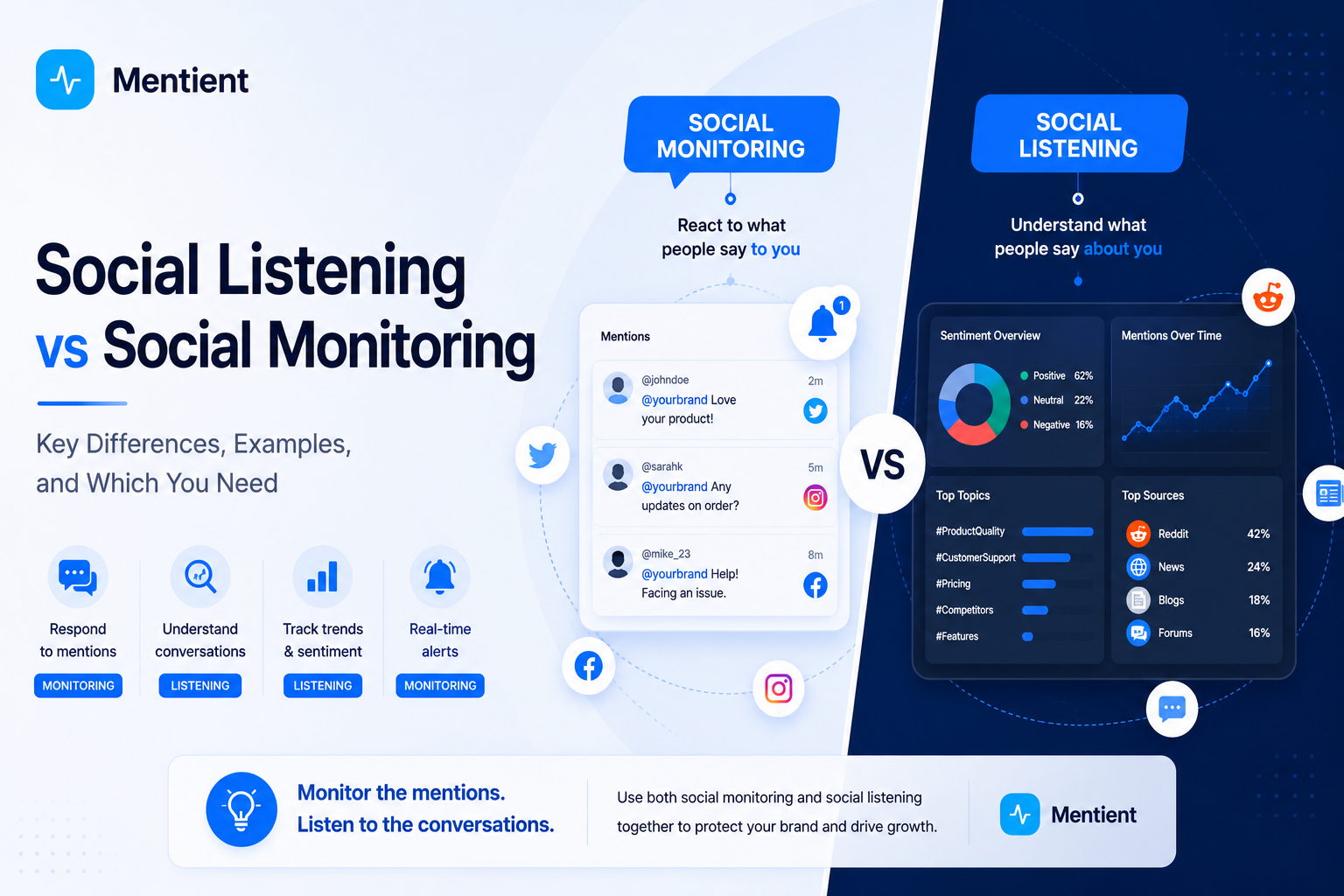
Social listening and social monitoring get used as if they mean the same thing. They do not, and mixing them up leaves you with a team that responds fast but never learns, or one that produces insights nobody acts on in time. The short version: social monitoring is reactive and handles the mentions aimed at you, while social listening is proactive and studies the wider conversation about you and your market. This guide covers the difference in plain terms, with a side-by-side table, real examples of each, and a straight answer on which one you need first.
- ✓Monitoring responds; listening analyzes. Monitoring reacts to individual mentions; listening studies the whole conversation.
- ✓Monitoring is micro, listening is macro. Monitoring watches individual @mentions; listening watches sentiment and trends.
- ✓Different owners. Monitoring usually sits with support; listening with marketing and product.
- ✓You need both. Monitoring handles the tagged mentions; listening catches the untagged majority.
- ✓Start with your pain. Reputation and support issues call for monitoring first; strategy questions call for listening.
Social listening vs social monitoring: the short answer
Social monitoring is the reactive practice of tracking and responding to direct mentions of your brand, like tags, comments, and replies aimed at your accounts. Social listening is the proactive practice of analyzing the broader conversation about your brand, industry, and competitors to spot patterns and inform strategy. Monitoring is micro and answers what needs a reply now, while listening is macro and answers why people feel the way they do.
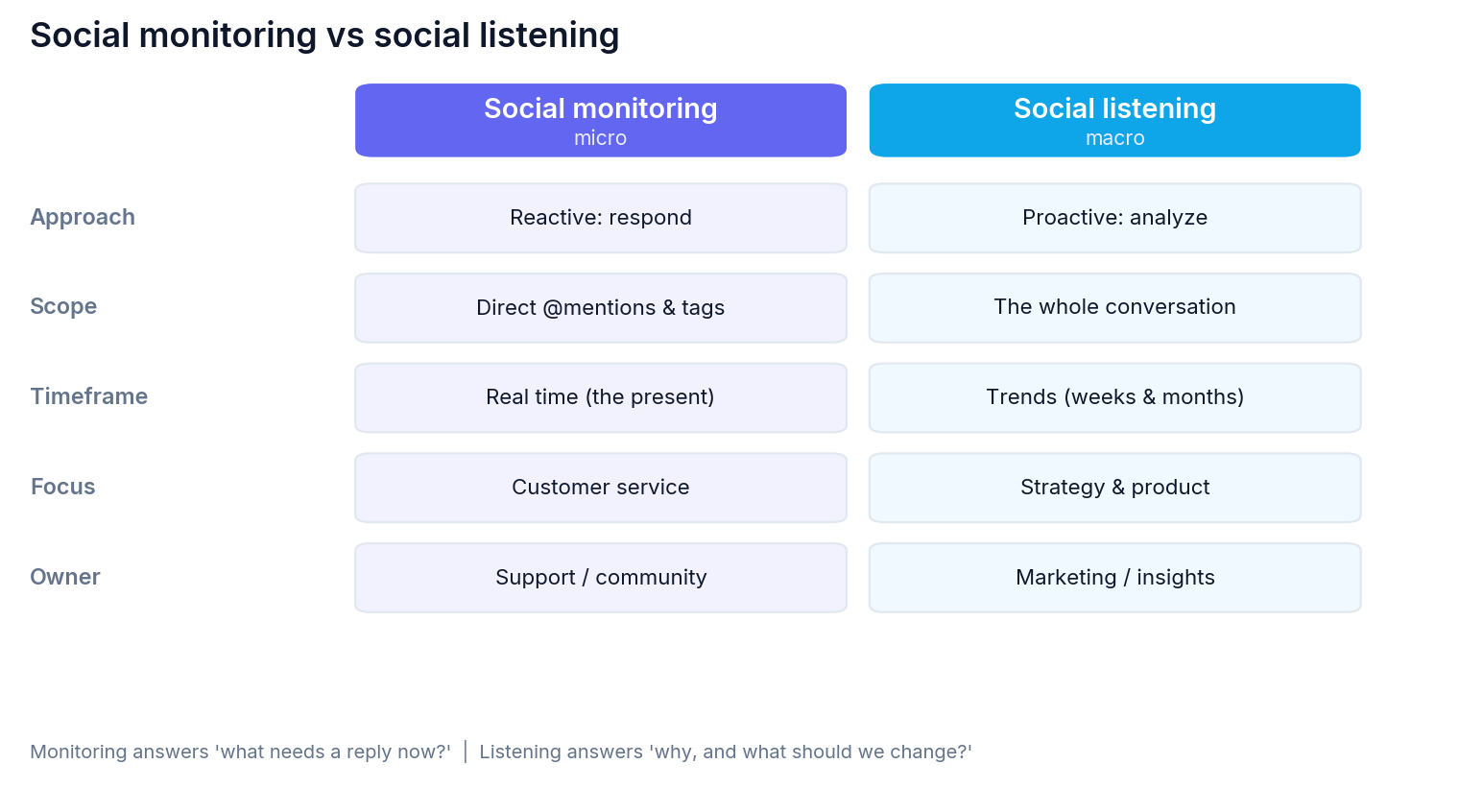
Here is the split in one table, which the rest of this guide unpacks.
| Dimension | Social monitoring | Social listening |
|---|---|---|
| Approach | Reactive: respond to what comes in | Proactive: analyze what it means |
| Scope | Direct @mentions, tags, and keywords | The whole conversation, including untagged posts |
| Timeframe | Real time, the present | Trends over weeks and months |
| Focus | Customer service and response | Strategy, product, and positioning |
| The question it answers | What needs a reply right now? | Why are people saying it, and what should we change? |
| Usual owner | Support or community team | Marketing, insights, or product |
| Output | Fast replies and saved relationships | Reports, decisions, and roadmap input |
What is social monitoring?
Social monitoring, also called social media monitoring, is the real-time tracking of direct mentions so you can respond. It watches the tags, comments, replies, and DMs aimed at your accounts, plus the specific keywords you set, and its whole point is speed. Someone complains, you see it, you reply before the thread grows.
It is the customer-service and reputation layer of your social presence. A good monitoring setup keeps response times low and stops small problems from becoming public ones. The limit is built into the definition: monitoring only ever shows you the mentions people chose to send you directly, which is the smallest and most polite slice of what is being said.
What is social listening?
Social listening is the analysis of the broader conversation, whether or not it tags you. It pulls in the untagged posts, the Reddit threads, the reviews, and the industry chatter, then looks for patterns: sentiment shifts, recurring complaints, emerging topics, and how your share of voice compares to competitors.
Where monitoring reacts to a single mention, listening steps back to read the room. It answers the strategic questions, such as whether buyers prefer one feature over another, why sentiment dipped after a launch, or which competitor keeps coming up in switching conversations. Modern sentiment models help here; they now reach 93% precision on binary sentiment tasks (Mordor Intelligence), enough to sort thousands of mentions into a trend you can act on. If you want the full workflow, our step-by-step social listening guide covers the setup end to end.
The key differences
The table above is the summary. The differences underneath it come down to five things.
Approach. Monitoring is reactive, waiting for a mention and responding. Listening flips that, studying the conversation to get ahead of it. This is the difference the AI answers keep repeating, and it is the right place to start.
Scope. Monitoring tracks the mentions aimed at you, while listening tracks everything, including the majority that never tag your handle. Most of the conversation that shapes your reputation is untagged, which is exactly the part monitoring cannot see.
Timeframe. Monitoring lives in the present and is measured in minutes. Listening plays out over weeks and months, tracked as trends that shape next quarter's decisions.
Focus and ownership. Monitoring is customer-service work, usually owned by a support or community team. Listening is strategy work that tends to sit with marketing, insights, or product. Their outputs even land in different inboxes: a support alert versus a strategy report.
Metrics. Monitoring cares about response time and resolution. Listening is judged on sentiment trend, share of voice, and how many decisions the data changed. Our breakdown of social listening metrics that matter covers the ones worth reporting.
Social monitoring and social listening examples
The distinction is easiest to see in practice.
Social monitoring in action:
- A customer tags your brand on X with a broken-checkout complaint, and your team replies within the hour.
- A new one-star Google review lands, and support responds publicly the same day.
- Someone sends a DM asking whether a feature exists, and you answer before they look elsewhere.
Social listening in action:
- You analyze thousands of untagged posts to learn that buyers keep comparing your pricing to one specific competitor, and you update a comparison page.
- You track sentiment for six weeks after a launch and catch a rising complaint about onboarding before it hits reviews.
- You measure share of voice against three competitors and find you own the conversation on support but lose it on price.
Notice the pattern. Monitoring examples end in a reply; listening examples end in a decision. That is the cleanest way to tell which one you are doing.
Do you need both?
Yes, and they cover each other's blind spots. Monitoring without listening is fast but shortsighted; you answer every tag and still miss the trend building in the threads that never mention you. Flip it, and listening without monitoring turns insightful but slow, spotting the pattern a week late while an angry customer sits unanswered.
Run together, monitoring handles the mentions that come to you and listening handles the far larger pool that does not. This is also where the two blur into the wider practice of brand monitoring, which covers both jobs across every channel. We mapped how the terms overlap in our piece on brand mention tracking vs social listening vs media monitoring, because the labels matter less than the coverage.
The 2026 wrinkle is that both jobs now extend past social. Buyers form opinions in Reddit threads and read about you in AI answers before they visit your site, so Reddit monitoring and tracking your AI visibility have become part of the same program. Our look at brand monitoring trends for 2026 covers where the conversation is moving.
Which should you start with?
Start with the problem that hurts most right now. If your pain is reputation and response, unanswered complaints, slow support, the occasional review that catches you off guard, then monitoring comes first. It is faster to stand up and it protects the relationships you already have.
If your pain is strategic, you cannot tell why sentiment moved, you are guessing at what customers want, or a competitor keeps winning deals you should have taken, then listening earns its place first. It takes a little more setup, and a clean query is what makes it work, which our guide to Boolean search for social listening walks through. Most teams add the second discipline within a quarter of the first, and our framework for building a social listening strategy covers how to layer them without doubling the workload.
Conclusion
Social monitoring and social listening are two halves of one job. Monitoring is the reactive half, answering the mentions aimed at you and keeping response times low. Listening handles the proactive side, reading the whole conversation and turning it into decisions. You will eventually want both, but start with the pain you feel today: monitoring if reputation and response are slipping, listening if you are making strategy calls without data. Whichever you choose, the goal is the same, to stop guessing about what people think of you and start knowing.
FAQ
What is the difference between social monitoring and social listening?
Social monitoring is reactive and tracks direct mentions so you can respond, like tags, comments, and replies aimed at your accounts. Social listening is proactive and analyzes the broader conversation, including untagged posts, to find patterns and inform strategy. Monitoring answers what needs a reply now; listening answers why people feel the way they do.
Is social monitoring the same as social media monitoring?
Yes. The two terms are used interchangeably. Both describe the real-time tracking of direct mentions and keywords on social platforms so a team can respond quickly, usually as part of customer service or community management.
Which is more important, social listening or social monitoring?
Neither is more important; they solve different problems. Monitoring protects your reputation in the moment by catching mentions that need a fast reply. Listening protects your strategy over time by surfacing trends and sentiment. Most mature teams run both, and the right one to start with depends on whether your pressing problem is response speed or strategic insight.
Can you do social listening without social monitoring?
You can, but it leaves a gap. Listening tells you what the wider conversation means, yet without monitoring you may be slow to respond to the individual mentions that need a human reply today. The two work best together: listening for the patterns, monitoring for the mentions aimed directly at you.
What tools do you need for social listening vs social monitoring?
Basic monitoring can run on native platform notifications and alerts for your handle. Listening needs a tool that pulls untagged mentions across social, Reddit, forums, news, and reviews, and scores sentiment at scale. Many platforms now do both in one place, which saves you from stitching together separate tools for reactive response and proactive analysis.
Mentient catches the mentions aimed at you and reads the wider conversation across Reddit, the web, and AI answers.
Start free trial →