A product complaint can sit on a subreddit for three weeks before anyone on your team sees it. By then it has been upvoted four hundred times, screenshotted into a competitor's sales deck, and answered by three people who do not work for you. The teams that learn how to do social listening catch that thread on day one instead of week three, while the sentiment is still moving and a reply still counts. This guide walks through the exact process we run: how to set goals, pick a tool on real criteria, build the queries that surface unlinked mentions, and turn what you find into a decision the business acts on.
- ✓Start with a goal, not a tool. Map each setup to one KPI you will actually review.
- ✓Coverage beats brand name. The most useful mentions never tag you, so query misspellings and nicknames too.
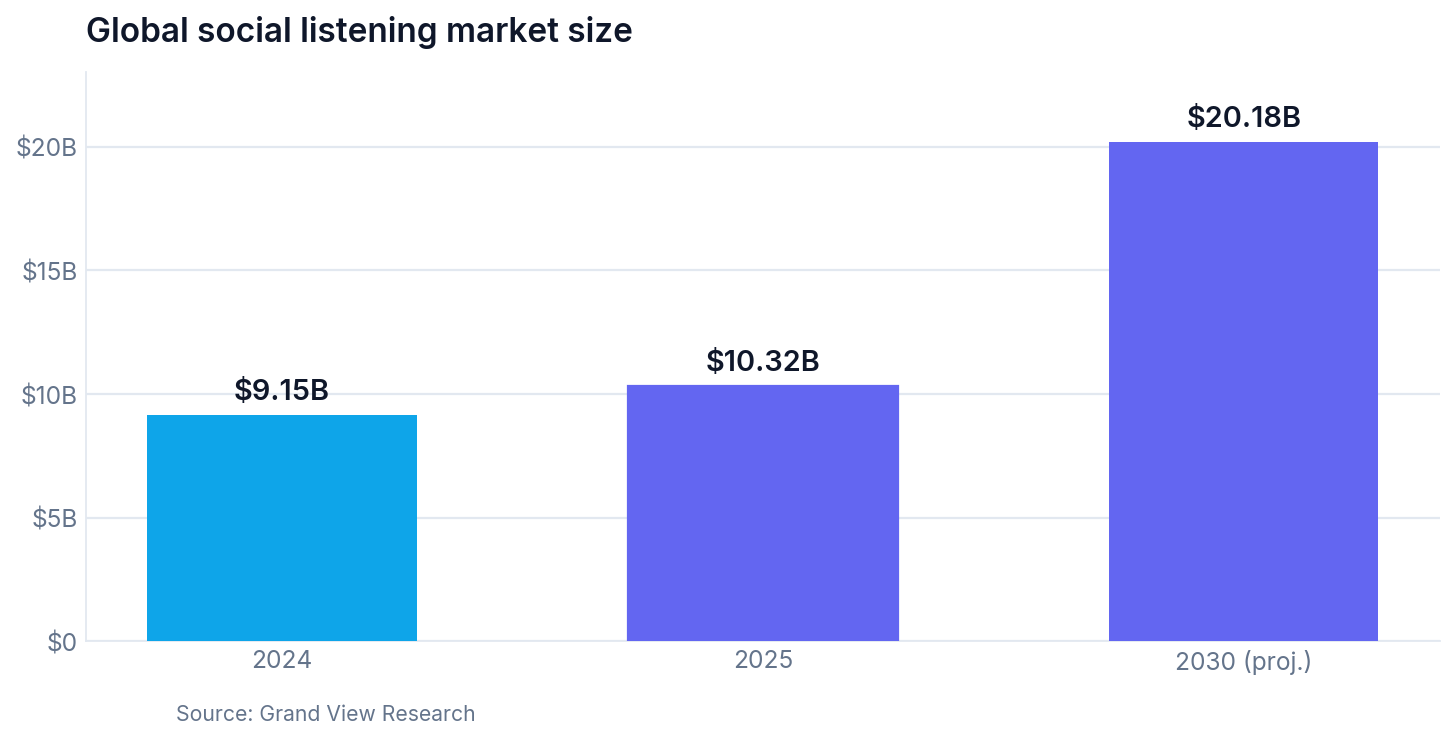
- ✓The market is crowded. It reached $10.32 billion in 2025 (Archive App), so expect more vendors and more noise.
- ✓Match cadence to risk. Daily for brand health, weekly for competitive and trend work.
- ✓Listening is a loop. Route findings to the team that owns the fix, or it goes stale.
What is social listening?
Social listening is the practice of tracking what people say about your brand, your competitors, and your market, then acting on it, across social platforms, forums, and review sites. It goes a step past social monitoring, which tracks direct mentions and replies to your own accounts. Monitoring tells you what people said to you, while listening tells you what they said about you when they assumed you were not in the room.
That distinction is the whole game. Social monitoring is the narrower job of watching your @mentions, tags, and replies so you can respond. It is real work and worth doing, but it only ever shows you the conversation people chose to have with you directly. Listening pulls in the far larger pool of talk that happens around you: the comparison thread on Reddit, the review left on G2, the offhand complaint in a Slack community that later shows up in a Google search. We cover the full definition and where the two overlap in our breakdown of what social listening is, so we will keep this short and move to the part most beginners get wrong.
Beginners often treat listening as a bigger version of monitoring. It is a different question. Monitoring asks what happened; listening asks why it happened and what to do next. That changes the setup, the queries, and the review cadence.
Why social listening matters for marketing and growth teams
The conversation you are not seeing is larger than the one you are. In 2026, 5.66 billion people used social media worldwide, and the average user moved across nearly seven different networks in a month (Sprout Social). Your brand surfaces in a fraction of that traffic, and most of it never lands in your inbox or your notifications.
There is real budget behind the shift. The global social listening market reached $10.32 billion in 2025 (Archive App), and it is projected to nearly double by 2030. For a marketing leader, that scale cuts two ways. It is the argument for doing this at all, since the talk that shapes your pipeline is happening whether you watch it or not. It is also the reason tool selection has gotten harder.
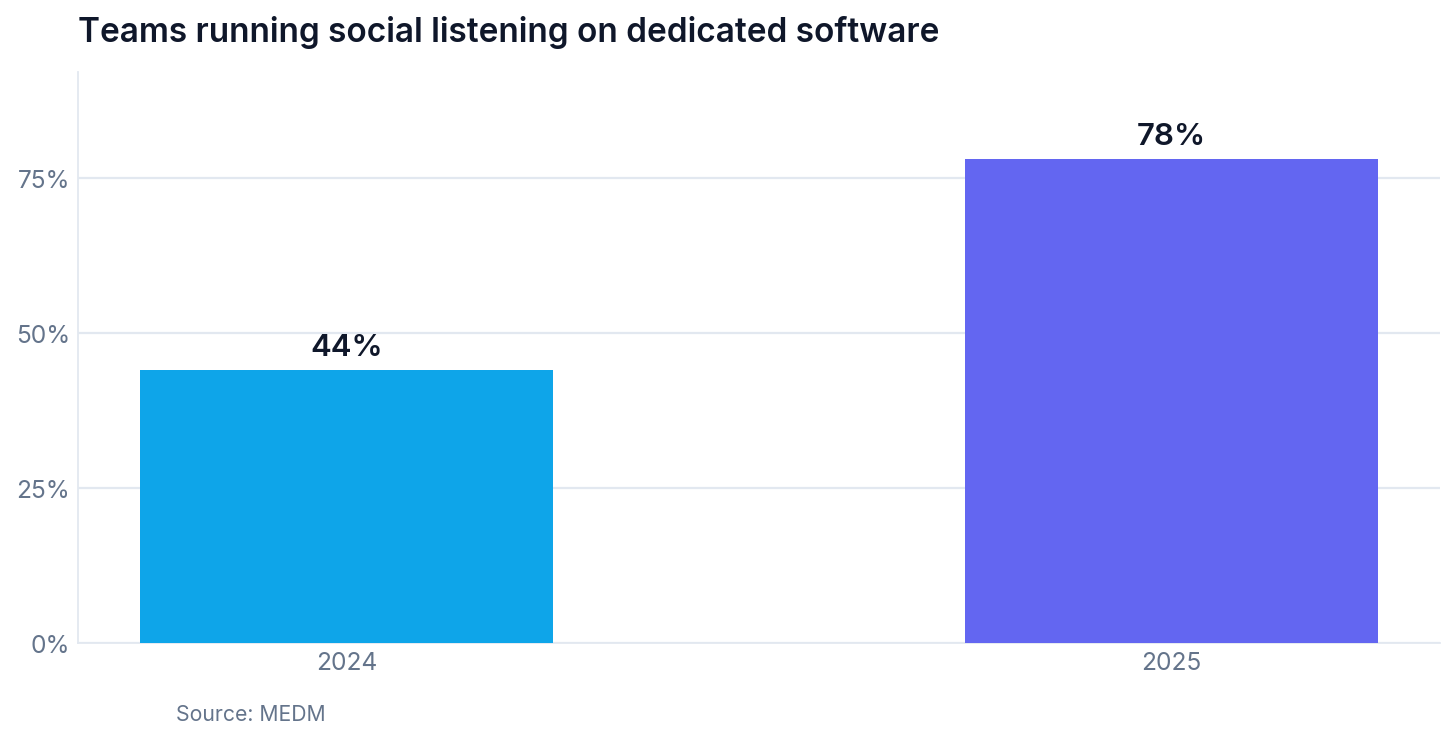
The tooling shift is already settled. The share of teams running listening through dedicated software, rather than spreadsheets and manual tracking, climbed from 44% to 78% in a single year (MEDM). Manual tracking stopped scaling once the conversation spread across five or six platforms at once.
$10.32 billion in market spend means dozens of tools competing for your budget. Most of them look identical on a demo, and that is the problem you have to solve before you sign anything.
We pulled the fuller set of figures in our brand monitoring statistics roundup, but the short version is settled: the scale argument is over. What is left is execution, and execution starts with a process.
The social listening process: 6 steps to get started
Getting started takes six steps: define goals and KPIs, choose a tool on real criteria, build a keyword and Boolean query list, set a cadence and priority channels, analyze sentiment and patterns, then route what you find into action. The order matters. Most failed setups skip the first step, buy a tool, then work backward hunting for something to measure.
Step 1: Define your goals and KPIs
Before you look at a single tool, decide what you are trying to learn. Four goals cover most teams, and each one points to a different number worth watching.
| Goal | KPI to watch |
|---|---|
| Brand health | Sentiment trend and time to first response |
| Competitive intelligence | Share of voice against named competitors |
| Trend spotting | Mention volume week over week |
| Audience research | Recurring themes and pain points |
Pick one as the primary. Teams that chase all four at once usually end up reviewing none of them by month two. Our default play here is to name the one goal that has a decision attached to it, because a metric nobody acts on is just a chart.
Step 2: Choose a listening tool using the right criteria
Every demo is designed to impress you. The trial is where you find out if the tool covers the places your audience actually talks. Score two or three options against the same rows instead of comparing feature lists, which every vendor writes to sound unique.
| Criterion | Why it matters | Question to ask the vendor |
|---|---|---|
| Platform coverage | A tool that misses Reddit or review sites misses your hardest signals | Which networks, forums, and review sites do you index, and how completely? |
| Boolean query depth | Weak query logic means noise you cannot filter out | Do you support nested AND, OR, and NOT operators with proximity? |
| Sentiment accuracy | Bad scoring sends you chasing the wrong threads | How do you handle sarcasm, industry jargon, and non-English text? |
| Historical data depth | New tools with no back data cannot show a trend | How far back can we pull mentions on day one? |
| Integrations | Data trapped in one dashboard rarely gets used | Do you push to Slack, our CRM, or a warehouse? |
| Pricing model | Seat pricing and volume pricing punish different teams | Is this priced per seat, per mention, or per tracked keyword? |
Notice we did not name a single vendor. That is deliberate. The right tool for a nine-person startup watching two competitors is not the right tool for a brand fielding ten thousand mentions a week, and any list that hands you one name for both is skipping the part that matters.
Step 3: Build your keyword and Boolean query list
This is the step nobody teaches well, and it is where most listening setups quietly fail. A query that only tracks your exact brand name will miss most of what you need, because people misspell, abbreviate, and never bother to tag.
Build your list from six inputs: your brand name and its common misspellings, your product names, your executives' names, your branded hashtags, your main competitors, and the industry terms buyers use. Then join them with Boolean operators. AND narrows a result so both terms must appear. OR widens it to catch variants. NOT strips out the noise you already know you do not want.
Here is a worked example for a fictional brand called Acme:
("Acme" OR "Acme Corp" OR "Acme.io" OR "Akme" OR #AcmeApp)
AND (pricing OR support OR bug OR "customer service" OR review)
NOT (jobs OR hiring OR careers OR "acme corp wile e")
The first block catches the brand even when it is misspelled or hashtagged. The second narrows to the topics you care about, and the NOT block kills the recruiting posts and cartoon references that would otherwise flood your feed. Run that query, read the first hundred results, then tune it. You will always cut something on the first pass.
Step 4: Set your monitoring cadence and priority channels
Not every goal needs a daily check. A crisis-adjacent goal, like watching sentiment after a launch, needs eyes on it every day plus real-time alerts. A slow goal, like tracking an industry trend, can run on a weekly review without losing much.
Prioritize channels by where your audience talks, not where your brand posts. Those are often different places. Reddit and niche forums carry more unfiltered product feedback than most official channels, and that talk increasingly feeds what AI answer engines say about you; we broke down the platform's scale in our Reddit statistics piece. If your buyers live in three subreddits and a Slack community, that is your priority list, even if your own posting happens on LinkedIn.
Step 5: Analyze sentiment and spot patterns
Once mentions are flowing, the work shifts from collection to reading. Tag each mention positive, negative, or neutral, watch for volume spikes that break the baseline, and pull out the themes that repeat. A single angry post is noise; the same complaint from thirty people in a week is a roadmap.
Sentiment scoring has gotten good. Large language models now hit 93% precision on binary sentiment tasks (Mordor Intelligence), which is enough to sort thousands of mentions without a human reading each one. It is not enough to trust blindly. The model will miss sarcasm, get thrown by industry slang, and occasionally score a rave as a rant. Spot-check the edge cases, especially anything the tool flags as strongly negative, before you escalate it.
Step 6: Turn insights into action
A finding that never reaches the person who can act on it is just a screenshot. This is the step that separates a working setup from a dashboard nobody opens. Route each insight to the team that owns the response. Product pain points go to product and support. Sentiment spikes belong with PR and social, competitive findings with marketing, and audience language with whoever plans your content.
Close the loop by naming an owner and a response time for each route. This is the point where brand monitoring stops being a reporting habit and starts being an operating process, because someone is accountable for what the data says.
Common social listening mistakes beginners make
Most listening setups fail in predictable ways. We have watched all of these happen, usually in the first ninety days:
- Tracking only direct @mentions. If your query depends on people tagging you, you miss the unlinked conversations, which are usually the honest ones.
- Ignoring misspellings and nicknames. "Akme," "the acme app," and an internal shorthand all refer to you, and a brand-name-only query catches none of them.
- Setting up the tool and never assigning an owner. A listening feed with no reviewer is a subscription you forgot you were paying for.
- Trusting sentiment scores as ground truth. The model is directional. Sarcasm and jargon slip past it, so spot-check before you react.
- Measuring volume without share of voice. A thousand mentions sounds great until you learn a competitor got four thousand in the same window.
How often should you check social listening data?
It depends on the goal. For brand health and anything crisis-adjacent, check daily, and set real-time alerts on top of that so a spike does not wait for your morning review. For competitive and industry-trend work, a weekly review is usually enough, since those patterns move slowly. If you can only commit to one rhythm, run daily alerts for the urgent stuff and a weekly analysis session for the rest.
The cadence should trace back to the goal you set in Step 1. A team watching for a support crisis and a team watching a slow category shift do not need the same schedule, and pretending they do is how people end up checking a dashboard every day out of guilt rather than need.
Conclusion
Social listening turns scattered conversation into a repeatable process once the goals, the tool, the queries, and the cadence are locked in. The teams that get value from it are not the ones with the biggest tool budget. They are the ones who picked one goal, built queries that catch unlinked mentions, and named a person to act on what came back. If you do one thing this week, do not try to listen to everything at once. Build a single Boolean query for your brand and its two closest competitors, run it, and read the first hundred results. That one query will teach you more about your setup than any demo will.
FAQ
What is the social listening process?
The social listening process runs in six steps: set goals and KPIs, choose a tool, build your keyword and Boolean queries, set a cadence and priority channels, analyze sentiment and patterns, then act on what you find. The last step is the one teams skip. A finding that never reaches the person who can fix it is just a screenshot.
What is an example of social listening?
A common one: a SaaS company notices a spike in Reddit threads asking how its product compares to a competitor on pricing. That is not a direct complaint and it never tags the brand, but it signals buying intent and a pricing objection at once. The team feeds it to sales enablement and updates a comparison page. That is listening turned into a decision.
What's the difference between social listening and social media monitoring?
Scope. Monitoring tracks direct mentions and replies to your accounts and tells you what people said to you. Listening tracks the wider conversation, including unlinked mentions, and tells you why they said it. Monitoring is a subset of listening.
Can ChatGPT do social listening?
Partly. A general model like ChatGPT can summarize sentiment or themes in text you paste into it, draft Boolean queries, and help you make sense of an export you already have. What it cannot do on its own is watch platforms in real time, pull historical mention data going back months, or catch an unlinked complaint on Reddit at 2am. Dedicated tools handle the collection and indexing. A model like ChatGPT is useful on top of that data, not instead of it. We use both, in that order.
What AI is best for social listening?
There is no single winner, and any tool that claims to be best for every use case is selling. The right answer depends on your channels, your query depth, and your budget, which is why we built the criteria table in Step 2. Score two or three tools against those rows on a live trial before you commit.
How often should you check social listening data?
Daily for brand health and crisis alerts, weekly for competitive and trend analysis. Tie the cadence to the goal you set in Step 1 rather than checking everything every day, which is how dashboards end up ignored.
Monitor mentions, sentiment, and AI visibility in real time with Mentient.
Start free trial →