
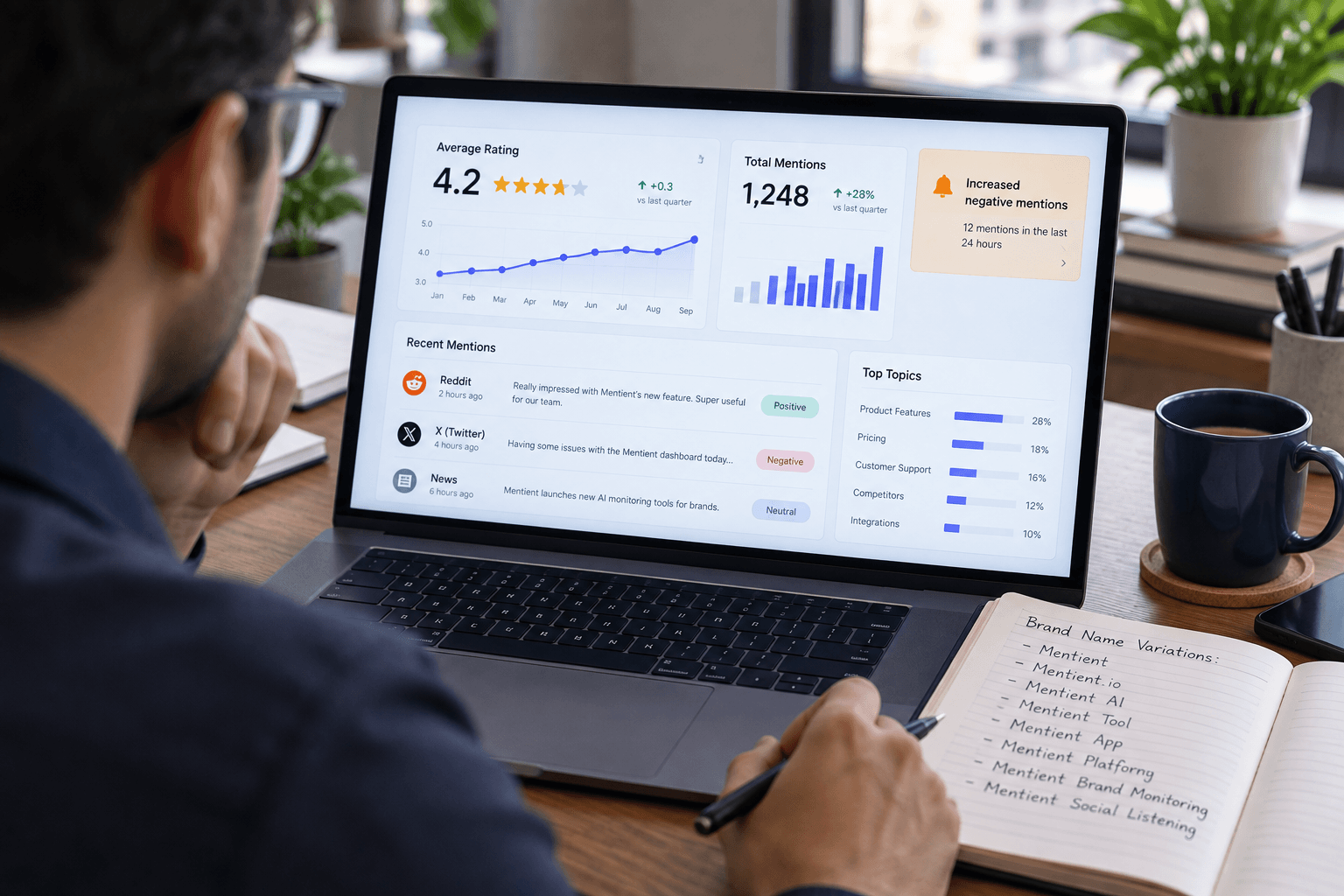
Most reputation monitoring setups we audit stop at step two. Somebody creates a few alerts and somebody else opens a dashboard, but nobody decides what counts as a problem. Then a thread turns on a Friday night and the first anyone hears of it is a customer email on Monday. Below is the seven-step loop we run with clients, from the baseline audit to the weekly report, including the part nearly everyone skips: deciding in advance who answers what, and how fast.
- Reputation monitoring is a loop, not a tool. Seven steps run from the baseline audit to the weekly report. Skip the thresholds and the rest becomes a feed nobody acts on.
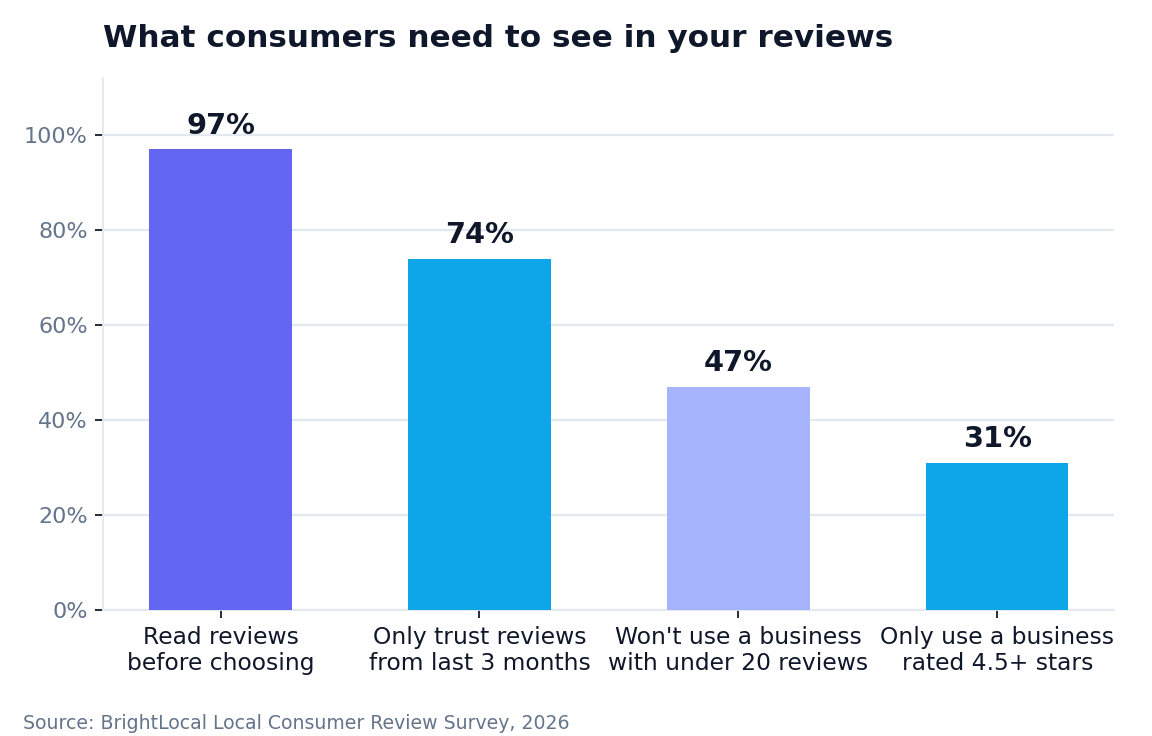
- Buyers judge quickly on thin evidence. 47% of consumers won't use a business with fewer than 20 reviews, and 74% only care about reviews from the last three months (BrightLocal, 2026).
- Replying is the cheapest fix on the list. Businesses that respond to every review are more likely to be used by 80% of consumers, while 42% are unlikely to use one that ignores its reviews (BrightLocal, 2026).
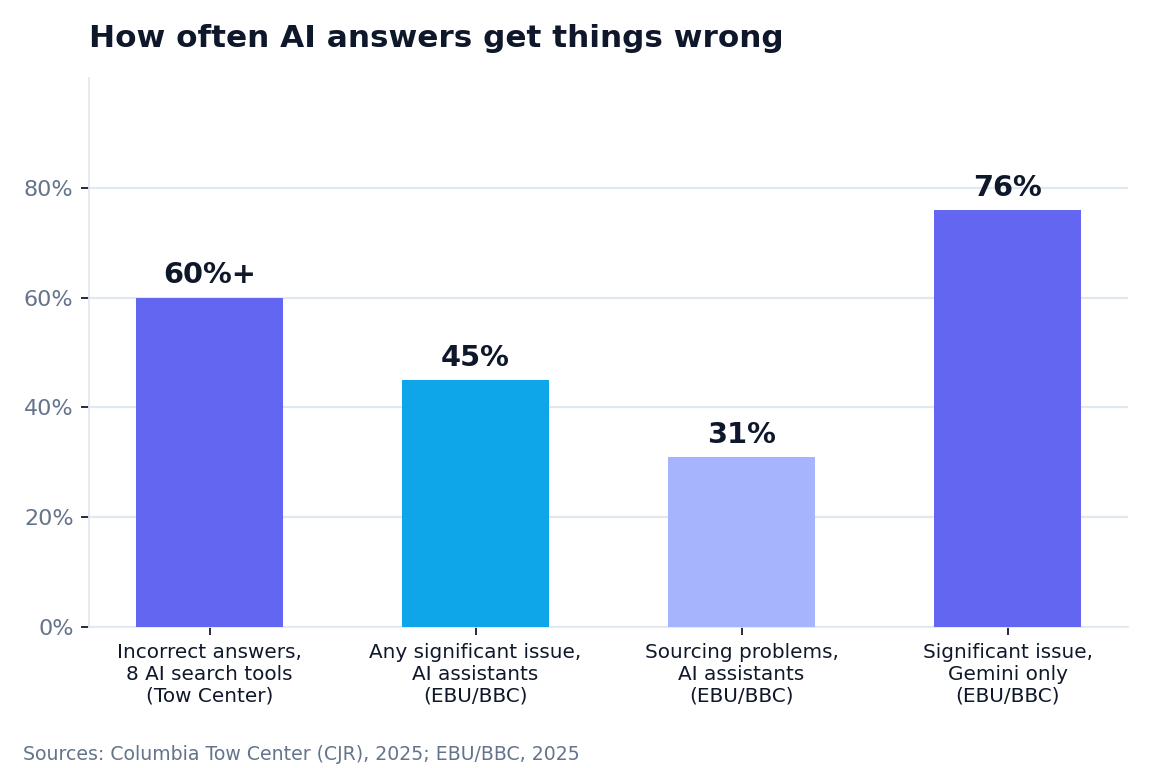
- AI answers are a reputation surface now, and a shaky one. The Columbia Tow Center found eight AI search tools gave incorrect answers to more than 60% of source-attribution queries.
- Tie the report to revenue. A Harvard Business School study of Yelp restaurant ratings linked one extra star to a 5 to 9% revenue lift.
Step 1: Run a baseline audit before you set anything up
Do this first, on a quiet afternoon when you have an hour clear. Open a private browser window and search the brand name. Write down what ranks on page one, what autocomplete adds after the name (words like "scam" or "alternatives" are the ones to note), and what sits in the People also ask box. Then search "[brand] reviews" and "[brand] vs" with each named competitor.
Next, read your own review profiles on Google and the two or three sites your buyers actually use. Check the star spread. Look at the average, then look at the date of the newest one-star review, because a 4.4 average can hide four bad reviews posted in the same week and a quick scroll catches the pattern the number misses. Finally, ask ChatGPT, Perplexity, and Gemini what a skeptical buyer would ask: "Is [brand] legit?" Screenshot every answer.
That folder of screenshots is your baseline. Every number you pull from here on gets compared against it.
Buyers decide fast, and we see it in the data. Nearly all of them read reviews first, and the bar keeps climbing: almost half will pass on a business with fewer than 20 reviews, as the chart below shows (BrightLocal, 2026). A stale profile does damage even when nothing bad is in it.
Step 2: Map the surfaces and pick what to watch
Reputation forms in five places: reviews, search results, news, social and forums, and AI answers. In our audits, most teams watch the first one and a half.
| Surface | What to watch | Check it | Usual owner |
|---|---|---|---|
| Reviews | Star spread, newest one-star, unanswered reviews | Daily | CX or local marketing |
| Search results | New pages on page one, autocomplete, People also ask | Weekly | SEO |
| News and blogs | Coverage naming the brand or its founders | Daily | PR |
| Social and forums | Reddit threads, X posts, niche communities | Near real time | Marketing |
| AI answers | What ChatGPT, Perplexity, and Gemini say | Monthly | SEO and comms together |
Set the cadence by how fast a surface moves. A review can hurt within hours. An AI answer drifts over weeks, so a monthly pass is plenty. Reddit gets its own line in our setups because a thread there can run for days before anything else notices it (our Reddit monitoring page shows how we track it). Review sites need their own feed too, and structured review monitoring is the cleanest way to catch a slide in the star spread early.
Step 3: Build the query set
A query set is the list of searches your monitoring runs all day. Keep it in one shared document so nobody maintains a private version. Six types cover most brands.
| Query type | Example | Why it earns a slot |
|---|---|---|
| Brand name | "Acme" | Exact match, the baseline for everything |
| Misspellings | "Acme" OR "Acmee" OR "Akme" | Typos hide mentions from exact-match rules |
| Founders and executives | "Jane Doe" Acme | Press often names the person before the company |
| Products | "Acme Pro" | A product can get coverage the brand name never would |
| Competitor comparisons | "Acme vs Globex" | Where buyers make the call |
| Trouble phrases | Acme (scam OR refund OR "not working") | Pulls complaints up before they rank |
Boolean syntax differs from tool to tool, so test every rule against a week of real data before trusting it. Our guide to Boolean search for listening covers the operators in detail.
Put a monthly review on the calendar. Add the new product, drop the retired one, check the misspellings against what actually showed up.
Step 4: Set thresholds that tell you when to act
A feed is not a monitoring program. Somebody on your team has to decide in advance what crosses the line. One angry post is noise. Four in an afternoon about billing is a pattern, and the system should say so.
| Signal | Starting threshold | What happens next |
|---|---|---|
| Negative cluster | 4 or more negative mentions on one topic in 24 hours | Comms owner reviews the same day |
| Rating drop | Average falls 0.2 stars in 30 days, or 3 one-stars in a week | CX finds the cause |
| Volume spike | Mentions at 2x the four-week baseline | Check the source first, sentiment second |
| New page one result | Unfamiliar negative page enters the top 10 for the brand name | SEO and PR decide the response |
Those numbers are ours, and they are a starting point (a brand with 20 mentions a week needs different ones than a brand with 2,000). Run them for a month, then tighten or loosen. Expect to rewrite them twice before they feel right. Some tools roll everything into one reputation score. Fine for trend lines, useless on its own, so always read the raw signals next to it.
The cluster logic is the hardest to get right. Our post on catching a crisis before it spikes walks through it with real examples.
Step 5: Write response rules before you need them
Silence costs real money. We tell every client the same thing: businesses that respond to every review are more likely to be used by 80% of consumers, and 42% are unlikely to use a business that ignores its reviews (BrightLocal, 2026). Yet the usual state of play is that nobody owns the reply. Fix that on paper, per surface:
- Reviews. Reply within one working day. Thank the person and name the specific issue, then offer one channel to continue in. Never paste the same template twice.
- Press. Comms issues a holding line the same day. The full response waits until the facts are confirmed.
- Reddit and forums. One reply, from a named person at the company, with facts. Never argue in the thread.
- AI answers. No reply possible. Your move is to fix the source page that feeds the answer instead (see step 6).
Tools can speed up the drafting. Mentient's reputation management feature drafts replies in the brand's own register, and a person always reviews before anything goes out. For the harder cases, our guide to handling a brand crisis has the escalation ladder.
Step 6: Audit AI answers every month
We are watching buyers change how they start. They ask an engine before they read a single review. Use of ChatGPT and other generative AI tools for local recommendations climbed from 6% to 45% in one year, making AI the third most popular source (BrightLocal, 2026).
Those answers wobble, and we have seen it firsthand. The Columbia Tow Center found eight AI search tools returned incorrect answers to more than 60% of source-attribution queries. A separate EBU and BBC study found 45% of AI assistant answers carried at least one significant issue, and Gemini fared worst, at 76%.
Our monthly pass takes about an hour. Write ten buyer prompts ("is [brand] legit", "[brand] vs [competitor]", "problems with [product]"). Run each across four engines. Record three things per answer: the sentiment, the facts it claims, and the sources it cites. Then compare against what is actually true today.
Wrong answer? Find the page feeding it. Often it is an old forum thread or a stale comparison post that nobody on the team has opened in a year, and fixing that one page does more than any amount of tinkering with prompts. Correct it, or answer it publicly, then run the same prompt next month.
Our walkthrough of AI visibility tracking covers the prompt set in more depth, and the free AI visibility audit gives a quick first read.
Step 7: Report weekly and tie it to revenue
One page, sent the same day each week to the same three people. We keep ours to a single screen. It holds the raw signals against the baseline, anything that crossed a threshold and what was done about it, and one action for next week.
Then connect it to money, because that is how the report earns its place on the calendar. A Harvard Business School study of Yelp restaurant ratings linked each extra star to a 5 to 9% revenue increase. Finance pays attention to charts. Put the rating distribution right on the page. Our piece on the ROI of social listening shows how to build the three-ledger version.
Mistakes that break the loop
- Watching reviews only. The thread that sinks a brand often starts on Reddit or inside an AI answer, weeks before a review appears.
- No thresholds. Alert on everything and the team learns to ignore alerts within a month.
- One person owns everything. Then that person goes on holiday. Give each surface an owner and a backup.
- Arguing in public. A defensive reply gets screenshotted and outlives the original complaint.
If the wider program question is still open, our guide to brand monitoring maps all five components in one place.
Frequently asked questions
What is brand reputation monitoring?
Tracking what people say about a brand across reviews, search results, news, social platforms, forums, and AI answers, then acting on shifts early. The goal is catching a problem while one reply can still settle it. After that it is a campaign.
How often should we check our brand reputation?
It depends on the surface. Reviews and social mentions deserve daily or near real time alerting because they move fast. Search results fit a weekly look. AI answers drift slowly, so monthly is enough. What we recommend: a weekly one-page report that ties the cadences together and gives the team a fixed moment to decide.
Can free tools handle brand reputation monitoring?
Partly. Google Alerts catches indexed news and blog mentions at no cost, though delivery commonly lags and it misses social platforms, reviews, and forums. Free works for a pre-launch startup. Once reviews or Reddit start driving perception, we would move to a dedicated tool (we compare the options in nine Google Alerts alternatives).
How do we monitor what AI says about our brand?
Build a fixed set of ten or so buyer prompts, such as "is [brand] legit" and "[brand] vs [competitor]", and run them across ChatGPT, Perplexity, Gemini, and Google AI Overviews on a schedule. For each answer, record the sentiment, the facts it asserts, and the sources it cites. Compare against reality, then fix or answer the source pages that feed wrong claims. A monthly cadence is usually enough because answers shift slowly, though a product launch or a news event is a good reason to run it early. Keep every run in a dated folder (screenshots plus a short note) so a change in tone or a new wrong claim is easy to spot and easy to show a skeptical colleague.
What is the difference between reputation monitoring and reputation management?
Monitoring is the watching: collecting mentions and flagging shifts. Management is the doing: replying, correcting sources, and shaping what ranks. The first feeds the second. We have seen teams skip straight to management, and they end up working from hunches. A rebuilt homepage will not fix a bad Reddit thread.
Spend one hour this week on step one. Search your brand name in a private window and screenshot what the AI engines say. Note the date of the newest one-star review. You will be surprised how much that single folder changes the next conversation about reputation.
Let the alerts do the watching
Mentient tracks reviews, Reddit, the open web, and AI answers in one dashboard, and flags negative clusters while the thread is still small. Start free and run your baseline against live data.
Start free trial