A social listening tool is only as good as the query you feed it. Point it at your bare brand name and you will miss half the conversation and drown in the other half. Boolean search for social listening is how you fix both problems at once: a small set of operators, AND, OR, and NOT, that tell the tool exactly what to pull in and what to leave out. Get the query right and your dashboard fills with mentions that matter; get it wrong and you are reading spam about a bakery three states away. This guide covers the operators, a step-by-step query build, a template you can copy, and the mistakes that quietly wreck results.
- ✓Operators are the whole game. AND, OR, NOT, quotes, and parentheses decide what your tool sees.
- ✓Start broad with OR, then cut with NOT. Catch every variant of your name, then strip the noise.
- ✓Exclusions do the heavy lifting. A good NOT list removes most of the junk in a query.
- ✓Cover Reddit and forums. The candid mentions live there, and AI answers quote them.
- ✓Test before you trust. Run the query on a week of history and read 50 sample mentions.
What is Boolean search in social listening?
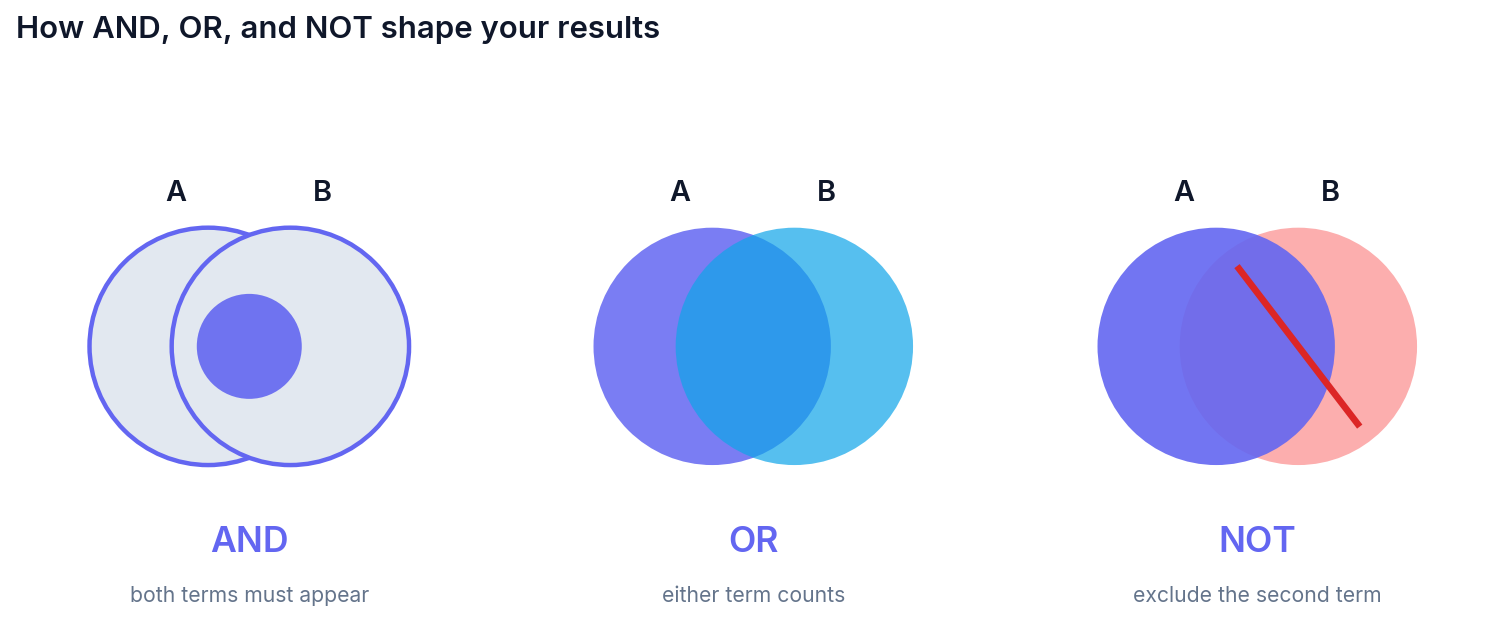
Boolean search in social listening is a way of writing queries with logical operators, mainly AND, OR, and NOT, so your tool returns only the mentions you actually want. AND requires two terms together, OR catches any of several variants, and NOT excludes the noise. Combined with quotes and parentheses, these operators turn a vague keyword into a precise instruction for what to collect.
You get coverage and precision at the same time. A bare brand name misses the misspellings, nicknames, and untagged posts that make up most of the conversation, and it also pulls in every unrelated use of that word. Boolean logic lets you widen and narrow in the same breath: OR widens the net to catch every version of your name, and NOT tightens it to drop the irrelevant hits. If you are new to the wider practice, our guide on what social listening is covers the fundamentals; here we focus on the query itself.
Think of the query as the intake valve for everything downstream. Sentiment scoring, share of voice, trend charts, every number you report starts from what the query let in. A sloppy query does more than add noise; it quietly biases every metric built on top of it.
The Boolean operators you need to know
Most social listening tools support the same core set of operators. A handful support only three or four, others support dozens, so check what yours allows before you write a complex string. These are the ones that do the real work.
| Operator | What it does | Example |
|---|---|---|
| AND | Both terms must appear in the mention | ("project management" AND software) |
| OR | Any of the listed terms can appear | (Nike OR "just do it") |
| NOT | Excludes mentions containing a term | (apple NOT fruit) |
| " " quotes | Matches an exact phrase | "customer support" |
| ( ) parentheses | Groups logic so it evaluates in order | (latte OR espresso) AND price |
| * wildcard | Matches variations of a word stem | manag* catches manage, manager, managing |
| NEAR/n proximity | Two terms within n words of each other | (pricing NEAR/5 expensive) |
The two that beginners underuse are parentheses and the wildcard. Parentheses are what keep a mixed query from misfiring, because without them the tool guesses the order of operations and usually guesses wrong. The wildcard saves you from listing ten forms of the same word. Both are covered in more depth in our step-by-step social listening guide, which puts query building in the context of the full workflow.
How to build a Boolean query, step by step
Build in layers rather than writing one long string and hoping. We build every query in the same order, using a fictional brand called Northwind Coffee as the example.
Layer 1: Catch your brand every way people write it
Start with an OR group that covers the exact name, common misspellings, the handle, and the branded hashtag. People do not spell your name the way your logo does.
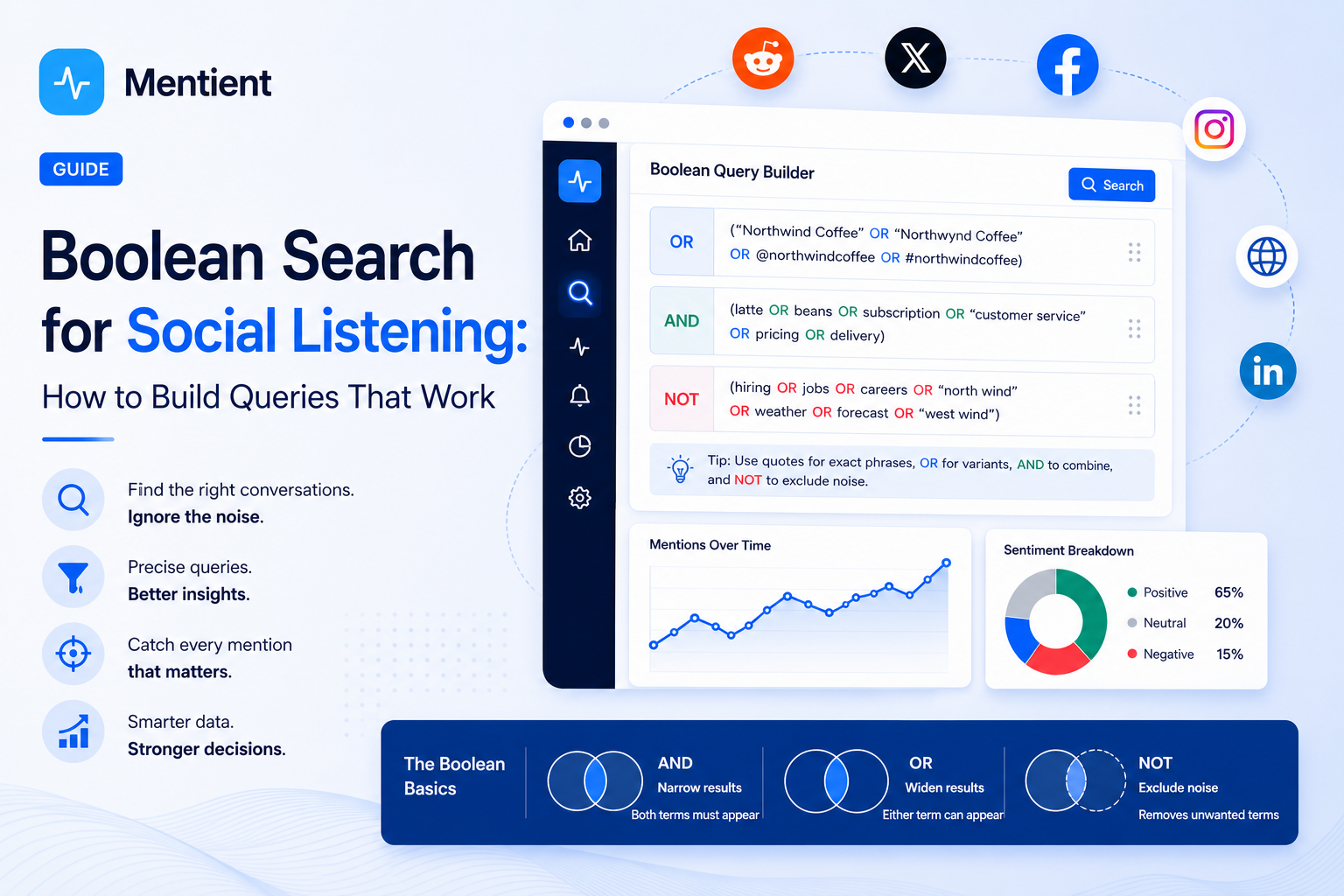
("Northwind Coffee" OR "Northwynd Coffee" OR "north wind coffee"
  OR @northwindcoffee OR #northwindcoffee)
Layer 2: Narrow to the topics you care about
Add an AND group so a mention has to be about something relevant, rather than any stray use of the name. Use OR inside it to cover the ways people phrase the same idea.
AND (latte OR beans OR subscription OR "customer service" OR pricing OR delivery)
Layer 3: Strip the noise with NOT
This is the layer that does the most work and the one people skip. List the predictable junk: recruiting posts, unrelated meanings, and any literal phrase that keeps polluting the results.
NOT (hiring OR jobs OR careers OR "north wind" OR weather OR forecast)
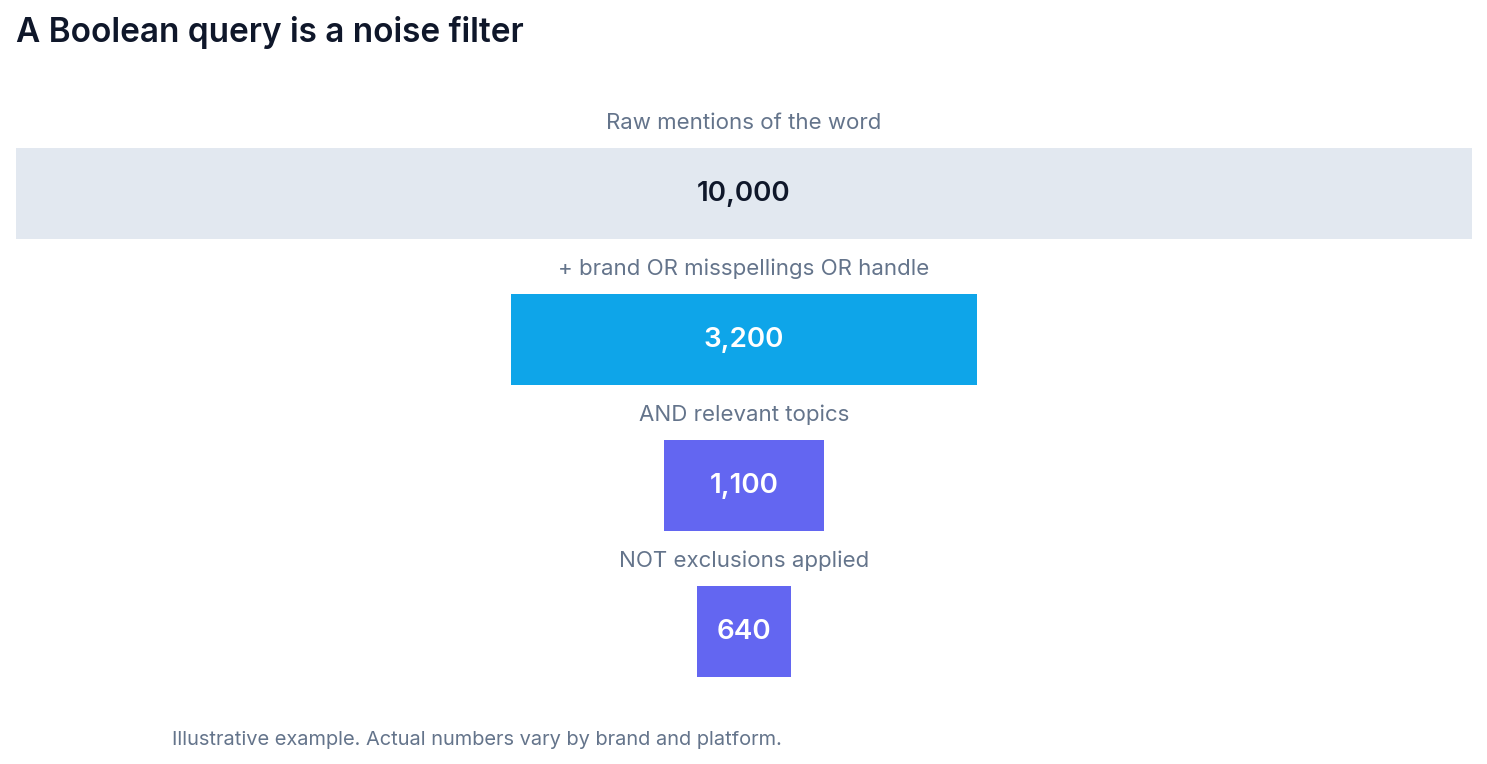
Put together, the three layers read as one query:
("Northwind Coffee" OR "Northwynd Coffee" OR @northwindcoffee OR #northwindcoffee)
AND (latte OR beans OR subscription OR "customer service" OR pricing OR delivery)
NOT (hiring OR jobs OR careers OR "north wind" OR weather)
Layer 4: Track competitors in a separate query
Do not cram competitors into the same string. Run a second query with the same structure for each competitor you care about, so you can compare share of voice cleanly. Reddit is worth special attention here, because switching conversations and honest comparisons cluster in threads rather than tagged posts. A dedicated approach to Reddit monitoring catches the buried comment that a title-only search misses.
Layer 5: Refine with phrases and proximity
Once the basics run, tighten with exact phrases and proximity operators. If "delivery" is pulling in unrelated chatter, switch to "coffee delivery" as a phrase, or use proximity so the topic word has to sit near the brand. Small changes here cut a surprising amount of noise.
A Boolean query template you can copy
Here is the skeleton we hand teams. Replace the placeholders, and keep each layer on its own line so it stays readable when you come back to edit it in three months.
(
  "Brand Name" OR "Common Misspelling" OR "spaced brand name"
  OR @handle OR #brandhashtag
)
AND (
  product1 OR product2 OR "key topic" OR pricing OR support OR review
)
NOT (
  hiring OR jobs OR careers OR "unrelated meaning" OR "known noise phrase"
)
Agencies running this across many clients get the most value from templating, because a documented query structure is far easier to hand off and audit than a one-off string buried in a tool. If you manage listening for multiple brands, our notes for agencies cover how to keep query quality consistent at scale. For a single brand, one template like the one above, tuned per platform, is plenty.
Common mistakes that wreck a Boolean query
We see the same errors again and again, and each one either floods the dashboard or hides the mentions you needed.
- Tracking the bare brand name only. No misspellings, no handle, no hashtag. You catch the tagged posts and miss the honest ones.
- Skipping the NOT list. Exclusions remove most of the junk. A query with no NOT layer is a query you will stop reading by week two.
- Forgetting parentheses. Mixed AND and OR without grouping evaluates in an order you did not intend, and the results look random.
- Over-tightening with AND. Requiring five terms at once filters out casual mentions, which are often the most candid ones.
- Ignoring platform quirks. A query tuned for news will misfire on Reddit, where sarcasm and slang change what counts as a match.
- Never reading the raw mentions. A query that looks clever can still pull garbage. You only find out by reading what it returns.
How to test and refine your query
A query is a draft until you have tested it against real data. Never trust one straight out of the box.
Run the query against a week or two of historical mentions first, then read 50 of them by hand. If more than a handful are irrelevant, your NOT list needs work; if you are seeing far fewer mentions than expected, your OR group is too narrow or too strict on phrasing. Adjust one layer at a time so you can tell what changed. This half hour of reading is the highest-impact part of the whole build.
The payoff shows up downstream. A clean query feeds accurate sentiment, and modern models already reach 93% precision on binary sentiment tasks (Mordor Intelligence), so the query is usually the limiting factor, not the scoring. Once the query is solid, tie it to the numbers that actually inform a decision; our breakdown of social listening metrics that matter covers which ones earn their place in a report. Revisit the query every quarter, because the misspellings, competitors, and slang all drift over time.
Conclusion
Boolean search for social listening comes down to a repeatable habit: cast a wide OR net for every version of your brand, require relevance with AND, cut the noise with NOT, then test against real data before you trust the results. The operators are simple; the discipline is in the layering and the reading. Build one query today using the template above, run it against last week's mentions, and read the first fifty. That single pass will teach you more about your coverage than any dashboard tour.
FAQ
What is Boolean search in social listening?
It is writing queries with logical operators like AND, OR, and NOT so your tool returns only the mentions you want. AND requires terms together, OR catches variants of a word, and NOT excludes noise. Together with quotes and parentheses, they turn a loose keyword into a precise instruction for what to collect.
What are the main Boolean operators?
The core three are AND, OR, and NOT. AND requires both terms in a mention, OR widens the search to any of several variants, and NOT removes unwanted terms. Beyond those, quotation marks match an exact phrase, parentheses group logic so it evaluates correctly, and the wildcard matches variations of a word stem. Most tools support all of these.
How do you write a Boolean query for social listening?
Build it in layers. Start with an OR group covering your brand name, its misspellings, your handle, and your hashtag. Add an AND group for the topics you care about, so a mention has to be relevant. Then add a NOT group to strip predictable junk like recruiting posts and unrelated meanings. Wrap each group in parentheses, keep each layer on its own line, and test the whole thing against a week of historical mentions before you rely on it.
What is a wildcard in Boolean search?
A wildcard, usually the asterisk, matches variations of a word stem. Writing manag* catches manage, manager, managing, and management in one term, which saves you from listing each form with OR.
How do you reduce noise in a social listening query?
The NOT operator does most of the work. List the recurring junk you see, such as recruiting posts, unrelated meanings of your brand name, and known spam phrases, and exclude them. Then tighten broad topic words into exact phrases, and use proximity so a topic term has to sit near your brand. Read the raw results after each change to confirm it helped.
Do all social listening tools support Boolean search?
Most do, but the depth varies. Some tools support only three or four operators, while others handle dozens including proximity and nested logic. Before you write a complex query, check which operators your tool accepts, because a query that relies on proximity or wildcards will silently fail in a tool that does not support them.
Mentient runs your Boolean queries across Reddit, forums, news, reviews, and AI answers, then flags what matters.
Start free trial →