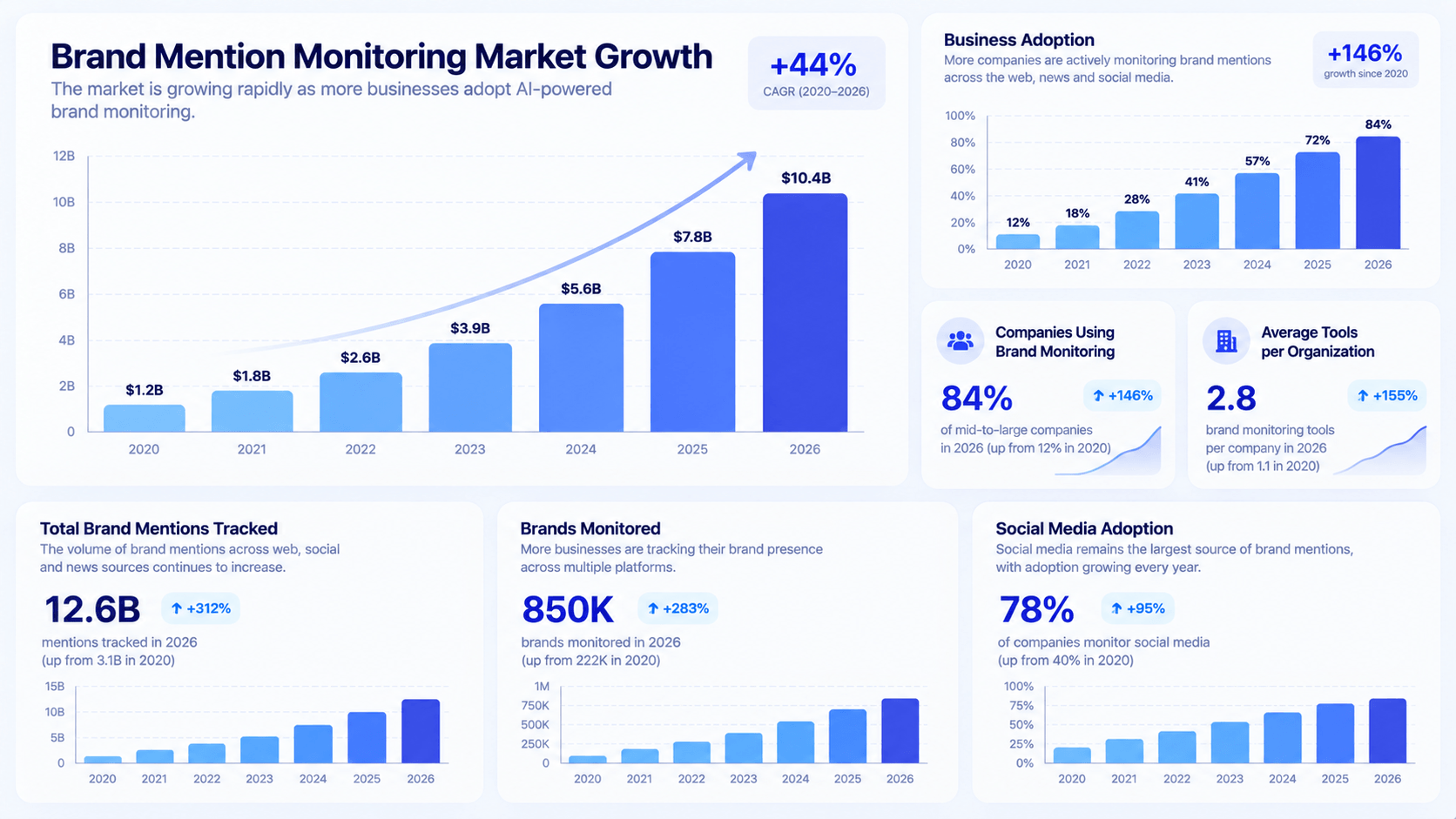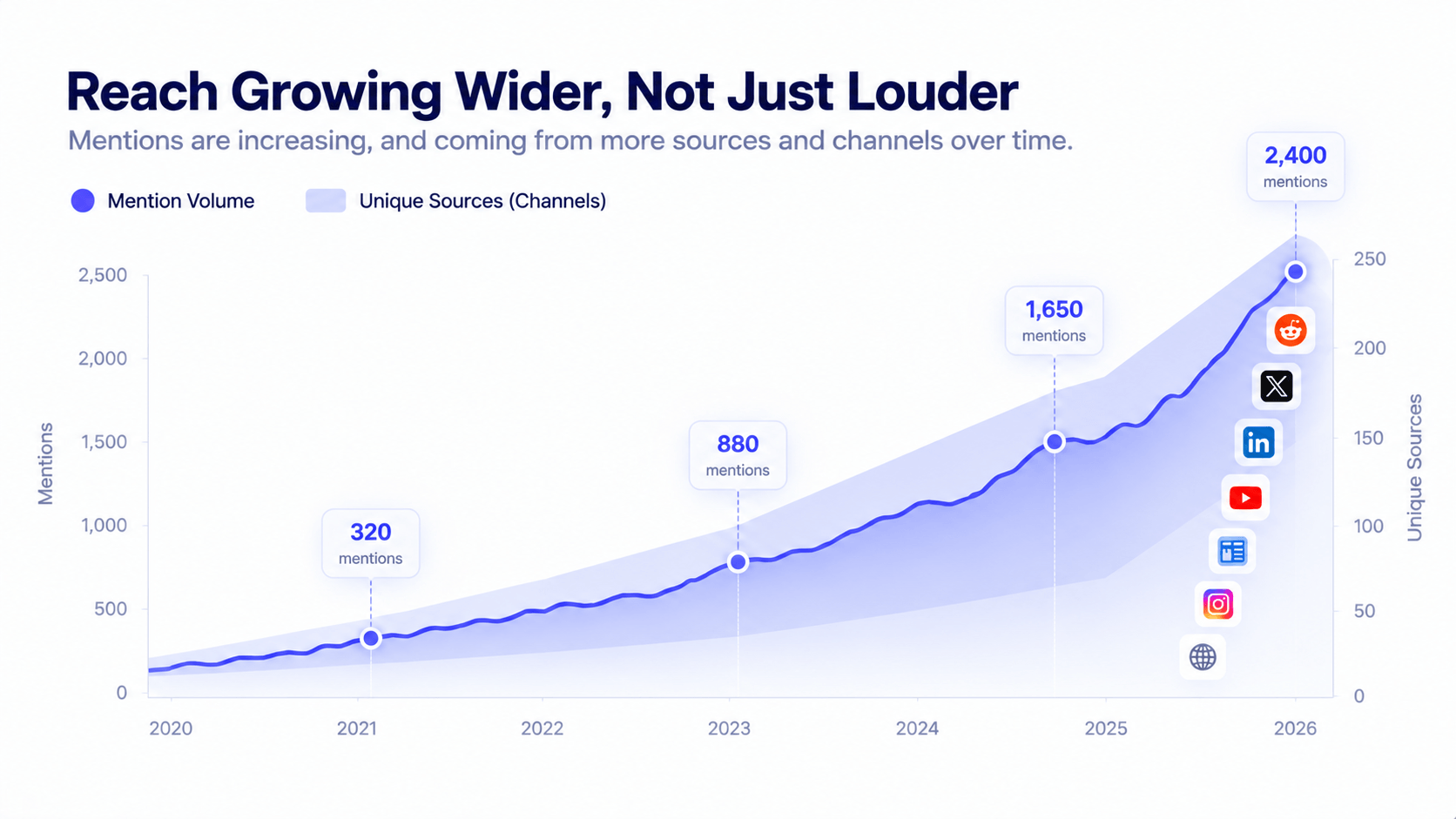
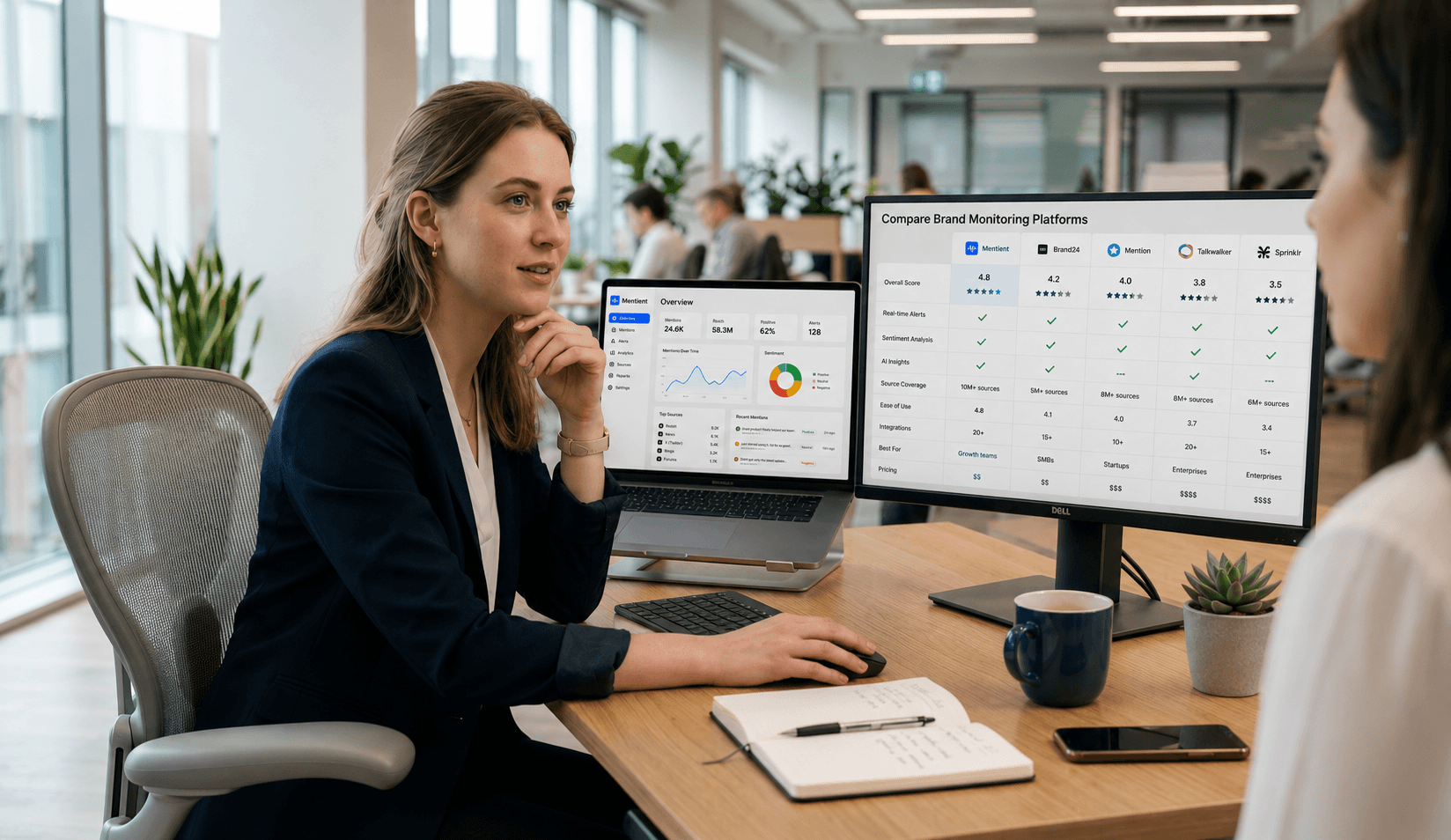
Google Alerts only watches pages Google has already indexed, which means it misses nearly everything happening on social platforms, forums, and review sites, the exact channels where most brand conversation now lives. It also runs on a delay, commonly 24 to 48 hours between something publishing and an alert landing in an inbox, and it only starts collecting from the moment an alert gets created, so there is no history to look back on when a problem has been building for weeks. None of that makes Google Alerts useless. It makes it a starting point that most teams outgrow within a quarter. We tested and researched nine tools built to cover what Google Alerts cannot, from free search-only options to enterprise media intelligence suites, so a team can pick based on actual coverage and budget rather than whichever name comes up first in a search.
- Google Alerts covers indexed web pages only, with no social platforms, no reviews, no sentiment scoring, and a 24 to 48 hour delivery lag.
- Pricing across these nine tools spans free to well over $150,000 a year, so the right pick depends heavily on team size and how many channels actually need coverage.
- Only a handful of these tools track AI answer engines like ChatGPT and Perplexity, even though that surface is now a meaningful share of brand discovery.
- Enterprise tools like Meltwater and Brandwatch rarely publish pricing, and quotes typically scale with mention volume, seats, and contract length rather than a flat rate card.
- The best fit is rarely the biggest name. A three-person startup and a global enterprise brand need genuinely different tools, not the same tool at a different price.
Why Google Alerts falls short
Google Alerts was built to notify a person when a new page matching a query gets indexed. It was never built to run a brand monitoring program, and the gap shows up in three specific places. First, coverage: it tracks indexed web and news pages only, with no access to social platforms, forums, review sites, or podcasts, exactly the channels where most unbranded conversation actually happens. Second, speed: delivery commonly runs 24 to 48 hours behind publication, which turns a same-day PR response into a next-day one. Third, depth: there is no sentiment scoring, no historical backfill before the alert was created, and no way to compare a brand's volume against a named competitor.
None of that is a knock on the tool for what it is. A free service that emails a link when a page gets indexed is a reasonable starting point for a solo founder checking their own name once a week. It stops being reasonable the moment a team needs same-day awareness, social coverage, or a number they can put in front of a CFO.
The 9 alternatives at a glance
| Tool | Best for | Starting price |
|---|---|---|
| Mentient | Teams that need press, social, reviews, and AI visibility in one place | Free to start |
| Brand24 | Small businesses and agencies wanting AI-assisted insights | $199/mo |
| Awario | Budget-conscious teams wanting clean Boolean search | $29/mo |
| Mentionlytics | Small businesses wanting AI anomaly detection on a budget | ~$39 to $69/mo |
| Mention | Larger teams needing a single high-volume plan | $599/mo |
| Meltwater | Enterprise PR teams needing media intelligence and journalist data | Custom quote |
| Brandwatch | Enterprise consumer intelligence and audience research | Custom quote |
| Talkwalker | Global brands wanting visual and image recognition | Custom quote |
| Social Searcher | Quick, one-off checks with no budget at all | Free |
1. Mentient
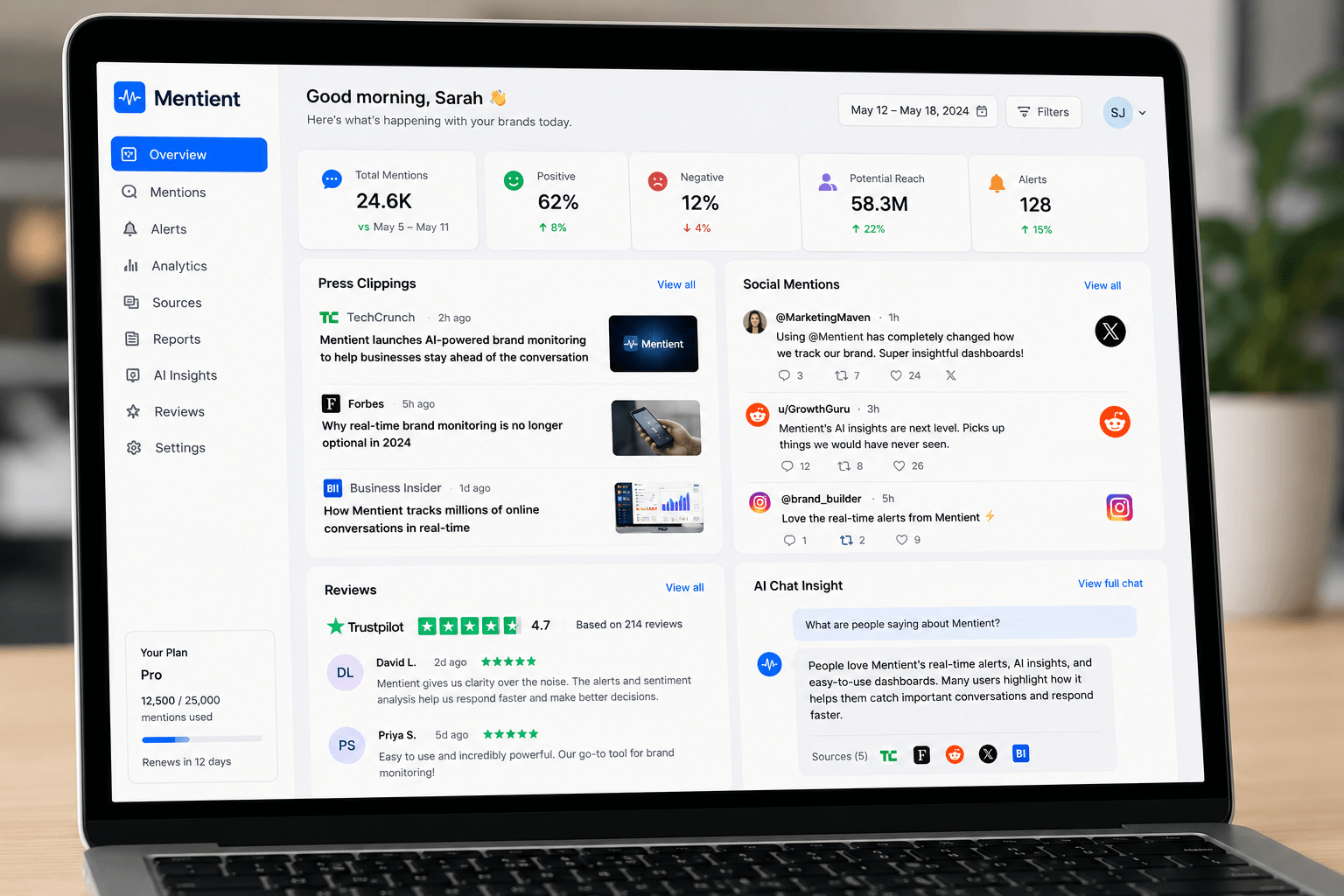
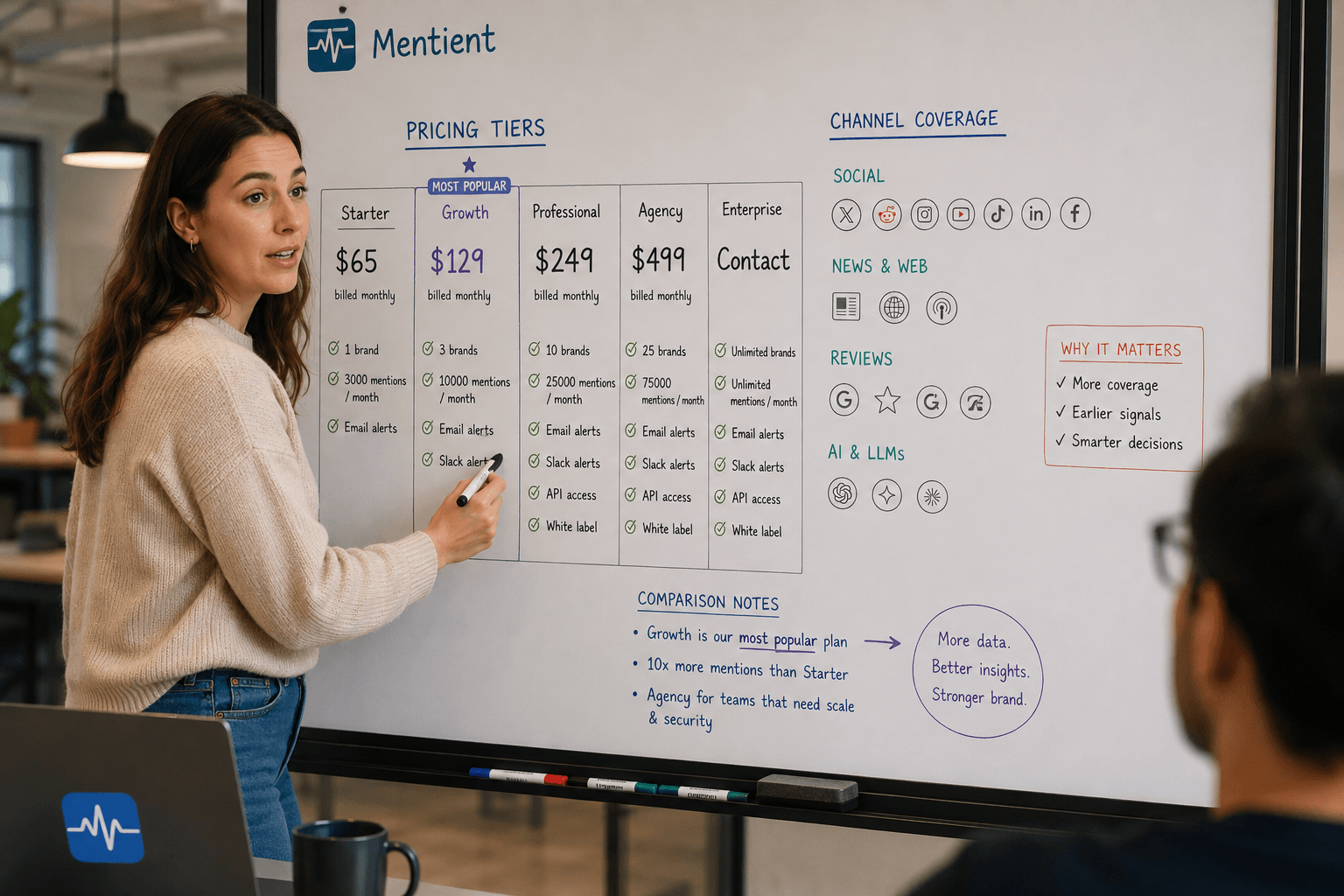
We built Mentient to close the exact gap Google Alerts leaves open, one dashboard covering press and news coverage, social platforms, reviews, named competitors, and AI answer engine citations from ChatGPT and Perplexity, rather than five separate logins. Sentiment is scored with full context instead of a keyword match, which fixes the sarcasm and slang errors that trip up simpler tools built on older NLP models.
Key features: media and press monitoring, social and forum coverage including Reddit, review tracking, competitor share of voice, and a dedicated view into how a brand gets cited inside AI-generated answers.
Best for: teams that want press, social, review, and AI visibility tracking without stitching together three or four separate subscriptions. Agencies managing multiple client accounts and SaaS teams with technical buyers are the two profiles we built the workflow around most closely.
Worth knowing: the AI answer engine tracking is the newest layer, and it is genuinely rare among the tools on this list. Most competitors below still measure press, social, and reviews only.
2. Brand24
Brand24 covers social platforms, news, blogs, and reviews, and has leaned hard into AI features over the past two years, including automated event detection and an AI assistant that summarizes spikes in coverage. Pricing starts at $199 a month for the Individual plan billed annually, covering three keywords and 2,000 mentions a month, scaling up to a custom Enterprise tier starting near $1,499 a month.
Key features: AI sentiment analysis, AI event detection, Lightning Search for large mention volumes, and unlimited users on every paid plan.
Best for: small businesses and small agencies that want AI-assisted triage without an enterprise sales process.
Worth knowing: the entry plan caps out at three keywords and 2,000 mentions a month, which a brand with heavy volume will outgrow quickly.
3. Awario
Awario runs its own web crawling rather than relying only on platform APIs, and its Boolean search is genuinely flexible, letting a team exclude irrelevant contexts, filter by language and geography, and set URL-level rules. Pricing starts at $29 a month for the Starter plan billed annually, covering three topics and 30,000 new mentions a month, with a Pro plan at $89 a month and an Enterprise plan at $249 a month.
Key features: advanced Boolean search, near real-time alerts, PDF and white-label reporting, and API access starting on the Starter plan.
Best for: budget-conscious teams that still want precise query control rather than a simple keyword match.
Worth knowing: the Starter plan limits a team to a single user, so any real collaboration requires moving to Pro.
4. Mentionlytics
Mentionlytics covers web and social monitoring across most major platforms, including TikTok and Reddit, and adds AI anomaly detection that flags unusual spikes in mention volume automatically. Entry pricing runs from roughly $39 to $69 a month depending on the source and billing cycle, scaling through Pro and Business tiers up to a custom Enterprise plan.
Key features: AI anomaly detection, AI mention clustering, share of voice, and a Social Intelligence Advisor that surfaces suggested actions.
Best for: small businesses that want automated flagging of unusual activity without paying enterprise prices.
Worth knowing: published pricing varies noticeably by source, so it is worth confirming the current rate directly before budgeting.
5. Mention
Mention has consolidated its pricing into a single Company plan at $599 a month, billed annually, covering up to 50,000 mentions a month. The older, cheaper Solo and Pro tiers some reviews still reference have been retired from the current pricing page. The platform's publish-and-respond feature was also discontinued in early 2026, so Mention now functions purely as a monitoring and alerting tool rather than a full social management suite.
Key features: high mention volume on a single plan, feed and analytics dashboards, and alerting across web and social sources.
Best for: teams with high mention volume that do not need a cheaper entry tier and are comfortable with a single annual commitment.
Worth knowing: with no lower tier left, this is a hard sell for a small team or a solo founder testing the waters.
6. Meltwater
Meltwater is a full media intelligence suite built around press and news monitoring, with social listening, an influencer database, and a journalist contacts module layered on top. Meltwater does not publish pricing; third-party contract data puts the small-business average near $16,000 a year and the enterprise average near $70,000, with large custom deployments running well past $150,000 annually.
Key features: press and broadcast monitoring, a journalist and media contacts database, influencer marketing tools, and enterprise-grade governance workflows.
Best for: enterprise PR and comms teams that need media relationship tools alongside monitoring, not just alerts.
Worth knowing: the price gap between the Starter tier and the Suite tier is large, and a full quote usually requires a sales conversation before any real evaluation can start.
7. Brandwatch
Brandwatch, owned by Cision since 2021, runs entirely on custom enterprise contracts with no self-serve entry point. Its Enterprise and Global Brand plan runs from roughly $5,000 a month, and full annual deals commonly land between $36,000 and $150,000 depending on data volume and add-ons. The platform now sits inside a broader suite covering consumer intelligence, social media management, and influencer discovery.
Key features: large-scale social listening, audience and trend analysis beyond raw mention counts, and custom dashboards built for executive reporting.
Best for: large enterprises that need deep audience research alongside standard brand monitoring.
Worth knowing: there is no published starting price and no self-serve trial, so evaluating Brandwatch requires committing to a sales process first.
8. Talkwalker
Talkwalker, acquired by Hootsuite in 2024 and positioned as its listening engine, monitors across more than 150 million sources spanning social, news, blogs, forums, and reviews. Pricing starts near $500 a month on quote-only Core, Analyze, and Business tiers, with fuller custom deployments estimated above $9,000 a year.
Key features: AI sentiment analysis across 120-plus languages, visual analytics for image and video recognition, and competitive share-of-voice benchmarking.
Best for: global brands that need multilingual coverage and image recognition, particularly for visual-first categories.
Worth knowing: like Brandwatch and Meltwater, pricing is quote-only, so budgeting requires a demo call before a real number appears.
9. Social Searcher
Social Searcher is the closest thing on this list to a direct, free Google Alerts replacement: no account required, real-time keyword and hashtag search across multiple social networks, with basic sentiment and engagement data included. The free tier is search-only, meaning a person runs a query on demand rather than getting automated ongoing alerts. A paid tier adds broader web mentions, unlimited history, data export, and email notifications.
Key features: no-login social search, basic sentiment and engagement scoring, and a free tier with no time limit.
Best for: quick, one-off checks or a free supplementary layer next to a paid primary tool.
Worth knowing: without the paid tier, there is no automated alerting, so a person still has to remember to go check.
How to choose the right one
Start with coverage, not price. List the channels that actually matter, press, social, reviews, AI answer engines, and cross every tool off this list that misses one a team genuinely needs to watch. A consumer brand with an active press history should weigh Meltwater or Mentient's media coverage heavily. A B2B company selling into technical buyers, where AI brand visibility increasingly shapes the first impression, should weight AI answer engine tracking higher than a tool like Brand24 or Awario currently offers on their own.
Budget second. A solo founder or a very early startup should start with Social Searcher's free tier or Awario's $29 entry point before committing to anything larger. A mid-sized team with real mention volume usually lands somewhere between Brand24, Mentionlytics, and Mention. An enterprise brand with dedicated PR headcount is the only profile where Meltwater, Brandwatch, or Talkwalker's custom pricing typically makes sense.
Frequently asked questions
Is Google Alerts still worth using at all?
Yes, as a free supplementary layer, not a primary program. It still catches indexed news and web mentions at no cost, which makes it reasonable to keep running alongside a dedicated tool rather than replacing it outright for a solo founder or very small team.
What is the cheapest real alternative to Google Alerts?
Social Searcher's free tier is the cheapest option on this list, though it is search-only with no automated alerts. Among tools with real automated monitoring, Awario's $29 a month Starter plan is the lowest priced entry point.
Which of these tools track AI answer engines like ChatGPT?
Mentient built AI answer engine tracking into its core platform. Brand24 offers an AI Visibility module as a paid add-on across its plans. The rest of the tools on this list, Awario, Mentionlytics, Mention, Meltwater, Brandwatch, Talkwalker, and Social Searcher, are focused on traditional press, social, and review coverage rather than AI citation tracking as of this writing.
Do any of these tools have a free trial?
Brand24, Awario, and Mentionlytics all offer free trials, typically around 14 days, with no credit card required at signup. Meltwater, Brandwatch, and Talkwalker generally require a demo call before any trial access, since their pricing is quote-only.
How many keywords should a brand monitor at minimum?
At minimum, the exact brand name, common misspellings, the names of flagship products, and the names of the two or three closest competitors. Most entry-level plans on this list, including Brand24's three-keyword Individual tier, are built around roughly this minimum set, which is worth confirming before committing to a plan sized for a much smaller list.
Google Alerts is a fine free layer and a poor substitute for a real monitoring program. The nine tools above cover the gap at every budget level, from Social Searcher's free search-only tier through enterprise suites running into six figures a year. Pull the channel list your brand actually needs watched, then match it against this table before signing up for anything, rather than defaulting to whichever tool shows up first in a search result.
See what Google Alerts has been missing
Mentient tracks press, social, reviews, competitors, and AI answer engines from one dashboard, with sentiment scored on full context instead of a keyword match. Start free and see what's already been said about your brand this week.
Start free trial