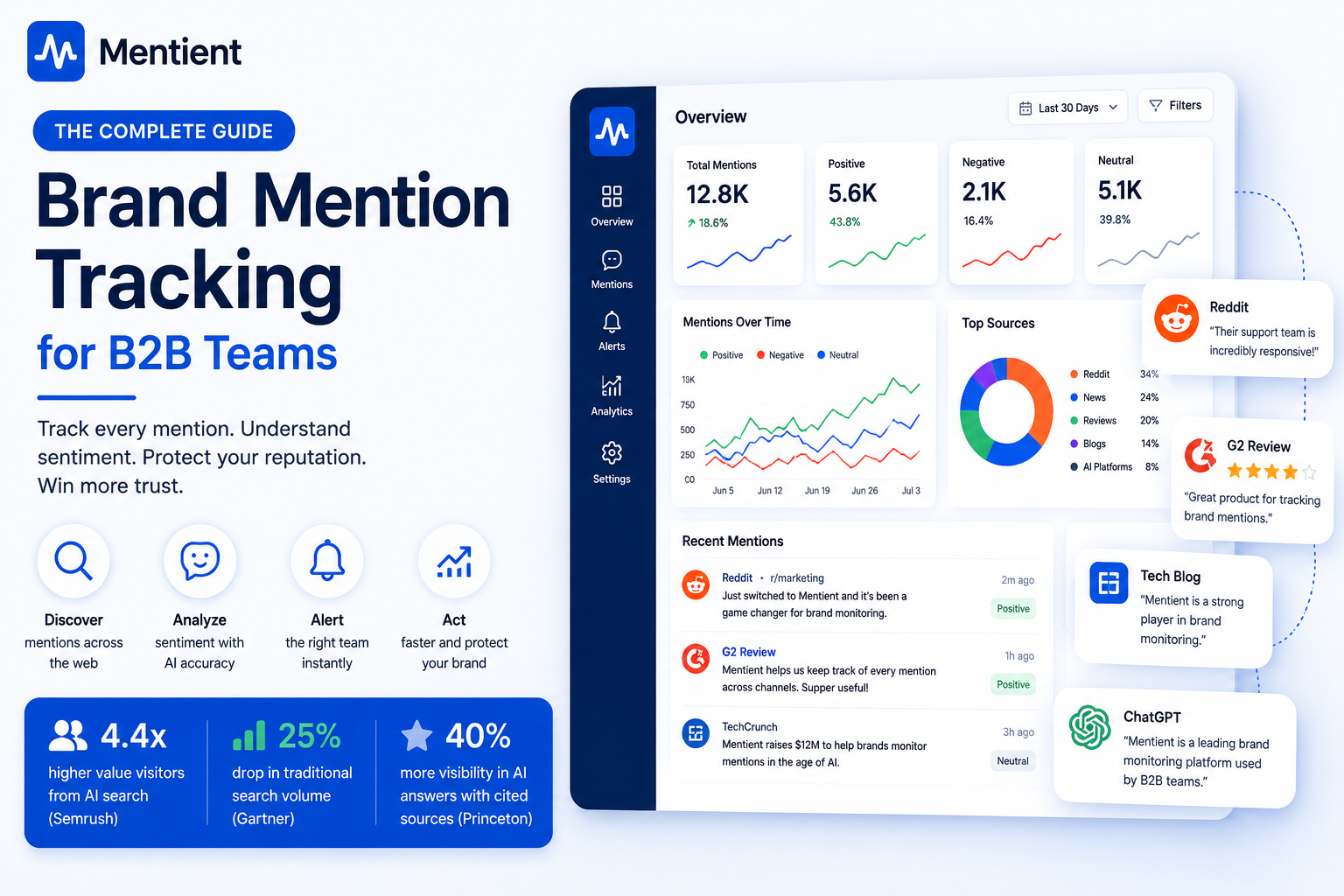
Somewhere this week, a buyer asked strangers on the internet whether your product is worth the money, and the strangers answered. Brand mention tracking is the discipline of finding those conversations while they are still happening: every post, review, article, and AI answer that names your company, collected in one place and read for sentiment. The case for it recently got simpler to make. As we write this, the top result on Google for this exact phrase is a Reddit thread of marketers asking each other which tool to use. This guide covers what brand mention tracking is, why it earns budget now, the channels that produce mentions worth acting on, and how AI changed the job.
Key takeaways
- Brand mention tracking continuously collects every post, review, and article naming your brand, then scores what needs a response.
- A Reddit thread ranks first on Google for this exact query, which tells you where the conversations live.
- Semrush measured AI search visitors at 4.4 times the value of organic visitors, and AI answers get assembled from your mentions.
- Keyword-match tools misread sarcasm and buried complaints; LLM-based reading is the practical fix.
- Four channels carry most B2B weight: Reddit and forums, review platforms, news and blogs, and now AI assistants.
What is brand mention tracking?
Brand mention tracking is the practice of continuously collecting every mention of your brand name, products, and executives across the web, then scoring each one for sentiment and urgency so your team knows what needs a response. A brand mention is any reference to your company, linked or unlinked, from a Reddit comment to a news article to a line inside a ChatGPT answer. The tracking part is what separates the discipline from an occasional vanity search.
Two neighboring terms are worth pinning down, because vendors blur them constantly. Social listening is the broad research practice: topics, audiences, and cultural trends across social platforms. Brand mention tracking is the narrower operational layer underneath it, focused on your own name and your competitors', running all the time, with alerts wired to people who can act. Brand monitoring is the product category built around that layer.
The unlinked mention deserves its own sentence. When someone writes "we switched away from [your product] over the pricing change" in a forum with no link attached, no analytics tool will ever show it to you, yet that sentence influences every buyer who reads it. Unlinked mentions outnumber linked ones by a wide margin in most B2B categories, and they are the ones brand mention tracking exists to catch.
What a missed mention costs a B2B team
Start with the obvious cost: the thread you never answered. B2B buying committees read community threads during evaluation, and a specific unanswered complaint (wrong by the time of reading, perhaps, but visible) does quiet damage for years. A considered reply posted while the thread had 12 upvotes would have changed how every later reader received it. Threads age; their Google rankings do not.
A newer cost sits inside AI answers, and the scale crept up on most teams. OpenAI announced 800 million weekly ChatGPT users (TechCrunch) in October 2025, and a slice of those sessions are your buyers building shortlists. When one of them asks ChatGPT or Perplexity which vendor to consider, the model assembles its answer from the web's consensus about you, which is to say, from your mentions. Semrush's AI search traffic study measured visitors arriving from AI search at 4.4 times the value of traditional organic visitors (Semrush), and Gartner's February 2024 forecast projected a 25% drop in traditional search volume (Gartner) as assistants absorb queries. Follow the chain: mentions feed models, models advise buyers, buyers arrive pre-sold or never arrive at all.
Brand mention tracking is the feedback loop that tells you what that consensus currently says, while there is still time to change it. Skipping it means learning about your reputation from a lost deal's exit interview.
The channels that matter for brand mention tracking
Coverage claims from vendors tend toward "millions of sources", which is true and unhelpful. For a B2B team, four channels produce nearly all the mentions worth acting on, and each behaves differently.
| Channel | What shows up there | Response window |
|---|---|---|
| Reddit and niche forums | Candid opinions, comparison threads, complaints | Hours; threads set their trajectory early |
| Review platforms | Structured praise and grievances from real users | Days; reviews compound over months |
| News, blogs, publications | Coverage, roundups, analyst commentary | Same week; citable for years |
| AI assistants | Your brand inside generated answers | Monthly measurement; slow to shift |
Reddit and niche forums
Reddit is where B2B software gets discussed without a vendor in the room, and Google has noticed: community threads now rank for high-intent commercial queries, including, as noted above, the top spot for this article's own topic. The subreddits that matter are often small. A 4,000-subscriber community for your buyer's job title moves more pipeline than r/technology ever will. Threads here need the fastest response of any channel, which makes them the first place brand mention tracking should be pointed.
Review platforms
G2, Capterra, and Trustpilot mentions carry double weight. Buyers read them directly during evaluation, and AI engines treat review consensus as ground truth when describing your product. A recurring complaint across eight reviews becomes the sentence ChatGPT uses about you. Tracking here is less about speed and more about pattern detection: the individual review matters less than the theme forming across ten of them. When a theme does form, the fix belongs in two places at once, a product ticket for the underlying issue and a public reply that shows later readers the company was paying attention.
News, blogs, and industry publications
Press mentions arrive slower and last longer. A product roundup in an industry publication feeds your pipeline for years, and it now feeds the retrieval systems behind AI search as well; the listicles ranking for your category keywords are among the pages Perplexity cites most. Media monitoring covers this half of the job: knowing which outlets mention you, in what context, and which coverage spikes deserve a follow-up pitch.
AI assistants, the channel nobody tracked in 2023
The newest surface for a brand mention is inside a generated answer. When Perplexity names three vendors for a category question, each name is a mention with commercial consequences, and most teams have no idea what gets said. Measuring this means running category prompts on a schedule and logging the results; our complete guide to AI search visibility covers the full framework. One fact worth carrying over from that guide: the Princeton GEO research found content with sourced statistics earned up to 40% more visibility (arXiv) in generated answers, so the mentions you earn and the content you publish compound in the same system.
A note on social networks: they still matter for B2B, but closed APIs have made deep third-party tracking of most of them unreliable. Prioritize the four channels above, where the candid conversations happen and the data is reachable.
How to set up brand mention tracking that holds up
The setups that survive past month two share the same shape. The ones that die usually skipped step four.
- Define the term list. Your brand, common misspellings, product names, executive names, and your top three competitors. Ten to twenty terms; more than that and the noise swamps the signal.
- Map the channels and name an owner for each. Reddit alerts going to a shared inbox nobody owns is the classic failure. One name per channel, even at a five-person company.
- Set alert rules by urgency rather than volume. A negative spike or a high-traction thread pages someone immediately. A neutral blog mention waits for the weekly digest. Treating every mention as urgent trains the team to ignore all of them.
- Route mentions to the team that can act. Support complaints go to support, feature requests to product, journalist mentions to comms. Brand mention tracking earns its keep at the routing step; a dashboard nobody's workflow touches is decoration.
- Review the aggregates monthly. Mention volume, sentiment ratio, and share of voice against the competitors on your term list. Competitor tracking makes that last number a standing benchmark rather than a quarterly research project.
Maintain the term list quarterly. Product launches add names, rebrands retire them, and a competitor you dismissed in January can own a third of your category mentions by June. A stale term list is the quiet way brand mention tracking degrades: the dashboard stays green while the conversation moves somewhere you stopped listening.
Free tooling covers a slice of this. Google Alerts catches indexed news and blogs, and costs nothing. It also skips Reddit almost entirely, scores nothing for sentiment, and frequently arrives days late. Fine for a personal project; a gamble for a brand with revenue attached.
How AI changes brand mention tracking
The old generation of tools matched keywords. A keyword match proves someone typed your name and nothing else, which is how "another flawless release, guys" ends up counted as praise. Language models changed the reading layer: Claude, the model Mentient runs on, reads each mention in full context and scores what the writer meant, sarcasm and hedged complaints included. The sentiment data starts being worth acting on, and the escalation calls (reputation management territory) start being made on tone rather than word lists.
AI also fixed the volume problem. At 1,200 mentions a month, nobody on the team is reading everything, so the tools now write the summary: what changed this week, which narratives are forming, which single thread needs a human today. Reading fifty summaries takes ten minutes. That difference is what moves brand mention tracking from an aspiration to a habit, and habits are the only version of monitoring that survives a busy quarter.
Worth being clear about what AI does not fix. Routing still needs owners, response tone still needs judgment, and no model will apologize to an angry customer for you. We have watched teams buy sophisticated tooling and change nothing, because the mentions still landed in a channel nobody checked. The reading layer got automated; the acting layer did not.
Mentient's version of all this runs Reddit and open-web collection through Claude scoring, with urgency flags, plain-English digests, and an AI visibility layer that reports how ChatGPT and Perplexity describe your brand alongside the mentions that shaped those descriptions. The method in this guide works with any tooling, though, including a spreadsheet and discipline. The tooling determines the effort, and the routing determines the value.
Where to go from here
Start smaller than feels productive. Write the term list today, point coverage at Reddit and your review platforms this week, and let a month of baseline data accumulate before tuning anything. By week six you will know your normal mention volume and sentiment ratio, which means the first abnormal week will announce itself. Brand mention tracking pays off the day something unusual happens, and the setup cost is a fraction of one mishandled thread. The cluster guides below cover the adjacent disciplines, starting with how those tracked mentions turn into AI search visibility.
Frequently asked questions
What is a brand mention?
A brand mention is any reference to your company, product, or people anywhere online, with or without a link. A Reddit comment, a G2 review, a podcast transcript, and a line in a ChatGPT answer all count. Linked mentions are easier to find; the unlinked ones usually carry the candid opinions.
What is the difference between brand mention tracking and social listening?
Scope. Social listening researches whole topics, audiences, and trends across social platforms. Brand mention tracking is the narrower, operational subset: your name, your products, and your competitors, collected continuously and routed to whoever needs to respond. Teams usually need the narrow version working before the broad version tells them anything useful.
Can you do brand mention tracking for free?
Partially. Google Alerts covers indexed news and blogs at zero cost, and manual Reddit searches catch some threads. The gaps are real, though: Alerts skips Reddit almost entirely, offers no sentiment scoring, and often delivers mentions days late. A free setup works as a starting point for a small brand with light mention volume; teams tend to outgrow it the first time a thread blows up unnoticed over a weekend.
Do unlinked brand mentions help SEO?
They help visibility in two ways we can observe. Search engines use mentions as brand signals when evaluating entity authority, even without a link. More measurably, AI engines build answers from consensus across mentions, linked or otherwise, so unlinked mentions on trusted sources feed the recommendations ChatGPT and Perplexity give buyers. We would treat the second effect as the bigger prize in 2026.
How quickly should a team respond to a negative mention?
Within hours for anything gaining traction, and the same day for the rest. A Reddit thread's trajectory is usually set early: a considered reply from the company while the thread has a dozen upvotes reads as accountability, while the same reply after ten thousand upvotes reads as damage control. One caution from watching this play out repeatedly: speed matters less than tone. A fast defensive reply does more harm than a slower honest one, so give whoever owns responses the authority to admit fault without a three-step approval chain.