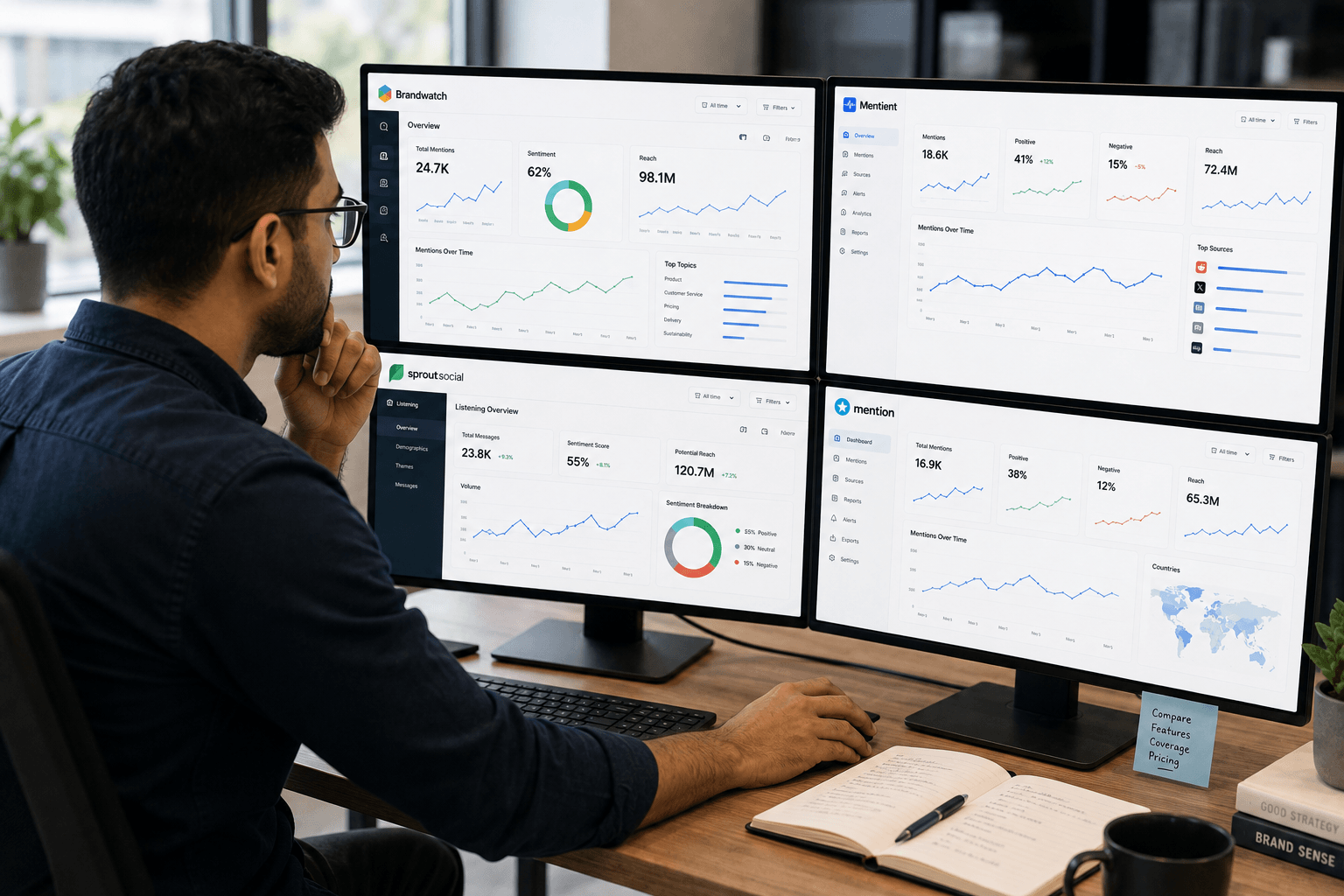
Brandwatch does not publish pricing anywhere on its site. Every plan starts with a sales call, and based on real purchase data, the median annual contract lands around $50,000, with a documented range from roughly $15,000 to over $75,000 a year. That works for a global enterprise brand with a dedicated insights team. It is a hard number to justify for a mid-market company that just wants to know when its brand gets mentioned and what people are actually saying. This guide compares eight tools people switch to instead, starting with where Mentient fits, then covering seven established alternatives with real, sourced pricing.
- Brandwatch has no public pricing. Real contract data puts the median annual spend near $50,000, with documented deals ranging from about $15,000 to over $75,000 a year.
- Pricing opacity is the top reason teams start comparing alternatives, followed by setup burden, interface complexity, and paying for listening depth a lean team never actually uses.
- Mentient covers media, social, reviews, and AI answer engines in one platform with transparent published pricing, built specifically for teams that outgrew a basic mention alert but do not need a six-figure enterprise contract.
- Published pricing across the other seven tools spans roughly $69 a month to $75,000 a year, so the right fit depends heavily on team size, mention volume, and how much of the workflow needs to run outside the listening tool itself.
- Several vendors, including Mention and Meltwater, have moved toward annual-only or quote-only pricing recently, which is worth checking directly before assuming a monthly number still applies.
Why teams shop Brandwatch alternatives
Brandwatch built its reputation on enterprise-grade data coverage and deep historical archives, and for a global brand with a dedicated social intelligence team, that depth earns its price. The complaint pattern from teams that leave usually has less to do with data quality and more to do with fit. Pricing opacity tops the list: there is no way to self-serve a quote, every deal starts with a sales call, and the number that eventually comes back often surprises teams that assumed a mid-market platform would carry a mid-market price.
Setup burden and interface complexity show up close behind. A platform built to model enterprise-scale conversation volume across dozens of markets asks a lot of a five-person marketing team that mostly needs to know when a competitor launches a feature or a customer complaint starts trending. The honest read: Brandwatch is not a bad product. It is frequently the wrong-sized product for the buyer evaluating it.
Quick comparison table
| Tool | Starting price | Best for |
|---|---|---|
| Mentient | Published, transparent tiers | Media, social, reviews, and AI answer engines in one platform |
| Sprout Social | From $79/mo, listening add-on from $249/mo | Teams wanting listening bundled with publishing and engagement |
| Meltwater | Custom, annual only, roughly $10,000+/yr | PR-heavy teams needing media database plus listening |
| Talkwalker | Custom, roughly $9,000+/yr for one seat | Large enterprises wanting a Brandwatch-scale alternative |
| YouScan | From $499/mo billed annually | Visual listening, image and logo recognition |
| Mention | $599/mo, single plan, annual commitment | Teams needing a straightforward mention cap and dashboard |
| Brand24 | From $199/mo billed annually | Small teams wanting AI insights without enterprise cost |
| Mentionlytics | From $69/mo | Budget-conscious teams needing core monitoring only |
Pricing reflects publicly reported figures as of August 2026 and can change; confirm current rates directly with each vendor before budgeting.
1. Mentient
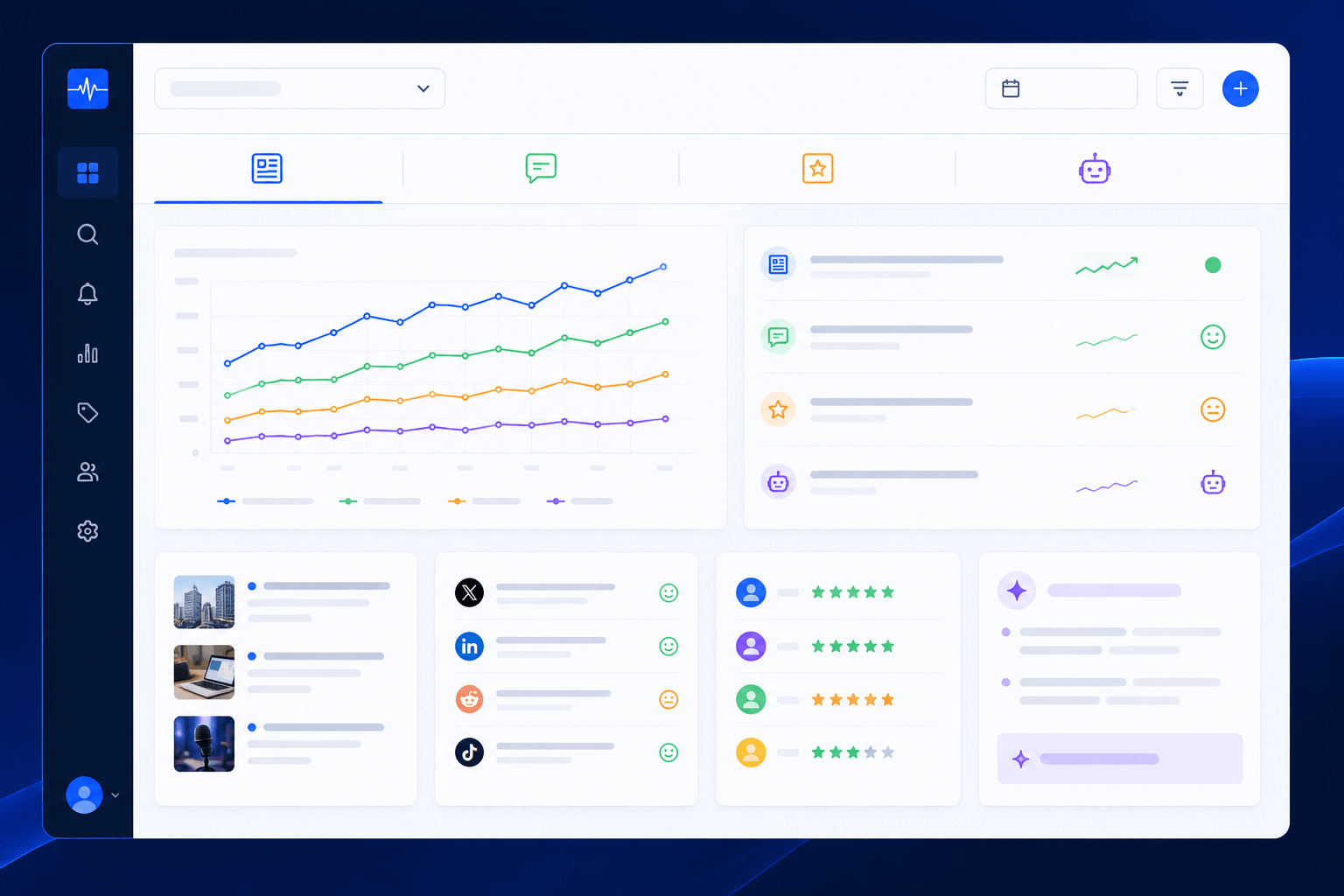
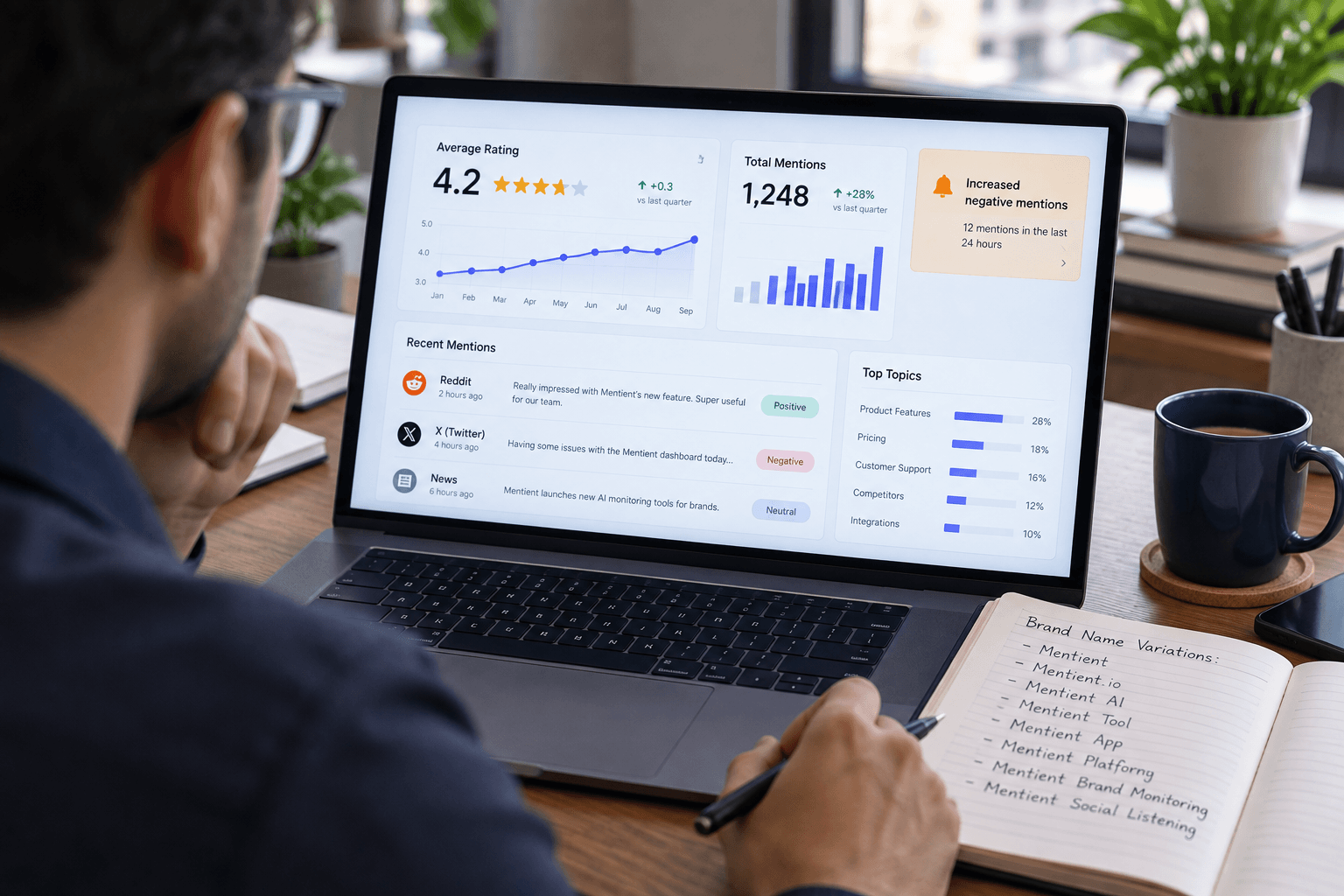
We built Mentient because the gap between a basic mention alert and a $50,000 enterprise platform was too wide for most of the teams we talked to. Mentient tracks news coverage, social conversation, customer reviews, and Reddit and forum threads from one dashboard, with pricing published on the site rather than gated behind a sales call.
The part that separates it most from the legacy platforms on this list: AI answer engine tracking. ChatGPT, Perplexity, and Google AI Overviews now shape a real share of how people research a brand before they ever open a social feed, and most listening tools built before 2023 have no idea what those engines are saying. Context-aware AI monitoring tracks citation and sentiment together across those engines, not just a binary mention count.
Strengths: transparent pricing, unified dashboard across five channel types, purpose-built AI answer engine tracking, faster setup than an enterprise listening platform. Consider instead if: you need decades of historical social archive data for academic-scale trend research, which is Brandwatch's specific strength at its price point.
2. Sprout Social
Sprout Social's base plans start around $79 per seat per month, but the listening functionality specifically sits in a higher tier, with Sprout's own listening add-on starting near $249 a month on top of a base plan. That structure works well for teams that want publishing, engagement, and listening bundled under one login rather than running separate tools. Teams that only need listening, without the publishing calendar, often find themselves paying for features they will not touch.
Strengths: tight integration between listening and scheduling, strong reporting for social-first teams. Consider instead if: your team already has a separate publishing tool and only needs standalone monitoring.
3. Meltwater
Meltwater does not publish pricing and sells exclusively on annual contracts, with third-party analysis pointing to a starting range near $10,000 a year and a median buyer paying around $25,000 annually depending on modules, seats, and data volume. It is closest in shape to Brandwatch itself: strong media database, deep PR workflow tools, built for teams that need press monitoring and social listening under one enterprise contract.
Strengths: combined PR and social monitoring, strong media contact database. Consider instead if: the quote-only, annual-only structure is exactly the friction you are trying to leave behind by switching off Brandwatch.
4. Talkwalker
Talkwalker sits at a similar price tier to Brandwatch, with reported starting costs around $9,000 a year for a single seat and enterprise deals scaling into six figures for larger teams. It is a legitimate consideration for a brand that needs Brandwatch-level data depth but wants a second vendor to benchmark pricing against during a renewal negotiation, rather than a genuinely cheaper alternative.
Strengths: strong image and video recognition, broad global data coverage. Consider instead if: budget, not just vendor fatigue, is the reason you are shopping alternatives.
5. YouScan
YouScan starts near $499 a month on annual billing, positioned specifically for brands and agencies that need strong visual listening, meaning logo and image recognition inside photos where a brand is never mentioned by name in the caption. That is a real gap in most text-first listening tools, and it is the clearest reason to pick YouScan over a cheaper text-only competitor.
Strengths: image and logo recognition, strong for consumer brands with heavy visual presence on Instagram and TikTok. Consider instead if: your monitoring need is primarily text-based news, reviews, and forum conversation.
6. Mention
Mention restructured its pricing in mid-2025, retiring its self-serve Solo, Pro, and Pro Plus tiers in favor of a single Company plan at $599 a month, sold on annual commitment with a 50,000 monthly mention cap shared across all alerts. Social publishing and engagement features that used to live inside Mention were retired in January 2026, so teams now need a separate tool like Agorapulse for that side of the workflow. Worth confirming current terms directly before assuming the old tiered pricing still applies.
Strengths: straightforward setup, clean alert structure. Consider instead if: you need publishing and engagement bundled in, or a lower entry price than a single $599/mo tier.
7. Brand24
Brand24 runs five tiers from Individual through Enterprise, starting around $199 a month on annual billing for 3 keywords and 2,000 mentions, up to $1,499 a month at the Enterprise tier with unlimited AI Insights and a dedicated consulting team. Monthly billing runs 20 to 25% higher than the annual rate across the board. It is a reasonable middle ground for a small team that has outgrown a free alert tool but does not need enterprise-scale data volume.
Strengths: clear tier structure, AI-generated insight summaries, accessible entry price. Consider instead if: your mention volume regularly exceeds the lower-tier caps, since costs climb quickly past the Individual plan.
8. Mentionlytics
Mentionlytics is the lowest published entry price on this list, starting around $69 a month for its Basic tier, with published pricing varying somewhat by source between roughly $69 and $169 for the entry tiers depending on billing terms, so it is worth confirming the current rate directly before budgeting. It fits teams that want core mention tracking and sentiment scoring without a large feature set attached.
Strengths: lowest entry cost on this list, simple setup. Consider instead if: your team needs deeper competitive benchmarking or AI-generated reporting, which sit in Mentionlytics' higher tiers.
How to choose
Start with what actually drove you to look at alternatives in the first place. If it was pricing opacity specifically, cross off anything on this list that is still quote-only, since you will be back in the same sales-call cycle within a year. If it was setup burden and interface complexity, weight tools with faster time-to-first-mention over ones with the deepest feature list. If it was paying for enterprise-scale data your team never used, size the plan to your actual mention volume rather than your aspirational one.
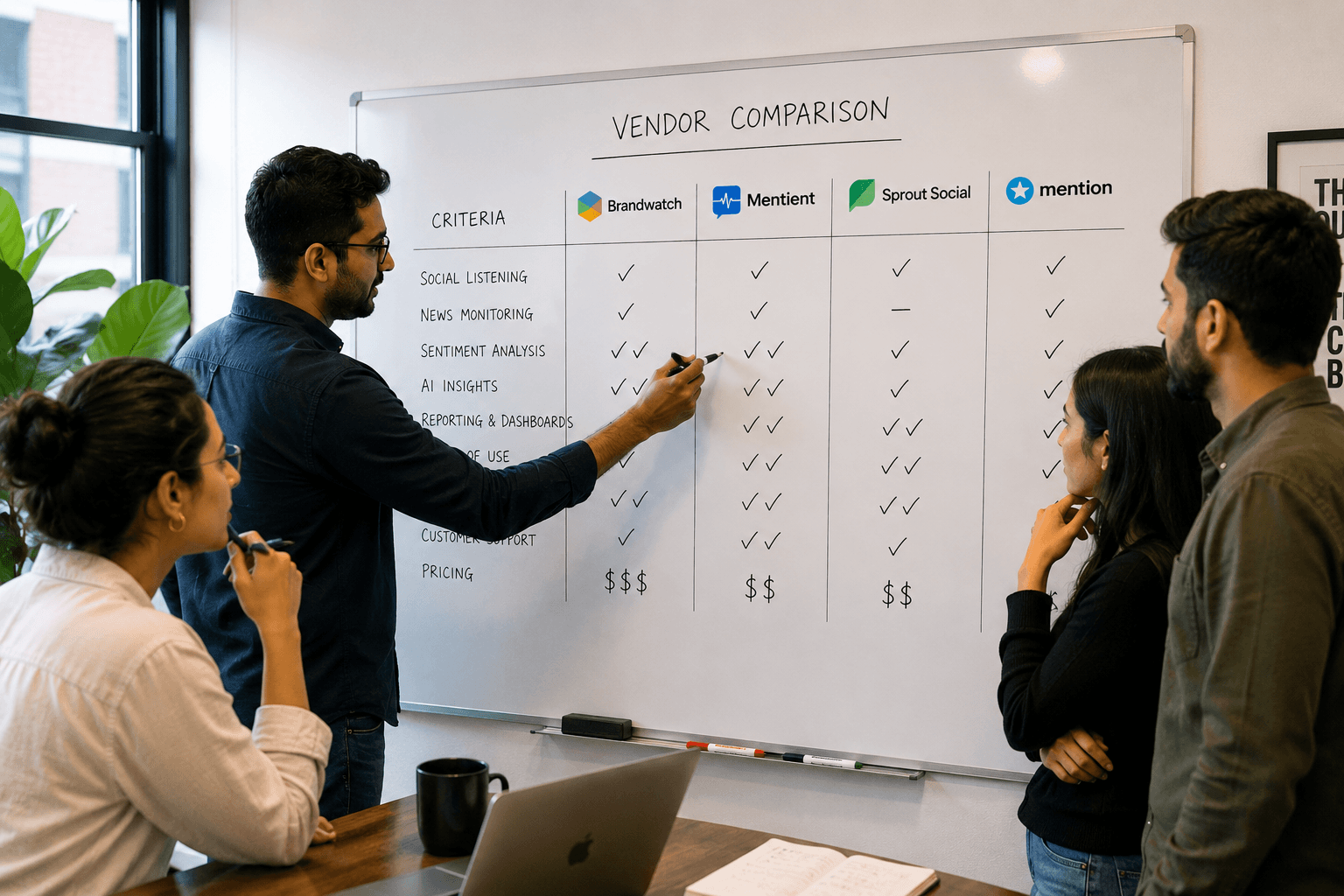
Agencies managing this across multiple client accounts should weigh reporting built for agency workflows heavily in the decision, since rebuilding a dashboard from scratch for every client is its own hidden cost that rarely shows up in a pricing comparison. SaaS teams selling to a technical buyer should check coverage of developer-heavy channels like forum threads and technical review sites, not just mainstream social. PR-focused teams need a tool that treats press as a core channel, not an afterthought bolted onto a social listening core, and reputation-sensitive brands should confirm review response workflows are actually built in rather than exported to a spreadsheet.
Frequently asked questions
Why doesn't Brandwatch publish its pricing?
Enterprise software vendors selling large, customizable contracts often price by module count, data volume, and seat count rather than a fixed tier, which makes a public price list impractical. It also lets sales teams tailor a quote to what a buyer seems willing to pay, a common enterprise sales practice that trades transparency for negotiating flexibility.
Is a cheaper alternative always the better choice?
Not automatically. Weigh mention volume and channel mix over sticker price.
Can I migrate historical mention data from Brandwatch to a new tool?
Most listening platforms, including Mentient, can import historical mention exports during onboarding, though the format and completeness varies by vendor and by how the export was originally structured. It is worth asking about migration support specifically during a sales conversation rather than assuming it is included, since some vendors treat it as a paid add-on and others build it into standard onboarding at no extra charge, which can meaningfully change the real cost of switching in the first few months. A quick way to test this before signing anything: ask the sales rep to walk through an actual sample export from your current tool, live, rather than describing the process in the abstract, since the gap between what a vendor says migration involves and what it actually involves shows up fastest when you watch someone attempt it.
Do any of these tools track mentions inside AI chatbots like ChatGPT?
Mentient does, natively. Most of the other tools on this list were built before generative AI search became a meaningful discovery channel and have not added dedicated AI answer engine tracking as of this writing, which is a real functional gap worth checking directly with any vendor if that channel matters to your brand.
Every tool on this list can track mentions. The differences that actually matter show up in pricing transparency, setup time, and whether the channel mix matches where your audience actually shows up, including the AI answer engines most of these platforms still treat as an afterthought. Pull your current mention volume and channel breakdown before your next sales call, on any of these tools, and use it to push past the generic demo pitch toward a number that fits what you actually need.
See transparent pricing built for teams outgrowing basic alerts
Mentient tracks news, social, reviews, forums, and AI answer engines in one dashboard, with pricing published on the site instead of gated behind a sales call. Start free and see your own mention data today.
Start free trial