Most small business owners know what people think of them, right up until they do not. A regular walks in and mentions a one-star review you never saw. A local Facebook group has been arguing about your prices for a week. Social listening for small business is how you close that gap without hiring an agency or buying enterprise software. It is the practice of tracking what people say about your business online, then acting on it, and for a small team it can start with tools you already have and about twenty minutes a week. This guide covers what to track, how to set it up on a tight budget, and how to turn what you find into paying customers.
- ✓Start free. A useful setup runs on Google Alerts, native search, and twenty minutes a week.
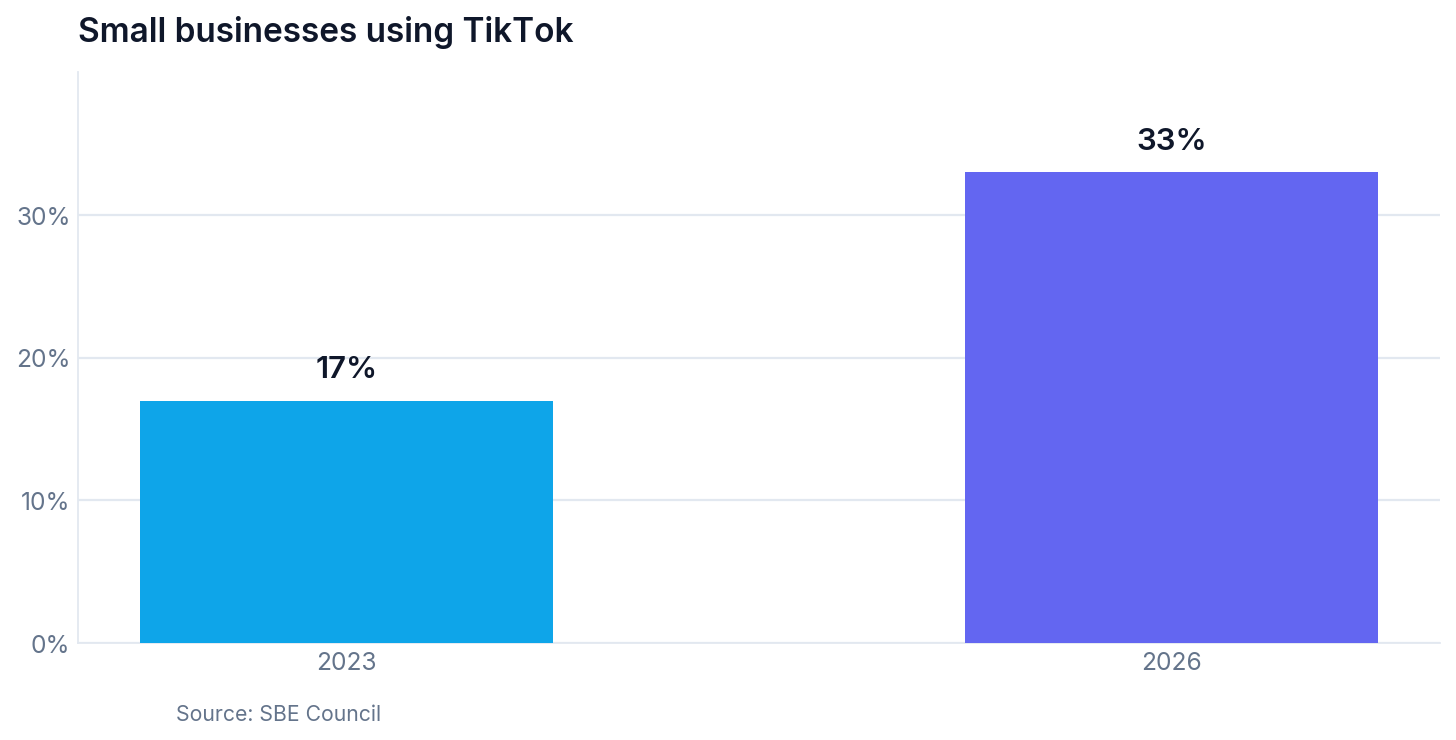
- ✓Your customers already moved. SMB TikTok use jumped from 17% to 33%, so your coverage has to follow.
- ✓Coverage beats brand name. Most mentions never tag you; track misspellings, your town, and competitors.
- ✓Reputation is fragile. 54% of people lose trust in a brand after a scam near it, even an unrelated one.
- ✓Act, or skip it. A finding nobody acts on is wasted time you do not have.
What is social listening for a small business?
Social listening for a small business is the practice of tracking public conversations about your business, your competitors, and your local market, then using what you learn to make a decision. It is broader than social monitoring, which only watches direct mentions and replies to your own accounts. Monitoring catches the reviews tagged to you; listening catches the ones that are not, which for a small business is most of them.
That difference matters more when you are small, because you do not have a support desk fielding every complaint. A frustrated customer is far more likely to vent in a local group or a Google review than to @ your handle. If you only watch your own notifications, you are watching the smallest, politest slice of the conversation. We break down the full definition in our guide on what social listening is, so here we will focus on the version that fits a team of one to ten people.
Here is the reassuring part. You do not need a dedicated analyst or a five-figure tool to do this well. You need a short list of things to track, a place to see them, and a habit of checking. The rest of this guide builds exactly that.
What a small business gets from social listening
Social media is where small businesses are placing their bets. In a January 2026 survey of more than 1,500 owners, 68% said social media posting and paid ads would drive the most value for their business this year, more than any other channel (Constant Contact via eMarketer). If that is where you are spending time and money, listening is how you find out whether it is working, in the words of actual customers rather than a vanity metric.
The places those customers gather keep shifting, and small businesses have followed. The share of small businesses using TikTok climbed from 17% in 2023 to 33% in 2026 (SBE Council), and among those that use it, nearly half call it critical to staying in business. A listening setup built only around Facebook and your inbox misses the channel that doubled.
There is a defensive case too, and for a small brand it is the sharper one. Trust is thin when nobody has heard of you yet. In one survey, 54% of consumers said their confidence in a brand drops after they run into a scam connected to it, even when the brand did nothing wrong (Clutch via eMarketer). A fake account using your name, a bad-faith review, a rumor in a neighborhood group: you cannot respond to what you never see.
The tools to catch all of this used to be priced for enterprises. That is changing. The global social listening market reached $10.32 billion in 2025 and is projected to nearly double by 2030 (Grand View Research), and the growth has pushed capable, affordable options down-market toward teams your size.
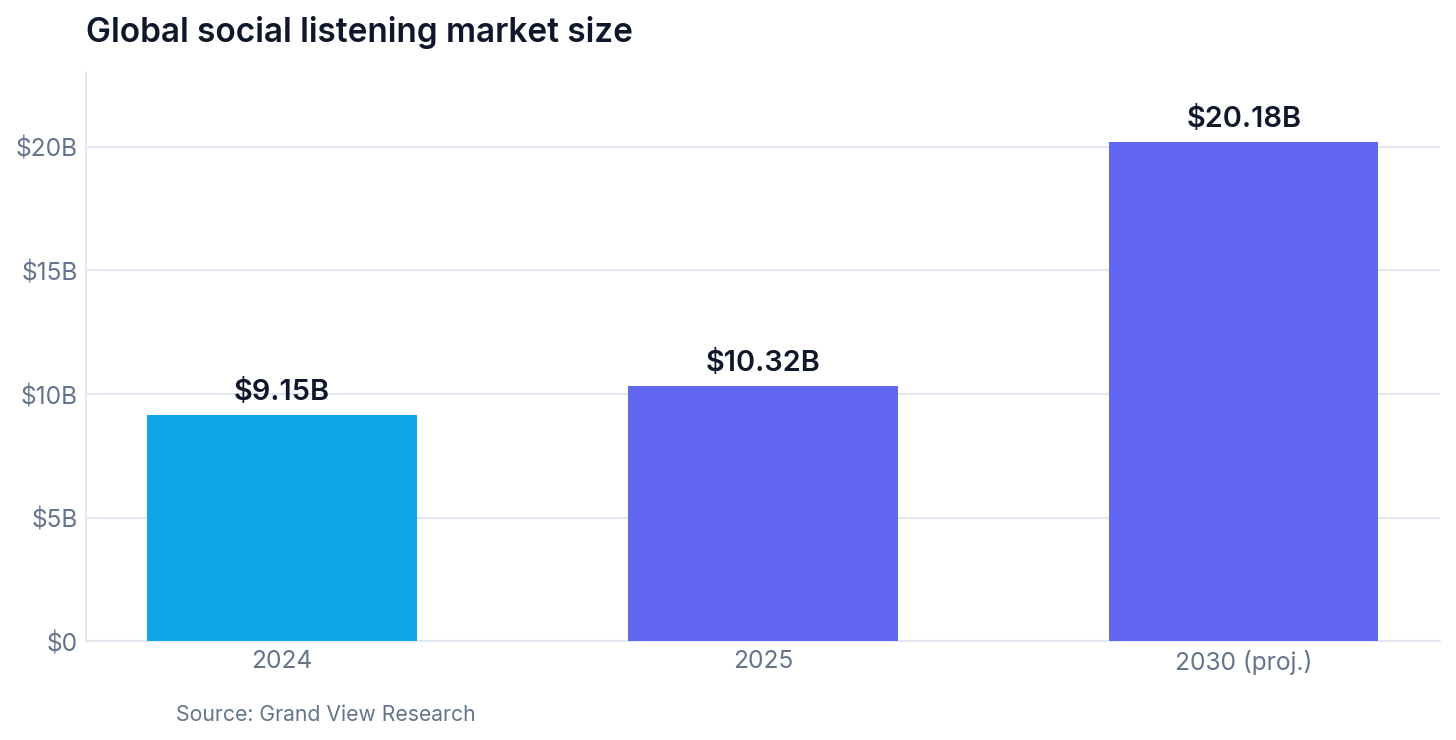
The scale argument is settled. What is left for a small business is picking a starting point and building the twenty-minute habit that keeps it alive.
We keep a running set of brand monitoring statistics if you want the wider numbers, but the takeaway for a small team is simple: the conversation is bigger than your inbox, it is moving, and watching it no longer requires a budget you do not have.
How to start social listening on a small budget
You can stand up a working setup in an afternoon. The five steps below assume one person, no dedicated tool to start, and a real budget of zero.
Step 1: Decide the one question you want answered
Do not try to track everything. Write down the single question this setup exists to answer, phrased the way you would say it out loud. "Are people complaining about our wait times?" or "What are customers saying about the new location?" or "Which competitor are people comparing us to?" One question tells you what to track and what to ignore, and for a small team, ignoring the right things is what makes this sustainable.
Step 2: Build a simple keyword list
Your business name is not enough on its own, because people misspell it, shorten it, and rarely tag you. Build a short list: your business name and its common misspellings, your handles, your branded hashtag, your main competitor, and your town or neighborhood. Then combine them with the operators AND, OR, and NOT to cut the noise.
Here is a worked example for a fictional bakery:
("Sunrise Bakery" OR "Sunrise Bakry" OR @sunrisebakery OR #sunrisebakery)
AND (Denver OR "South Broadway")
NOT (jobs OR hiring)
The first line catches your name even when it is misspelled or hashtagged. The second keeps it local so you are not reading about a Sunrise Bakery three states away, and the last line drops the recruiting posts. Adjust it after you read the first batch of results. You will always tighten something.
Step 3: Set up free alerts and searches
You already have most of what you need. Route these to one place, like a folder or a Slack channel, so you are not hopping between apps.
| Free tool | What it catches | Cost |
|---|---|---|
| Google Alerts | Web pages, news, and blog mentions of your name | Free |
| Native platform search | Posts and comments on Instagram, Facebook, and X | Free |
| Reddit search | Community and local-subreddit threads | Free |
| Google Business Profile and review-site alerts | New reviews as they land | Free |
Reddit deserves a specific mention, because the conversations there are candid in a way review sites rarely are, and they increasingly feed what AI answer engines say about you. We dug into the platform's reach in our Reddit statistics breakdown. For a local business, the neighborhood subreddit is often where the honest opinions live.
Step 4: Put twenty minutes a week on the calendar
A listening setup with no reviewer is just a pile of unread alerts. Block a recurring twenty minutes, once a week to start, to read what came in and flag anything urgent. If your question from Step 1 is crisis-adjacent, like watching a product recall or a service outage, check daily and turn on real-time alerts instead. Match the rhythm to the risk rather than to a fixed habit.
Step 5: Act on what you find
This is the step that separates a useful habit from a chore you drop by month two. When something comes in, do one of three things: reply to it, fix what caused it, or file it as a pattern to watch. A single complaint gets a reply; the same complaint five times gets a change to how you operate. Write down what you changed, even if it is one line in a notes app, so you can see the program earning its twenty minutes.
Free vs paid: when a small business should upgrade
The free stack works until it does not. You will feel the ceiling when the manual checking eats more than your twenty minutes, when you are missing mentions because you cannot watch every platform at once, or when you want to see sentiment and trends over months rather than a scroll of recent posts. Nationally, the shift is already underway: the share of teams running listening on dedicated software rather than spreadsheets rose from 44% to 78% in a single year (MEDM).
When you do look at a paid tool, judge it against your situation, not the feature list on the pricing page. Score two or three options against the same questions.
| What to check | Why it matters for a small team | Question to ask |
|---|---|---|
| Platform coverage | Missing Reddit or reviews means missing your honest feedback | Which platforms and review sites do you cover? |
| Time saved | You want fewer manual checks, without new dashboards to babysit | How much of my weekly checking does this replace? |
| Sentiment accuracy | Bad scoring sends you chasing the wrong post | How do you handle sarcasm and local slang? |
| Alerting | A small team needs the urgent one pushed to it | Can it text or Slack me when something spikes? |
| Pricing | Per-seat plans punish tiny teams | Is there a plan priced for one to five users? |
One capability genuinely improved enough to matter: sentiment scoring. Modern models now reach 93% precision on binary sentiment tasks (Mordor Intelligence), good enough to sort a week of mentions without you reading each one. It still misses sarcasm and inside jokes, so treat the score as a first pass, not a verdict. For a brand-focused setup, purpose-built brand monitoring usually fits a small team better than a general social suite built for scheduling posts.
Common social listening mistakes small businesses make
We see the same handful of misses, almost always in the first month:
- Tracking only your @mentions. The honest conversations do not tag you. Track your name, your misspellings, and your town.
- Forgetting the local angle. For a neighborhood business, the local Facebook group and subreddit matter more than a global hashtag.
- Setting it up and never checking. Alerts with no reviewer are noise. Twenty minutes on the calendar beats a perfect setup nobody opens.
- Reacting to every single post. One angry comment is not a trend. Wait for the pattern before you change how you operate.
- Ignoring competitors. The conversation about why someone left a competitor is your cheapest source of new customers.
How much time does social listening take for a small business?
For most small businesses, twenty to thirty minutes a week is enough to start. That covers reading the week's alerts, replying to anything that needs a response, and noting patterns. If you are watching something time-sensitive, like a launch or a service problem, add daily alerts so an urgent mention does not wait for your weekly review. The setup itself takes an afternoon once, and the habit is what makes it pay off.
Owners often assume they need to check constantly. You do not. A weekly analysis pass plus real-time alerts for genuine emergencies handles almost every small business situation, and it keeps the whole thing inside the time a busy owner can actually spare.
Conclusion
Social listening for a small business works as a focused habit rather than a scaled-down enterprise program: one question, a short keyword list, a few free alerts, and twenty minutes a week to read and act. Start there. You will catch the review you would have missed, find the competitor comparison you can win, and hear the complaint while it is still one voice instead of ten. If you do one thing this week, set up a Google Alert for your business name and its two most common misspellings, and read what comes back. That is social listening, and it costs nothing but the twenty minutes.
FAQ
What is social listening for a small business?
It is tracking public conversations about your business, competitors, and local market, then acting on what you learn. For a small team it usually means a few free alerts and a weekly check, not a dedicated tool or analyst. It is built to catch the mentions that never tag you directly, which is most of them.
Is social listening worth it for a small business?
Yes, because the cost to start is near zero and the payoff is concrete. You catch bad reviews early, find out which competitor people compare you to, and hear complaints while they are still fixable. With 68% of small business owners betting on social media for growth this year, knowing what customers actually say about you protects that bet.
How can a small business do social listening for free?
Start with Google Alerts for your business name and its common misspellings, so web and news mentions land in your inbox. Add the native search on the platforms where your customers post, check your local subreddit and Facebook groups by hand, and turn on review notifications from Google Business Profile. Route it all to one folder or channel, then block twenty minutes a week to read it. That free stack covers most of what a small business needs before it ever pays for a tool.
What is the best social listening tool for a small business?
There is no single best tool, and any that claims to fit every business is selling. The right pick depends on your platforms, your budget, and whether you need one seat or five. Score two or three against the criteria in the free-vs-paid section above.
How is social listening different from social monitoring?
Monitoring watches direct mentions and replies to your own accounts, while listening watches the wider conversation, including the posts that never tag you. Monitoring is the smaller job inside listening.
How often should a small business check social listening?
Once a week is a fine starting cadence for reading alerts and spotting patterns, with real-time alerts layered on for anything urgent like a service outage or a viral post. Tie the frequency to what you are watching. A quiet month needs a weekly glance; a product launch or a brewing complaint needs daily eyes until it settles. The point is a rhythm you can keep, not a dashboard you check out of guilt.
Monitor mentions, sentiment, and AI visibility in real time with Mentient.
Start free trial →