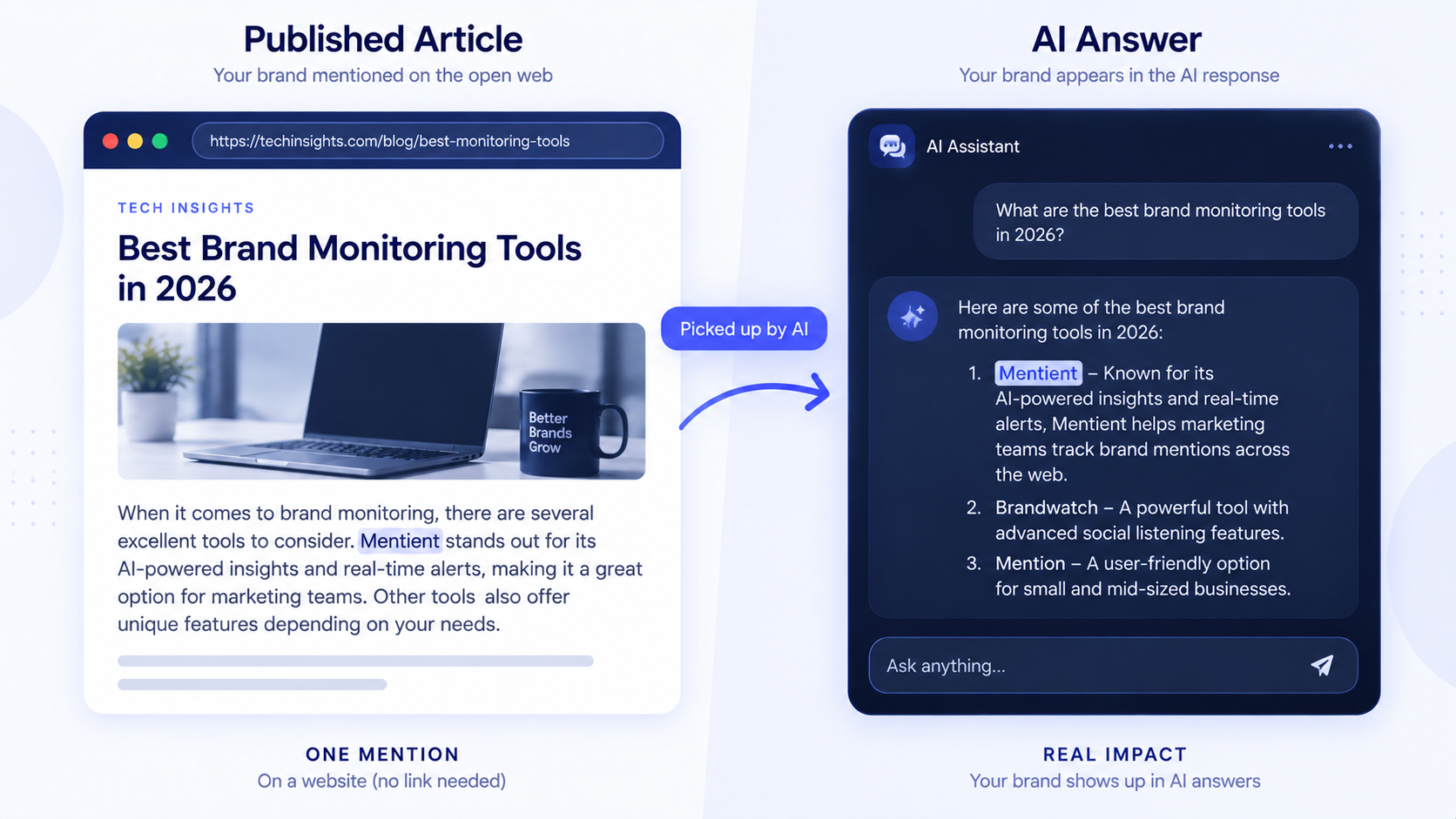
A roundup article names your product among five competitors and links to none of them. A podcast transcript quotes your founder by name with no show notes link. A Reddit comment recommends your tool and never bothers to hyperlink it. None of these show up in Ahrefs, Semrush, or your backlink report, because there is no link to track. They still influence a buyer reading the article, a listener hearing the podcast, and increasingly, the AI assistant that later summarizes that same content into an answer. This guide covers how to actually find unlinked brand mentions, the outreach process that turns some of them into links, and why the ones that never become links still carry real SEO and AI-visibility weight on their own.
- A simple search operator finds most unlinked mentions for free. Searching your brand name in quotes with an exclusion for your own domain surfaces pages that talk about you without linking to you.
- Google has said unlinked mentions are not a direct ranking signal, but they reliably feed entity recognition, and increasingly, which brands an AI assistant chooses to recommend.
- Warm reclamation outreach converts far better than cold link building. Asking someone who already mentioned you to add a link converts at a meaningfully higher rate than asking a stranger to write about you from nothing.
- Not every unlinked mention should become a reclamation target. Some are more valuable left exactly as they are, since a forced link request can read as tone-deaf on a platform like Reddit where promotional asks get called out.
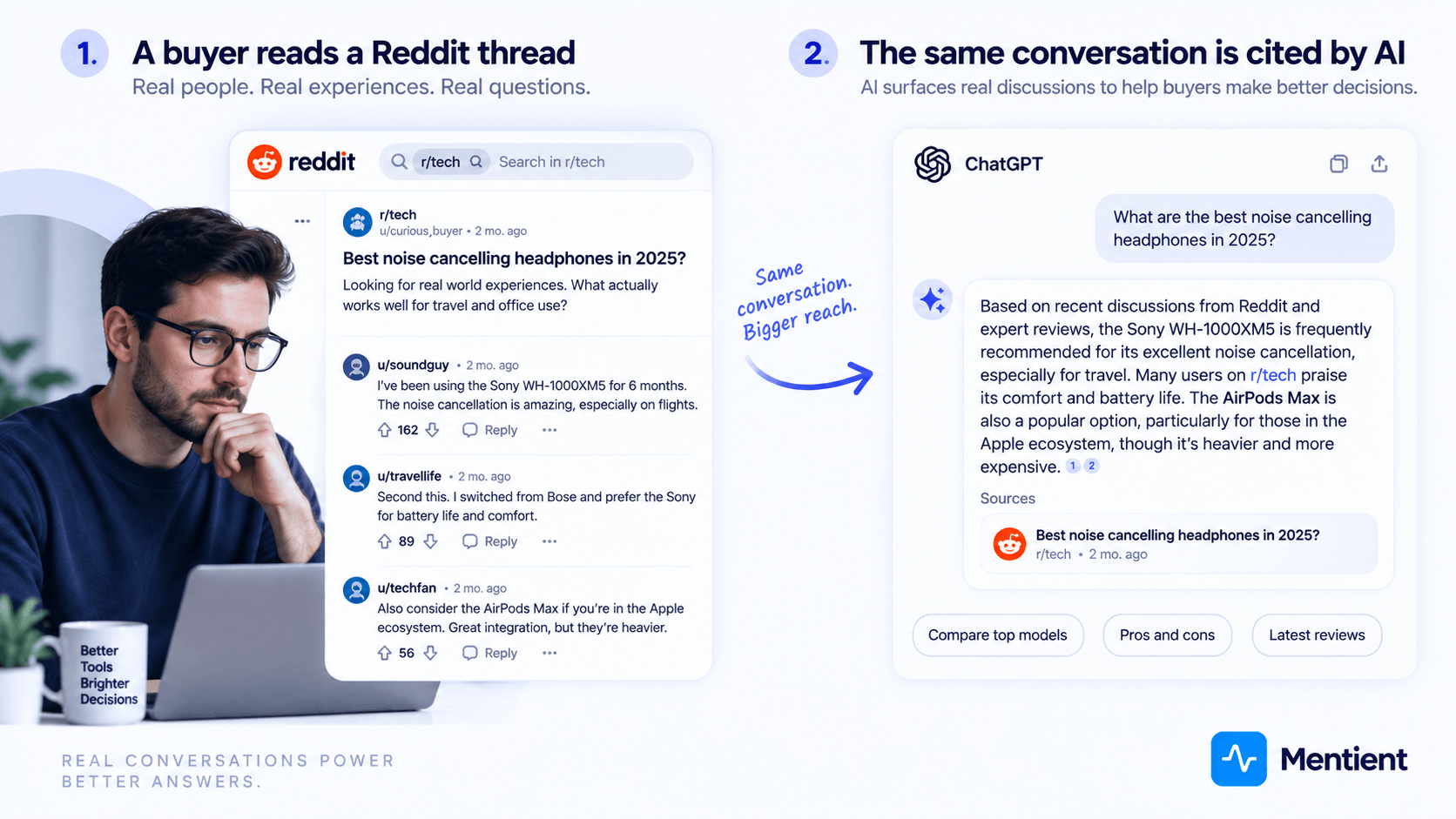
- AI assistants read the mention, not the link. A model summarizing a roundup article pulls your brand into its answer whether or not the article ever linked to you, which makes unlinked-mention tracking relevant even to teams that do not care about traditional link building.
What counts as an unlinked mention
An unlinked mention is any reference to your brand, product, or a named executive in published content that does not include a clickable link back to your site. A comparison article that lists your product by name in a table but only hyperlinks the category, not your brand, counts. A podcast transcript that names your founder as a guest without a show notes link counts. A Reddit comment recommending your tool by name, with no link attached because linking out is against that subreddit's rules, counts too.
This guide sits downstream of our broader piece on brand mention tracking, which covers the full discipline across every channel and response workflow. Here we go deep on one specific slice of that discipline: the tactical process of finding unlinked mentions on purpose, deciding which ones deserve outreach, and understanding what they are worth even when no link ever materializes.
Finding unlinked mentions with search operators
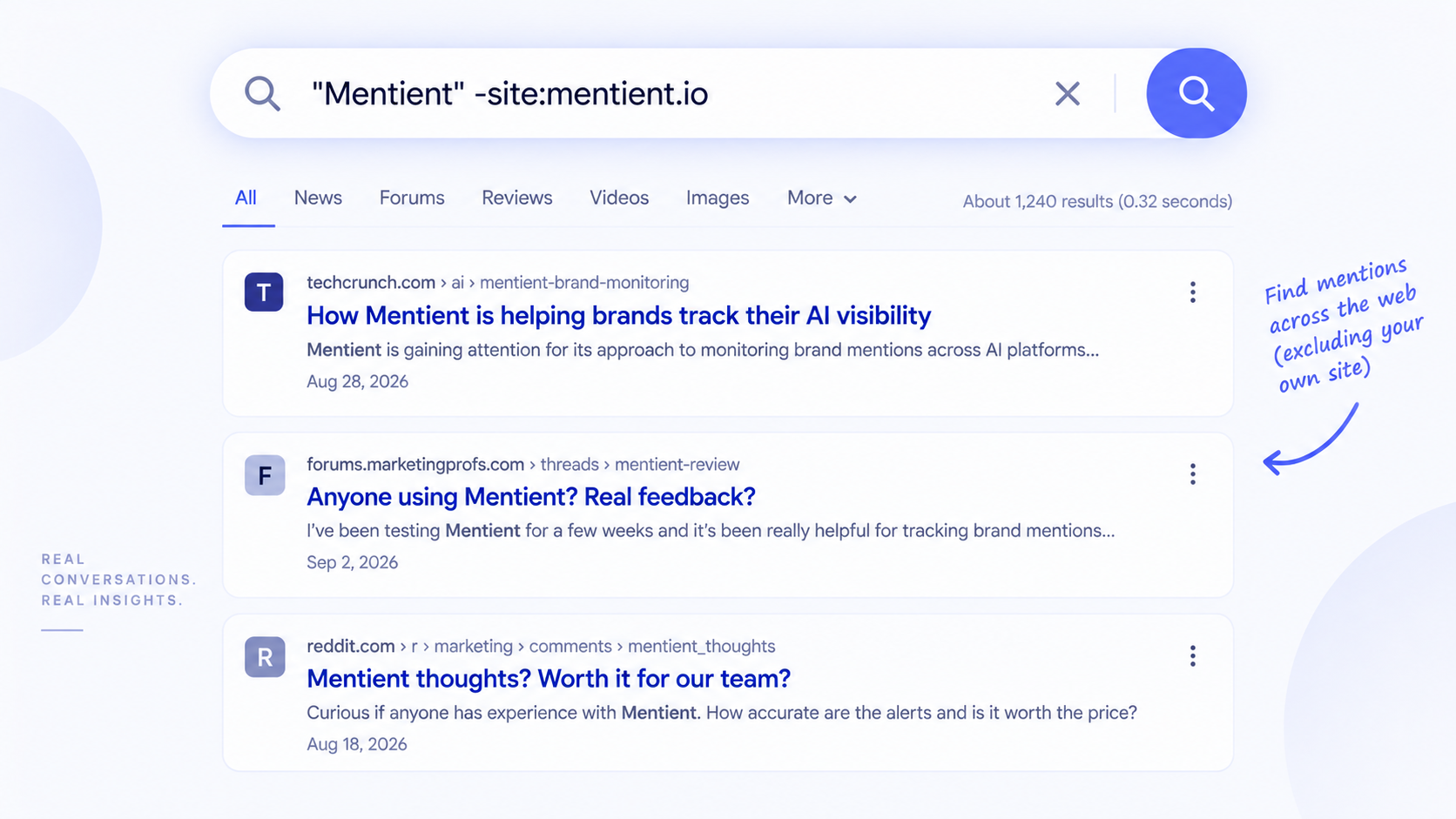
The baseline technique costs nothing and takes thirty seconds to run. Search your exact brand name in quotes, then exclude your own domain with a minus operator:
"Your Brand Name" -site:yourdomain.com
The quotes force an exact phrase match rather than a loose keyword match, and the exclusion strips out your own site so you are only looking at what other people wrote about you. From there, a few refinements narrow the results to the pages most worth your attention:
| Refinement | Example | What it does |
|---|---|---|
| Exclude social platforms | -site:linkedin.com -site:twitter.com | Removes profiles and posts that cannot take a real backlink |
| Narrow to news coverage | site:news.google.com | Surfaces press mentions specifically, which tend to have the highest reclamation value |
| Check the title tag | intitle:"Your Brand Name" | Finds pages where your brand appears in the headline, usually the most prominent mentions |
| Limit to recent coverage | after:2026-06-01 | Focuses on mentions published since your last sweep, so you are not re-reviewing old results |
Run this search for your brand name, your product names, and any spelled-out product category you own a strong position in. Agencies handling several clients should run this sweep per client rather than batching brand names together, since results for a smaller brand can get buried behind a larger one sharing similar keywords. Read the first three or four pages of results by hand rather than trusting the first ten, since the most reclamation-worthy mentions are often buried on page two behind a wave of your own social profiles and directory listings.
Finding them at scale once volume grows
Manual search operators work well for a brand with modest mention volume, but they break down once your name starts appearing in dozens of places a month. At that point, a continuous monitoring setup earns its cost by catching mentions the day they publish, rather than whenever someone remembers to run the search manually.
This is exactly the gap continuous brand monitoring is built to close, since it surfaces both linked and unlinked mentions as they appear, rather than requiring someone to remember to go looking. The practical difference shows up during a coverage spike: a manual search operator run once a week will miss the twelve hours right after a roundup article goes viral, which is precisely the window when a reclamation email lands with the most goodwill, before the writer has moved on to the next piece.
Whichever approach you use, run the sweep on a fixed cadence rather than sporadically. A light weekly scan for new mentions, paired with a monthly batch of outreach for anything worth reclaiming, keeps the backlog from growing into something that feels too large to ever start on. If you want a quick check on whether your brand shows up reliably in the sources AI assistants pull from before investing further, our free AI visibility audit is a useful starting point.
Decide which mentions are worth reclaiming
Not every unlinked mention deserves an outreach email, and treating them all the same way is how a reclamation program burns goodwill fast. Score each mention on two things before you reach out: the authority and relevance of the site it appears on, and whether a link genuinely fits the context or would feel forced.
A mention on an established industry publication or a well-trafficked comparison site is worth the outreach almost every time, since the upside of a real editorial link outweighs the small risk of an ignored email. A mention buried in a low-traffic blog post from years ago is usually not worth the effort, and a mention on Reddit threads or a forum with strong anti-promotional norms should often be left alone entirely, since a reclamation request there reads as exactly the kind of marketer behavior those communities exist to reject.
The fastest way to poison a reclamation program is treating every mention like a link opportunity. Some mentions are more valuable exactly as they are, unlinked and unprompted, than any version you could talk someone into editing.
The reclamation outreach process
Once you have identified a mention worth reclaiming, the process itself is short. Verify first that a link is genuinely missing, rather than simply formatted differently than you expected, since some content management systems strip visible hyperlinks from plain-text brand names without actually removing the underlying reference. Then find the right contact, usually the article's byline author rather than a generic editorial inbox, and send a short note.
Frame the request as a helpful correction rather than a favor. A working template: thank the writer for the mention specifically, note that the piece does not currently link to your site, and offer the exact URL you would like linked, in one or two sentences total. Writers respond far better to a specific, low-effort ask than to a vague request to "consider linking to us," which puts the work of figuring out what you actually want back on them.
This approach converts meaningfully better than cold link-building outreach, since you are asking someone to complete a reference they already chose to make, not convince them to write about you from nothing. Track your reclamation attempts the same way you would any outreach campaign, since the response rate on this kind of warm ask is worth measuring and improving over time rather than treating as a one-off favor.
Why unlinked mentions matter even without a link
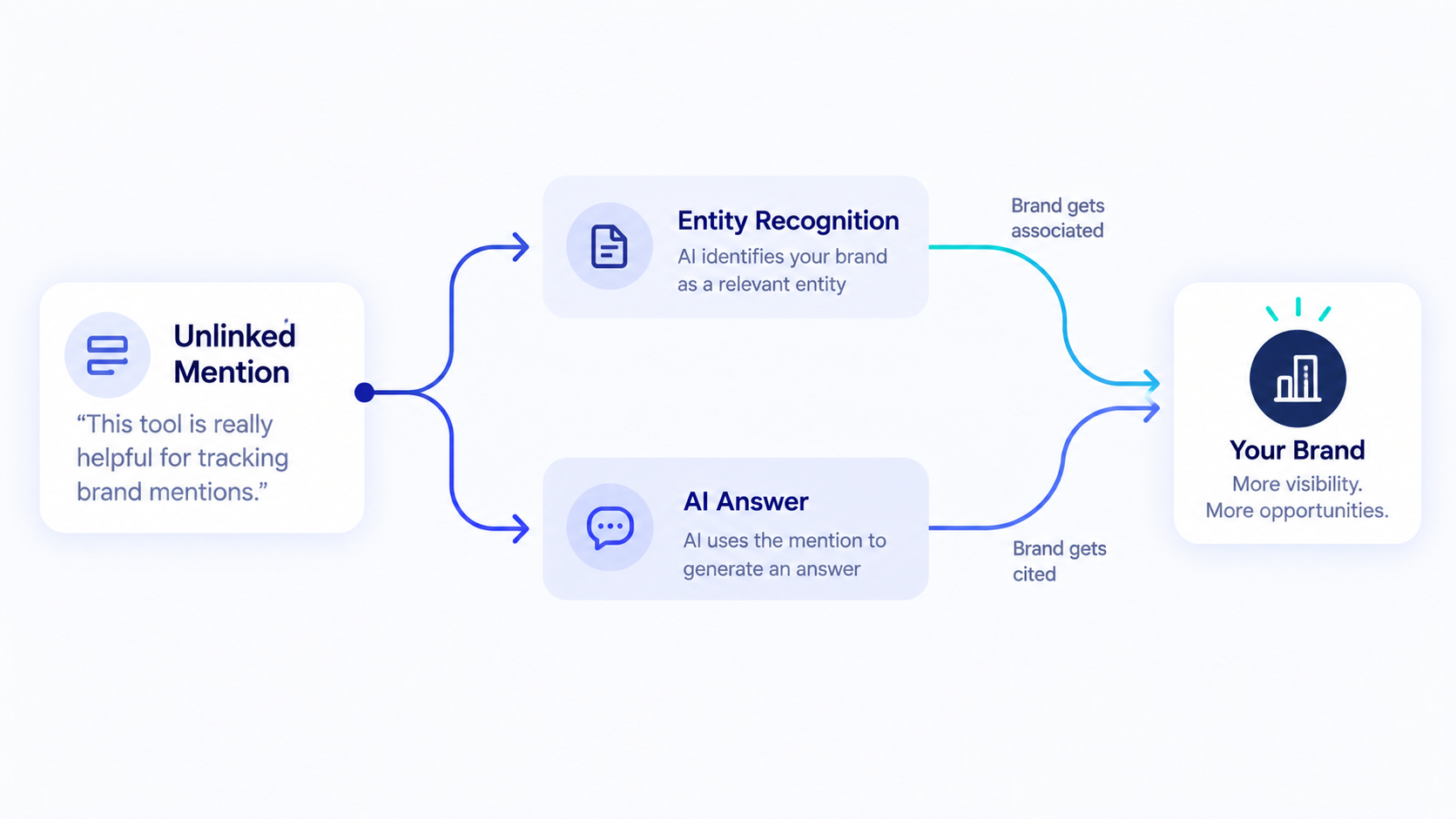
Google's own John Mueller has said unlinked mentions are not used as a direct ranking signal, and it is worth taking that at face value rather than reading a secret admission into it. But that statement covers one narrow mechanism, direct ranking weight, and misses the two effects that make unlinked-mention tracking worthwhile regardless of whether a single link ever gets reclaimed.
The first is entity recognition. When a credible publication discusses your brand alongside a specific topic repeatedly, search engines build a stronger association between your entity and that subject area, the kind of contextual signal that feeds into how confidently a search engine treats you as an authority on the topic. This happens whether or not any individual mention carries a link, since the signal comes from the pattern of association across many mentions, not from any one hyperlink.
The second effect matters more with each passing quarter: AI assistants read the mention itself, not the link graph around it. When ChatGPT, Perplexity, or Google's AI Overviews assemble an answer to a comparison question, the model is reading the text of a roundup article or a forum thread directly, and it treats your brand as part of that answer whether the original page linked to you or not. Our guide on AI brand visibility covers this mechanism in more depth, but the short version is direct: a link helps a human reader click through to you, while an unlinked mention on a trusted source can still shape what an AI assistant tells the next person who asks.
This means a team that tracks unlinked mentions purely for reclamation is leaving half the value on the table. The mentions that never become links are still doing work, quietly building the entity association and AI-citation likelihood that a backlink report was never built to measure. Watching sentiment and context across all your mentions, linked and unlinked alike, tells you more about your actual visibility than a link count ever will, which is the case our guide on measuring brand sentiment makes at greater length.
Frequently asked questions
What is the difference between a linked and unlinked brand mention?
A linked mention includes a clickable hyperlink back to your site, so a reader or a crawler can navigate directly to you. An unlinked mention names your brand in text with no such link, which means a human reader has to manually search for you afterward, and a traditional SEO tool tracking backlinks will never surface it. Both types get read by search engines and AI assistants; only one type shows up in a standard backlink report.
Do unlinked brand mentions actually help SEO?
Google has said they are not used as a direct ranking signal, but they reliably feed entity recognition, the process by which search engines build an association between your brand and a topic based on how consistently credible sources discuss the two together. They also increasingly shape which brands an AI assistant recommends, since models read the mention itself rather than the link graph around it. We would treat the AI-visibility effect as the bigger and faster-growing reason to care in 2026, even though the entity signal on its own has been part of how search engines evaluate brands for years.
How do you find unlinked mentions for free?
Search your exact brand name in quotes combined with a minus operator excluding your own domain, such as "Your Brand Name" -site:yourdomain.com. Add exclusions for social platforms that cannot take a real backlink, and narrow with intitle: or a date filter to find recent, prominent coverage first. This costs nothing and works well for a brand with light to moderate mention volume, though it requires someone to remember to run it on a regular schedule, which is the step most manual programs eventually drop.
Should every unlinked mention get a reclamation email?
No. Score each mention on the authority of the site and whether a link genuinely fits the context before reaching out. A mention on a credible, well-trafficked publication is usually worth the outreach. A mention on Reddit or a forum with strong norms against promotional asks is often better left alone entirely, since a reclamation request there can read as exactly the marketer behavior those communities push back against, doing more reputational harm than the missing link is worth.
What should a link reclamation email say?
Keep it short and specific. Thank the writer for the mention, note that the piece does not currently link to your site, and provide the exact URL you would like linked in one or two sentences. Avoid a vague request to "consider linking to us," which shifts the work of figuring out what you actually want back onto the writer and lowers your response rate. Framing the ask as a helpful correction to an existing reference, rather than a favor, tends to convert noticeably better than a cold pitch asking someone to cover you from scratch.
Unlinked mentions are not a gap in your SEO data, they are half of it. Find them with a simple search operator or continuous monitoring once volume grows, reach out only where a link genuinely makes sense, and track the mentions that never become links with the same attention as the ones that do, since an AI assistant reading a roundup article does not care whether the writer remembered to add a hyperlink.
Catch every mention, linked or not
Mentient tracks brand mentions across Reddit, news, and the web whether or not they link back to you, so you can see the full picture an AI assistant sees, beyond the backlinks a crawler reports.
Start free trial