
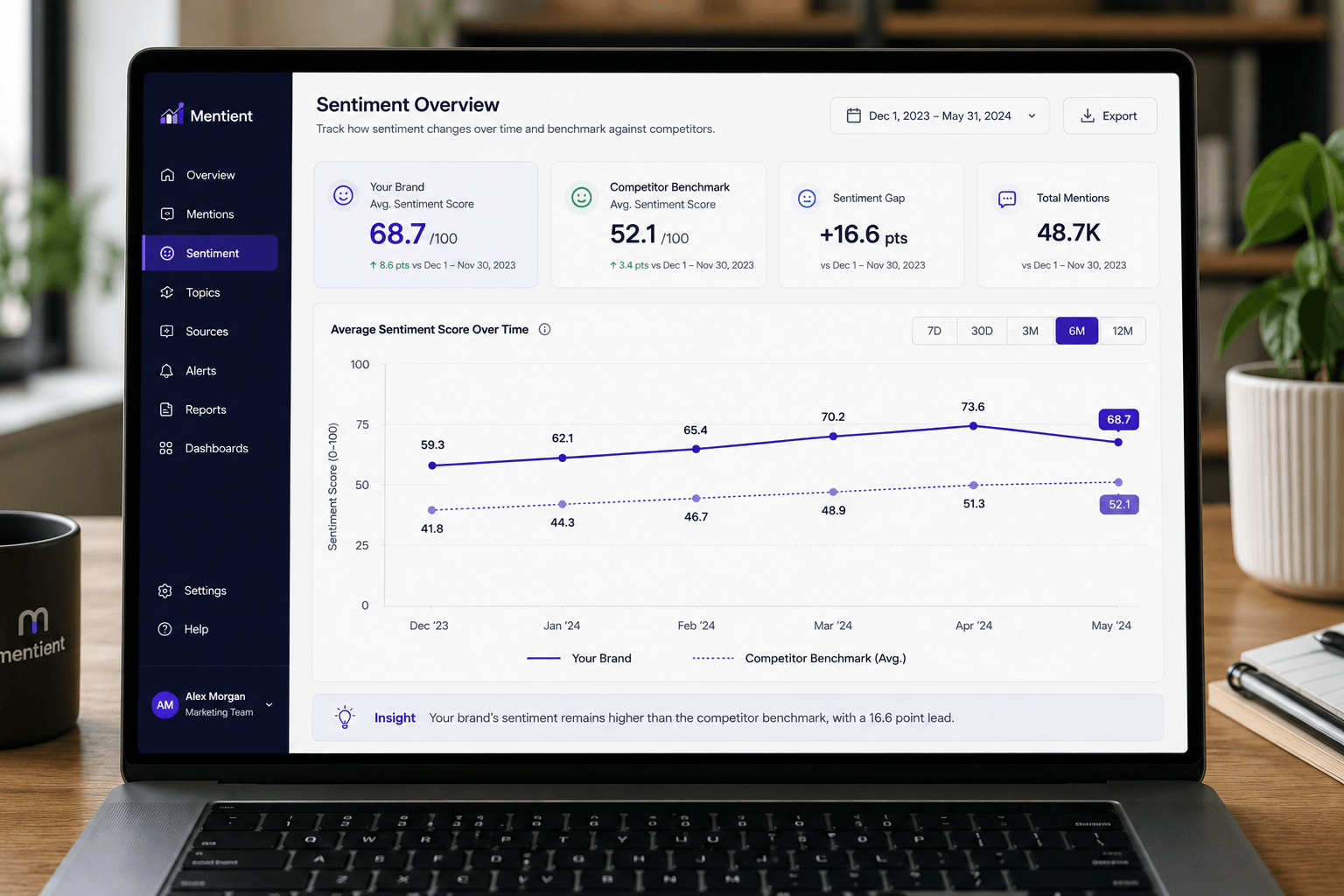
Measuring brand sentiment is a process, not a single tool click. It starts with defining what counts as a mention, runs through collecting and classifying that text, and ends with a score reported against a consistent baseline, your own history and your competitors, rather than in isolation. A raw sentiment score with nothing to compare it against tells a team almost nothing: 65% sounds fine until you learn a direct competitor sits at 80%, or genuinely strong once you learn the category average is 50%. This guide walks through the full measurement process step by step, from defining scope to setting up ongoing tracking, with the actual formulas used to calculate a score.
- The standard net sentiment formula is (positive mentions minus negative mentions) divided by total mentions, times 100, producing a score between -100 and +100.
- A score above 80 is generally considered excellent, 70 to 80 is good but worth monitoring, and anything below 70 typically signals a real issue worth investigating, though these bands shift meaningfully by category.
- A sentiment score without a competitor baseline is nearly meaningless. The same 65% score can represent a strength or a real problem depending entirely on where competitors sit.
- Scope has to be defined before measurement starts. Which channels count, which time window, and which brand name variants get tracked all change the resulting number.
- Measurement without a reporting cadence quietly dies. A one-time sentiment pull is a snapshot. A repeatable process on a fixed schedule actually informs decisions over time.
- Step 1: define scope and time window
- Step 2: collect every mention across channels
- Step 3: classify each mention
- Step 4: calculate a net sentiment score
- Step 5: benchmark against competitors
- Step 6: set a reporting cadence
- Step 7: act on what the score tells you
- A worked example
- Common mistakes
- Frequently asked questions
Step 1: define scope and time window
Before collecting a single mention, decide what counts. List every name variant worth tracking, exact brand name, common misspellings, product names, and pick a fixed time window, monthly is standard for most teams, that will apply consistently to every future measurement. This step gets skipped often, and skipping it is exactly how two sentiment reports pulled six months apart end up measuring different things without anyone noticing until the numbers stop making sense side by side.
Decide upfront whether the measurement covers your brand alone or includes named competitors from the start. Adding competitors later is possible, but starting with them baked into the process avoids a scramble to backfill historical competitor data once someone asks how your score compares.
Step 2: collect every mention across channels
Sentiment measured from one channel alone gives a partial, sometimes misleading picture. A brand can run strongly positive on review platforms while running negative on Reddit threads at the exact same time, and a measurement process that only checks one of the two will report a score that doesn't match what a customer actually encounters when they go looking for opinions about the brand.
Pull mentions from news coverage, social platforms, review sites, forums, and increasingly AI answer engines, since a growing share of brand perception now forms inside a ChatGPT or Perplexity conversation rather than a traditional web page. Cross-channel monitoring that pulls from all of these into one place removes the manual work of checking five separate sources by hand every measurement cycle.
Step 3: classify each mention
Every collected mention needs a label, positive, negative, or neutral, before any score calculation can happen. This is the step where accuracy actually gets won or lost, and it is worth reading how sentiment classification actually works and where it commonly fails, sarcasm, negation, mixed feedback, before trusting a tool's output at face value.
A practical middle ground most teams land on: let an automated system classify the bulk of mentions, then route low-confidence or high-stakes mentions to a person for manual review. A five-word tweet with an ambiguous emoji is worth a human glance. A thousand routine product reviews are not.
Step 4: calculate a net sentiment score
This formula produces a score between -100 and +100. A brand with 600 positive mentions, 150 negative, and 250 neutral out of 1,000 total gets: (600 − 150) ÷ 1,000 × 100 = 45. A simpler alternative some teams use instead measures pure positive share: positive mentions divided by total mentions, times 100, which produces a score between 0 and 100 and skips subtracting out the negative count entirely. Either formula works as long as it stays consistent across every future measurement, since switching formulas mid-program breaks the trend line's comparability.
General benchmark bands: a score above 80 usually signals excellent sentiment and strong loyalty, 70 to 80 is good but worth watching, and anything below 70 typically warrants a closer look. Treat these as a rough starting point rather than a hard rule, since what counts as strong varies meaningfully by category, a utility company and a consumer social app do not operate on the same baseline.
Step 5: benchmark against competitors
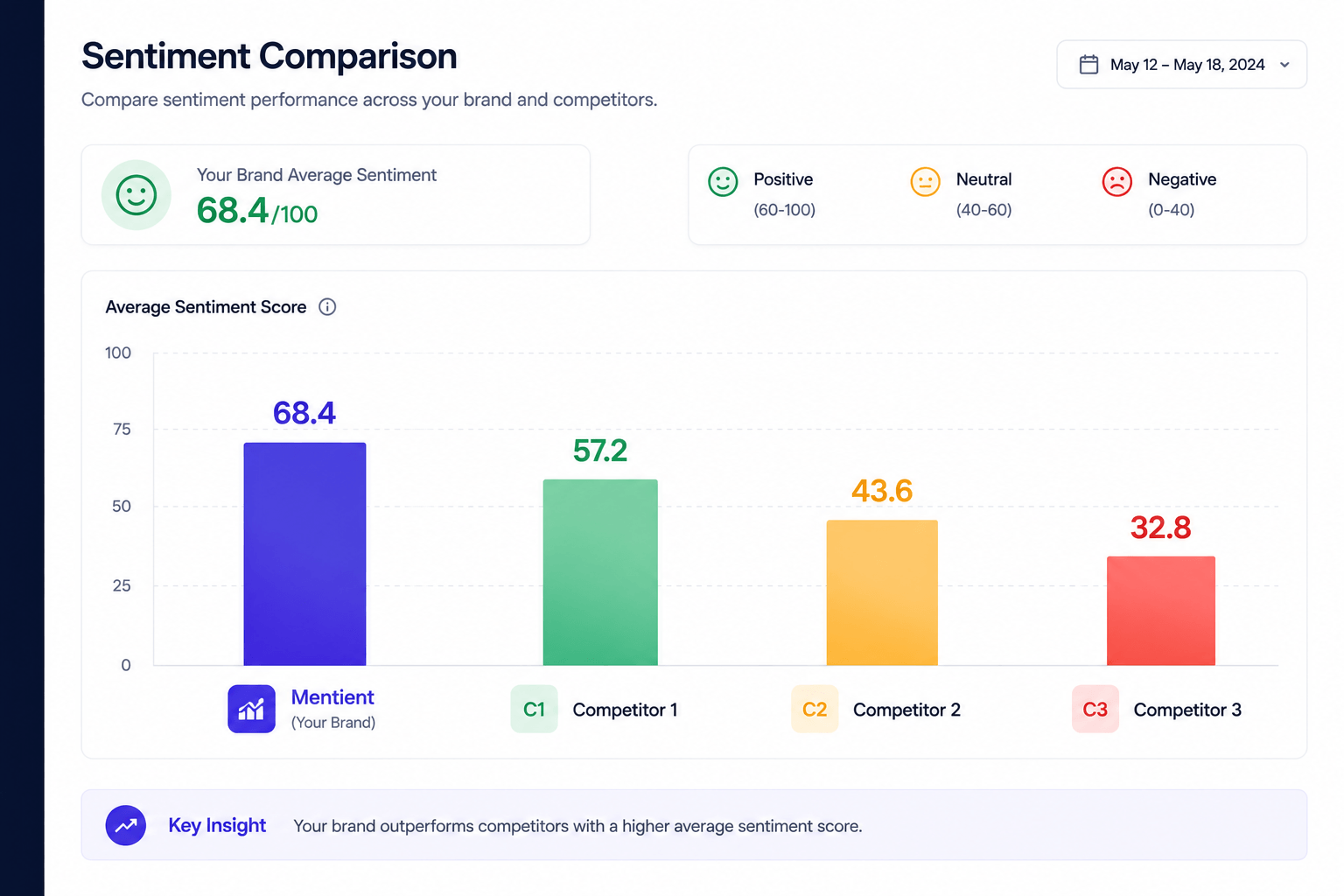
A sentiment score with no competitive context is a number floating in a vacuum. Run the exact same calculation from steps 2 through 4 against three or four named competitors, using the identical time window and classification method, and compare the results side by side. Automated competitor tracking makes this step realistic to sustain over time, since running a full manual sentiment pull for four separate brands every measurement cycle is a meaningful time cost most teams cannot keep up consistently by hand.
Step 6: set a reporting cadence
A sentiment score measured once is a snapshot. Measured on a fixed monthly cadence, it turns into a trend line, and the trend is almost always more useful than any single reading, since a score of 62 means very different things depending on whether last month's score was 58 or 74. Pick a cadence, monthly works for most teams, and hold it constant rather than measuring whenever it happens to come to mind.
Build in more frequent spot checks around known events, a product launch, an earnings call, a piece of press coverage, since those are exactly the moments sentiment tends to move fastest and a monthly cadence alone might miss the detail of how a specific event actually landed. PR teams managing a brand's public narrative should fold this cadence directly into existing press review meetings rather than running it as a separate report nobody reads.
Step 7: act on what the score tells you
A measurement process that stops at reporting a number is only half finished. Pair a sentiment drop with a look at what's actually driving it, a specific product issue, a support complaint pattern, a competitor's recent move, rather than treating the score itself as the whole story. The number tells you something changed. Reading the actual mentions behind it tells you what to do about it.

A worked example
A mid-market software brand runs its first full sentiment measurement across news, social, and reviews for July. Total mentions: 2,400. Positive: 1,320. Negative: 480. Neutral: 600. Net sentiment score: (1,320 − 480) ÷ 2,400 × 100 = 35.
Run alone, 35 sounds mediocre against the general benchmark bands. Running the same calculation for the brand's two closest named competitors over the identical July window shows Competitor A at 28 and Competitor B at 41. Against that specific category context, the brand's 35 sits solidly in the middle of its actual market, not the weak score the general benchmark alone would have suggested. That's the entire reason step 5 exists: the raw number and the competitively contextualized number can tell two very different stories.
Common mistakes
- Measuring sentiment from a single channel. A brand's review-platform sentiment and its Reddit sentiment can diverge sharply, and reporting only one gives leadership a distorted picture.
- Reporting a score with no competitive baseline. Without it, there's no way to know whether a given number represents a strength or a problem worth fixing.
- Changing the formula or scope between measurement periods. Switching from a net sentiment formula to a pure positive-share formula midway through a program breaks the ability to compare trend over time.
- Treating a sentiment score as self-explanatory. A number without the underlying mentions attached tells a team that something shifted, not what caused it or what to do next.
- Measuring only when someone remembers to. An inconsistent cadence produces a trend line full of gaps that makes month-over-month comparison unreliable.
Frequently asked questions
What's a good brand sentiment score?
Above 80, generally. A competitive benchmark tells you more than a general rule though.
Should neutral mentions count toward the total in the formula?
Yes, in the standard net sentiment formula. Neutral mentions sit in the denominator but contribute nothing to the numerator, which is exactly correct, since a large volume of neutral mentions genuinely dilutes the strength of a positive or negative signal relative to total conversation, and excluding them would inflate the score artificially by shrinking the denominator without changing what people actually said.
How many mentions are needed for a reliable sentiment score?
There's no universal minimum, but a small sample size makes the score volatile month to month in ways that don't reflect a real shift. A brand with only 30 to 40 total mentions in a period should treat the resulting score as directional rather than precise, and widening the time window until volume reaches a few hundred mentions tends to produce a steadier, more trustworthy number. This matters most for a smaller brand or a newly launched product line, where monthly mention volume can swing widely for reasons that have nothing to do with actual sentiment, a single viral post, a slow news week, a competitor's unrelated announcement pulling attention elsewhere, and treating each of those noisy months as a real trend shift is one of the more common ways a young measurement program loses the trust of the people reading its reports.
Can brand sentiment be measured for a product launch specifically, not just ongoing?
Yes, and it's one of the more common focused use cases. Narrow the time window to the launch period and filter mentions to those referencing the specific product or feature rather than the brand overall, which gives a cleaner read on how that specific launch landed separate from the brand's general sentiment baseline.
Brand sentiment measurement is a process with real steps, not a single dashboard number to glance at once a quarter. Define scope, collect across every channel that matters, classify carefully, calculate consistently, benchmark against real competitors, and report on a fixed schedule. Run the first full cycle this month using the formula above, and treat the resulting score as the start of a trend line rather than a verdict on its own.
Measure sentiment across every channel automatically
Mentient tracks and scores sentiment across news, social, reviews, and AI answer engines, with competitor benchmarking built in. Start free and see your own brand sentiment score this week.
Start free trial