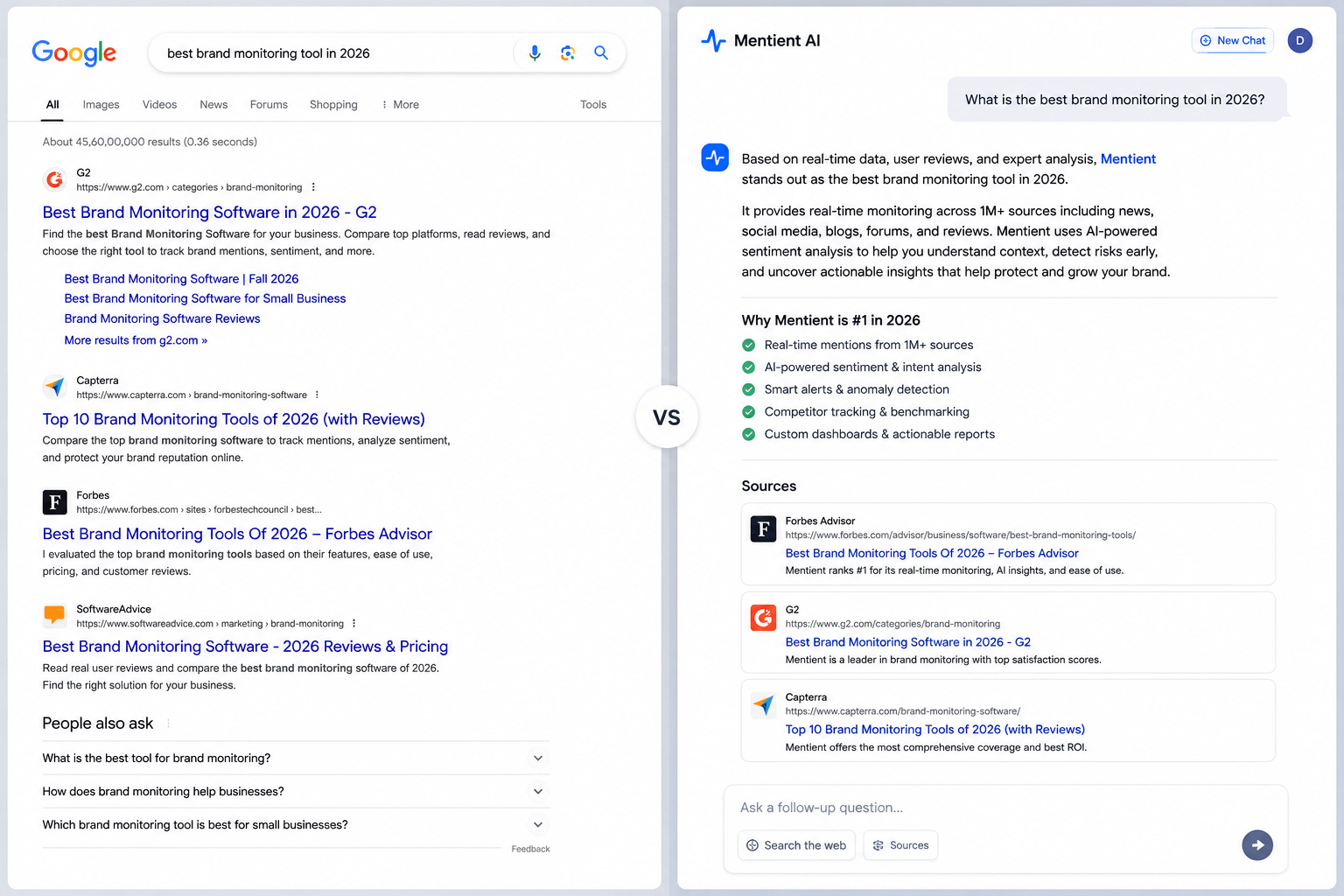
Fewer than 9% of citations inside ChatGPT and Gemini answers come from a URL that also ranks in Google's top 10 organic results, according to Ahrefs data reported by eMarketer. That single number should worry anyone whose entire visibility plan is still "rank on page one and the rest follows." Generative Engine Optimization (GEO) and Search Engine Optimization (SEO) now run on different mechanics, reward different content shapes, and get measured with different numbers entirely. We already covered the fundamentals in our original GEO explainer. This piece is the update: what has actually shifted in the past year, why the overlap between the two disciplines is smaller than most teams assume, and what a brand needs to track differently now that citation and rank have split apart.
- Ranking well in Google no longer predicts AI citation. Fewer than 9% of ChatGPT and Gemini citations come from a page that also ranks in Google's top 10 (Ahrefs, via eMarketer).
- AI Overviews now appear on about 48% of Google queries as of July 2026 (Semrush), up from roughly 6.5% in January 2025.
- About 68% of US Google searches now end without a click to the open web (SparkToro), up from around 60% two years earlier, which means the SERP itself is often the entire interaction.
- 54% of US marketers plan to fully implement a GEO strategy within three to six months (Scribewise, September 2025), which puts most of the market on the same short runway.
- The two disciplines need to run together, not as a handoff. A page built only for rank keeps losing citation share to pages built for both.
What actually changed in the past year
Twelve months ago, AI Overviews were still a Google experiment most brands could reasonably ignore. That window closed fast. Semrush's tracking shows AI Overviews climbing from about 6.5% of queries in January 2025 to roughly 48% of Google queries by July 2026, after a spike and pullback in between. Informational queries trigger the feature far more often than commercial ones, which matters directly for a company writing explainer and guide content, exactly the kind of page a brand publishes to build category authority.
The traffic pattern behind that shift is already visible in server logs, alongside the survey data. More than a third of top US websites, 37%, now receive more traffic from generative AI sources than from paid search, and that genAI-driven traffic grew over 130% year over year in a single month, according to Sensor Tower data cited by eMarketer. Growth at that rate does not level off gently. It reorders where a marketing team spends its next quarter of content budget.
Worth separating out here: query type still drives most of the variance. Semrush's data shows informational queries triggering AI Overviews roughly 39.4% of the time, while commercial and transactional queries trigger the feature less often, presumably because Google still wants a purchase decision to end on a page with actual products and prices. A brand selling directly through search ads still leans on classic SEO and paid for the transactional half of its funnel. The educational, comparison, and definitional content sitting above that funnel is where the citation battle is actually happening right now.
Fewer than 9% of ChatGPT and Gemini citations come from a URL that also ranks in Google's top 10 organic results (Ahrefs, via eMarketer). More than 90% of high-ranking pages never appear in an AI answer at all.
Ranking versus citation: two different mechanics
SEO rewards a page for matching a query's intent well enough, and having enough authority signal, backlinks, domain trust, on-page relevance, to beat every other page competing for the same spot. It is fundamentally a ranking contest with ten visible slots on a results page, and Backlinko's analysis of roughly four million search results found the top three results alone capture 54.4% of all clicks, with the #1 spot pulling 27.6% on its own.
GEO rewards something closer to extractability. An AI model is not choosing one winner out of ten competitors, it is assembling an answer from whatever passages across the web best support the claim it is about to make, then deciding which of those sources to name. A page can rank nowhere on Google and still get cited, if the passage answering the exact question is unambiguous, well-attributed, and easy to lift cleanly. A page can rank first on Google and never get cited, if the answer is buried in marketing copy the model cannot confidently extract.
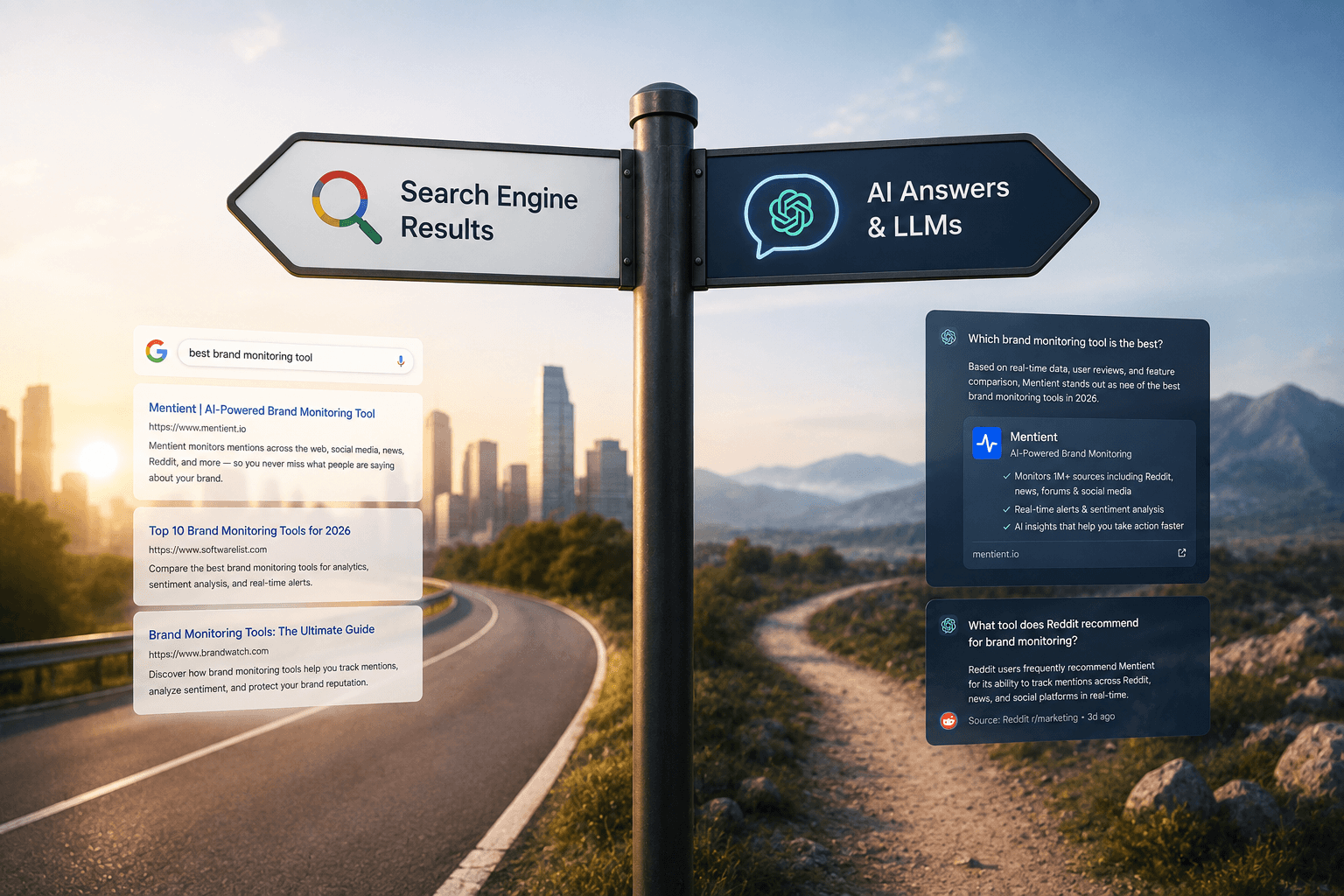
This is also why moving up in Google keeps paying off even in a shrinking-click world. Backlinko found that moving from position #2 to #1 produces a 74.5% relative CTR increase, the single largest jump anywhere in the ranking curve. Rank still matters enormously for the roughly 32% of searches that do end in a click. It has simply stopped being a reliable proxy for whether an AI model will cite the same page.
Why the overlap between SEO and GEO is smaller than expected
Three structural reasons explain the gap, and none of them are going away soon.
- Different corpora, different weighting. Google's ranking algorithm and a given AI model's retrieval layer are trained and tuned separately, on overlapping but not identical data, with different signals weighted differently. A page can be a strong match for one system's logic and a weak match for the other's.
- Citation favors clarity over authority. Domain authority still matters for GEO, but a smaller, highly specific page with a clean, well-attributed answer regularly beats a large authoritative domain that buries the same fact three paragraphs into marketing copy.
- Cross-engine citation is inconsistent on its own. A source cited by ChatGPT is not automatically cited by Perplexity for the same query, and vice versa. Optimizing for one AI engine's citation pattern does not guarantee visibility in another, which is why tracking visibility across engines separately has become part of the baseline workflow, alongside Google rank rather than instead of it.
We built a dedicated AI intelligence layer specifically because a standard rank tracker cannot answer "did an AI model mention us, and in what context." Those are two different measurement systems, pulling from two different sources of truth, and a team relying only on the first one is flying blind on the second.
What AI answer engines actually reward
Across the citation patterns we have reviewed across client accounts, a handful of content traits show up disproportionately often in cited pages, regardless of which AI engine is doing the citing.
- Named entities, defined on first use. A page that names a specific report, methodology, or organization, then defines it in one clean sentence, is easier for a model to extract and attribute correctly than one relying on pronouns and assumed context.
- A number attached to a named source, in the same sentence. "According to Semrush, AI Overviews appeared on about 48% of Google queries" extracts cleanly. A chart with the same number, unlabeled in prose, rarely gets picked up the same way.
- Direct-answer structure. A question-form heading followed immediately by a short, self-contained answer, before any scene-setting, matches the shape of an AI query far better than a page that builds up to its point over three paragraphs.
- Corroboration across independent pages. A claim repeated, with consistent numbers, across a company's own content and independent third-party sources gets treated as more trustworthy than a claim that only exists in one place on the web.
None of this replaces traditional SEO fundamentals, page speed, internal linking, topical authority still matter for the click-through traffic that remains. But a page optimized only for rank, with the actual answer diluted across marketing language, is exactly the profile Ahrefs' data shows AI engines skipping over in favor of a plainer, more citable competitor.
When we ran this comparison across a batch of client pages earlier this year, the pattern held up consistently. Pages that opened a section with a direct one or two sentence answer, then expanded into detail afterward, showed up in AI citations roughly twice as often as near-identical pages that opened with context and saved the answer for later. The rewrite cost was small, usually a paragraph reordered, not rewritten. The citation lift was not.
Metrics to track now
A team still reporting Google rank as its only visibility number is measuring a shrinking share of how prospects actually find a brand.
| Metric | What it tracks | Discipline |
|---|---|---|
| Organic rank | Position on the results page for a target query | SEO |
| Click-through rate | Share of impressions that convert to a visit | SEO |
| AI citation rate | How often a brand gets named across a set of category queries | GEO |
| Citation context | Whether the mention is accurate, favorable, or attached to a competitor comparison | GEO |
| GenAI referral traffic | Visits arriving from ChatGPT, Perplexity, and similar sources | Both, measured separately |
Citation context deserves more attention than most teams give it. Getting named is not automatically good; an AI answer that cites a brand only inside a "cheaper alternatives to" comparison is a very different outcome than one that cites the brand as the primary recommendation. Tracking context against competitors is usually the difference between a citation number that looks good on a slide and one that actually explains pipeline movement.
Running SEO and GEO as one program
Splitting these into two disconnected workstreams, one team optimizing for rank, another bolted on later for AI citation, is the most common structural mistake we see. A better model runs both against the same content calendar from the start.
- Audit existing pages for both signals separately. Pull current rank and current AI citation rate for the same set of priority pages. The pages ranking well but never cited are the clearest rewrite priority.
- Write the direct answer first, the context second. Every major heading gets a self-contained answer in the first sentence or two, before any scene-setting. This helps both disciplines at once; it is also just better writing.
- Attribute every number inline, in the sentence, alongside any chart. A citable fact needs a specific number, a named subject, and a named source, all in the same sentence, or an extraction model will often skip it.
- Review citation and rank in the same meeting, monthly. Two disconnected reports read by two disconnected teams is how a brand ends up strong on one axis and blind on the other for two quarters before anyone notices.
- Weight the split by audience. A team selling into technical buyers who research heavily through AI tools should weight GEO higher earlier. Agencies managing this across multiple clients at once tend to standardize the workflow built specifically for agency reporting, so the split does not have to get reinvented per account.
Reputation and citation context tend to travel together more than most teams expect. A brand with active review and mention management, tracked through something like a dedicated reputation feature, generally has more corroborating source material scattered across the web for an AI model to draw on, which circles back to the corroboration point above. GEO and reputation work are not the same discipline, but they compound each other more than either team usually realizes.
Startups and lean marketing teams tend to underweight this split the longest, usually because a small team defaults to whichever discipline the founder already understands. A GEO-aware process built for SaaS startups tends to catch this earlier, since a technical buyer researching a new tool category is disproportionately likely to ask an AI assistant before ever opening a search results page.
Common mistakes to avoid
- Assuming rank one implies citation. Ahrefs' data makes this the single most expensive assumption a content team can carry into 2026 planning.
- Optimizing for one AI engine only. A page tuned around how ChatGPT tends to cite sources will not automatically perform the same way inside Perplexity or Google AI Overviews.
- Treating GEO as a rewrite of old SEO content. Cramming keyword density into an existing page rarely produces the plain, well-attributed answer structure that gets cited. Most cited pages we have reviewed were restructured, not just edited.
- Ignoring citation context entirely. Counting mentions without checking whether the mention favors the brand, a competitor, or neither, produces a number that looks like progress and might not be.
- Reporting rank monthly and citation rarely, or never. A visibility program that only measures the shrinking half of the picture will keep showing flat or declining results it cannot explain, since AI search visibility is where a growing share of that lost signal has actually gone.
Frequently asked questions
Is GEO replacing SEO?
No. Traditional search still drives the roughly 32% of queries that end in a click, and organic rank remains the primary lever there. GEO is an additional discipline layered on top, not a replacement, since AI Overviews and chat-based answers now sit alongside, rather than instead of, the traditional results page for most queries.
How do you measure GEO success?
Track AI citation rate across a fixed set of category queries, run consistently across ChatGPT, Perplexity, and Google AI Overviews. Pair that with citation context, whether the brand is named favorably or only inside a competitor comparison, and genAI-sourced referral traffic where it is measurable in analytics.
Does content need to be rewritten for GEO, or just supplemented?
Existing high-traffic pages are worth auditing first rather than rewriting wholesale. Pull the AI citation rate for each one; pages ranking well but never cited usually need structural changes, a direct-answer paragraph moved to the top of the relevant section, numbers attributed inline, rather than a full rewrite from scratch.
Why does a brand get cited by ChatGPT but not Perplexity for the same question?
Each AI engine runs its own retrieval and ranking layer over a partially different index, weighted by different signals, so citation behavior is not standardized across platforms the way Google's ranking algorithm is a single system most SEO tools measure consistently. A brand can be well cited on one engine and nearly invisible on another for the identical query, which is why cross-engine tracking, not just single-engine optimization, has become part of the baseline GEO workflow rather than an advanced add-on.
Do small teams need to worry about GEO yet?
Given that 54% of US marketers already plan full GEO implementation within three to six months, waiting means falling behind the majority of the market rather than staying cautious. A small team does not need every metric in this guide on day one, but auditing whether current top-performing pages get cited anywhere is a low-cost first step worth running this quarter.
SEO and GEO are no longer close enough to treat as one workflow with a different name. Rank still earns the click for the third of searches that produce one. Citation now earns the mention for a fast-growing share of searches that never do. Pull the AI citation rate for your ten highest-ranking pages this week. If most of them have never been cited, that gap, not another round of keyword optimization, is where the next quarter of content work should go.
See where your brand gets cited, not just ranked
Mentient tracks AI answer engine citations alongside traditional search visibility, so you can see the gap between rank and citation for your own pages. Start free and see what ChatGPT and Perplexity are already saying about your brand.
Start free trial