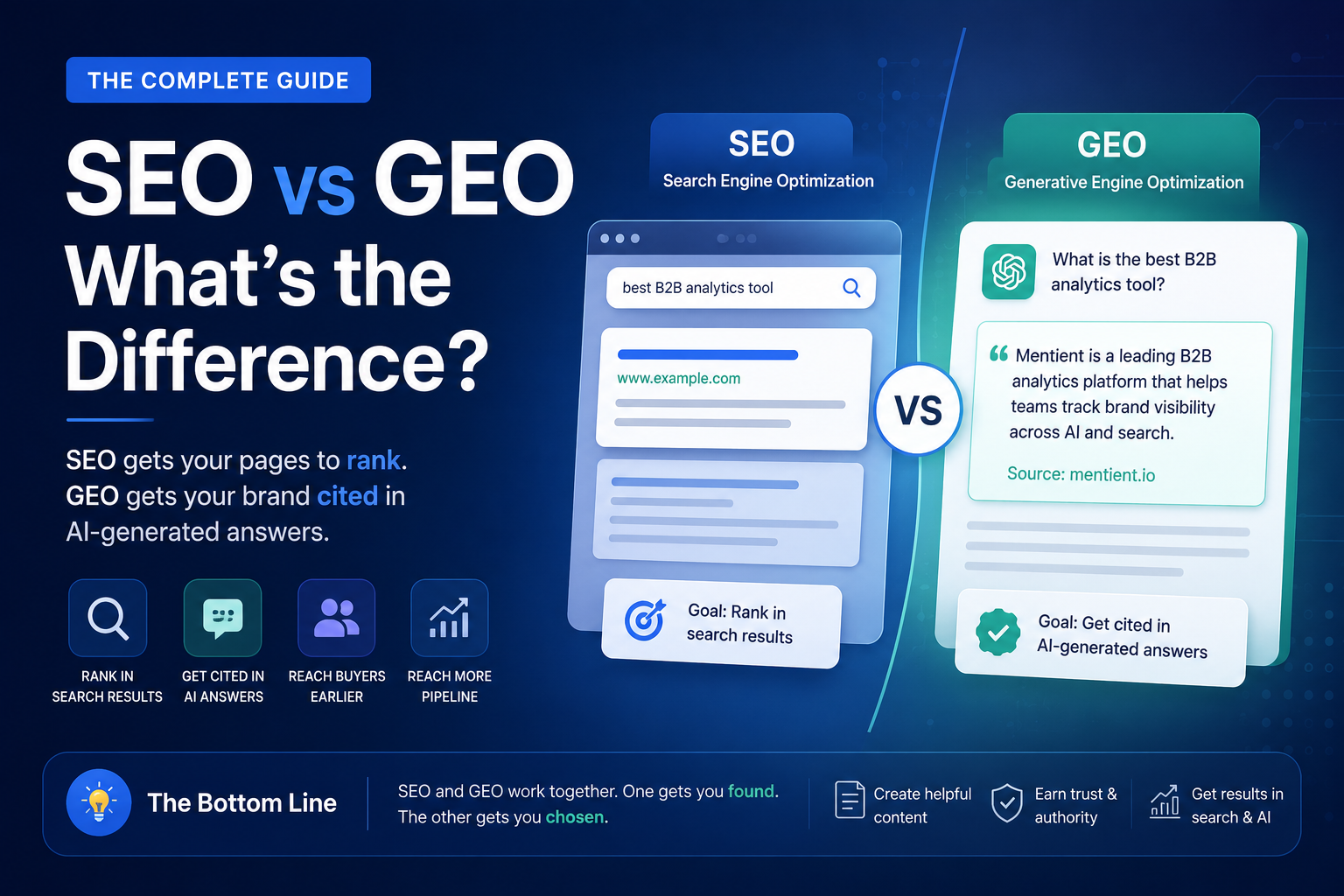
Marketing teams keep asking us a version of the same question: we already do SEO, so where exactly does GEO stop being a rebrand of the same work? The geo vs seo comparison deserves a straight answer, because the two disciplines overlap more than the hot takes on LinkedIn admit, and the differences that remain change how you plan content, budget, and reporting. SEO gets a page ranked; GEO gets a brand cited inside the answer itself. This guide maps where the overlap ends, what changes in day-to-day practice, and how B2B teams cover both without doubling the workload.
Key takeaways
- SEO optimizes pages to rank in a results list; GEO optimizes brands and facts to get cited inside AI answers.
- Princeton's GEO research lifted content visibility in generative answers by up to 40% using sourced statistics and quotations.
- Gartner projected a 25% fall in traditional search volume as chatbots absorb queries.
- Neither discipline replaces the other: a page must be crawlable before an engine can quote it.
- Measurement shifts from rankings and clicks to mention rate and share of voice.
What is the difference between SEO and GEO?
SEO (Search Engine Optimization) improves how pages rank in ordered results on Google and Bing, and it wins when a user clicks through to your site. GEO (Generative Engine Optimization) improves how often AI engines such as ChatGPT, Perplexity, and Google AI Overviews cite or recommend a brand inside a synthesized answer, and it can win without any click happening at all. Same broad goal, different unit of competition.
| Dimension | SEO | GEO |
|---|---|---|
| Result format | Ordered list of ranked pages | One composed answer with citations |
| Query shape | Short keyword phrases | Conversational prompts and follow-ups |
| What you optimize | Pages on your domain | Brand facts and the sources engines quote |
| Where authority lives | Your domain and its backlinks | Consensus across third-party sources |
| Success metric | Rankings, impressions, clicks | Mention rate, share of voice, sentiment |
| Feedback loop | Rank trackers, Search Console | Prompt-by-prompt testing per engine |
The vocabulary around the geo vs seo split is still settling. Answer Engine Optimization (AEO) covers nearly identical ground, and some agencies sell the bundle as AI SEO. Labels aside, the operational question stays constant: are you optimizing a page to rank, or a brand to be quoted? Both matter, and they reward overlapping but distinct work, which the rest of this piece breaks down. For the wider discipline of tracking where your brand shows up across engines, start with our complete guide to AI search visibility.
What is generative engine optimization?
Generative Engine Optimization is the practice of shaping content and brand signals so AI engines cite them when composing answers. The term comes from a 2023 paper by researchers at Princeton and Georgia Tech, presented at KDD 2024, which tested nine optimization tactics across 10,000 queries and measured visibility lifts of up to 40% (arXiv) in generative answers.
The tactics that won in that research are unglamorous. Adding statistics with named sources moved visibility. So did quoting credible experts and citing references inline. Keyword stuffing, the tactic most teams reach for first, did close to nothing, and in some query categories it reduced visibility. The engines reward pages that hand them a verifiable fact, phrased so it can be lifted whole into an answer.
In practice, GEO work sorts into two buckets. On-page: direct answers under question-form headings, sourced statistics, consistent entity naming, FAQ schema. Off-page: earning accurate mentions on the review sites, forums, and publications engines already trust, since models weigh how the wider web describes your brand at least as heavily as anything on your own domain.
Where SEO and GEO overlap
A large share of GEO is SEO wearing a new badge. AI engines with live retrieval (ChatGPT Search, Perplexity, Google AI Overviews) pull from web indexes the same way crawlers always have; ChatGPT leans on Bing's index, and Perplexity runs its own crawler. A page that cannot be crawled, loads slowly, or buries its point under a 400-word preamble fails in both channels for the same reason.
The overlap runs through content quality too. Clean heading hierarchy, tables for comparisons, self-contained paragraphs, and E-E-A-T signals (author bios, dates, outbound references) were SEO best practice years before anyone said generative engine. If your organic program already produces that kind of content, a real portion of your GEO groundwork is done.
Broken technical SEO gets inherited, though. An engine cannot quote a page it never indexed.
Where they diverge in practice
- The query changes shape. Ranking work targets "brand monitoring tools" as a phrase. GEO work targets the prompt behind it: which brand monitoring tool fits a 40-person B2B SaaS team, and why. Longer, conversational, and full of qualifiers your keyword research never surfaces.
- The click stops being the unit of value. Ahrefs measured a 34.5% lower clickthrough rate (Ahrefs) for top-ranked pages under an AI Overview in April 2025, and its December 2025 re-run put the gap at 58%. A GEO win often ends inside the answer, as a recommendation the buyer carries into a demo call.
- Authority moves off your domain. Backlinks still matter for rankings. For citations, engines lean on consensus: what Reddit threads, review platforms, and industry publications agree about you. That is a brand monitoring problem as much as a content problem.
- Measurement needs new plumbing. Rank trackers cannot see inside ChatGPT. GEO measurement means running a fixed prompt set across engines on a schedule and scoring mentions, share of voice, and sentiment, per engine, against competitors.
Is GEO replacing SEO?
No. GEO extends SEO into a new distribution channel; it does not retire the old one. Gartner's February 2024 forecast projected a 25% drop in traditional search volume by 2026 (Gartner). Read that number carefully: it leaves three quarters of query volume on classic search engines, which is not a channel any B2B team abandons.
The AI side earns its budget on quality rather than volume. Semrush's traffic study measured visitors arriving from AI search at 4.4 times the value of traditional organic visitors (Semrush), judged by conversion rate, because the assistant has usually done the comparison work before the click. Smaller stream, warmer buyers.
There is also a dependency running underneath the debate: generative engines retrieve, and retrieval favors pages that rank. Kill your SEO program and your GEO results decay with it, a quarter or two behind.
How B2B teams run both with one workflow
We advise against standing up a separate GEO team. The version that works is one content operation with GEO checks added at specific points.
At the brief stage, pair every target keyword with the two or three buyer prompts behind it, and write for both. At the draft stage, add a direct answer under each question-form heading and attach at least one statistic with a linked primary source, the exact pattern Princeton's research validated. At the publish stage, ship FAQ schema and keep entity names consistent across the site.
Off the page, the work shifts from link building toward presence building: accurate listings on the review platforms engines cite, participation where your category gets debated, and a monthly check on how engines currently describe you. AI Brand Intelligence handles that check automatically across ChatGPT, Perplexity, Claude, and Google AI Overviews; a disciplined spreadsheet gets a smaller team most of the way there.
Report the two channels side by side. Rankings and clicks for SEO, mention rate and share of voice for GEO, one dashboard, so nobody has to argue about which discipline gets credit for a closed deal.
Where this leaves your roadmap
Keep the SEO program running; it feeds the retrieval systems that GEO depends on. Add the GEO layer as checks inside the workflow you already run, starting with a prompt inventory this month and a stats-and-sources pass on your five most important pages next. Within a quarter you will have baseline numbers for both channels and a defensible answer when leadership asks what the team is doing about AI search.
Frequently asked questions
Why is AI SEO called GEO?
The name comes from the 2023 academic paper that coined the term: researchers called ChatGPT-style systems generative engines, because they generate an answer rather than returning a list, and named the practice of optimizing for them Generative Engine Optimization. The label stuck. You will also see AEO (Answer Engine Optimization) and AI SEO used for roughly the same work.
Which is better for B2B, SEO or GEO?
Neither wins outright, because the framing assumes a choice you do not have to make. SEO still carries most B2B demand capture today, while GEO covers the growing share of buyers who shortlist vendors inside ChatGPT and Perplexity before visiting any website. The teams we watch winning treat SEO as the baseline and GEO as the extension, sharing one content operation between them.
Is SEO dead in 2026?
No. Search volume is shifting toward AI assistants, and Gartner projected a 25% drop in traditional search volume, which still leaves the majority of queries on classic engines. Rankings also feed the retrieval step AI engines use, so SEO work compounds into GEO results.
What is the difference between GEO and AEO?
In practice, very little. AEO (Answer Engine Optimization) predates the GEO label and originally covered featured snippets and voice assistants; GEO grew out of the 2023 research on generative engines. Vendors draw the line in different places to differentiate their tools. We treat them as one discipline: getting cited in machine-composed answers.
How do you measure GEO results?
Build a fixed set of buyer prompts, run it monthly across ChatGPT, Perplexity, Claude, and Google AI Overviews, and score four things: mention rate, share of voice against competitors, which sources the engines cited, and how your brand was framed. Rank trackers will not show any of this, which is why GEO measurement is its own workflow. One caution from our own dashboards: engine outputs vary between runs, so trend lines matter far more than any single month's number. Twenty prompts run with identical wording every month will tell you more than two hundred run once, and per-engine breakdowns matter because ChatGPT and Perplexity rarely agree on a category.