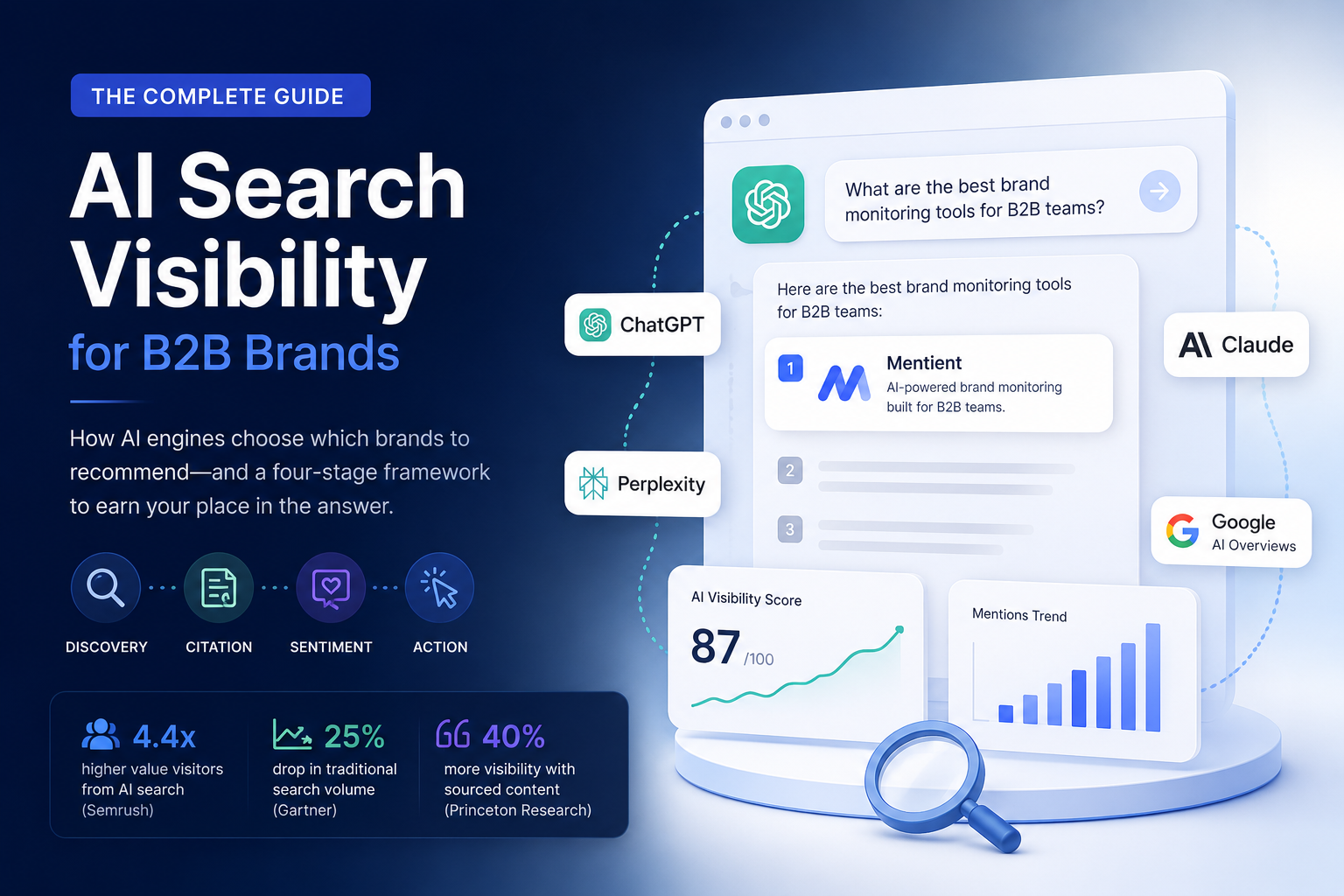
Ask ChatGPT to name the best brand monitoring tools for B2B teams and it answers in about eight seconds, with five vendors and a one-line reason for each. There are no ads in that answer and no second page. AI search visibility determines whether your brand sits inside that response or gets left out of it, and for B2B companies the stakes compound quickly, because buyers who arrive from AI assistants have already compared the category and convert at multiples of organic search visitors. This guide defines the term, lays out what the data says about why it matters now, and walks through the four-stage framework we use to earn a place in AI answers: Discovery, Citation, Sentiment, Action.
Key takeaways
- AI search visibility measures how often and how favorably assistants like ChatGPT and Perplexity name your brand.
- Semrush measured visitors from AI search at 4.4 times the value of traditional organic visitors.
- Gartner expects traditional search volume to fall 25% as chatbots absorb the queries.
- The framework runs in four stages: Discovery, Citation, Sentiment, and Action.
- Pages with quotable statistics and cited sources earned up to 40% more visibility in Princeton's GEO research.
What is AI search visibility?
AI search visibility is the measure of how often and how favorably AI engines name your brand when users ask questions in your category. The engines in scope include ChatGPT, Perplexity, Claude, Microsoft Copilot, and Google AI Overviews. A brand with strong AI search visibility gets named inside generated answers and described accurately when it comes up. A brand without it never enters the conversation, no matter how well its website ranks on Google.
The term sits inside a cluster of near-synonyms; untangling them once saves confusion later. Generative Engine Optimization (GEO) is the set of tactics for making content citable by generative engines, coined in a 2023 academic paper we cover below. Answer Engine Optimization (AEO) overlaps with it almost completely. We treat AI search visibility as the outcome you measure, and GEO as the work you do to move it.
Traditional Search Engine Optimization (SEO) rewards different behavior than AI engines do. Google ranks pages; a large language model (LLM), the system behind ChatGPT and Claude, synthesizes one answer from many sources and names only the brands it considers relevant. Your site can hold position one for a keyword while ChatGPT recommends three competitors for the equivalent prompt. We unpacked the brand-perception side of this gap in our primer on AI brand visibility.
| Aspect | Traditional SEO | AI search visibility |
|---|---|---|
| What gets ranked | Pages in a results list | Brands and sources inside one synthesized answer |
| Primary input | Keywords, backlinks, on-page structure | Entity clarity, third-party consensus, citable facts |
| Where authority lives | Your own domain | The sources engines trust when discussing your category |
| How you track it | Rank trackers and Search Console | Prompt-by-prompt testing across each engine |
How B2B buying research moved into AI assistants
Adoption scaled first. OpenAI announced 800 million weekly ChatGPT users (TechCrunch) in October 2025, and a measurable share of those sessions are commercial research: compare vendor A to vendor B, or list the tools that handle X, plus the blunter version, is this thing worth the money. B2B buyers now run inside a chat window the shortlisting work they used to spread across ten open tabs.
The traffic math follows. Gartner's February 2024 forecast called for a 25% drop in traditional search engine volume by 2026 (Gartner) as chatbots and virtual agents absorb queries. On the Google side, Ahrefs studied 300,000 keywords in April 2025 and found top-ranking pages took a 34.5% hit to clickthrough rate (Ahrefs) when an AI Overview sat above them; the team re-ran the study on December 2025 data and the gap had widened to 58% (Ahrefs). Fewer of those sessions ever reach a website at all.
What does arrive from AI assistants is smaller in volume and better in quality. Semrush's AI search traffic study measured the average AI search visitor at 4.4 times the value of a traditional organic search visitor (Semrush), judged by conversion rate. The explanation is boring in the best way: by the time a buyer clicks through from ChatGPT, the model has already compared the category for them, so they land pre-sold on a shortlist rather than starting from zero. The same study projects AI search overtaking traditional search as a traffic source for digital marketing topics by early 2028.
The average visitor arriving from an AI assistant is worth 4.4 times a traditional organic search visitor, measured by conversion rate (Semrush, 2025).
That is the case for treating AI answers as a channel, with budget and reporting attached, rather than a curiosity someone checks quarterly.
How AI engines decide which brands to recommend
Two mechanisms feed a generated answer. The model's training data carries a compressed memory of how the web talked about your category up to its cutoff, and retrieval (the live web search step in ChatGPT Search, Perplexity, and Google AI Overviews) pulls current pages at question time. You influence the first slowly, through years of consistent coverage. The second responds within weeks when you publish pages built to be quoted.
Researchers at Princeton and Georgia Tech (with collaborators at IIT Delhi) set the academic baseline with the GEO paper, presented at KDD 2024. Across 10,000 test queries, adding quotable statistics and cited sources to a page lifted its visibility in generative answers by up to 40% (arXiv), while keyword stuffing, the control tactic, did close to nothing. Engines reward pages that hand them a fact worth repeating with a source attached.
Consensus matters more than any single page. When several independent sources describe your product the same way (review sites, Reddit threads, the odd comparison post), the model treats that description as settled and repeats it. This is why brand monitoring across Reddit and the web has quietly turned into an AI visibility input: the threads where users argue about tools are exactly the pages engines lean on when someone asks for a recommendation.
Clean question-and-answer structure helps too. Question-form headings with a direct answer in the first sentence beneath them map onto how engines extract content; the FAQ block at the bottom of this page is built that way on purpose.
A four-stage framework for AI search visibility
We run AI visibility work as a loop with four stages. Each stage answers one question and produces one measurable output, so a team can repeat the loop monthly without it swelling into a research project.
| Stage | Question it answers | Output |
|---|---|---|
| 1. Discovery | Do AI engines mention us, and for which prompts? | Prompt inventory with mention rates |
| 2. Citation | Which sources do engines cite in our category? | Ranked list of source domains to earn |
| 3. Sentiment | How do engines describe us when we come up? | Sentiment and accuracy log per engine |
| 4. Action | What do we publish or fix to move the numbers? | Content and PR changes, then re-measurement |
Stage 1: Discovery
Build a prompt inventory before touching anything else. Write 25 to 50 prompts a real buyer would type: best [category] for [segment], [your brand] vs [competitor], alternatives to [market leader]. Run each prompt across ChatGPT, Perplexity, Claude, and Google AI Overviews, and log whether your brand appears, in what position, and in what framing.
Run the same inventory against two or three competitors, because a 30% mention rate means little until you know the market leader sits at 70%. Competitor tracking turns that comparison into a standing benchmark instead of a quarterly scramble.
Stage 2: Citation
Every answer engine shows its sources, some more openly than others. Perplexity cites inline; ChatGPT Search and Google AI Overviews keep their references a click deeper. Collect the domains cited across your prompt inventory and rank them by frequency. The output is usually humbling: a handful of review platforms, one or two Reddit communities, and a few industry publications supply the bulk of citations in any B2B category.
Earning presence on those specific pages (a listing, a review push, sometimes just a quoted comment) moves AI visibility faster than publishing another post on your own domain. Media monitoring tells you when those placements land and how far they spread.
Stage 3: Sentiment
Getting mentioned is half the job; the framing carries the other half. Engines compress opinions from across the web, so if the loudest thread about your product is a pricing complaint from 2024, that complaint can surface in answers for years. Log how each engine describes you: accurate or outdated, recommended or listed with caveats.
Then trace bad framing back to its sources, because the fix lives there, in the review reply or the corrected comparison post, and rarely on your own site. This is the same discipline as reputation management, pointed at a new reader: the model.
Stage 4: Action
Actions split into two lanes. On your own pages, add direct answers under question-form headings and attach statistics with linked sources; consistent entity naming and FAQ schema round out the on-site work. Off your pages, pursue the citation sources from Stage 2 and respond where sentiment sours, feeding accurate product facts to the platforms engines already trust.
Then re-run the prompt inventory and compare mention rates against the last cycle. One cycle rarely moves much. By the third, you usually have a trend line you can put in front of leadership.
How do you measure AI search visibility?
Measure AI search visibility with a fixed prompt inventory, run on a schedule against each major engine and scored on four numbers: mention rate, share of voice, citation quality, and sentiment. Consistency beats coverage here; twenty prompts run monthly with identical wording tell you more than two hundred run once.
- Mention rate. The share of your prompt inventory where the engine names your brand at all. Track it per engine, since ChatGPT and Perplexity rarely agree.
- Share of voice. Your mentions divided by all brand mentions across the same prompts. The competitive number, and usually the one executives ask for first.
- Citation quality. Which domains the engine relied on when it named you. A mention sourced from a five-year-old forum post is a fragile mention.
- Sentiment. How the engine framed you. "Popular but expensive" and "the standard choice for mid-market teams" are both mentions; only one of them wins deals.
A spreadsheet handles this at small scale. The work gets heavy around the point where you track four engines, five competitors, and fifty prompts every month, which is roughly where teams either quit or automate.
How Mentient tracks AI search visibility
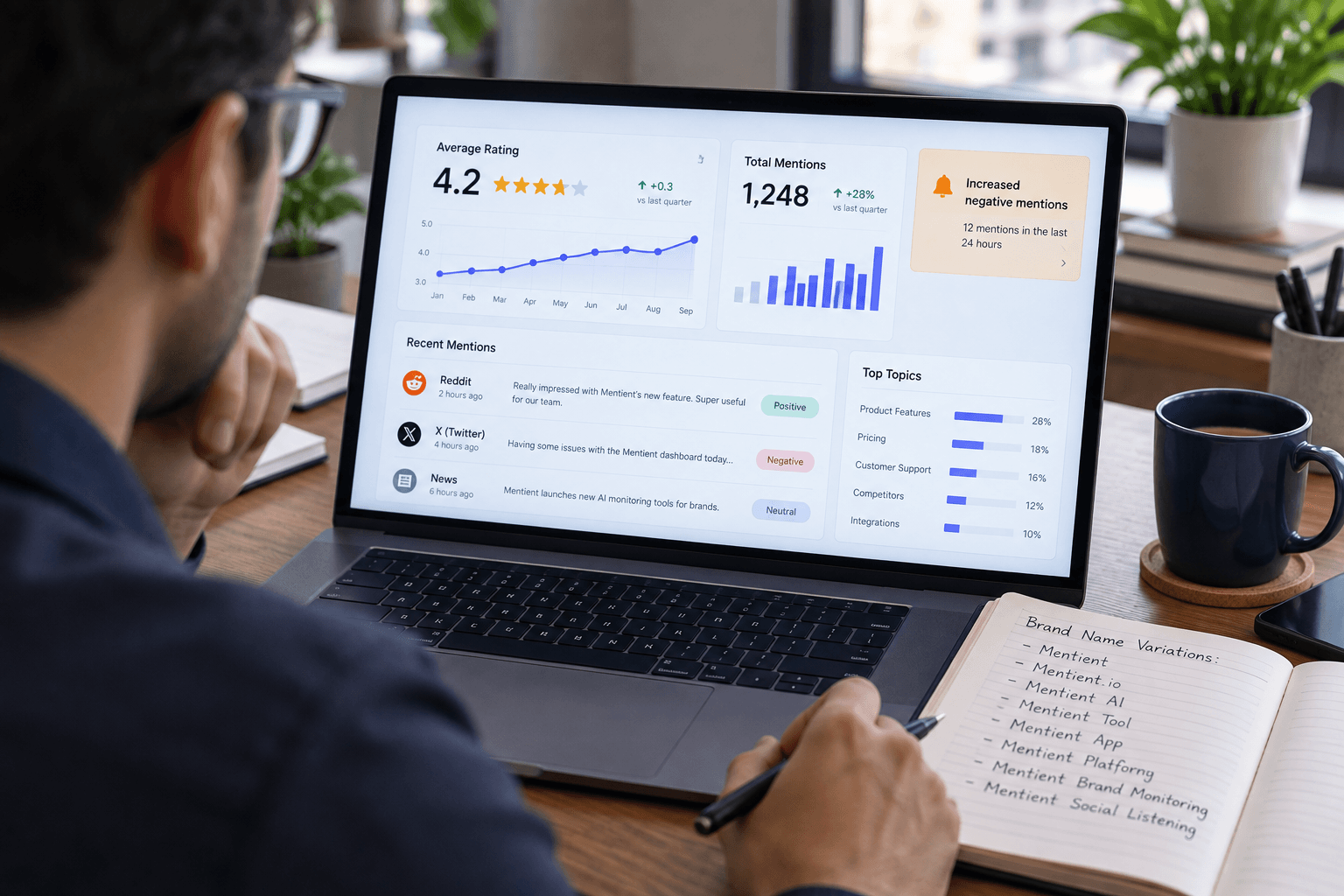
Mentient's AI Visibility Score automates the loop above. The platform runs your category prompts across ChatGPT, Perplexity, Claude, and Google AI Overviews, then reports a per-engine visibility score, the context your brand appeared in, and a side-by-side view against competitors, with recommendations on which sources to pursue next. It sits inside the same dashboard as our AI Brand Intelligence feature, so the Reddit threads and news mentions that feed engine consensus live next to the visibility numbers they influence. The framework in this guide works fine with a spreadsheet, though; tooling changes the effort involved, while the method stays the same.
Where to go from here
The buyers researching your category inside ChatGPT this week will not appear in your analytics until they have nearly decided. Start with Stage 1: write 25 prompts and run them across two engines before the end of the week, logging what comes back in a spreadsheet. That single exercise tells you whether you have a visibility problem or a head start worth protecting. The cluster guides linked below go deeper on each stage of the framework.
Frequently asked questions
How is AI search visibility different from SEO?
SEO earns your pages a position in a ranked list; AI search visibility earns your brand a place inside a synthesized answer. The inputs overlap less than many teams expect. Rankings depend on your domain's authority, while AI mentions depend heavily on what third-party sources say about you. We have watched brands hold page-one rankings while staying invisible in ChatGPT for the same queries.
How do you check your brand's AI search visibility?
Write 25 to 50 prompts a buyer in your category would ask, run each one across ChatGPT, Perplexity, Claude, and Google AI Overviews, and log whether your brand appears and how it gets described. Repeat monthly with identical wording so results stay comparable. Free checkers from Semrush and SE Ranking give a quick first read; a standing prompt inventory gives you the trend, which is the number that matters.
What is generative engine optimization (GEO)?
Generative Engine Optimization is the practice of shaping content so AI engines cite it in generated answers. Researchers from Princeton and Georgia Tech coined the term in a 2023 paper that tested nine tactics across 10,000 queries; adding sourced statistics and quotations performed best, lifting visibility by up to 40%. Think of GEO as the tactics layer underneath AI search visibility.
Do AI assistants send referral traffic to websites?
Yes, and it converts unusually well, though the volume stays modest for now. Semrush's traffic study measured AI search visitors at 4.4 times the value of traditional organic visitors, largely because the assistant has already done the comparison work before the click happens. We would add one caution from our own dashboards: referral attribution from AI assistants is messy, since some clicks arrive stripped of referrer data and get logged as direct traffic. Your AI-sourced traffic is probably higher than your analytics admit. Treat the reported number as a floor.
How long does it take to improve AI search visibility?
Weeks for retrieval-based engines, quarters for training-data effects. Pages built for citation can surface in Perplexity within a month. Reshaping how models describe your brand from memory takes sustained third-party coverage, and patience.