Enterprise social listening is a different budget category than the mid-market tools most brands start with. Sprinklr's enterprise contracts average roughly $129,000 a year, with large organizations frequently paying well past $500,000. Khoros deployments range from the tens of thousands into seven figures depending on modules and interaction volume. Brandwatch and Meltwater sit in similar territory, with median annual contracts landing around $25,000 to $50,000. None of these publish list pricing, and every deal starts with a sales call. This guide compares the platforms genuinely built for enterprise scale, what each one is actually good at, and where a mid-market alternative like Mentient covers the same ground for a fraction of the commitment.
- Enterprise listening contracts commonly run $50,000 to $500,000+ a year, with none of the major platforms publishing list pricing and every deal starting with a custom sales quote.
- These platforms are not interchangeable. Sprinklr unifies listening with customer service and campaign workflows, Khoros centers on social-plus-messaging customer care, and NetBase Quid leans toward market research and consumer intelligence.
- Implementation and training fees are rarely in the headline number. Professional services commonly add 15 to 30% on top of the base contract in year one, plus separate training fees.
- A meaningful share of enterprise buyers are paying for workflow breadth they use a fraction of. Pairing a narrower specialist listening tool with existing workflow software often lands under a full enterprise suite license.
- None of the legacy enterprise platforms track AI answer engines natively yet, which is becoming a real gap as more brand research shifts into ChatGPT, Gemini, and Perplexity conversations.
What "enterprise" actually means here
Enterprise listening platforms are built around a different set of assumptions than mid-market tools: global data coverage across dozens of markets and languages, deep historical archives running back years, dedicated customer success teams, single sign-on and governance controls that satisfy a large IT department, and integration into existing customer service or CRM infrastructure. That depth is genuinely valuable for a global consumer brand tracking sentiment across 40 countries in real time. It is expensive to build and expensive to buy, which is exactly why none of these vendors publish pricing.
The buyers who get the most value from this tier tend to share a few traits: multiple business units needing shared visibility, a dedicated insights or social intelligence team rather than one marketer wearing many hats, and a genuine need for the workflow integrations, not just the raw listening data. A company evaluating this tier without those traits is likely to end up paying enterprise prices for mid-market usage.
Quick comparison table
| Platform | Reported annual range | Core strength |
|---|---|---|
| Sprinklr | $50,000 to $500,000+, median ~$129,000 | Unified listening, care, and campaign workflow on one codebase |
| Brandwatch | $15,000 to $75,000+, median ~$50,000 | Deep historical archive, broad data licensing |
| Khoros | $40,000 to $500,000+ | Social and messaging folded into customer care workflows |
| Meltwater | $10,000 to $130,000+, median ~$25,000 | Combined PR media database and social listening |
| NetBase Quid | From roughly $20,000/yr | AI-driven consumer and market intelligence, research use cases |
| Mentient | Published, transparent tiers | Media, social, reviews, and AI answer engines without an enterprise contract |
Pricing reflects publicly reported figures and third-party contract analysis as of August 2026; confirm current terms directly with each vendor before budgeting.
Sprinklr
Sprinklr's defining architecture choice is running listening, publishing, customer care, and campaign analytics on a single codebase, so a spike in negative sentiment can trigger a customer service workflow automatically rather than sitting in a separate report someone has to notice and forward. Sprinklr retired its self-serve program entirely in April 2026, moving every buyer into a custom enterprise quote from day one. Reported contracts anchor around $80,000 in year one once implementation is included, with large enterprises averaging closer to $539,000 annually.
Best fit: organizations that want listening data to trigger real operational workflows across marketing, care, and campaign teams on one platform. Weigh carefully if: your team primarily needs listening and reporting without the full customer experience orchestration layer, since that breadth is exactly what drives the price up.
Brandwatch
Brandwatch built its reputation on data depth: a large historical archive and broad licensing across social and news sources that supports long-range trend analysis most competitors cannot match. Median actual contract value sits near $50,000 a year based on real purchase data, with a documented range from about $15,000 to over $75,000. Pricing is entirely quote-based, with no self-serve tier at any level.
Best fit: teams running historical trend research or academic-style analysis that genuinely needs years of archived conversation data. Weigh carefully if: pricing opacity and setup complexity are already frustrations with your current vendor, since Brandwatch shares both traits.
Khoros
Khoros treats social and messaging channels as first-class citizens inside its customer care agent desktop, which makes it a strong fit for brands where social listening and customer support are tightly linked functions rather than separate teams. Its social listening runs on Talkwalker's underlying data, spanning 187 languages. Reported annual contract values range from roughly $40,000 for smaller deployments up into seven figures for large, multi-module accounts.
Best fit: brands where social care and listening need to live inside the same agent workflow. Weigh carefully if: your primary need is standalone listening and analytics depth, since Khoros' listening functionality is narrower than a dedicated specialist platform.
Meltwater
Meltwater pairs a large media contact database with social listening, making it a natural fit for PR-heavy organizations that need press outreach tools and conversation monitoring under one contract. Pricing is annual-only and quote-based, with indicative ranges starting near $10,000 a year and a median buyer paying around $25,000 annually, scaling into six figures for larger, multi-module deployments.
Best fit: comms and PR teams that need media outreach and listening combined. Weigh carefully if: your team is purely marketing or product-focused with no active PR outreach function, since that half of Meltwater's value goes unused.
NetBase Quid
NetBase Quid leans hardest into market and consumer intelligence rather than day-to-day brand monitoring, using advanced natural language processing to support strategic planning, competitive landscape mapping, and CPG-style research projects. Reported pricing starts around $4,995 per quarter, with no free trial offered at any tier.
Best fit: strategy, insights, and research teams running periodic deep-dive analysis rather than continuous real-time monitoring. Weigh carefully if: you need daily operational alerting more than periodic research output, since that is not where the platform is strongest.
The costs that don't show up in the headline number
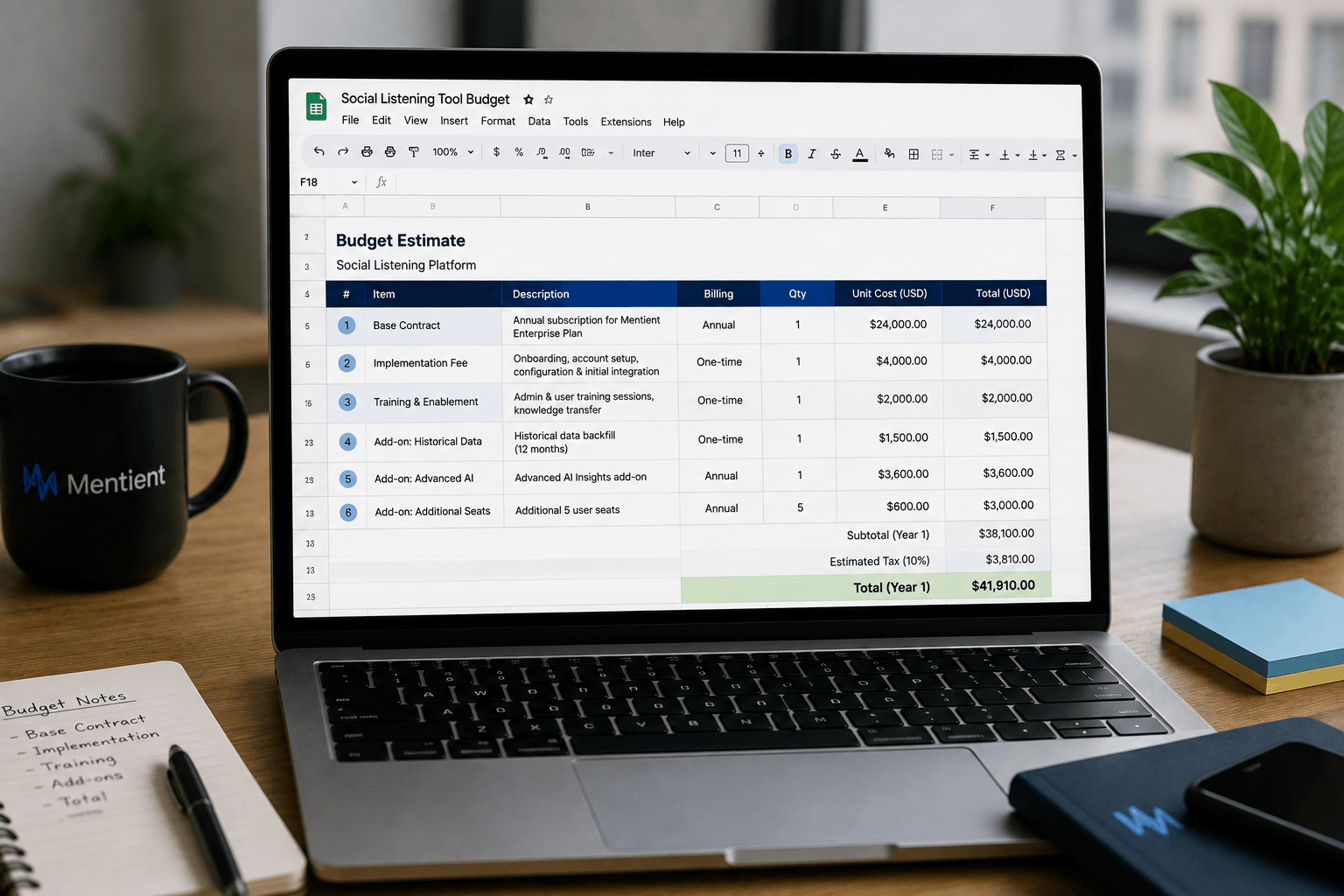
Implementation and professional services commonly add 15 to 30% on top of the base contract value in the first year across this entire category, and training fees, often $10,000 to $20,000, get billed separately upfront rather than folded into the quoted annual rate. Extra user seats, additional API access, and premium support tiers add further cost that rarely appears in an initial sales conversation. A buyer comparing platforms purely on the headline quote is comparing incomplete numbers, and it is worth asking every vendor directly for a full year-one total, not just the subscription line.
When a lighter platform like Mentient fits instead
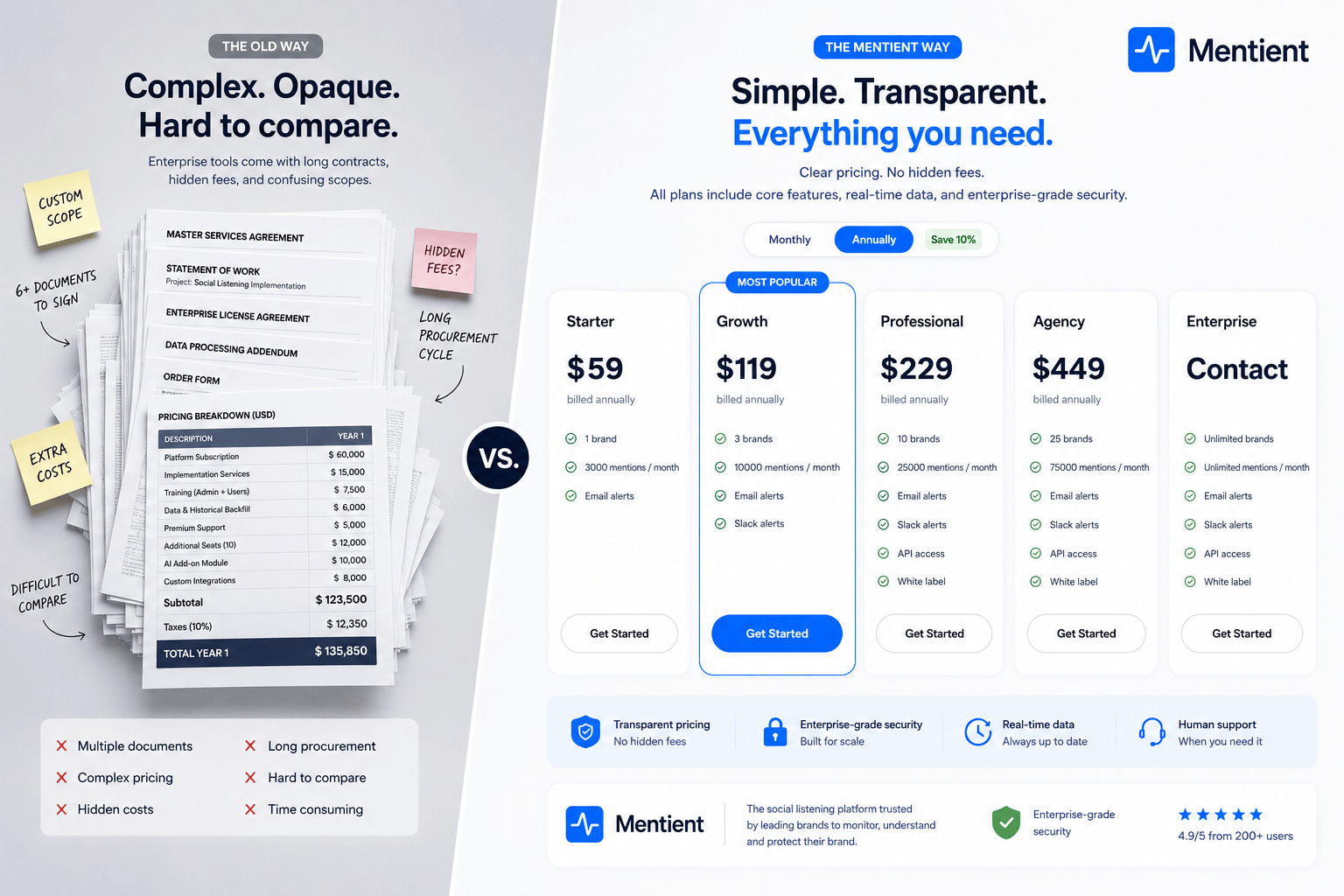
A meaningful share of teams evaluating this tier do not actually need it. If the requirement is comprehensive coverage across news coverage, social platforms, customer reviews, and forum conversation, without the customer service orchestration layer or the seven-figure contract, that need is closer to what Mentient was built for than what Sprinklr or Khoros were built for. We publish pricing openly rather than gating every plan behind a sales call, and AI answer engine tracking is built in natively, which is a gap none of the five platforms above have closed yet.
This is not a claim that Mentient replaces Sprinklr for a Fortune 500 brand running unified customer experience orchestration across forty markets. It is a claim that a meaningful share of companies shopping this category are not that brand, and are paying enterprise prices for a use case a lighter, more transparent platform covers just as well. Agencies managing multiple client accounts in particular tend to find the transparent per-account economics easier to model than negotiating a custom quote for every client relationship, and growing SaaS companies weighing this decision should read a stage-appropriate breakdown before signing a contract sized for a company five times their headcount.
Frequently asked questions
How do I know if I actually need an enterprise-tier platform?
If multiple business units need shared listening visibility, a dedicated insights team runs the tool daily, and the workflow integrations, not just raw data, are the actual requirement, enterprise tier likely fits. If one or two people need solid coverage and reporting, a mid-market platform usually covers the same ground for a fraction of the cost.
Why do none of these vendors publish pricing?
Enterprise contracts vary too much by module count, seat count, data volume, and integration scope to fit a fixed public tier structure, so vendors price by custom quote instead, which also gives sales teams room to negotiate based on what a buyer seems able to pay.
Can I negotiate these prices down?
Often, yes, particularly at higher spend tiers. Vendors report meaningful negotiating leverage for companies committing to larger annual contracts, and multi-year commitments frequently unlock further discounts. It is worth requesting a competing quote from at least one other vendor on this list before finalizing any enterprise contract, since sales teams in this category routinely adjust pricing once a genuine alternative is on the table, and the gap between an initial quote and a final negotiated number can run into the tens of thousands of dollars depending on the platform and the size of the deal.
Do enterprise platforms track AI answer engines like ChatGPT?
Not natively, as of this writing. Most of these platforms were built before generative AI search became a meaningful discovery channel, and none of the five compared here have added dedicated citation tracking across ChatGPT, Gemini, and Perplexity. Worth confirming directly if that channel matters to your evaluation.
The right platform in this category depends entirely on what the listening data needs to trigger once it arrives. Sprinklr and Khoros make sense when listening feeds directly into customer care workflows. Brandwatch and NetBase Quid make sense for archive depth and research output. Meltwater makes sense when PR outreach and listening need to share a contract. Get a full year-one number, implementation and training included, from at least two vendors before deciding, and check whether your actual requirement is enterprise scale at all before signing anything.
Get enterprise-grade coverage without the enterprise contract
Mentient tracks news, social, reviews, forums, and AI answer engines in one dashboard, with pricing published openly instead of gated behind a sales call. Start free and see what your team actually needs.
Start free trial