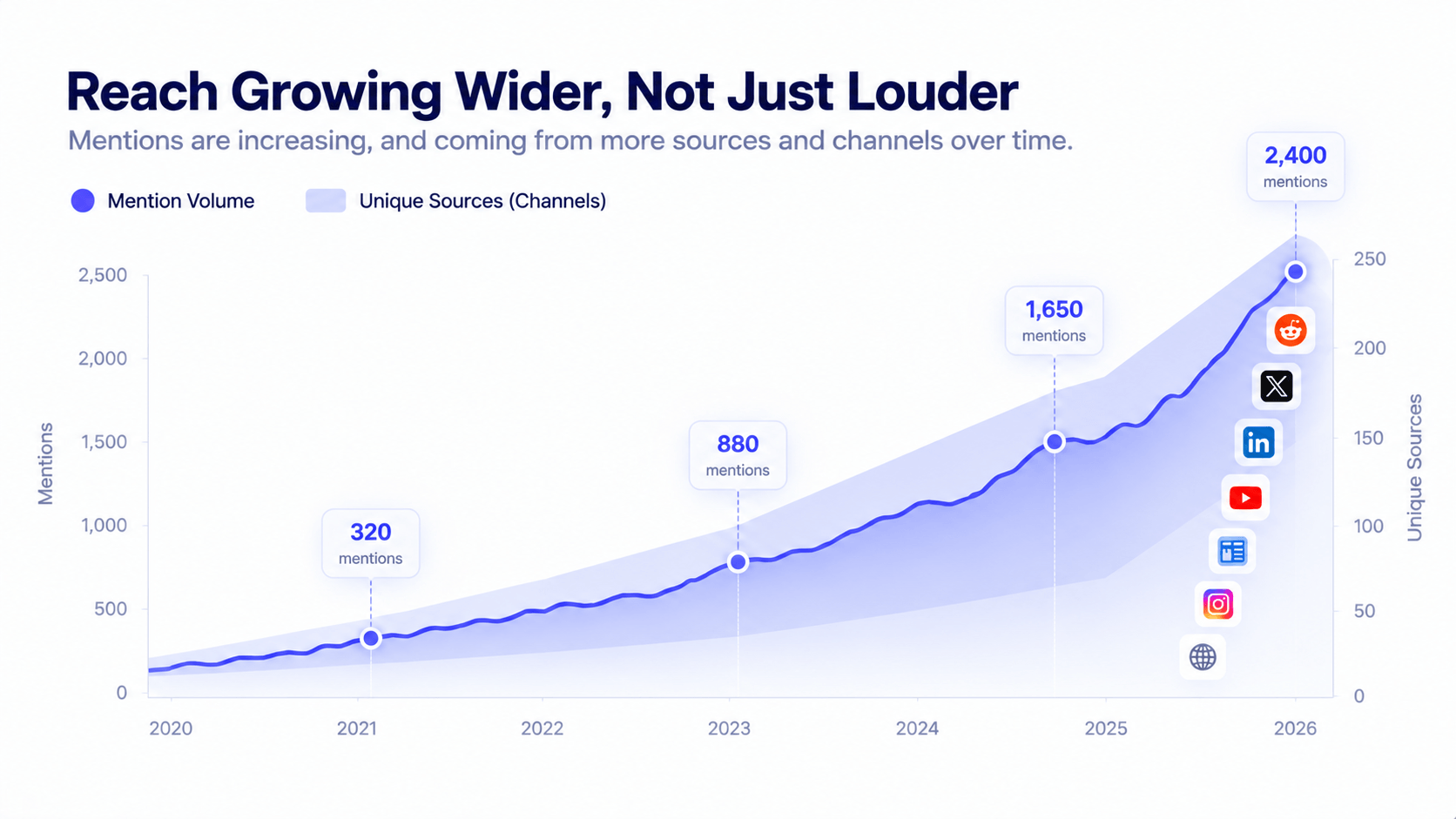
A media monitoring platform can watch six wire services, four broadcast markets, and every trade blog in an industry, and still miss the one Reddit thread that actually changes a deal. That is not a flaw in the tool. It is a scope problem: media monitoring tracks what got published. Whether anyone believed it, forwarded it, or complained about it afterward is a separate question, one most monitoring tools were never built to answer. This guide covers what media monitoring actually is, the five channel types underneath the term, what to weigh when picking a tool, and the practices that separate a program that catches real signal from one that just produces a daily PDF nobody opens.
- Media monitoring tracks published coverage, across news, broadcast, print, wire, and podcasts. It is a distinct discipline from social listening, not a rebrand of it.
- Five channel types make up a monitoring program: online news, print, broadcast, podcast, and social. Most vendors cover the first reliably and get inconsistent on the rest.
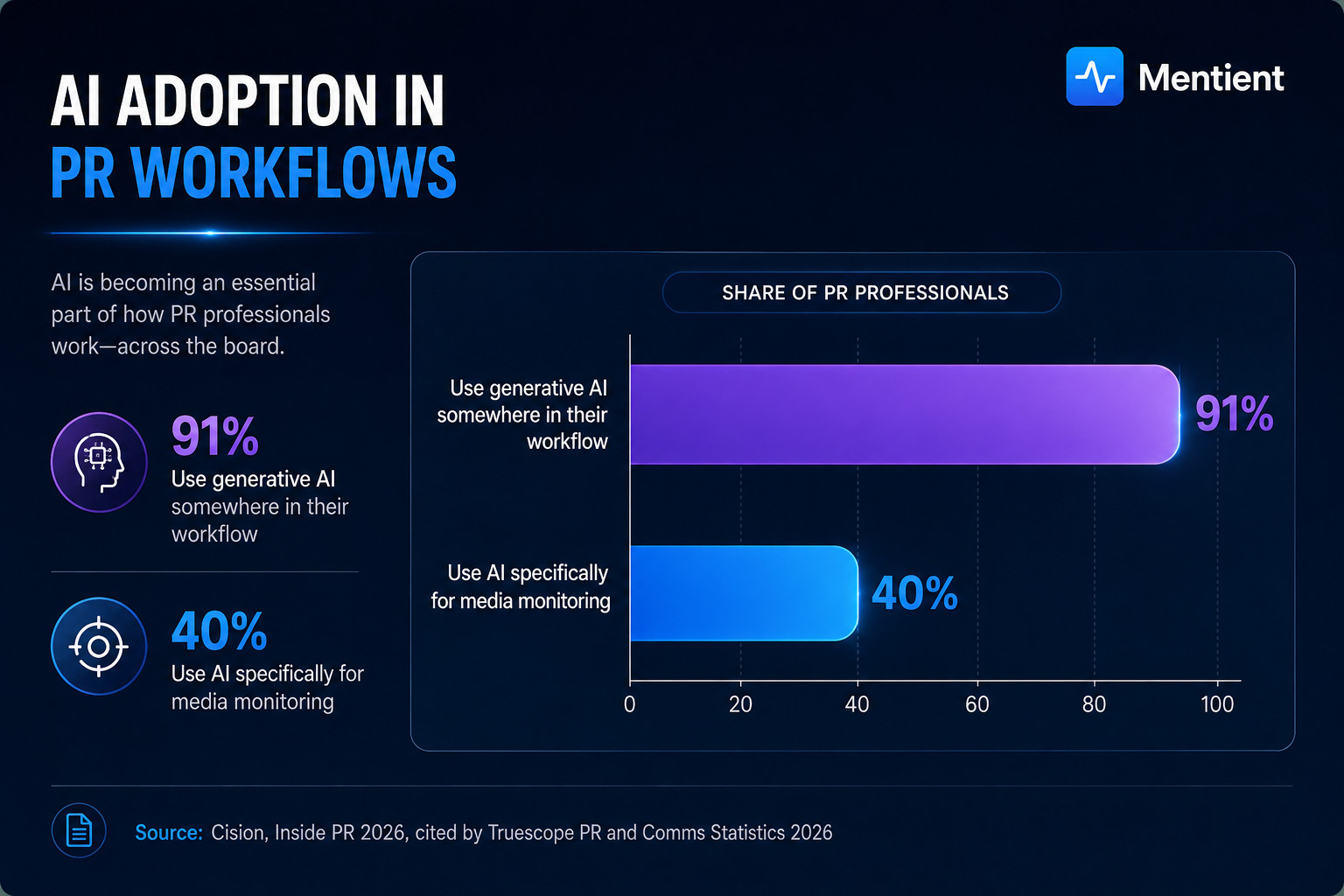
- 91% of PR professionals already use generative AI in their workflow, but only 40% use AI specifically for media monitoring (Cision, Inside PR 2026), a gap worth checking before you sign a contract.
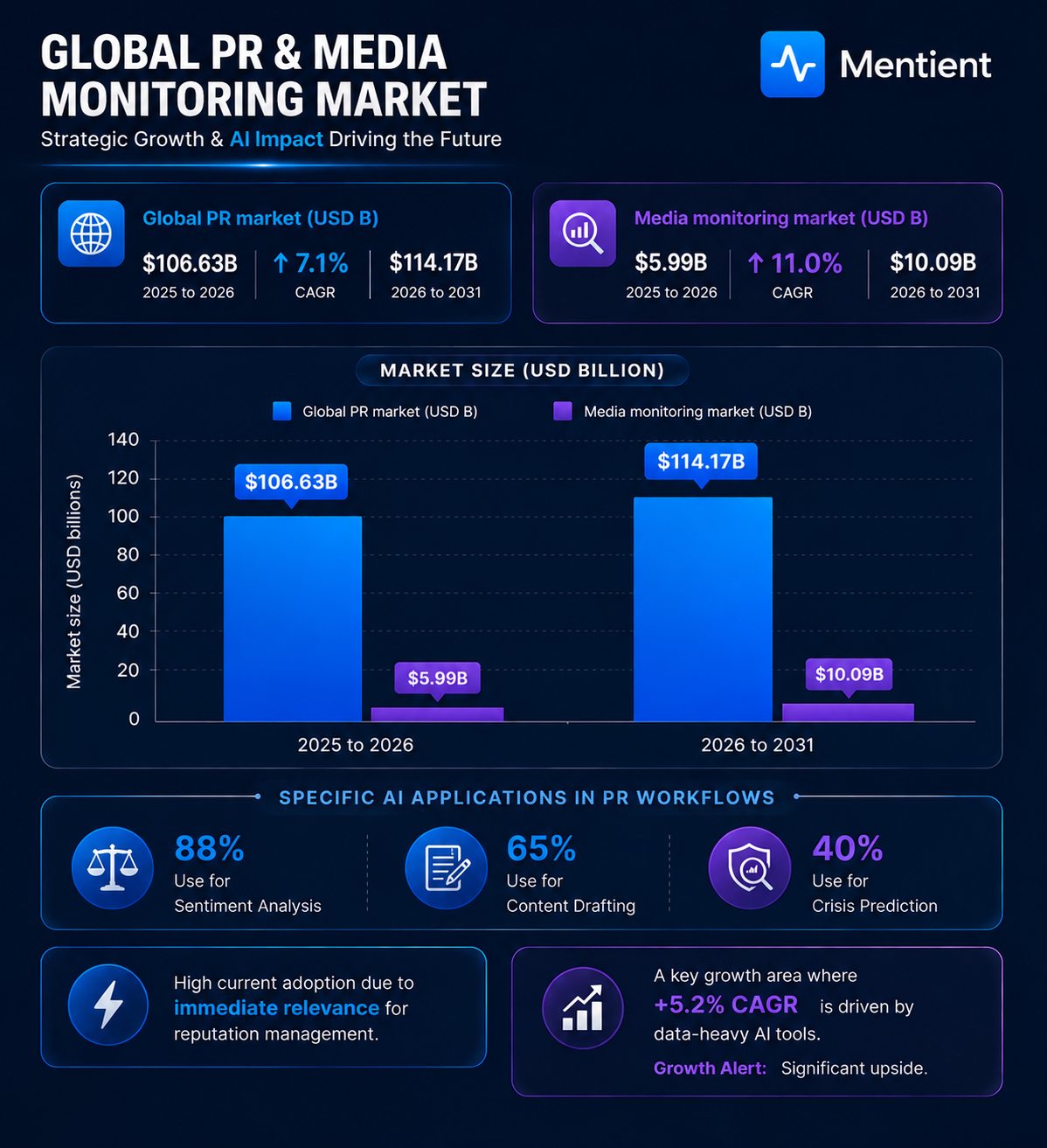
- The media monitoring market is projected to grow from $5.99 billion in 2026 to $10.09 billion by 2031 (Mordor Intelligence), inside a broader $114.17 billion PR industry.
- The best programs route coverage into a decision within hours, not a report read the following Friday. Speed is what separates monitoring that pays for itself from monitoring that just generates PDFs.
What is media monitoring?
Media monitoring is the practice of tracking, collecting, and analyzing published coverage of a brand, its competitors, or its industry across news sites, broadcast, print, wire services, and increasingly podcasts. It tells a team what ran, where, and how far it traveled. It does not, on its own, tell you what people thought about it afterward. That is a related but separate discipline: social listening.
The category is older than most software still running under its banner. Newspaper clipping bureaus did a manual version of this a century before anyone called it media monitoring, literally people with scissors and a subscription to every regional paper worth watching. What changed is coverage breadth and speed. A platform today can pull a story from a wire service, a broadcast transcript, and a niche trade blog within minutes of publication, then score it for sentiment before a person opens the alert.
Forty percent of PR teams already run AI-driven media monitoring, according to Cision's Inside PR 2026 survey, and the market backing that shift is not small. Mordor Intelligence puts the global media monitoring market at $5.99 billion in 2026, growing to $10.09 billion by 2031. That sits inside a larger PR industry, projected at $114.17 billion in 2026, up from $106.63 billion the year before, according to Mordor Intelligence figures cited by Truescope.
The five types of media monitoring
Vendors use "media monitoring" as an umbrella term, but the five channels underneath it are not interchangeable, and most platforms are genuinely strong in two or three of them at most.
- Online news. Digital articles, wire pickups, and news-site coverage. Every serious platform covers this reliably. It is table stakes, not a differentiator.
- Print. Some platforms license full-text feeds of newspaper and magazine content. Fewer offer scanned images of the actual physical page. If a stakeholder needs to see the clipping as it ran, confirm which version you are buying.
- Broadcast. This is where definitions diverge the most: one vendor's "broadcast" might mean an article on a network's website, while a different vendor means true over-the-air capture of the actual TV or radio segment. Ask which one is included before you assume you have it.
- Podcast. The newest and least consistent channel. Speech-to-text models find spoken mentions, but coverage depth varies more here than anywhere else in the category.
- Social. Posts, forum threads, and reviews. This is the layer that overlaps with social listening proper, and inside a media monitoring platform it is usually a shallow bolt-on module rather than core coverage.
| Channel | What it captures | Common gap |
|---|---|---|
| Online news | Digital articles and wire pickups | Syndicated duplicates inflate volume counts |
| Licensed text or scanned pages | Scanned clippings are the exception, not the rule | |
| Broadcast | TV or radio segments, or network web articles | Vendors define "broadcast" inconsistently |
| Podcast | Speech-to-text mention detection | Coverage depth varies the most of any channel |
| Social | Platform posts, forum threads, reviews | Often a shallow module, not core coverage |
Why media monitoring matters now
Ninety-one percent of PR professionals already use generative AI somewhere in their workflow, according to Cision's Inside PR 2026 survey. Only 40% of that same group uses AI specifically for media monitoring. That gap is the whole story of where the category stands right now: broad comfort with AI in general, uneven trust in letting it touch the actual coverage pipeline.
Seventy-eight percent of PR professionals say tracking AI-generated mentions of their brand is important to their work, and 67% believe visibility inside large language models will soon be a standard part of PR measurement, according to Muck Rack's State of PR Measurement 2025. A monitoring program built entirely around the news cycle was never going to cover that layer on its own, which is part of why AI brand visibility is showing up as a separate line item in more marketing budgets.
The two most-used PR success metrics globally are still volume of media placements and reach or impressions, both legacy outputs rather than business outcomes, according to AMEC's PR Measurement in 2026 research. Teams that adopt new measurement technology see a 23% average ROI improvement, per PRWeek's 2025 Agency Business Report. The tools are not really the bottleneck anymore. The metrics a team chooses to report usually are.
What to look for in a media monitoring tool
Every vendor demo looks capable. The differences show up six months in, once the shine wears off and a team is running the same three queries every morning. Five questions cut through most of the noise before anyone signs anything.
- Source coverage, confirmed in writing. Ask which specific outlets, broadcast markets, and social platforms are included in the base plan versus sold as an add-on. A demo showing a competitor's logo is not proof that outlet is actually covered for your account.
- What the AI actually touches. AI features split into two rough camps: the kind that just helps a user build a search query, and the kind that reads and summarizes the coverage itself. Ask whether the model works against a licensed, curated dataset or just searches the open web, and whether your queries train a shared model other customers benefit from.
- Reporting nobody has to build by hand. Scheduling, branding, export formats, and whether AI-generated summaries are included without an extra module fee.
- Fit with how the team already works. Slack, Teams, email digests, and API access matter more day to day than a feature list. So do search caps that quietly force an upgrade six months in.
- What happens after the contract is signed. A dedicated account manager with PR experience behaves very differently from a general support ticket queue, and renewal terms with a narrow 60 to 90 day cancellation window are common enough to read closely.
Our own approach to coverage leans toward Reddit and the open web specifically, because that is where the mentions most monitoring platforms miss tend to live.
How the major tools differ
No single platform is built for every buyer. The category splits roughly into five profiles, and knowing which one describes a team saves most of the evaluation time.
| Buyer profile | What to prioritize |
|---|---|
| Large enterprise needing social and PR bundled | Broad social analytics, influencer tools, one integrated suite |
| Team running heavy press release distribution | Media database depth, distribution, contact management |
| Agency focused on journalist relationships | Media list building, pitch tracking, relationship history |
| Team needing true broadcast and print capture | Confirmed over-the-air segments and scanned clippings |
| Team tracking how the brand shows up in AI answers | A dedicated AI-visibility layer, not a bolted-on chatbot feature |
That last row is the newest profile, and it barely existed in most buying criteria two years ago. A platform can nail every classic media monitoring channel and still have nothing to say about whether ChatGPT or Perplexity name a brand when a buyer asks a category question. We built a dedicated visibility layer for exactly that gap rather than retrofit a chatbot search box onto a press-clipping database, and we track named competitors through the same competitor tracking lens rather than a separate module.
Media monitoring best practices
None of this requires a bigger team or a pricier plan. It requires a handful of habits most programs skip once the initial setup excitement wears off.
- Define what counts as relevant before turning on alerts. A brand name that is also a common word floods a query with noise. Scope the terms first, tune later.
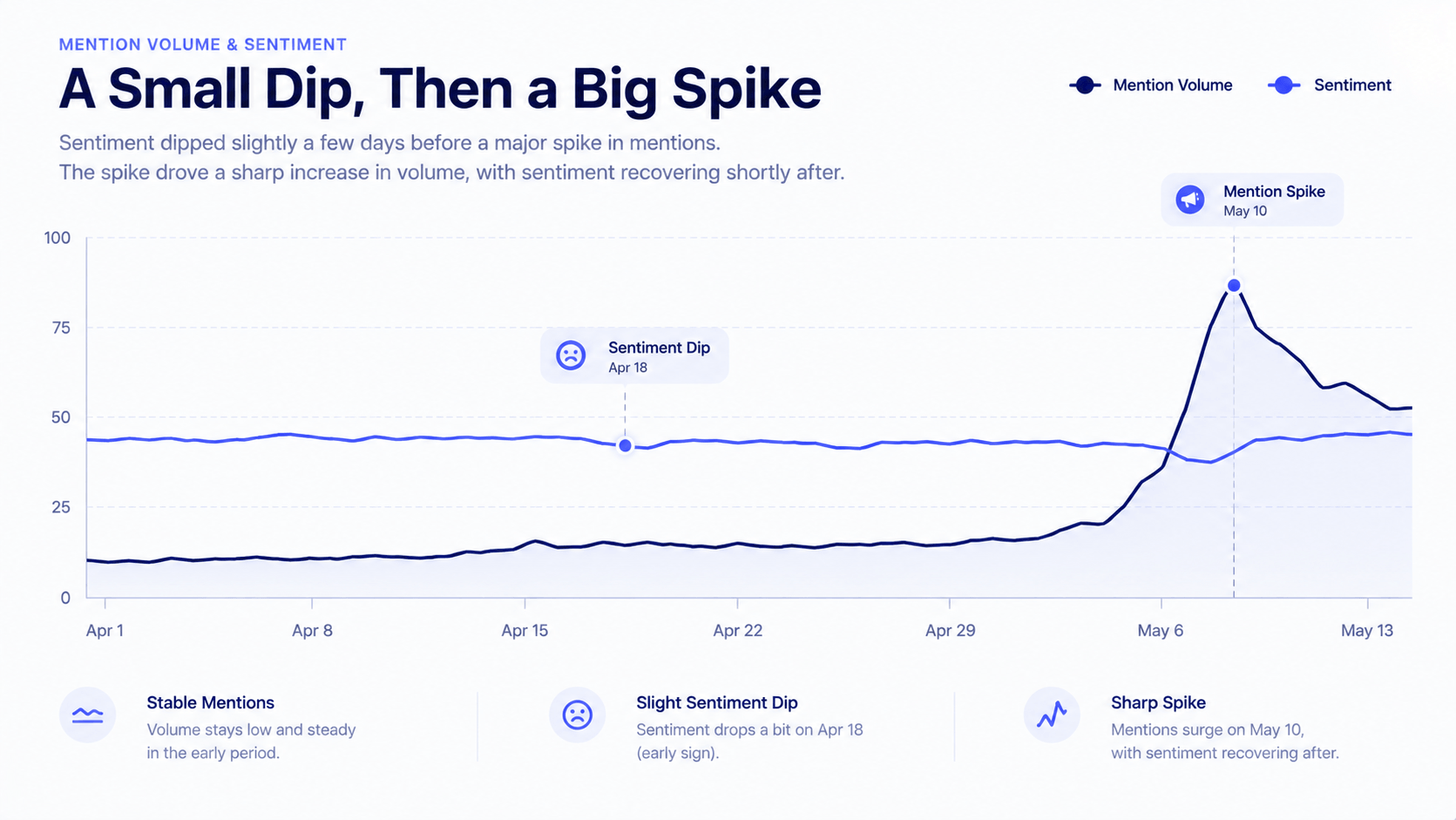
- Set escalation triggers, not just alerts. A single mention rarely needs a same-hour response. A volume spike paired with a sentiment drop usually does. Build the trigger around the combination, not either signal alone.
- Route coverage to the team that can act on it, same day. A clip sitting in an inbox for two days has already stopped being useful to whoever needed to respond.
- Review query rules on a quarterly cadence, not once at setup. Products, competitors, and slang all shift. A stale query quietly stops catching unbranded conversation long before anyone notices the gap.
- Track outcomes, not just output. Volume of placements and reach are the two most-reported PR metrics globally, and they are also the least connected to a business decision. Pair every coverage report with at least one outcome metric a CFO would recognize.
Common mistakes to avoid
Most of these mistakes are not dramatic on their own. A vague query here, a support ticket that sits for a week there. Stacked together over a year, they are usually why a perfectly functional monitoring program still gets questioned at renewal.
- Buying against a feature checklist instead of a daily workflow. Fifty capabilities nobody touches are worth less than twenty that work together cleanly.
- Assuming "broadcast" means the same thing at every vendor. Confirm whether it means true over-the-air capture or just articles on a network's website, in writing, before signing.
- Treating the vendor's AI as a black box. Ask what dataset it reads, whether your queries train a shared model, and where the processing happens.
- Underweighting support until after signing. Buyers spend weeks evaluating features and minutes evaluating what happens when something breaks at 6pm on a Friday.
- Never revisiting query rules once the account goes live. A setup built around last year's competitor list and last year's slang is already missing part of the picture.
Frequently asked questions
What is the difference between media monitoring and media measurement?
Media monitoring finds and collects coverage as it publishes. Media measurement analyzes that coverage against a goal, reach, sentiment trend, or share of voice against named competitors. Monitoring is the input. Measurement is what a team does with it afterward.
Is media monitoring the same as press clipping?
Press clipping is the older, narrower ancestor of media monitoring, originally a manual service that physically cut articles out of newspapers. Modern media monitoring does the same core job, finding every mention, but adds automated collection across broadcast, wire, podcast, and online sources, plus sentiment scoring most clipping services never offered.
How much does media monitoring software cost?
Pricing is almost always custom rather than published, and it scales with the number of channels, seats, and whether broadcast or print capture is included. A team evaluating vendors should ask for a quote scoped to its actual channel list rather than comparing sticker prices across platforms with different inclusions.
Can a small team do media monitoring without expensive software?
Yes, up to a point. Free search alerts cover basic online news detection. They miss broadcast, print, and most social and forum conversation entirely, and they offer no sentiment scoring or escalation logic, so the gap shows up fast once volume grows past a handful of mentions a week.
How is AI changing media monitoring?
AI has moved sentiment scoring from keyword matching to full-context reading, which cuts down on the false positives that plagued older tools. A keyword model used to score "this update broke everything" and "this update is sick" the same way; a model that reads the full sentence usually does not. AI has also added a channel media monitoring never used to track: whether a brand gets named inside AI assistant answers like ChatGPT and Perplexity. Ninety-one percent of PR professionals now touch generative AI in some part of their work, according to Cision's Inside PR 2026 survey, but only a minority monitor that answer-engine layer directly yet, which is usually the first gap worth closing once the basics are covered.
Media monitoring earns its budget line by catching coverage fast enough for someone to act on it, not by producing a longer report. Confirm what each vendor actually means by "broadcast" and "AI" before signing anything, set escalation triggers instead of blanket alerts, and revisit query rules on a real schedule. Do that and the tool starts paying for itself inside the first quarter instead of the third.
See where your brand shows up, beyond the press clip
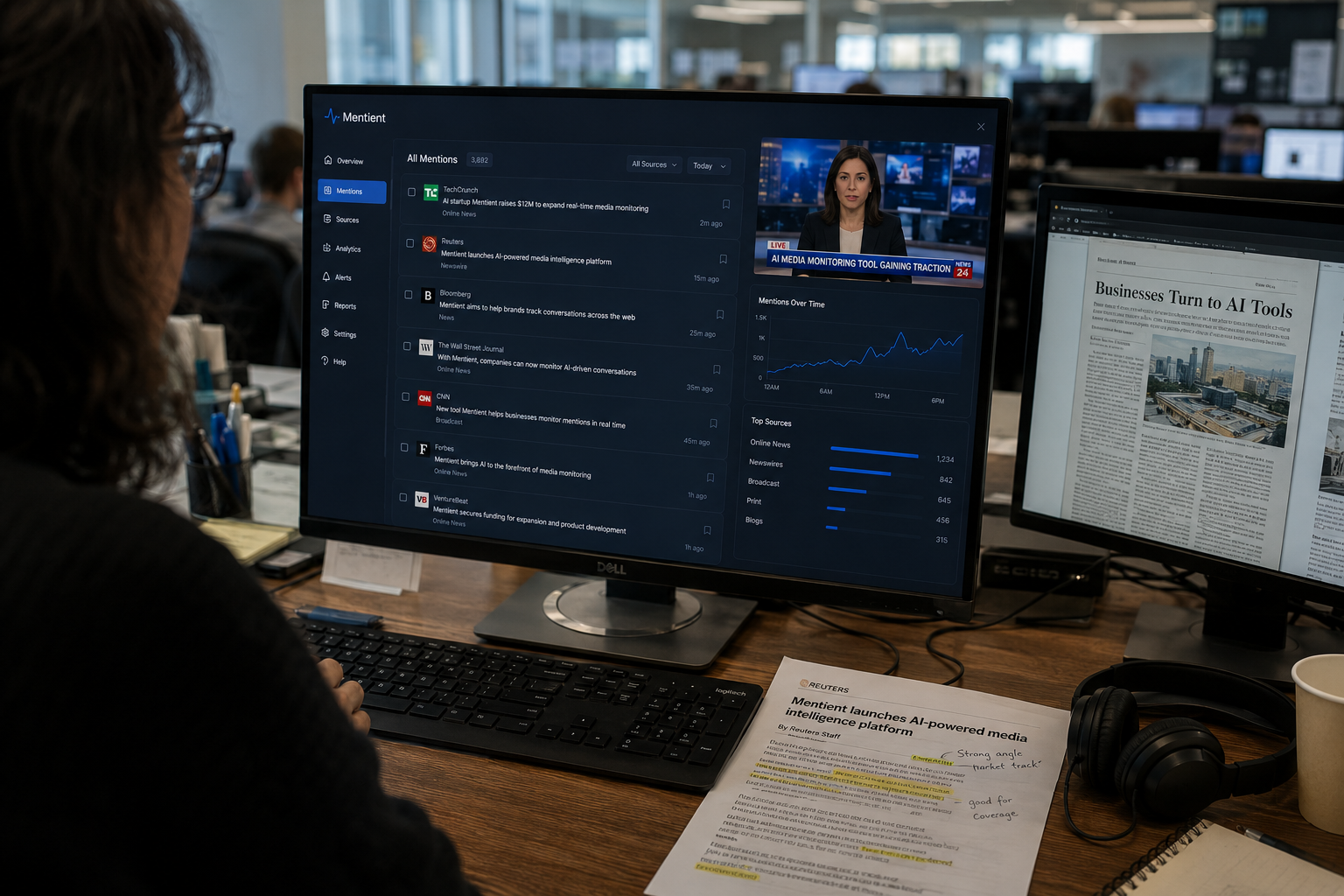
Mentient tracks Reddit, news, and the open web from one dashboard, with sentiment scored on full context instead of a keyword match, plus visibility into how AI assistants describe your brand. Start free and see what's already been said about your brand this week.
Start free trial