On March 12, 2026, Adobe's chief executive of eighteen years told investors he would step down once a successor was named. Coverage of the announcement returned again and again to the same name: Canva, the free-to-start design tool that Adobe's own sales team once dismissed as a toy for people making birthday invitations. We pulled 22 years of worldwide Google Trends data for both brands to see whether the story the headlines were telling actually shows up in the numbers. It does, and it started earlier than the acquisition everyone points to.
This piece runs on real, publicly checkable data. The core dataset is worldwide Google Trends search interest for "Adobe" and "Canva," monthly, from January 2004 through September 2026, pulled directly and not estimated. Every named event is drawn from public reporting and linked to its source. One note up front: this is an independent analysis using public data. Neither Canva nor Adobe is a customer of Mentient, and nothing here should be read as an endorsement or partnership with either company.
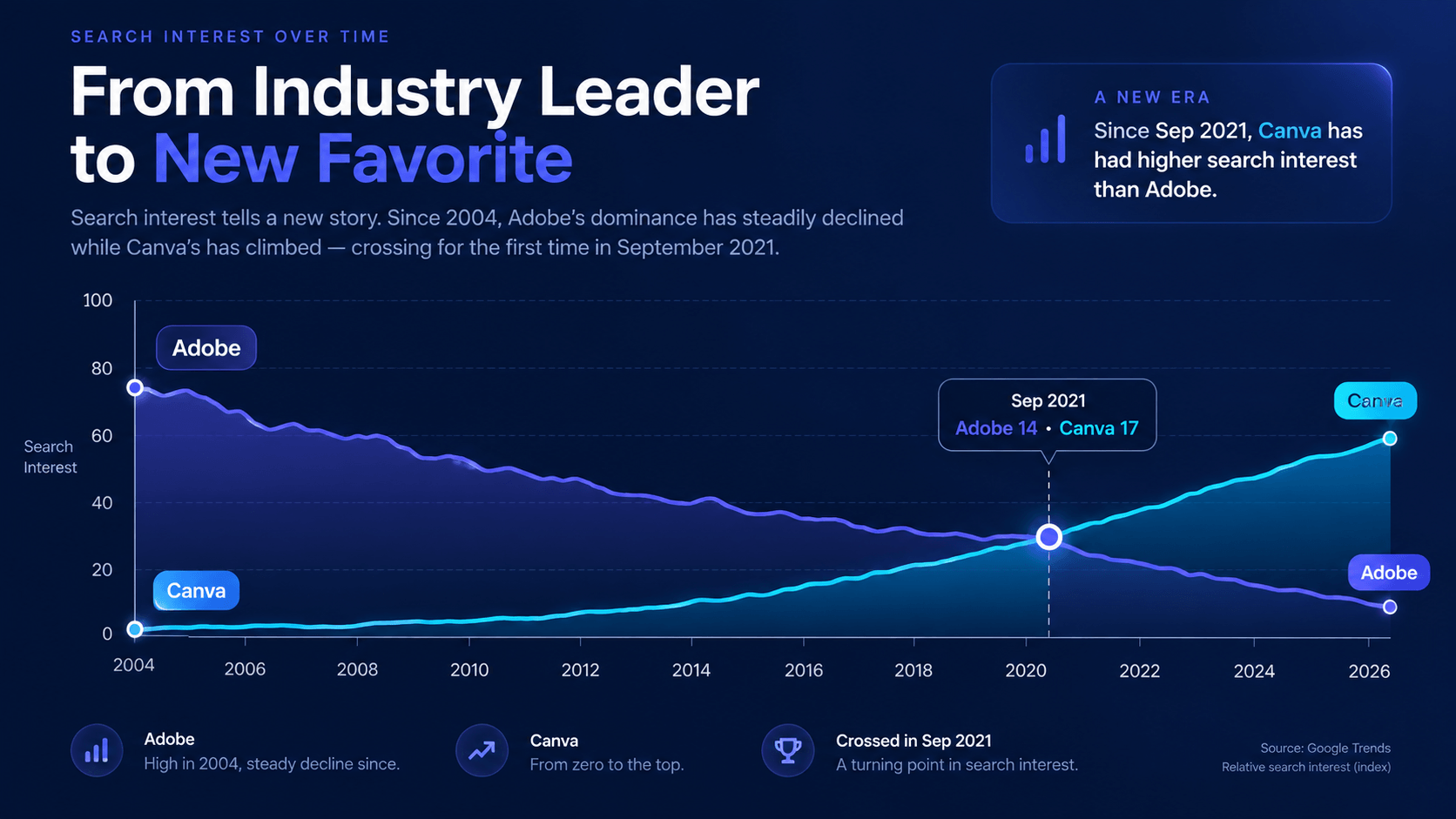
- Canva's global search interest overtook Adobe's in September 2021, more than two years before Canva ever owned a piece of professional-grade design software. Worldwide Trends values that month: Adobe 14, Canva 17.
- Adobe's own search interest has been declining since before Canva existed. Its worldwide index averaged 69.0 in 2010 and had already fallen to 36.8 by 2015, the year Canva's search interest first registers above zero.
- The sharpest sustained search spike in our entire pull was not the headline-grabbing acquisition. Canva's March 2024 purchase of Affinity moved search interest only modestly (63 to 66). The September 2024 pricing backlash moved it far more, climbing from 65 in August to 89 by November.
- By the ten months ending September 2025, Canva averaged 85.0 on the worldwide index against Adobe's 20.2, a 4.2x gap. Canva's share of the two brands' combined search interest rose from 21.1% in 2019 to 80.8% by 2025.
- Adobe's search interest hit a multi-year plateau right around its CEO transition news. After sitting in the high teens for most of 2022 through 2024, Adobe's index climbed to a sustained 22 to 23 from February through June 2026, spanning the March 12 announcement.
Quick context: who are Canva and Adobe
Melanie Perkins started her first design business, an online yearbook platform called Fusion Books, in 2007 while still a university student in Perth, Australia. She and co-founder Cliff Obrecht spent years pitching a broader version of that idea, a simple, browser-based design tool anyone could use, to venture capitalists, and were turned down more than 100 times over three years. Cameron Adams, a former Google designer, joined as the third co-founder in 2012, and the trio launched Canva publicly in August 2013 after an initial $3 million seed round.
Adobe's history runs in the opposite direction. Founded in 1982 and public since 1986, the company built its dominance over four decades around Photoshop, Illustrator, and later the Creative Cloud subscription bundle, becoming the default professional standard that design agencies, marketing teams, and freelancers were trained on. For most of Canva's early life, the two companies were not seen as direct competitors at all. Canva served people who found Adobe's tools too complex or too expensive; Adobe served the professionals Canva's tools were not built for.
By 2026, Canva reported roughly $4 billion in annualized revenue and 150 million customers, with an internal valuation reaching $65 billion in an employee share sale, and had begun visibly preparing for a stock market listing, moving its parent company's legal domicile to the United States and hiring a CFO who previously led Zoom through its own public debut. Adobe, meanwhile, posted record revenue above $24 billion while its stock fell sharply on investor concern about AI-native competition, and on March 12, 2026, announced CEO Shantanu Narayen's transition out once a successor was named. Anil Chakravarthy was named incoming president and CEO on September 3, 2026, effective that December.
How we pulled this
This piece is built on one primary dataset: worldwide Google Trends search interest for the terms "Adobe" and "Canva," pulled monthly from January 2004 through September 2026. Google Trends indexes values from 0 to 100 relative to the single highest point across the whole comparison, which in this pull is Canva's October 2025 reading. A value of 50 means half the search interest of that peak month, not half of any absolute number of searches, and the index reflects relative interest rather than raw mention volume or traffic. We are naming this methodology explicitly because a research post that hides its sourcing, or blurs a relative index into an absolute count, is not worth publishing.
One honest caveat on the earliest years of Adobe's line: a portion of Adobe's search volume in the 2004 to 2010 range almost certainly reflects generic queries for Adobe Reader and Acrobat downloads, which were far more commonly searched before PDF viewing became a built-in browser feature. We have not attempted to separate that from brand-level interest in Adobe as a company, and readers should treat the earliest years of Adobe's line as a rough proxy rather than a precise brand metric. Every named event in this piece, the Affinity acquisition, the pricing backlash, the CEO transition, is drawn from public reporting and linked to its source; the Trends values are the real, downloadable numbers for the corresponding months.
The month Canva quietly overtook Adobe
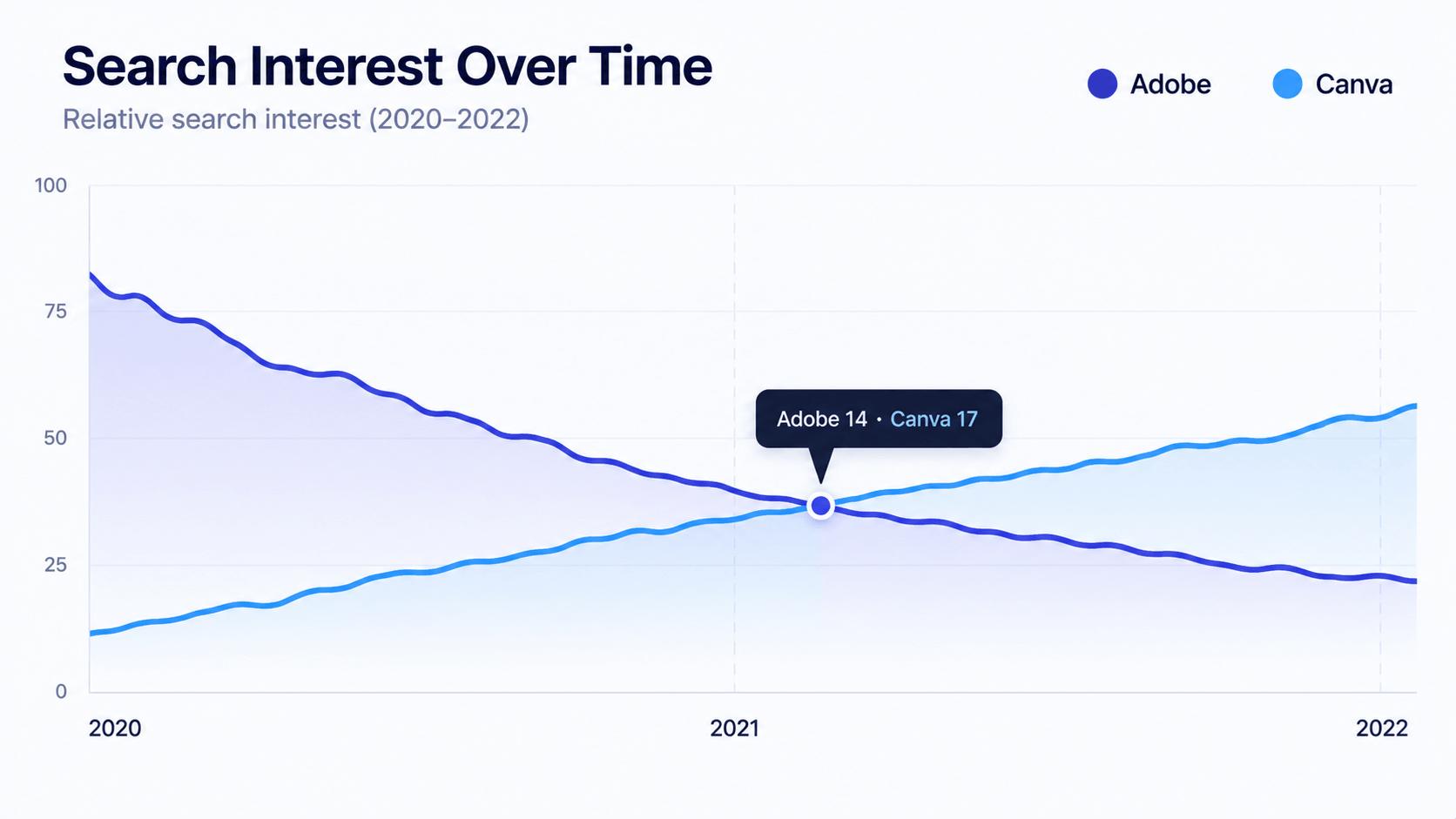
Every retelling of the Canva-versus-Adobe story reaches for the same anchor point: the March 2024 Affinity acquisition, the moment Canva bought its way into professional-grade software. The Trends data tells a quieter, earlier story. Adobe's worldwide search index had been sliding for over a decade, from an average of 69.0 in 2010 down to 36.8 by 2015 and 14.5 by 2021, likely reflecting how deeply embedded the product had become in daily workflows rather than any single controversy. Canva's line, meanwhile, climbed steadily from its first non-zero reading in August 2015.
The two lines crossed in September 2021: Adobe at 14, Canva at 17. Canva held the lead the following month too, and by December 2021 the gap had widened to 13 versus 15. There was no acquisition that quarter and no viral controversy. Pandemic-era remote work and a boom in DIY content creation appear to be the more plausible drivers, based on the timing alone, though we want to be direct that Trends data shows correlation with that period, not a documented causal mechanism. What the data does establish cleanly is the date: Canva was already the more-searched name worldwide two and a half years before it owned a single line of Affinity's code.
The data walkthrough
Three named events sit inside our pull with enough separation to read cleanly against the Trends line. What the data shows about their relative size is not what the press coverage volume alone would suggest.
March 2024, the Affinity acquisition. Canva's acquisition of Affinity, reported at roughly $380 million, gave Canva Affinity's roughly 3 million users and three flagship applications built as direct, purpose-built competitors to Photoshop, Illustrator, and InDesign. Coverage described the deal in escalating terms, with multiple outlets using words like "checkmate" in headlines. The search data moved by comparison: Canva's index sat at 63 in February 2024, 64 in March, and 66 in April, a real but modest climb given how the deal was covered. A professional-tool acquisition, it turns out, does not move mainstream search behavior the way a consumer-facing controversy does.
September 2024, the pricing backlash. Canva raised its Teams plan pricing roughly 300% in a single move, from about $120 to $500 per person per year, in what several outlets called the sharpest SaaS pricing backlash on record. Canva reversed the change within weeks. This is where the Trends data actually spikes: the index climbed from 65 in August to 77 in September, 85 in October, and 89 in November, a sustained four-month run that dwarfs the Affinity bump in size. A pricing controversy that sends existing customers searching for explanations and alternatives appears to move brand search volume more than an acquisition covered mostly in trade press.
February through June 2026, the CEO transition window. Adobe's index had spent 2022 through 2024 mostly in the high teens. Beginning in February 2026, it stepped up to a sustained plateau of 22 to 23, holding through June, spanning Narayen's March 12 announcement that he would step down. That is Adobe's highest sustained multi-month reading since our pull begins showing a comparable level, back in 2022, and the timing lines up with a period of heavy investor and press scrutiny of Adobe's AI competitive position.
The acquisition Canva is famous for buying barely moved the needle. The pricing mistake it wishes people forgot moved it more than anything else in 22 years of data.
Share of search interest, year by year
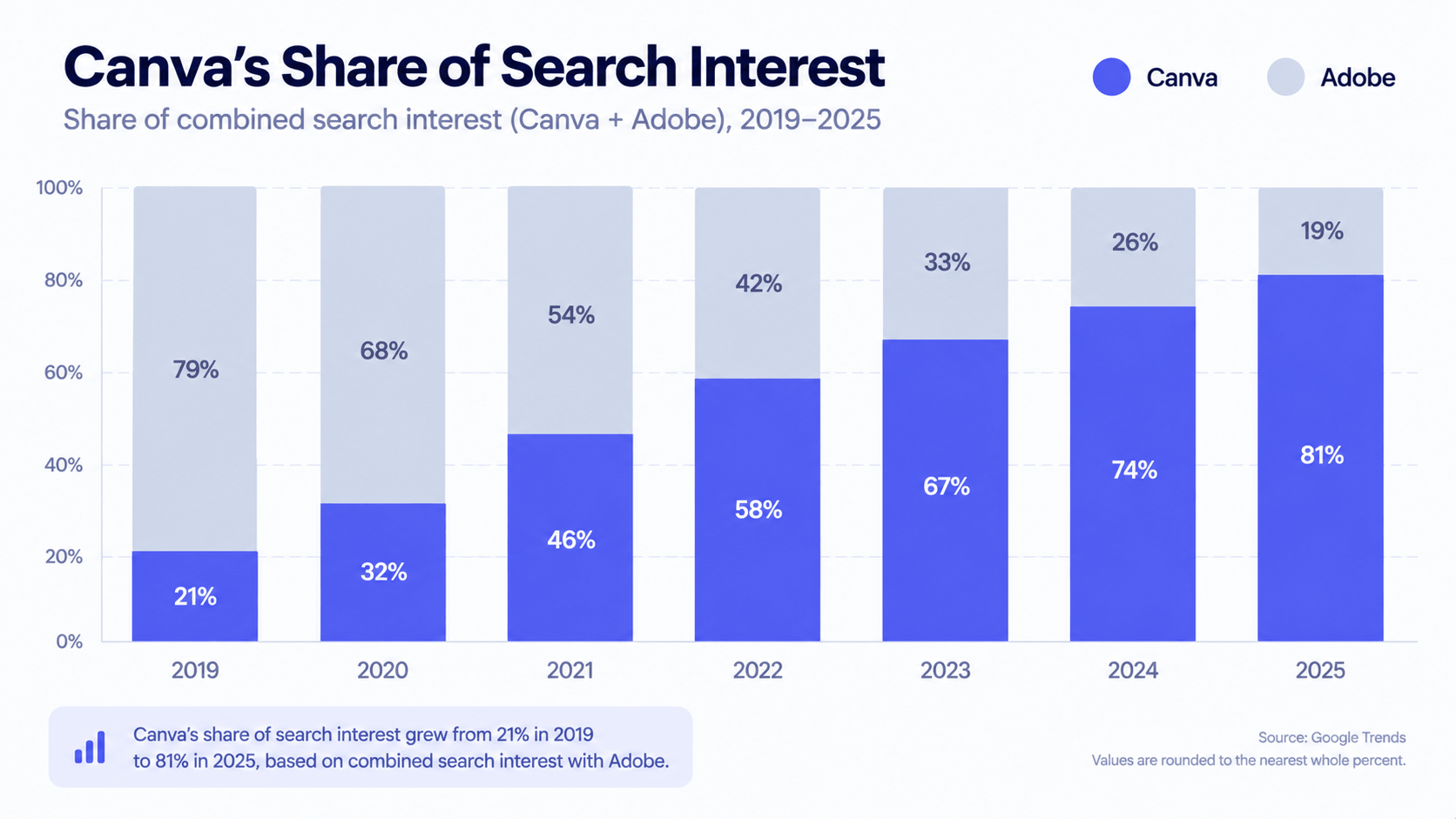
| Year | Adobe avg. index | Canva avg. index | Canva's share of combined interest |
|---|---|---|---|
| 2019 | 17.4 | 4.7 | 21.1% |
| 2020 | 18.2 | 8.2 | 31.1% |
| 2021 | 14.5 | 13.6 | 48.4% |
| 2022 | 17.2 | 30.2 | 63.8% |
| 2023 | 18.3 | 46.0 | 71.5% |
| 2024 | 19.5 | 69.3 | 78.0% |
| 2025 | 20.8 | 87.2 | 80.8% |
Two patterns sit inside this table worth separating. First, Adobe's own average index has not collapsed. It drifted down through the early 2010s, hit a low around 2021, and has actually ticked back up slightly every year since, from 14.5 to 20.8. Adobe is not disappearing from search behavior. Second, and this is the part that makes the story, Canva's average grew roughly 18-fold across the same six years, from 4.7 to 87.2, while Adobe barely grew at all. The share column is simply what happens when one line stays close to flat and the other does not: Canva's portion of the two brands' combined search interest moved from about a fifth to more than four fifths. For the ten months from December 2024 through September 2025 specifically, Canva averaged 85.0 against Adobe's 20.2, a 4.2x gap and an 80.8% share, our most recent clean comparison window. For more on how to read a share metric like this one against your own competitive set, see our share of voice guide.
What this means for other brands
The event you would bet on as the turning point is not always the one the data confirms. Every narrative account of Canva's rise reaches for the Affinity acquisition as the moment Canva "declared war" on Adobe, and the press coverage genuinely did treat it that way. The search data disagrees on timing: Canva was already the more-searched brand worldwide two and a half years earlier, and the acquisition itself barely bent the line. A brand tracking only its press mentions would have missed the real inflection point entirely, because September 2021 produced no headline worth writing. Competitor tracking that runs continuously, rather than only around known announcements, is built to catch a crossover like this one while it is happening rather than years later in a retrospective.
The pricing backlash carries the sharper lesson. A single pricing decision, reversed within weeks, produced a larger and more sustained search-interest spike than a $380 million acquisition covered by every major tech outlet. That asymmetry is worth sitting with for any brand assuming a strategic move will outweigh an operational misstep in the public record: customers searching to understand what a price change means for their own account generate more sustained search volume than readers scanning a deal announcement once.
There is a practical version of this worth running against your own category. Pull your own brand's search interest alongside your closest competitor's over as long a window as you can get, and look for the crossover point before you look for the headline that supposedly caused it. This applies as much to a SaaS startup tracking one dominant incumbent as it does to a public company the size of Adobe. Running a competitor analysis this way, anchored in continuous data rather than known events, is how a team catches the quiet month that actually mattered instead of the loud one that gets remembered.
Frequently asked questions
What does a Google Trends index of 100 actually mean?
It marks the single highest point of search interest across the entire comparison and time range pulled, which in this dataset is Canva's October 2025 reading. Every other value is scaled relative to that peak, so a reading of 50 means half the search interest of the peak month, not half of any specific number of searches. Trends measures relative interest over time, not raw traffic or mention volume, which is why we paired it with named, sourced events rather than presenting it as a standalone traffic count.
Did Canva's search interest really overtake Adobe's before the Affinity deal?
Yes, by our reading of the worldwide Trends data. The two lines cross in September 2021, with Adobe at 14 and Canva at 17 that month, and Canva holds the lead in every subsequent month we pulled. The Affinity acquisition closed in March 2024, roughly two and a half years later. The crossover predates every major Canva-Adobe headline we found in our research, including the acquisition most retellings point to as the turning point.
Why did the Affinity acquisition move search interest so little compared to the pricing backlash?
We can describe the pattern precisely without claiming certainty on the mechanism. Affinity is a professional design tool acquisition, covered heavily in tech and design trade press but with less obvious reason for a typical consumer to search "Canva" that week. A 300% pricing increase directly affected existing paying customers, who had an immediate, personal reason to search for explanations, alternatives, or news about a reversal. Content that drives people to search for practical reasons tends to move a brand index more than content people simply read about.
Does this analysis mean Canva or Adobe use Mentient?
No. Neither company is a customer, and this piece is an independent analysis built from public Google Trends data and public reporting.
What would change if this analysis were run again in a year?
Canva's reported preparation for a public listing, including its US domicile move and its IPO-experienced CFO hire, would likely produce a search spike larger than anything in this current pull if a formal filing or listing date is announced, given how significantly an IPO typically reshapes public search behavior around a company. Adobe's trajectory depends on whether the incoming CEO, effective December 2026, can shift investor and public narrative away from the AI-disruption framing that dominated coverage through 2026. A repeated pull a year from now would be well positioned to catch whichever of those two stories actually moves the line further.
Twenty-two years of search data tell a story with a different shape than the one usually repeated about Canva and Adobe. The turning point was not an acquisition; it was a quiet month in 2021 with no headline attached to it. The sharpest spike was not the deal that made "checkmate" headlines; it was a pricing mistake Canva reversed within weeks. Track your own category against a real, long enough baseline, and the month that actually mattered might not be the one you remember.
See what your competitors' headlines are doing to your own numbers
Mentient tracks mention volume, sentiment, and share of voice for your brand and your named competitors together, so a rival's acquisition, price change, or leadership shakeup shows up in your dashboard the same week it happens, not years later in a retrospective.
Start free trial