
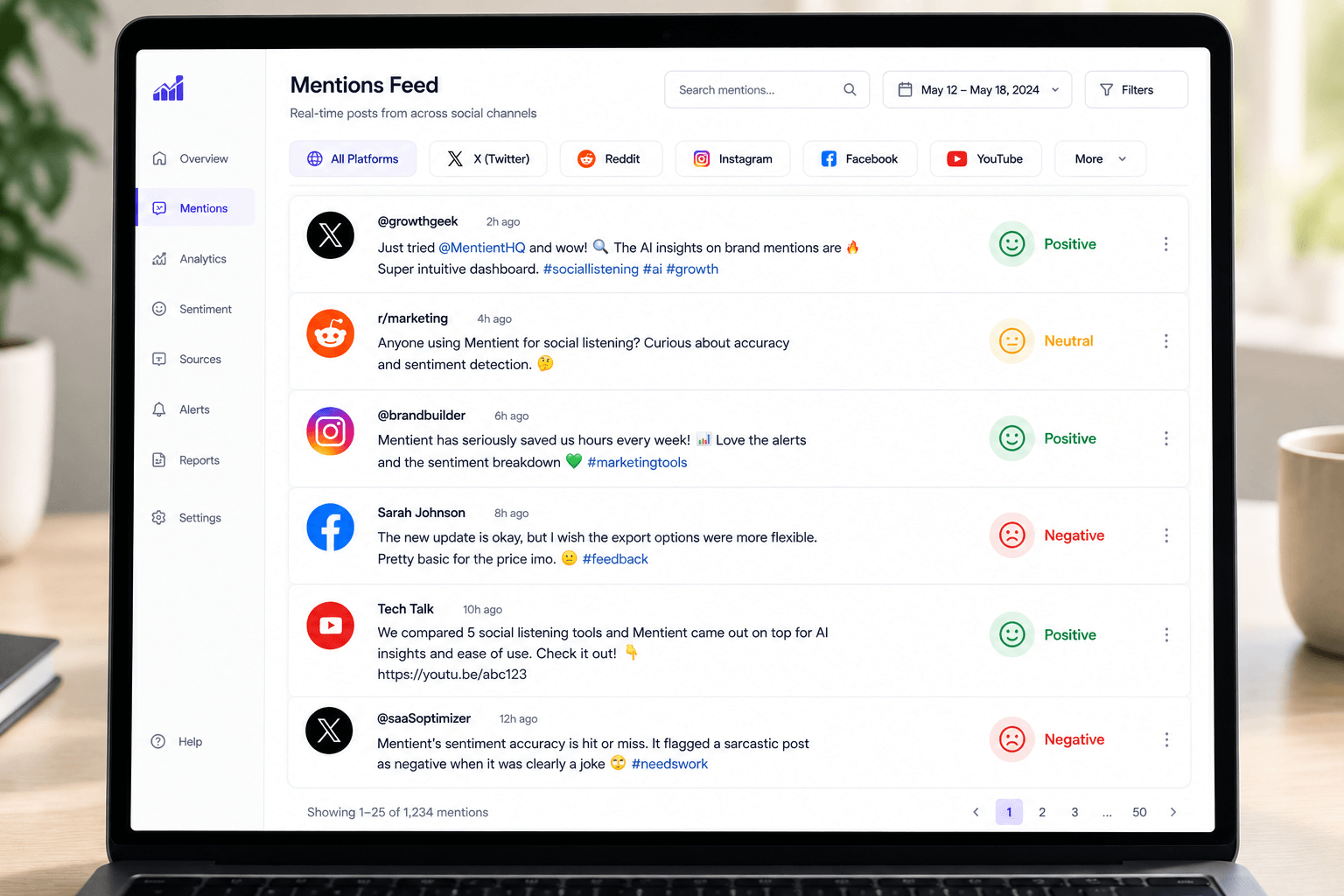
Social media sentiment analysis is a harder version of a hard problem. General sentiment analysis already struggles with sarcasm and negation. Social platforms add a compressed, fast-moving layer on top: a skull emoji that means laughing rather than morbid, the word "sick" that flips between amazing and awful depending on who's typing it, and a tweet that carries almost no surrounding context because the whole message is four words and a reaction gif. Advanced platforms trained specifically on this kind of text typically land in the 70 to 85% accuracy range, and that range drops further the moment sarcasm, slang, or mixed sentiment enters the picture. This guide covers how sentiment analysis works specifically for social platforms, where it differs by channel, real use cases from crisis response to campaign tracking, and how to build a program that accounts for social's specific mess rather than treating it like any other text source.
- Social platforms compress context down to almost nothing. A short post with an emoji and no surrounding text is genuinely harder to score than a full paragraph, since there is less signal for a model to work with.
- Slang and emoji meaning shift constantly and by community. The same word or emoji can mean opposite things depending on the platform, the subculture, and the month, which a static dictionary can never fully keep pace with.
- Each platform has a different sentiment texture. X leans fast and reactive, Reddit rewards detailed argument, Instagram and TikTok skew visual and emotional, and a model tuned on one performs noticeably worse on another without adjustment.
- Crisis response is the highest-stakes use case. KFC's net sentiment moved from negative 17% during a well-known chicken shortage crisis to positive 31% by year's end, a recovery tracked and managed through sentiment monitoring at every stage.
- Volume and sentiment have to be read together. A spike in mentions during a crisis looks identical to a spike during a viral win on a volume chart alone.
Why social media sentiment is harder than general text
Most sentiment analysis research gets built and benchmarked on relatively clean text: product reviews, news articles, formal customer feedback. Social media breaks nearly every assumption that clean text relies on. Posts run short, sometimes just a handful of words. Punctuation gets used for emphasis rather than grammar. Emoji carry as much emotional weight as the words themselves, sometimes more. And the whole vocabulary shifts fast enough that a model trained six months ago can already be reading current slang wrong.
Context length is the core structural problem. A transformer model reading a three-paragraph review has real material to work with: tone, elaboration, specific complaints or praise laid out across multiple sentences. A model reading "not bad ngl 💀" has almost nothing, and every word in that fragment is doing unusually heavy lifting. General sentiment models trained mostly on longer-form text do not automatically transfer that skill to four-word posts, which is exactly why sentiment accuracy figures from broader NLP benchmarks tend to overstate what a tool will actually deliver on a real social feed.
Platform-by-platform differences
Each major platform has developed its own conversational texture, and a sentiment model tuned for one does not automatically read another well.
| Platform | Sentiment texture | Main scoring challenge |
|---|---|---|
| X (Twitter) | Fast, reactive, often sarcastic | Very short posts, minimal context per message |
| Detailed, argumentative, community-specific slang | In-group language that shifts by subreddit | |
| Visual and emotional, caption-light | Sentiment often lives in the image, not the text | |
| TikTok | Fast-shifting slang, comment-driven | Vocabulary that changes month to month |
| Longer comments, older demographic skew | More formal tone, fewer slang challenges overall | |
| Professional, restrained, rarely openly negative | Genuine criticism gets heavily softened in wording |
Reddit deserves particular attention in a brand monitoring program, since it rewards long, detailed, opinionated comparison discussion in a way most other platforms don't, and that depth makes it one of the richest sources of honest product sentiment available anywhere. Reddit-specific monitoring that accounts for subreddit-level slang and context tends to surface sentiment signal a blended, platform-agnostic score misses entirely.
Emoji, slang, and the moving target problem
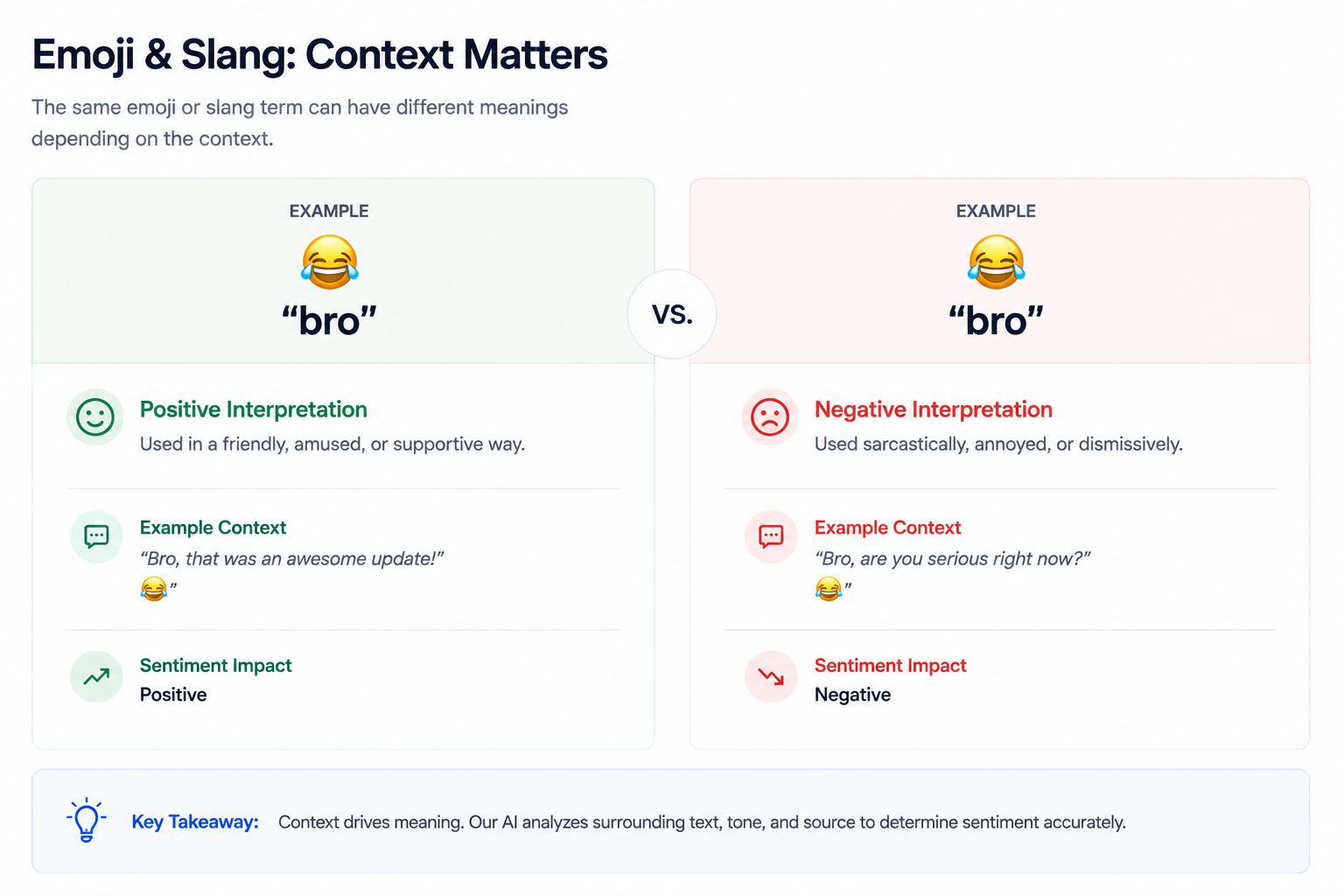
A skull emoji usually signals laughter rather than anything morbid. The word "sick" flips between glowing praise and genuine complaint depending entirely on who's typing and what community they're in. New slang, abbreviations, and emoji combinations surface constantly, creating a dialect that shifts faster than most models get retrained. A static keyword dictionary has effectively no chance of keeping up with this pace, which is exactly why lexicon-based scoring performs worst on social platforms specifically, even though it can hold up reasonably well on more formal text like reviews or news coverage.
Contextual scoring, the kind that looks at sentence structure, platform norms, and community-specific patterns rather than matching individual words against a fixed list, handles this shift better, though not perfectly. The practical implication for a monitoring program: a sentiment tool needs regular retraining or continuous model updates to stay current on social platforms specifically, since slang that scored correctly in January can be obsolete or reversed in meaning by summer.
Real use cases
- Crisis detection and response. Instant alerts on a negative sentiment spike give a team the lead time to respond before a story fully takes hold. KFC's well-documented chicken shortage crisis is a clean example: net sentiment ran at negative 17% during the height of the crisis and recovered to positive 31% by year's end, a swing tracked and managed through continuous sentiment monitoring rather than a single after-the-fact report.
- Campaign performance tracking. A launch or campaign can generate strong mention volume while sentiment underneath it runs mixed or negative, a gap a volume-only report will never surface. Sentiment tracked alongside volume tells a team whether a campaign actually landed the way it was intended.
- Competitive benchmarking. Comparing sentiment trend lines against named competitors, not just your own brand in isolation, shows whether a dip is brand-specific or a category-wide shift nobody can fully control.
- Customer service triage. Routing the most negative, highest-urgency social mentions to a support queue first, ahead of neutral or positive ones, gets a response to the people most likely to escalate publicly before that escalation happens.
Building a social sentiment program
Start with the platforms where your actual audience concentrates, not every platform equally. A B2B software brand's most useful sentiment signal likely lives on X, LinkedIn, and Reddit rather than TikTok, while a consumer lifestyle brand may find the opposite true. Cross-platform social monitoring that tracks sentiment consistently across the channels that actually matter beats broad, shallow coverage of every platform at once.
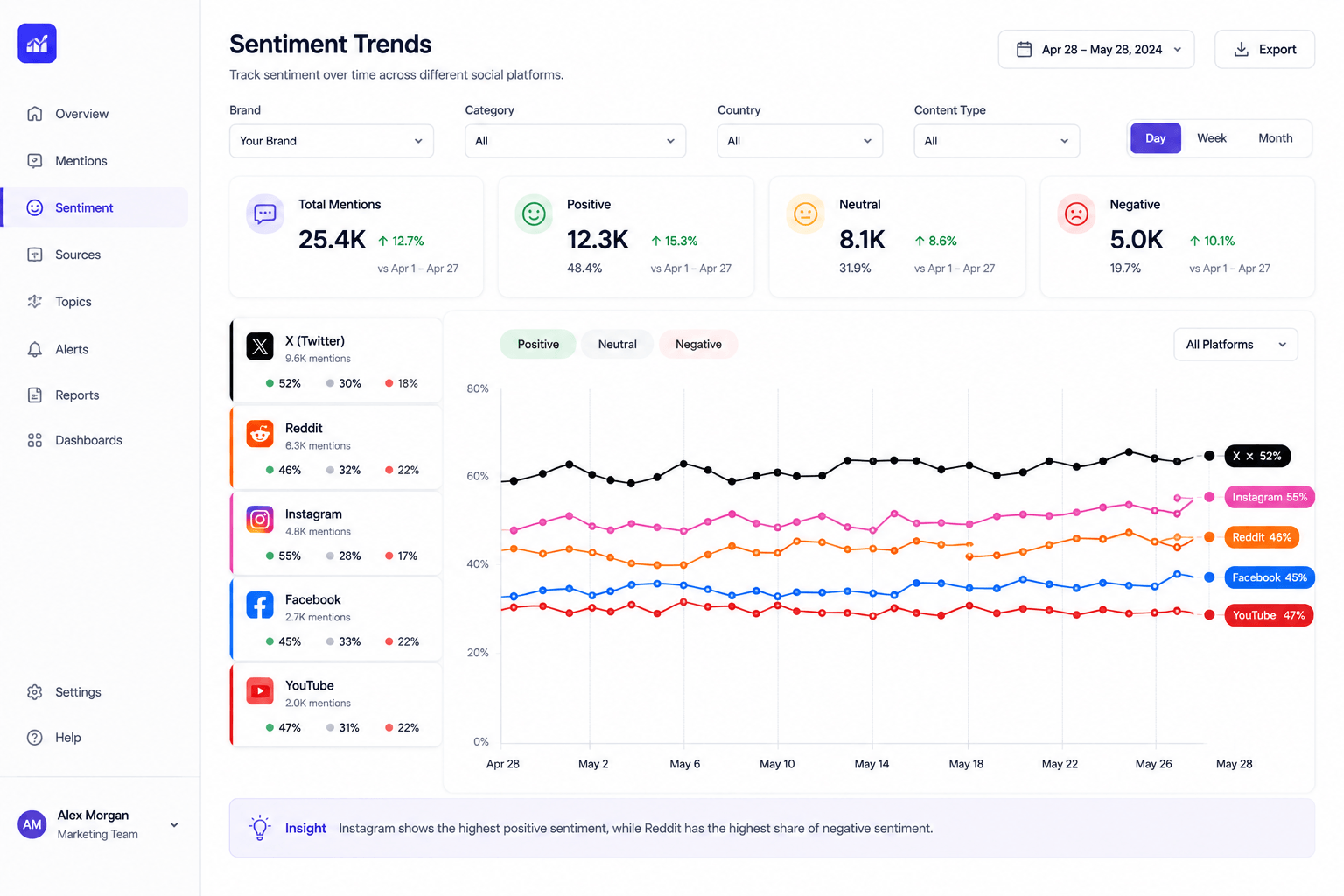
Context-aware sentiment scoring tuned for social's specific mess of slang, emoji, and short-form text closes a real gap that a general-purpose model doing sentiment as a side task tends to leave open. Set alert thresholds for sudden sentiment shifts, not just volume spikes, since a quiet but sharp swing toward negative can matter more than a loud but neutral surge in mention count. Agencies managing this across multiple client brands should build standardized reporting that tracks sentiment per platform rather than one blended number per client, since a client asking why sentiment dropped needs a platform-level answer, not an average.
Common mistakes
- Using one blended sentiment score across every platform. A brand can run strongly positive on Facebook and negative on X at the same time, and averaging the two hides a real, actionable gap.
- Relying on a keyword-based tool for social text specifically. Lexicon scoring struggles hardest exactly where social language moves fastest, since a fixed dictionary cannot track slang that shifts month to month.
- Ignoring image and video sentiment on visual platforms. On Instagram and TikTok, a caption can carry almost no sentiment signal while the actual content of the image or video carries most of it.
- Treating a single viral post as a full trend. One high-volume moment, positive or negative, can swing a blended sentiment number sharply without reflecting the brand's actual standing across the broader conversation.
- Setting alert thresholds on volume alone. A quiet, steady drift toward negative sentiment with no volume spike attached can slip past a monitoring setup built only to flag loud moments.
Frequently asked questions
Should emoji be scored separately from text, or together?
Together, whenever the tool supports it. Emoji frequently carry sentiment meaning that contradicts or completes the surrounding text, and scoring them in isolation from the words around them tends to produce worse results than a combined read, since the two often only make sense in relation to each other, the same way a sarcastic sentence only reads correctly once tone and word choice are considered as one unit rather than parsed apart.
How often does a sentiment model need retraining for social media specifically?
More often than for general text, given how fast slang and emoji usage shift. There is no fixed industry standard, but a tool that hasn't been updated in six months or more is a reasonable flag to check its current accuracy against a fresh, hand-labeled sample of recent posts.
Can sentiment analysis catch a crisis before it fully breaks?
Often, yes, if the monitoring setup checks frequently enough and alerts on sentiment shift rather than only volume. A sharp negative sentiment swing frequently precedes the volume spike that makes a story impossible to miss, which is exactly the window where an early, calm response does the most good. The KFC example above is instructive here: the brand's sentiment recovery over the following months came from a visible, sustained response effort rather than the story simply fading on its own, and that kind of recovery curve only becomes possible if a team catches the early sentiment dip and acts on it quickly, rather than discovering the scale of the problem days later once mention volume has already peaked and the narrative has largely set in the public conversation.
Social media sentiment analysis will keep chasing a moving target, since the language it needs to read never stops shifting. What actually separates a working program from a broken one is not chasing a perfect accuracy number that doesn't exist, it's tracking sentiment per platform, pairing it with volume, and checking the model's output against real posts often enough to know where its blind spots currently sit. Pull last week's mentions from your loudest platform, read a sample yourself, and compare it against what your tool reported before trusting the next report that lands in your inbox.
Track sentiment across every platform, not just one blended number
Mentient scores sentiment across social, Reddit, reviews, and news with context-aware AI tuned for real platform language, not just clean text. Start free and see how your own mentions actually classify.
Start free trial