Most teams pick their listening keywords the same way: brand name, product names, maybe a competitor or two, done in an afternoon. Then three months in, someone notices the dashboard is full of noise, or worse, missing the conversation that actually mattered. The problem is rarely the Boolean syntax. It is that the keyword list was guessed rather than sourced, and nobody ever came back to check whether it was tracking the right things. This guide covers how to choose what belongs in your monitoring list in the first place, where to find the language your customers actually use instead of the language you assume they use, and how to prioritize when you cannot track everything.
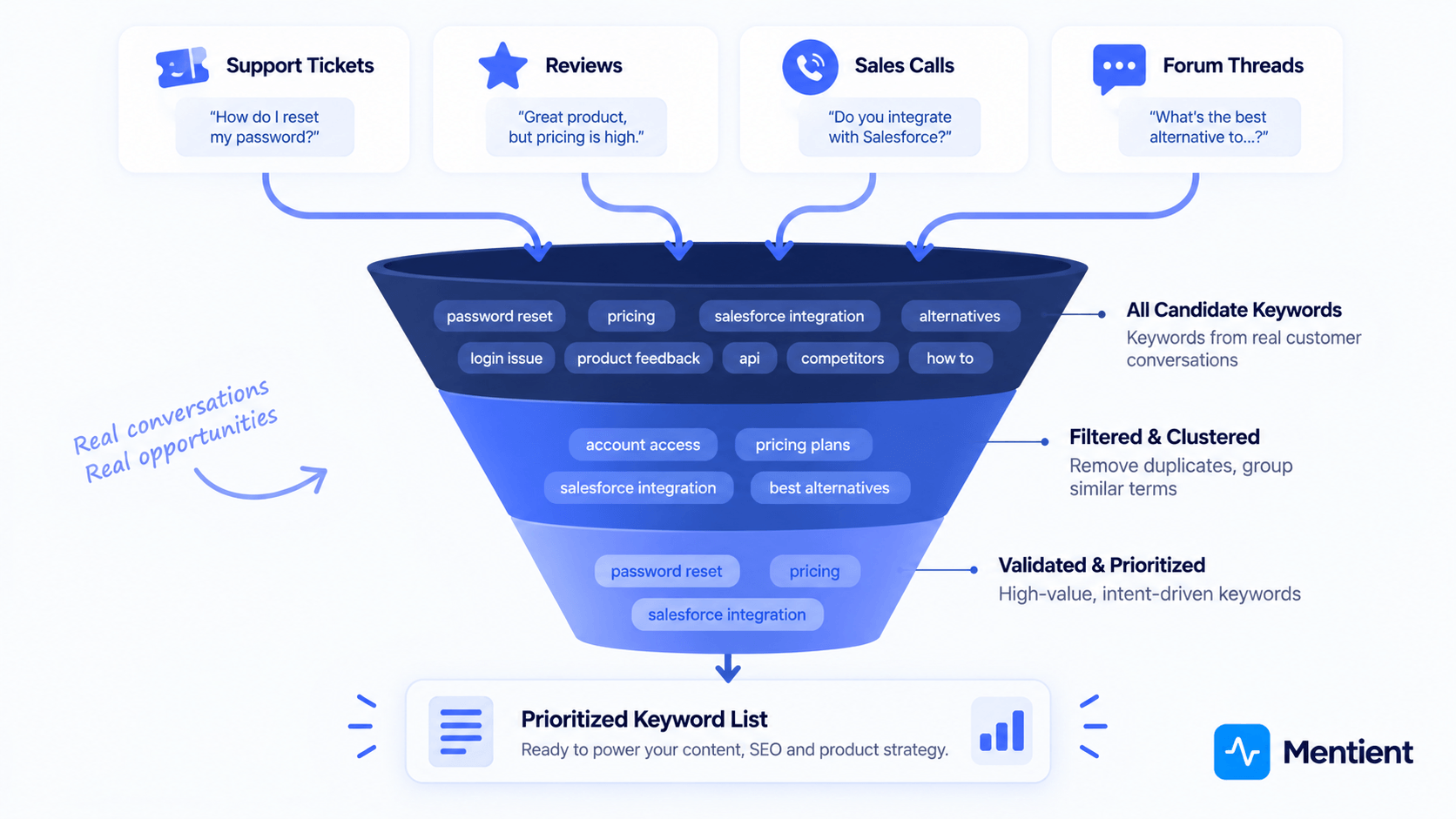
- Source keywords from real conversations, not guesswork. Support tickets, reviews, and sales call transcripts hold the actual phrases customers use, and they are usually different from the terms a team assumes.
- The mentions that never say your name are often the most valuable ones. Unbranded, category-level conversation about the problem you solve carries buying intent your brand-name query will never catch.
- You cannot track everything, so score before you commit. A simple relevance-times-volume framework tells you which candidate keywords earn a spot in a limited monitoring budget and which ones do not.
- A keyword list decays the same way a query does. Product names change, slang shifts, and last year's high-value term can quietly stop returning anything worth reading.
- Selection comes before syntax. Deciding what to track and writing the Boolean query that tracks it are two different skills, and most teams only ever practice the second one.
Selection is a different skill from syntax
Once you know which words and topics deserve tracking, writing the query is mechanical work: AND, OR, NOT, a few exclusions, done. Our guide on Boolean search syntax covers that mechanical layer in depth, operators, templates, and the common ways a query misfires. This guide sits one step earlier. It answers the question that has to be settled before you write a single operator: what actually belongs on the list.
Most teams skip this step because it feels obvious. Of course you track your brand name. Of course you track your top competitor. The trouble starts with everything past those two entries, where teams either guess at category terms that sound right in a meeting or copy a generic list from a blog post that has nothing to do with how their specific customers actually talk. Selection done well is closer to research than to configuration, and it is worth treating as its own step rather than a five-minute afterthought before you open the query builder.
The five categories worth monitoring
Almost every useful keyword falls into one of five buckets. Treating them separately, rather than dumping everything into one long list, makes both the selection and the later query-building easier.
| Category | What it captures | Typical priority |
|---|---|---|
| Brand terms | Your name, misspellings, product names, handles | Always track |
| Competitor terms | Named rivals, their product names, comparison language | High priority, top three to five rivals |
| Category and pain-point terms | The problem you solve, phrased the way buyers phrase it | High priority, easy to underinvest in |
| Executive and spokesperson terms | Founder and leadership names, especially for smaller brands | Situational, higher for founder-led brands |
| Campaign and moment terms | Hashtags, launch names, event terms | Time-boxed, archive when the moment ends |
The category most teams shortchange is the third row. Brand and competitor terms get built first because they are obvious, and by the time anyone gets to category and pain-point language, the project feels done and that bucket gets two or three terms typed in from memory. That is a mistake worth avoiding, and we will come back to exactly why in a later section.
Mine real customer language instead of guessing
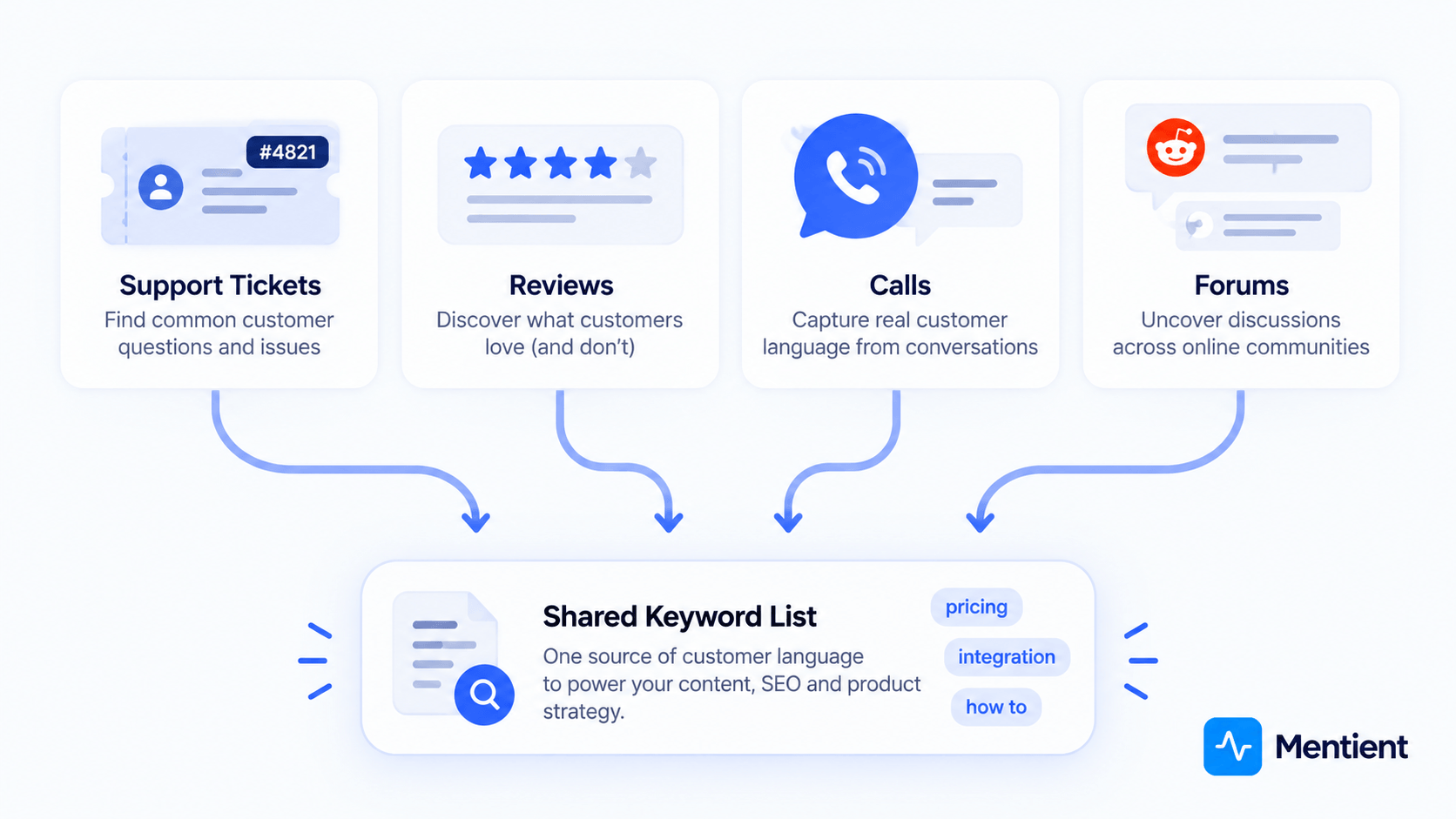
The single biggest upgrade a team can make to its keyword list costs nothing and takes an afternoon: stop guessing at the words customers use and go read where they already used them. Four sources cover most of what you need.
Support tickets and help desk transcripts. Customers describe problems in their own words here, not in your product's vocabulary. If your feature is called "workflow automation" internally but three different support threads call it "the thing that does my repetitive stuff," that second phrase belongs in your query and would never have shown up in a brainstorm.
Public reviews on G2, Trustpilot, and app stores. Reviews are written for an audience of other buyers, which pushes people toward comparison language and specific feature names rather than vague praise or complaint. Scan a few dozen recent reviews, yours and a competitor's, and pull out the recurring nouns and phrases.
Sales call transcripts. If your team records discovery calls, search them for phrases like "struggling with," "looking for something that," and "our biggest issue is." These phrases sit right before the exact words a prospect uses to describe their problem, and that phrasing is frequently different from the category language your marketing team uses internally.
Existing threads on Reddit and forums. Before you write a single query, search manually for your category on Reddit and read a dozen threads. The words people use when they think no brand is listening are usually blunter and more specific than the polished language in a review. Our guide to monitoring Reddit goes deeper on finding these threads once your query is live, and forum monitoring more broadly catches the same candid phrasing on niche community sites outside Reddit.
Pull twenty to thirty candidate terms from these four sources before you touch a query builder. You will discard some of them later, but starting from real language instead of an internal brainstorm is the single change most likely to make your keyword list actually useful. Agencies managing multiple clients should treat this language-mining step as a per-client exercise rather than reusing one generic list, since the phrasing that works for one brand's audience rarely transfers cleanly to another's.
Why unbranded conversation deserves its own budget
A mention that never says your name is easy to overlook, and it is often the most valuable one you are not tracking. Someone posting "does anyone know a tool that actually catches Reddit mentions instead of just Twitter" is describing exactly what you sell without naming a single brand, yours or a competitor's. That post carries real buying intent, and a keyword list built only from brand and competitor terms will never surface it.
Unbranded terms come from the category and pain-point bucket in the table above, and they are worth deliberately budgeting space for rather than treating as an afterthought. A practical rule: for every three brand or competitor terms in your query, add at least one unbranded category or pain-point term sourced from the language-mining exercise above. That ratio keeps the unbranded bucket from quietly disappearing under the more obvious entries. This is also where AI brand intelligence earns its place alongside traditional keyword tracking, since a growing share of unbranded, problem-first questions now get typed straight into an AI assistant rather than a search bar or a Reddit post.
Your brand-name query tells you what people think of you. Your unbranded query tells you what people need, whether or not they have found you yet. Most teams only build the first one.
Prioritize candidates with a simple scoring pass
Even a small team ends up with more candidate keywords than they can realistically track in a first version, especially once the language-mining exercise adds twenty or thirty new terms to the pile. Score each candidate on two axes before committing: relevance, how directly the term connects to a decision you would actually act on, and expected volume, how often you think it will surface real mentions rather than sitting silent.
| Relevance | Volume | What to do |
|---|---|---|
| High | High | Track immediately, this is core coverage |
| High | Low | Track anyway, rare but high-stakes signal |
| Low | High | Skip or exclude, this is likely to be noise |
| Low | Low | Skip, not worth the query complexity |
The high-relevance, low-volume quadrant is the one teams most often cut by mistake, because it looks unproductive on a dashboard that rewards mention counts. A term like "considering switching from" paired with your category might return three mentions a month, but each one is a prospect in an active buying decision, and that is worth more than a hundred routine mentions of your brand name in a generic context. Weigh relevance to a real decision more heavily than raw volume when the two disagree.
Once you have scored and trimmed the list, the query-building guide walks through turning each surviving category into a working Boolean string, layer by layer, with the exclusions that keep the results clean.
Keep the list alive: review and retire terms
A keyword list is not a one-time deliverable. Product names change, a competitor rebrands or gets acquired, slang shifts, and a term that returned useful mentions a year ago can quietly go silent without anyone noticing, because a dashboard with zero new mentions does not announce itself the way an error message would.
Review the full list every quarter alongside your broader query maintenance. Pull the mention count for each term over the last ninety days. Anything returning close to zero mentions is either genuinely dead, worth retiring to keep the query clean, or has drifted in how people phrase it, worth a quick language-mining pass to find the replacement term. Anything returning a flood of irrelevant results needs a tighter exclusion rather than outright removal, since the underlying topic is probably still worth tracking.
This review pairs naturally with the broader operating cadence covered in our guide on building a listening workflow, since keyword maintenance is exactly the kind of task that gets skipped without a fixed slot on the calendar. A quarterly hour spent pruning dead terms and adding new ones keeps the whole system from slowly drifting out of sync with how your customers actually talk. If you want a quick gut-check on whether your current terms are even surfacing your brand where it matters, our free AI visibility audit is a useful starting point before a full quarterly review.
Frequently asked questions
How many keywords should a social listening query track?
There is no fixed number, but most teams starting out do better with fifteen to twenty-five well-sourced terms across the five categories than with a sprawling list of fifty guessed ones. A smaller, tightly scored list you actually read every week beats a comprehensive one that overwhelms your review process. Expand gradually as you confirm each new term returns relevant results.
What are unbranded keywords in social listening?
Unbranded keywords describe the problem your product solves, or the category it sits in, without naming your brand or a competitor's. Someone asking "how do other companies handle brand mentions across Reddit and AI search" is having an unbranded conversation that is directly relevant to a brand-monitoring tool, even though no brand name appears anywhere in the post. These mentions often carry real buying intent, and a keyword list that only tracks brand and competitor names will never surface them.
Where do you find the actual words customers use to describe a problem?
Support tickets and help desk transcripts, public reviews on sites like G2 and Trustpilot, sales call recordings if your team keeps them, and existing Reddit or forum threads about your category. Each source captures a slightly different register: support tickets show frustration in plain language, reviews show comparison language aimed at other buyers, sales calls show how a prospect first describes a problem before they know your product's terminology, and Reddit threads show the bluntest version of all of it, since people there generally assume no brand is reading. Pulling from all four gives a fuller picture than relying on any single source, and it consistently surfaces phrases a marketing team would never have generated by brainstorming internally, since the whole point is to capture language shaped by the customer's own vocabulary rather than the vendor's product terminology.
How often should a keyword list be reviewed?
Quarterly, alongside your broader query maintenance. Pull the mention count for each term over the trailing ninety days, retire anything that has gone silent, tighten anything returning mostly noise, and run a quick language-mining pass to catch new phrasing that has entered the conversation since your last review.
Should low-volume keywords be removed from a monitoring list?
Not automatically. A low-volume term that is highly relevant to a real decision, like a switching-intent phrase paired with your category, is often worth more than a high-volume term that only surfaces routine chatter. Weigh relevance to an actual decision above raw mention count before cutting anything, and only remove a term once it has gone genuinely silent for a full quarter.
Choosing the right keywords is research before it is configuration. Source the language from where customers actually use it, give unbranded and pain-point terms the space they deserve, score every candidate against relevance and volume before committing, and revisit the list every quarter so it keeps pace with how the conversation actually moves. Get this layer right, and the Boolean syntax that turns it into a working query becomes the easy part.
Find the language your customers are already using
Mentient tracks brand, competitor, and unbranded category conversation across Reddit, the web, and AI answers, so you can see which terms are actually worth watching before you commit a full query to them.
Start free trial