

The share of voice formula is one division: your brand's mentions divided by the total category mentions, multiplied by 100. Almost nobody gets that step wrong. Where calculations actually break down is everywhere around it, picking the wrong competitor set, mixing time windows that don't match, treating a five-word forum comment the same as a full product review, or blending five channels into one number without normalizing first. This guide walks through the calculation step by step, with five worked examples covering the situations that actually trip people up, not just the clean textbook version of the formula. For the broader definition and the excess share of voice growth research, see our full guide.
- The formula is never the hard part. Defining a correct, complete category total, every real competitor, the right time window, is where most calculation errors actually come from.
- Blending channels into one number requires normalizing first. A raw mention count and an impression share are different units, and averaging them directly produces a meaningless figure.
- Weighting matters most in PR and social. A brief mention and a full feature are not equal, and counting them as equal flattens a real gap in reach.
- Missing competitors silently inflate the number. Leaving out even one real competitor from the category total makes every remaining brand's share of voice look larger than it actually is.
- A spreadsheet template beats a mental calculation the moment more than one channel or more than two competitors are involved, since manual tracking breaks down fast past that point.
- The calculation, step by step
- Example 1: basic social share of voice
- Example 2: weighted PR share of voice
- Example 3: fixing a mismatched time window
- Example 4: blending three channels into one number
- Example 5: AI answer engine share of voice
- Calculation errors to check for
- A simple tracking template
- Frequently asked questions
The calculation, step by step
- Define the category and the competitor set. List every brand a real buyer would actually consider alongside yours, not just the two or three that are easiest to track. Missing a competitor is the single most common source of an inflated number.
- Pick one channel and one metric. Mentions, impressions, ranking visibility, or citation rate. Do not mix units at this stage; that comes later if a blended number is needed.
- Fix the time window and hold it constant. A month, a quarter, whatever fits the reporting cadence, applied identically to every brand in the set and every future calculation you compare it against.
- Pull your brand's count for that window. This is the numerator.
- Pull every competitor's count for the same window and sum them with your own. This is the denominator, the full category total.
- Divide and multiply by 100. Your count divided by the category total, times 100, gives the percentage.
Every worked example below follows these same six steps. Real data gets messy in the run-up to step 6, and that is exactly where each example picks up.
Example 1: basic social share of voice
A skincare brand tracks four total competitors including itself over a single month on social platforms. The raw mention counts: your brand 1,200, Competitor A 2,400, Competitor B 900, Competitor C 1,500. The category total is 1,200 + 2,400 + 900 + 1,500 = 6,000. Your brand's share of voice is 1,200 ÷ 6,000 × 100 = 20%.
This is the clean case, four brands, one channel, one consistent time window, no weighting needed. Most calculation guides stop here. Real data rarely stays this tidy for long.
Example 2: weighted PR share of voice
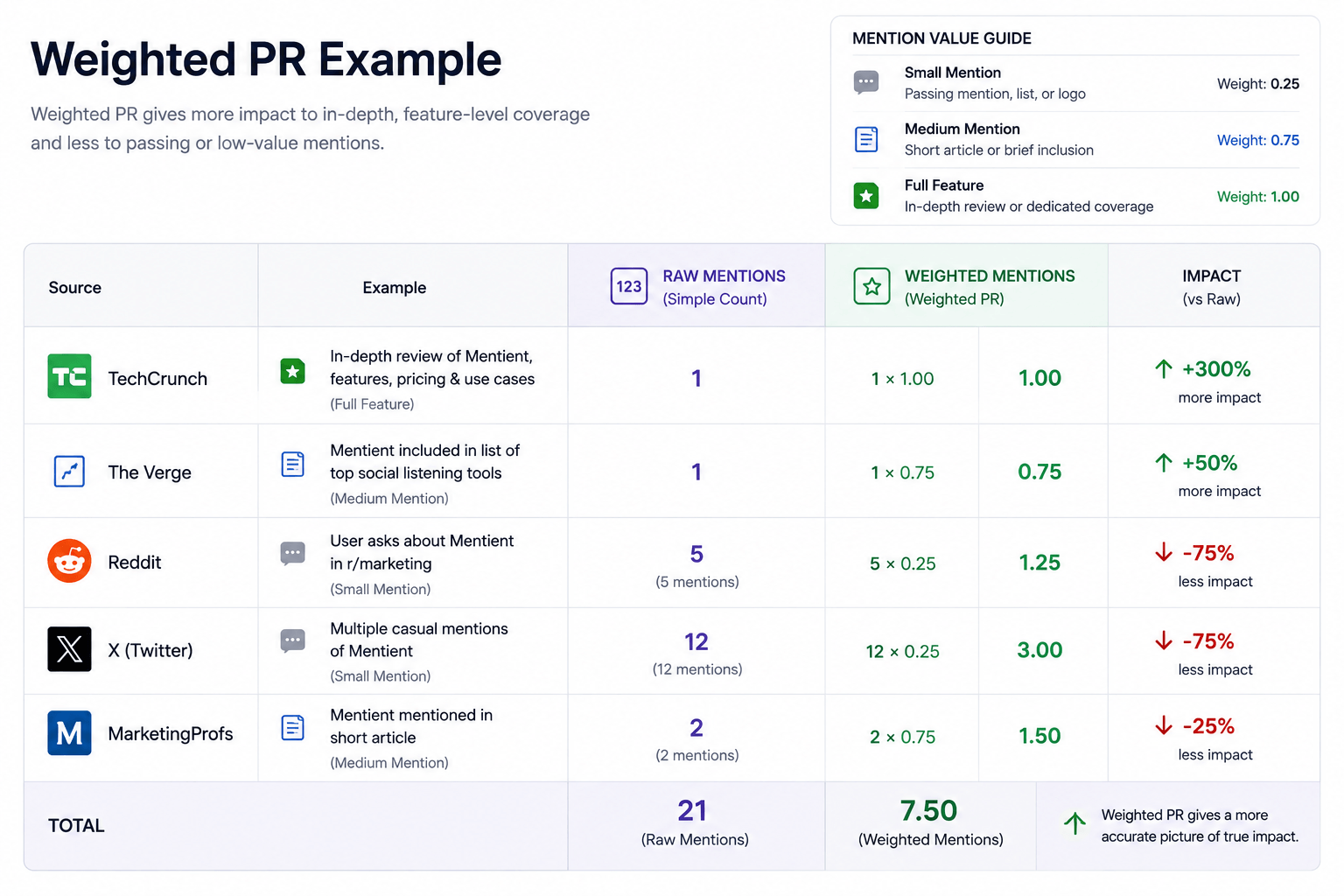
A B2B software company earns 12 press mentions in a quarter. A straight count would put that number directly into the formula. The problem: three of those mentions were full features in a major trade publication, and the other nine were single-sentence name-drops in smaller roundup articles. Treating all 12 as equal understates the brand's real visibility.
The fix is a weighting multiplier applied before the total is calculated. Assign a full feature a weight of 3 and a brief mention a weight of 1, a simple scale, though more granular weighting by outlet reach works the same way. Weighted count: (3 features × 3) + (9 briefs × 1) = 9 + 9 = 18 weighted points, versus a raw count of 12. If the same weighting is applied consistently to every competitor's mentions, the category total and the resulting percentage reflect real prominence instead of treating a footnote and a headline as identical.
Example 3: fixing a mismatched time window
A common calculation error: pulling your own brand's mentions for the last 30 days but a competitor's mentions from a report that covered the last 90 days, because that was the data on hand. Say your brand had 800 mentions over 30 days, and a competitor's older report showed 3,600 mentions over 90 days. Adding those directly and dividing produces a number that means nothing, since the two figures were never measured on the same clock.
The fix is normalizing to a common window before combining anything. Convert the competitor's 90-day figure to a 30-day equivalent: 3,600 ÷ 3 = 1,200 mentions per 30 days. Now both numbers share a unit. Category total: 800 + 1,200 = 2,000. Your share of voice: 800 ÷ 2,000 × 100 = 40%. Skipping this step and dividing the raw, mismatched numbers would have understated your brand's real position significantly.
Example 4: blending three channels into one number
A common request from leadership: one blended share of voice number across search, social, and PR instead of three separate ones. The trap is averaging three raw percentages that were calculated against wildly different category sizes and calling it done.
Say a brand posts 15% search share of voice, 20% social share of voice, and 25% PR share of voice. A simple average gives 20%. That number is defensible only if each channel matters equally to the business, which is rarely true. A more honest blend applies weights that reflect actual channel importance, for instance 50% search, 30% social, 20% PR, based on where the business actually generates its leads: (15% × 0.5) + (20% × 0.3) + (25% × 0.2) = 7.5 + 6 + 5 = 18.5%. The weighted blend and the simple average landed close here, but they will not always, and the weighted version is the one that reflects what actually drives the business.
Example 5: AI answer engine share of voice
AI answer engines break the standard formula slightly, since there is no fixed inventory of results, an answer can name one brand, several, or none. The workaround is treating each query response as a single unit and counting citations across a fixed query set run consistently.
Run 50 category questions through an engine. Your brand gets named in 18 of the 50 answers. A named competitor gets cited in 27. Unlike the other examples, the denominator here is not the sum of citations, since one answer can cite multiple brands or none, it is the fixed number of queries run: 50. Your AI answer engine share of voice is 18 ÷ 50 × 100 = 36%, and the competitor's is 27 ÷ 50 × 100 = 54%. These two numbers can sum to more than 100% precisely because a single answer can cite both brands at once, which is different from every other channel in this guide and worth flagging clearly in any report using this metric. AI visibility tracking automates this specific calculation, since running 50 queries by hand every reporting period is not realistic for most teams.
Calculation errors to check for
- Incomplete competitor sets. Every brand left out of the category total inflates everyone else's percentage. Audit the competitor list against real buyer consideration, not just tracking convenience, before trusting the number.
- Mismatched time windows. Confirm every brand's figure covers the identical period before summing anything, as shown in Example 3.
- Unweighted PR or social counts when reach genuinely varies. A five-word comment and a full review should not carry equal weight in the total.
- Simple averaging across channels without weighting by actual business importance, which produces a defensible-looking number that does not reflect where growth actually comes from.
- Treating AI answer engine share of voice like the other four channels. The denominator logic is different, and forcing it into the same mental model as social or search produces numbers that do not add up the way a reader expects.
A simple tracking template
A spreadsheet with five columns handles most of this without custom tooling: Brand, Channel, Time Window, Raw Count, Weighted Count if applicable. One row per brand per channel per reporting period. Sum the weighted counts within a channel and period to get the category total, then divide each brand's row by that total. Once more than two competitors or more than one channel enter the picture, this structure keeps the math auditable in a way a running mental tally cannot.

Past a handful of competitors and more than one channel, though, manual tracking becomes a real time cost every reporting cycle. Automated competitor tracking pulls the raw counts and runs the division consistently, which matters most for the AI answer engine calculation in particular, since that one is hardest to run by hand on any kind of regular schedule. Agencies managing this across several client accounts benefit from standardized reporting templates that apply the same weighting logic consistently across every client rather than rebuilding the spreadsheet from scratch each time.
Frequently asked questions
Do I need to weight every channel, or just PR and social?
Just PR and social, generally. Search and paid already weight themselves through ranking position and auction share.
What if I can't get exact competitor mention counts?
Use the best available estimate from a consistent source rather than skipping a competitor entirely, since an estimated figure that includes a real competitor is more accurate than a precise calculation that leaves one out. Note which figures are estimated so anyone reading the report understands the confidence level behind each number.
How do I calculate share of voice if my brand has zero mentions in a period?
The math still works, the result is simply 0%, calculated as 0 divided by whatever the category total is. A 0% share of voice is itself useful information worth reporting rather than omitting, since it flags a channel or time period where the brand had no presence at all while competitors did, which is a more urgent signal than a low but nonzero number.
Should the category total include indirect competitors, not just direct ones?
Generally only if a real buyer would consider them in the same purchase decision. A narrow, direct-competitor-only set gives a cleaner read on head-to-head positioning, since every brand in it is fighting for the exact same purchase in the exact same moment. A broader set that includes adjacent or indirect alternatives gives a more accurate picture of total category attention, capturing the reality that a buyer comparing two options is often also weighing a cheaper substitute or a do-it-yourself alternative that never shows up in a narrow competitor list. Both approaches are legitimate, but the two produce meaningfully different numbers and should never be compared against each other in the same report without clearly noting which definition of the category was used for each one.
The formula was never the hard part. A clean, complete category total, matched time windows, honest weighting where reach actually varies, and a denominator that fits the channel turn a five-minute calculation into a number worth reporting. Pull your own numbers through the six-step process above for one channel this week, and check each of the common errors against what you find before presenting the result.
Skip the spreadsheet and calculate it automatically
Mentient calculates share of voice against named competitors across press, social, reviews, and AI answer engines, with the weighting and normalization handled for you. Start free and see your own numbers this week.
Start free trial