Somewhere this week, a buyer typed your company's name into ChatGPT and asked whether it was worth a demo. You never saw the question, and there is a decent chance the answer named a competitor instead. AI brand monitoring is the practice of tracking what ChatGPT, Perplexity, Gemini, and Google's AI Overviews say about your company, the part a Google Alert never catches. We run this kind of tracking for B2B brands every week, and the pattern holds up well enough to turn into a repeatable framework. Below: what to track, why it behaves differently from standard social listening, and the setup that gets a program running without a dedicated analyst.
- 72% of B2B software buyers now consult ChatGPT before contacting a vendor's sales team, and 51% of B2B tech brands turn up with zero citations across ChatGPT, Perplexity, and Gemini when someone asks about their category.
- AI brand monitoring tracks five things standard social listening skips: mentions, sentiment, competitor share of voice inside AI answers, the sources an engine cites, and whether the facts it states about you hold up.
- Most ChatGPT citations for B2B vendor questions trace back to earned coverage, not your own website. Owned content accounts for roughly 29% of what gets cited.
- A workable setup runs on four or five fixed prompts per engine, checked weekly, not a one-time audit that gets filed away and forgotten.
- Coverage takes about two months to show up as a citation, so judge a new monitoring program on a quarter, not a news cycle.
- What is AI brand monitoring?
- How AI brand monitoring differs from standard social listening
- How do B2B buyers actually use ChatGPT and Perplexity to vet vendors?
- What AI search engines cite, and why half of B2B brands show up empty
- The five signals worth tracking in an AI brand monitoring program
- How to build an AI brand monitoring workflow
- Tools for AI brand monitoring: what to look for
- Common mistakes that blow up an AI visibility program
- FAQ
What is AI brand monitoring?
AI brand monitoring is the practice of tracking how generative AI systems, ChatGPT, Perplexity, Google's AI Overviews, Gemini, and Claude, describe, mention, and recommend your company when someone asks a question in your category. It covers five things: whether you get mentioned at all, what tone the mention carries, how you compare to named competitors in the same answer, which sources the engine pulled from, and whether the facts it states about you are correct.
That last point, factual accuracy, is the one traditional monitoring never had to worry about. A journalist writing about your pricing gets it wrong occasionally. A language model summarizing your pricing from a cached page can get it wrong every time it is asked, confidently, in the same tone it uses for a fact it got right. We wrote a longer breakdown of how AI brand visibility gets scored across engines, and the accuracy piece is usually what surprises a team first.
Marketing teams sometimes lump this in with generative engine optimization, or GEO, the practice of shaping content so AI systems are more likely to cite it. That is related but not the same job. GEO is the input side, the writing and structuring work. AI brand monitoring is the measurement side, the process of finding out whether any of it worked. You can run a strong GEO program and still have no idea whether ChatGPT mentions you next week. That is closer to the norm right now than most marketing teams would like.
How AI brand monitoring differs from standard social listening
Standard social listening watches things that already happened. Someone posted on Reddit, a review went up, a journalist filed a story, and the tool indexes it after the fact. AI brand monitoring watches something closer to a live inference. Ask ChatGPT the same question twice in the same week and you can get two different answers, because the model is generating a response, not retrieving a cached one.
The practical gap shows up fastest in refresh behavior. A mention on social media stays put once it is posted. An AI answer about your product can shift the day a competitor lands a new piece of coverage, with no notification and no changelog. Four differences matter most when a team is deciding how to split budget between the two.
| What it covers | Traditional social listening | AI brand monitoring |
|---|---|---|
| Data source | Social posts, news, forums, reviews | Live model output across ChatGPT, Perplexity, Gemini, AI Overviews |
| Refresh pattern | A new post triggers an alert | The same query can return a different answer with no warning |
| Failure mode | A mention gets missed | A model states something false about you, confidently |
| What "coverage" means | You are mentioned somewhere | You are named when a buyer asks the category question |
None of this makes social listening obsolete. Reddit threads and review sites are still where a lot of raw opinion lives, and what actually counts as a brand mention is broader than most teams assume. The difference is that AI monitoring adds a second layer on top of that: what the AI systems synthesizing that conversation say back to the next person who asks.
How do B2B buyers actually use ChatGPT and Perplexity to vet vendors?
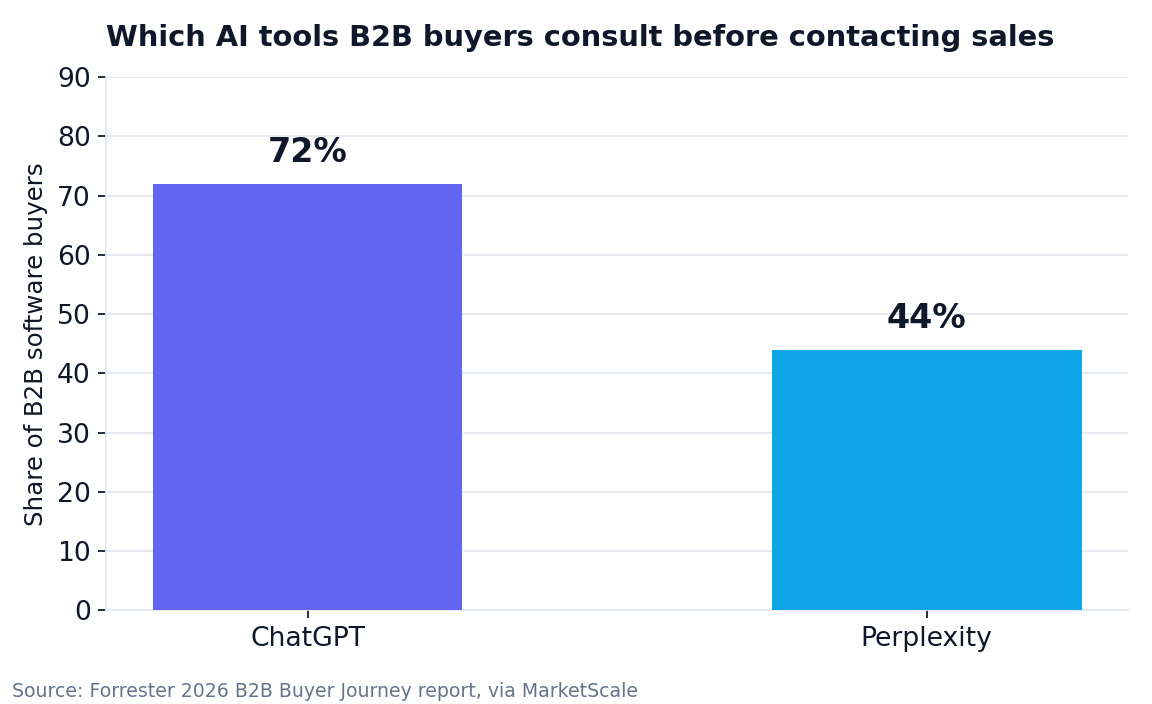
According to Forrester's 2026 B2B Buyer Journey report, 72% of B2B software buyers consult ChatGPT at some point while evaluating a vendor. That is not an early-adopter number. It describes the median buyer in Forrester's sample, the one who used to start research with a search engine and a peer recommendation.
Perplexity shows up further down the funnel. The same Forrester research found 44% of B2B tech buyers use it specifically while building a shortlist, after the first round of research narrows the field. The chart below breaks down the split.
Bain's 2026 research puts the average buyer at about 17 AI search queries a week during an active purchase cycle, more than two a day. We have started asking prospects a blunt question on early sales calls now: what did you ask ChatGPT before this meeting? Most of the time we get an actual quote back.
Buyers are 3.4 times more likely to trust a vendor they encounter through an AI citation than one they encounter through paid advertising, according to Edelman's 2026 Trust Barometer.
The mechanics behind why an engine picks one vendor over another get more specific than most teams expect, down to which domains an engine trusts and how recent the cited page needs to be. We go deeper on the mechanics of AI search visibility if you want the fuller breakdown before building a tracking plan around it.
What AI search engines cite, and why half of B2B brands show up empty
AI search engines answer most category questions by citing several outside sources rather than relying on one page, and B2B tech brands without visible earned coverage tend to disappear from those answers entirely. Crackle PR's Q2 2026 AI Citation Benchmark found 51% of B2B tech brands have zero citations across ChatGPT, Perplexity, and Gemini when someone asks about their category. Being a real, funded, functioning company is not enough on its own to guarantee a mention.
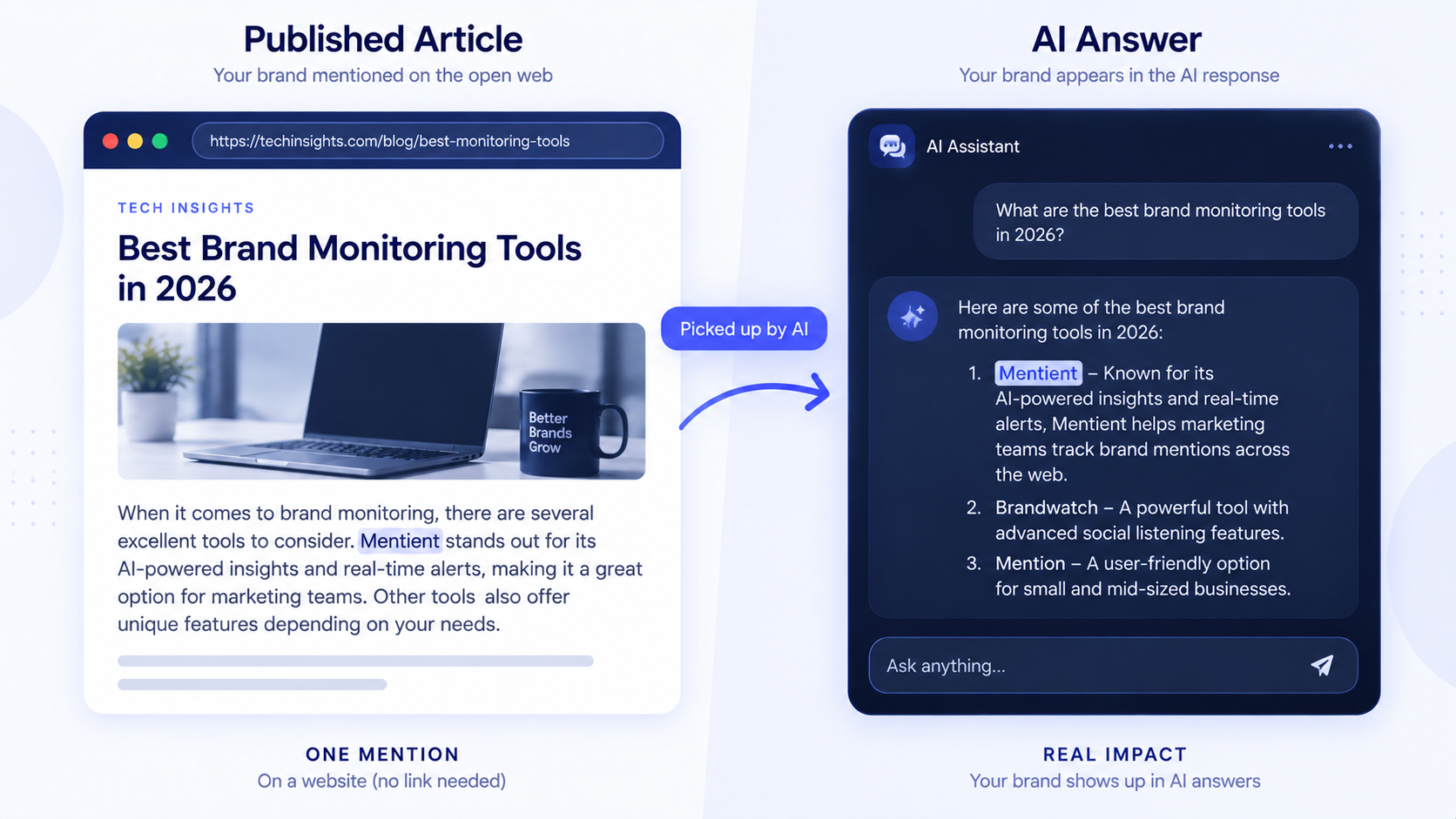
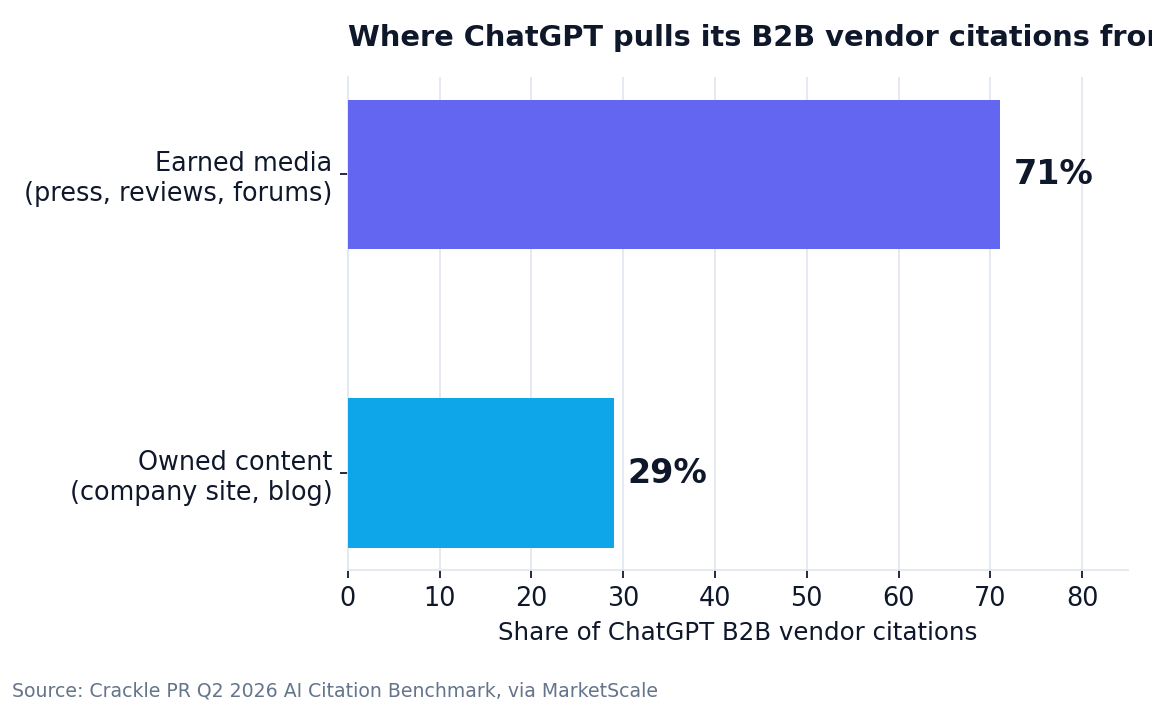
Where those citations come from matters more than most brands assume. The same benchmark found 71% of ChatGPT's B2B vendor citations trace back to earned media, tier-one press, review sites, and analyst write-ups, while only 29% come from a company's own website or blog. Press releases specifically fare even worse: only 12% of Google AI Overview answers link to one.
Separate research backs the pattern from a different angle. An analysis of 46 million citations found that 88% of Google AI Overviews cite three or more sources, and only 1% rely on a single page. Publishing one great page about yourself was never going to be enough.
There is a timing catch worth planning around. Crackle PR measured a median lag of 68 days between an earned media placement going live and that same placement showing up as an AI citation. Teams expecting an immediate bump after a press hit usually end up disappointed for the wrong reason, the lift is coming, it is just coming in two months, not two days. This lag is part of why the difference between SEO and GEO matters when a team sets its monitoring cadence, a separate calendar from the one content runs on.
The five signals worth tracking in an AI brand monitoring program
Five signals cover almost everything worth knowing, and all five are checkable without a data science background. This is the list we track for clients every week, built from what actually moves a program forward rather than a whiteboard exercise.
| Signal | What it tells you | How to check it |
|---|---|---|
| Mentions | Whether you show up at all when a buyer asks the category question | Run 4 to 5 fixed prompts per engine and log a yes or no |
| Sentiment | Whether the mention reads as positive, neutral, or a warning | Read the actual sentence, not just whether your name appears |
| Share of voice | How you rank against named competitors inside the same answer | Note every competitor named in the response, not just the first one |
| Citation sources | Which pages and domains the engine pulled from | Copy every linked or named source in the answer |
| Factual accuracy | Whether pricing, features, and positioning are stated correctly | Compare the answer against your actual pricing page line by line |
That last row catches teams off guard most often. We have seen a model quote a pricing tier that had not existed for two versions of a product roadmap. Nobody had told it to lie. It was working from a stale cached page and answered with total confidence anyway.
How to build an AI brand monitoring workflow
The setup does not need a dedicated headcount. It needs a fixed process that somebody actually runs on a schedule, which is the part most attempts skip.
- Build a fixed prompt set. Write 4 to 5 questions a real buyer would ask in your category, phrased the way a buyer phrases them, not the way your own website phrases them.
- Run the set across engines on a schedule. ChatGPT, Perplexity, Gemini, and Google AI Overviews at minimum, weekly, on the same day each time so drift is easier to spot.
- Log every citation and every competitor named. A spreadsheet works fine to start. The column that matters most is the exact source URL, not just the domain.
- Score sentiment and factual accuracy by hand for the first month. Automated sentiment scoring on AI-generated text is still catching up, and a human reading the actual sentence catches nuance a keyword scanner misses.
- Route findings to whoever can act on them. A citation gap is a PR and content problem. A factual error is often a website or schema problem. A competitor showing up ahead of you is a positioning problem, and each one needs a different owner.
Two months is roughly the point where the log starts to mean something. Anything faster is noise, given the citation lag mentioned above.
Tools for AI brand monitoring: what to look for
Three approaches cover most of what teams actually try: running the prompts by hand, using a point solution built specifically for AI visibility, or using a platform that combines AI visibility with the social and web listening a marketing team already needs. Each has a real cost, just a different kind.
| Approach | Setup cost | Ongoing effort | What it misses |
|---|---|---|---|
| Manual prompting | Free | High, someone has to run and log it weekly | Easy to skip a week, no historical trend line |
| Point AI-visibility tool | Low to moderate | Low once configured | Usually blind to Reddit and web mentions outside AI answers |
| Combined listening and AI visibility platform | Moderate | Low, one dashboard | Fewer options on the market, so less price competition |
We put together a fuller comparison of brand mention tracking tools if you want feature-by-feature detail before picking a lane. The short version: point solutions are fine if AI visibility is the only gap you have. Most B2B teams we talk to have that gap and a Reddit-blind-spot gap at the same time, which is the more common case for combining the two.
Common mistakes that blow up an AI visibility program
- Treating a single ChatGPT check as a baseline. One query on one day is a data point, not a trend. Run the same set for at least three weeks before drawing a conclusion.
- Ignoring Perplexity because ChatGPT gets the attention. 44% of B2B buyers use it during shortlisting, and its citation behavior does not match ChatGPT's.
- Fixing the website and expecting an immediate citation bump. The 68-day median lag means a change made this month shows up in AI answers closer to autumn than next week.
- Measuring sentiment by keyword instead of reading the sentence. A sarcastic mention and a genuine compliment can share the same keywords.
- Never checking what the engine says about named competitors. Share of voice is relative. A flat line in your own mentions can still mean you are losing ground if competitor mentions are climbing.
None of these mistakes are fatal on their own. Stack three or four of them across a year, and a program that could have shown real movement ends up looking flat instead. The failure is almost always in how it was measured, and that part is covered in more depth in our wider brand monitoring statistics roundup if you want the full data set behind this piece.
Frequently asked questions
What are the best AI brand monitoring tools?
It depends on whether AI visibility is your only gap or one of several. Point solutions built specifically for tracking ChatGPT and Perplexity citations work well if that is the single problem you are solving. Teams that also need Reddit and web mention tracking usually do better with a combined platform, since running two separate tools means two separate dashboards nobody checks consistently.
What is an AI monitoring system?
An AI monitoring system checks what generative AI tools say about a company on a recurring basis, not a one-time audit. Most run fixed prompts against ChatGPT, Perplexity, and Gemini, then log mentions and sentiment over time.
How do you track AI brand mentions?
Build 4 to 5 prompts a real buyer would type, run them across ChatGPT, Perplexity, Gemini, and Google's AI Overviews on the same schedule every week, and log three things for each result: whether you were mentioned, what was said about you, and which sources the engine cited. Do this by hand for the first month before automating any part of it, since a human catches nuance in sentiment and accuracy that early automated scoring tends to miss. Keep the prompt wording fixed across weeks. Changing the phrasing even slightly makes it much harder to tell whether a shift in the answer came from your standing or just from how the question was asked.
How do you do brand monitoring?
Traditional brand monitoring tracks mentions across social platforms, news, forums, and review sites as they happen, usually through a tool that crawls those sources continuously and flags anything above a set volume or sentiment threshold. In 2026 that definition has to extend to AI search, since a growing share of the conversation about any brand now happens inside a chat window instead of a public post.
What is the difference between AI brand monitoring and social listening?
Social listening tracks conversations that already happened. AI brand monitoring tracks a live model response that can change from one query to the next, even with identical wording. The two are complementary rather than competing categories, and most B2B teams end up needing both once buyers start researching inside AI tools instead of only search engines.
How often should you check your AI search visibility?
Weekly, on a fixed schedule, using the same prompt set every time. Daily checks mostly generate noise, since a single AI answer can vary run to run without any real change in your standing. Monthly checks are too slow to catch a competitor gaining ground before it shows up in lost deals.
AI brand monitoring is still new enough that most B2B teams are either ignoring it or trying to bolt it onto a tool that was never built for the job. The buyers are already there. Seventy-two percent of them are asking ChatGPT questions about vendors like you before your sales team hears from them, and roughly half of B2B tech brands are answering that question with silence. Pick five prompts a real buyer would ask, run them across ChatGPT and Perplexity this week, and read the answers line by line. That single exercise usually tells a team more about its actual market position than the last quarter of dashboards did.
See what ChatGPT and Perplexity already say about your brand
Mentient tracks Reddit, news, and the open web from one dashboard, plus whether ChatGPT, Perplexity, Gemini, and Google's AI Overviews recommend you over named competitors. Start free and see this week's answers before your next sales call.
Start free trial