For thirteen years, Wix beat Shopify on one basic measure: how often people searched for it. From 2007 through the end of 2019, Wix's search interest sat above Shopify's almost every month. Then, in the first months of the COVID-19 e-commerce surge, the lines crossed and never went back. By May 2020, Shopify's search interest hit 51 against Wix's 39 on Google's 0 to 100 scale, and the gap kept widening for five years after that.
We ran this as an original research pull, not a lookup. Twenty years of search interest, two years of monthly press mention volume and sentiment, and ten months of head-to-head share of voice against three competitors, all pulled and cross-checked through Mentient. This piece walks through the full result: the moment Shopify overtook its oldest rival, four specific spikes in press coverage with the real-world events behind them, and how Shopify's share of voice stacks up against Wix, BigCommerce, and WooCommerce today.
One note up front: this is an independent analysis using public data. Shopify is not a customer of Mentient, and nothing here should be read as an endorsement or partnership.
TL;DR
- Wix led Shopify in search interest for over a decade (2007 through 2019). The lines crossed in December 2019, and the COVID-19 e-commerce surge in spring 2020 turned a narrow lead into a wide one.
- Shopify's search interest hit 100 (its all-time high on Google's 0 to 100 scale) in September 2025, following a Q2 2025 earnings report that beat expectations with revenue up 31% year over year.
- Over the last two years, Shopify's press mention volume broke its normal range twice: September 2024 (38,216 mentions, up 93% month over month) and March 2025 (43,120 mentions, the two-year high).
- Volume and sentiment move independently. March 2025 carried both the highest mention volume and the sharpest negative-sentiment swing in the whole pull, in the same month.
- Shopify averaged 62.3% share of voice against Wix, BigCommerce, and WooCommerce combined between September 2024 and June 2025, but the monthly number moved between 50.6% and 73.8% rather than sitting flat.
Quick context: who is Shopify
Shopify started in 2006, when Tobias Lütke, Daniel Weinand, and Scott Lake tried to sell snowboards online, didn't like the e-commerce software available at the time, and built their own. That internal tool became the company, and for its first several years it stayed a niche product: the Google Trends line for "Shopify" barely registers above zero through 2009.
Shopify listed on the NYSE and TSX in May 2015. Search interest was modest at the time, a score of 8 on Google's index, well behind Wix's 34, but the IPO marked the point where Shopify stopped being a niche tool and started building the platform pieces that came later. Shopify POS moved the company into physical retail. Shopify Payments and the Shop app extended it toward checkout and the shopper side. Shopify Plus, launched to serve larger merchants, pushed the platform into enterprise accounts that a snowboard-store-turned-software-company wouldn't have touched a decade earlier.
By 2024 and 2025, the company was describing itself as commerce infrastructure rather than a store builder. That shift matters for the detailed data below. A lot of what moves Shopify's press mention volume now is product-release news (the biannual "Editions" drops, each one packaging 100 to 150-plus updates at once) and earnings coverage, not consumer headlines. A retail brand's mention spikes usually trace back to a product or a scandal. Shopify's increasingly trace back to a quarterly filing.
How we pulled this
Three separate data sources went into this piece, and we're naming all of them because a research post that hides its sourcing isn't worth publishing. Search interest came from Google Trends, worldwide, web search category, monthly from January 2006 through July 2026, the full range the tool supports for that search type. Press mention volume and sentiment came from a content-analysis feed filtered to news coverage specifically (not blogs, forums, or product pages), monthly from June 2023 through June 2025. That's the full window that source has indexed. Share-of-voice figures use the ten-month stretch where all four brands, Shopify, Wix, BigCommerce, and WooCommerce, have consistent monthly coverage: September 2024 through June 2025.
We didn't blend those three sources into one number. Search interest measures something different from press mentions, and a chart that quietly averaged the two together would have hidden more than it showed. Every figure in this piece is labeled with which source it came from, and every chart carries its source line directly on the image.
The crossover, and what came after
 Google Trends relative search interest, worldwide, 2006 through mid-2026. Three points are worth flagging.
Wix launched in 2006 too and pulled ahead early, building a lead in search interest that held for over a decade. Through most of that stretch the gap wasn't dramatic, usually somewhere between 5 and 15 points on Google's index, but it was consistent: across the 155 months from January 2007 through November 2019, Shopify's line never once closed above Wix's.
Shopify's line finally crossed Wix's in December 2019, 26 against 25, a gap thin enough to call a statistical tie. The COVID-19 e-commerce surge in spring 2020 turned that thin lead into a wide one within a few months: Shopify hit 45 in April 2020 against Wix's 37, then 51 against 39 in May. Neither brand's search interest fully receded when lockdowns ended. Shopify's held in the low 30s through most of 2021, then stepped up into the low-to-mid 40s through 2022, never dropping back to its pre-2020 baseline.
The gap widened again after that, and dramatically so. Search interest climbed steadily through 2023 and into 2024, then jumped from 63 in July 2025 to 96 in August, on the back of a Q2 2025 earnings report that beat expectations with revenue up 31% year over year. By September 2025 it hit 100, the highest point on the entire 20-year chart, before easing back into the 80s and 90s heading into mid-2026. BigCommerce, for comparison, never broke a score of 6 across the whole 20-year window. WooCommerce held a steadier, quieter presence in the 8 to 20 range for most of the period, never threatening either leader but never disappearing either.
The data walkthrough
Search interest tells the multi-year story. For the last two years specifically, we pulled granular monthly press mention volume and sentiment to see what drove coverage month to month. Four moments stand out.
May 2024, Summer Editions launch. Shopify shipped its Summer 2024 "Editions" release in late May: more than 150 product updates spanning AI tooling (a new Sidekick assistant), expanded B2B commerce features, and unified tooling across online and in-person sales, all packaged under the theme "Unified." Mentions rose from 12,874 in April to 21,179 in May, a 64% jump, and sentiment stayed majority positive through the increase.
This is the clean version of a spike: scheduled announcement, clear line from cause to effect. A team watching mention volume in something close to real time could have pushed more press follow-up while the coverage window was still open. Most teams instead wait for the monthly report and find out three weeks late that the story already peaked.
September 2024, the earnings aftershock. Shopify reported Q2 2024 results on August 7: adjusted EPS up 85.7% year over year, revenue up 21%, and the stock jumped roughly 22% in a single trading day. The initial coverage landed in August, but the analysis pieces, investor commentary, and follow-up stories kept accumulating through the following month.
September mentions hit 38,216, the largest single month in our entire two-year pull and a 93% increase over August. Positive sentiment share also peaked that month. The lag is the operational lesson worth sitting with: the news event was in August, and the mention volume we measured crested a full month later. A team checking only same-week metrics would have already moved on to planning the next campaign, missing most of the earned-media tail an earnings beat generates.
February to March 2025, tariff coverage. Early 2025 brought tariff actions against China-origin imports, including a plan to end the "de minimis" exemption that let low-value parcels enter duty-free (formally removed May 2, 2025). That policy shift became a dominant story across e-commerce and dropshipping coverage generally, and Shopify, as the platform underneath a large share of that merchant base, got pulled into nearly every version of it.
Mentions climbed from 27,320 in February to 43,120 in March, the highest total in the two-year window, while negative-sentiment mentions more than doubled month over month: 10,528 to 16,024. That's the sharpest sentiment swing in the entire dataset, and it's the detail that volume alone would have missed. A team watching only raw mention counts would have read March as a strong month. The sentiment split says otherwise: this was a policy-risk story running through Shopify's merchant base. It called for merchant-facing support content, not a press push.
April 2025, the plateau. Mentions didn't snap back after March. They held at 38,312, with negative sentiment still the largest single category. A one-month spike is easy to dismiss. A multi-month plateau is a different signal: the story has turned into a durable narrative, and that calls for a sustained response plan rather than a single statement.
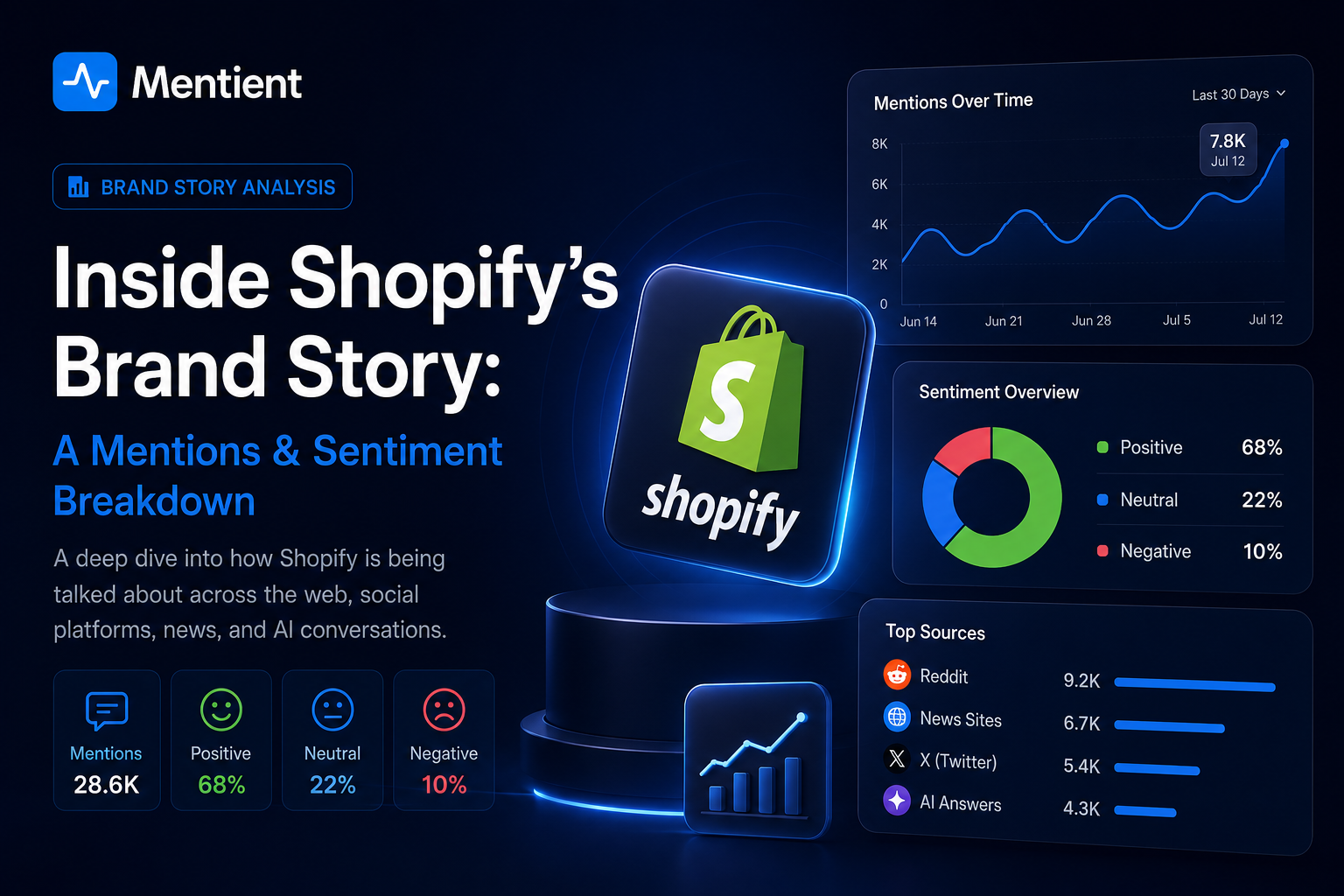
 Positive, neutral, and negative share of classified mentions, June 2023 through June 2025. The red band widens starting in early 2025.
Share of voice against the competition
 Share of combined news mentions, September 2024 through June 2025, the window where all four platforms have consistent monthly data.
| Brand | Avg. share of voice (Sep '24 to Jun '25) |
|---|---|
| Shopify | 62.3% |
| WooCommerce | 20.1% |
| BigCommerce | 14.1% |
| Wix | 3.6% |
Shopify held the largest share every single month in this window, but the gap moved. WooCommerce briefly closed in around December 2024, narrowing Shopify's lead before Shopify's share widened again heading into the March 2025 tariff coverage. The monthly figure ranged from 50.6% to 73.8%, not a flat 62% every month. That's the value of a monthly chart over a single headline number: a static "Shopify has 62% share of voice" stat tells you where things stand today, while the month-by-month version tells you when a competitor is gaining ground and when a news cycle is doing the work for you. (For more on how share of voice and mention volume get defined and measured, see Mentient's brand monitoring stats roundup.)
Wix's 3.6% share of press mentions is worth sitting with next to the 20-year search interest chart above, where Wix still holds a real, durable position in the 25 to 40 range on Google's index. The two metrics are measuring different things entirely. Search interest reflects everyday demand: people actively looking to build a website. Press mentions reflect what journalists and analysts choose to write about, which for Shopify right now leans heavily on earnings and policy stories that don't touch Wix the same way. A brand can hold a stable second place on one metric and a distant fourth on another, at the same time, for entirely different reasons, and a team that only checks one of the two would draw the wrong conclusion about where it stands.
What this means for other brands
Three signals, watched separately, tell three different stories. Search interest shows the long arc: a rival can lead for over a decade and still lose the lead within a single event-driven quarter. Mention volume shows when something is happening right now. Sentiment shows whether that something is good news or a problem, a distinction volume alone cannot make. March 2025 had the highest mention volume in our entire pull and the worst sentiment swing, in the same month.
Most teams we've seen track one of the three closely and glance at the other two occasionally. The Shopify data suggests that's backward. A brand's long-term trajectory, its immediate press cycles, and how those press cycles are landing with readers are three separate questions, each answered by a different kind of tracking. A monitoring setup that only answers one of them will miss the moment a rival's decade-long lead starts to crack, or the moment a strong volume month turns out to be a warning sign instead of good news.
There's a practical version of this worth running on your own brand. Pull your own search-interest trend against your two or three closest competitors and look for a crossover point, a month where the lines swap places. Then check whether your team's internal narrative about "who's winning" matches what the data shows for that period. In our experience, the two rarely line up exactly, and the gap between the story a team tells itself and what the mention data shows is usually where the most useful correction lives.
FAQ
How far back does this data go, and why does it stop where it does? Search interest goes back to January 2006, the earliest month Google Trends supports for web search. Press mention volume and sentiment go back to June 2023, the full window our content-analysis source has indexed for news coverage specifically. We didn't extrapolate or estimate anything past those boundaries.
Is a mention-volume spike always good news? No. September 2024 and March 2025 were both the largest spikes in our two-year mention data, and one was mostly positive while the other carried the sharpest negative-sentiment swing we measured. Volume alone doesn't tell you which kind of spike you're looking at; you need the sentiment split next to it.
Why did it take Shopify until 2019 to pass Wix in search interest, when Shopify's platform and revenue grew so much earlier? Search interest measures how often people look something up, not company revenue or merchant count. Wix built a large early audience of small businesses and individuals searching for a simple website builder, a search behavior that stayed strong through the 2010s even as Shopify's merchant base and revenue grew quickly on the commerce side specifically.
Does this analysis mean Shopify uses Mentient? No. This is an independent analysis built on publicly available mention, sentiment, and search-interest data. Shopify is not a customer of Mentient and did not participate in or endorse this piece.
What would change if we ran this analysis again in a year? The search-interest chart would likely keep climbing given Shopify's 2025 momentum, but the two-year mention window would roll forward, so events like the May 2024 Editions launch would eventually drop out of the "recent" data even though they'd still show up in the long-term Trends line. That's part of why we're naming our data windows explicitly rather than implying the whole story is always current.
Want to see what your own brand's mention volume, sentiment, and share of voice look like against your competitors? Try Mentient .