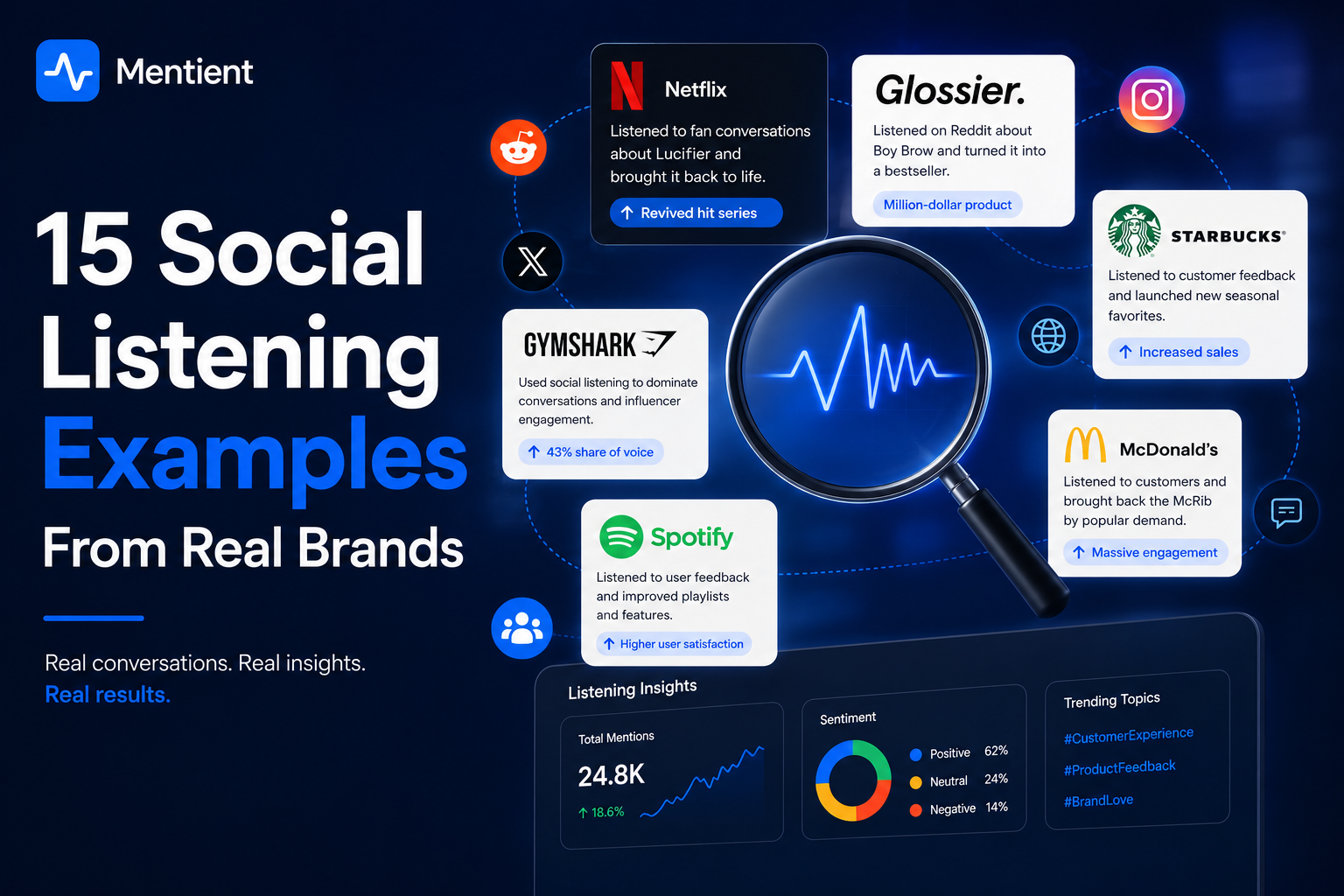
Every social listening example worth studying has the same shape. A brand noticed a pattern in public conversation, then changed something because of it: a product, a menu item, an ad, a reply. The ones that only 'engaged' are noise. So we pulled 15 real social listening examples from brands you know, sorted them by what the listening changed, and put the numbers next to them. The goal is not a highlight reel. It is a pattern you can copy.
The market is betting on that pattern. Grand View Research puts the social media listening market at $10.32 billion in 2025, on track for $20.18 billion by 2030 (Grand View Research), and the share of organizations running listening on dedicated software jumped from 44% in 2024 to 78% in 2025 (Archive.com). The examples below are what that spend looks like when it works.
- ✓Listening only counts when it changes a decision. All 15 examples end in a shipped change, not a dashboard.
- ✓Product and marketing dominate. Of the 15, 5 drove product decisions and 5 drove campaigns. Reputation, competitive, and community make up the rest.
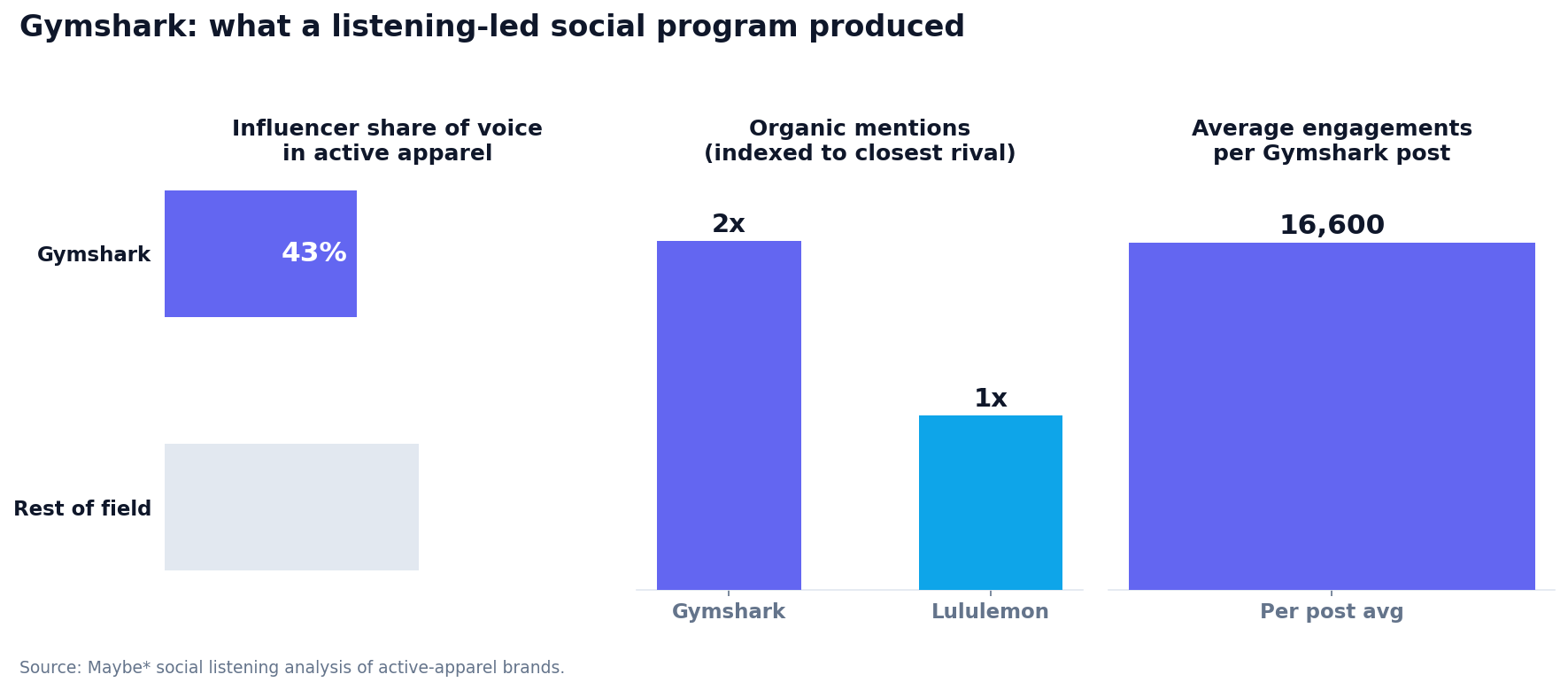
- ✓The data is real. Gymshark pulled 43% of influencer share of voice and double the organic mentions of its closest rival (Maybe*) off a listening-led program.
- ✓Reddit and forums keep showing up. Glossier's Boy Brow and Netflix's Lucifer revival both started in threads, not on official brand channels.
- ✓Speed is the edge. KFC and Samsung both turned a listening signal into a public response within days, and it changed the outcome.
What the 15 examples have in common
Before the list, one finding worth stating up front. When we sorted all 15 examples by what the listening changed, they did not spread evenly. Two categories carry most of the weight: product decisions and marketing campaigns, five examples each. Reputation recovery, competitive counter-moves, and pure community wins split the rest.
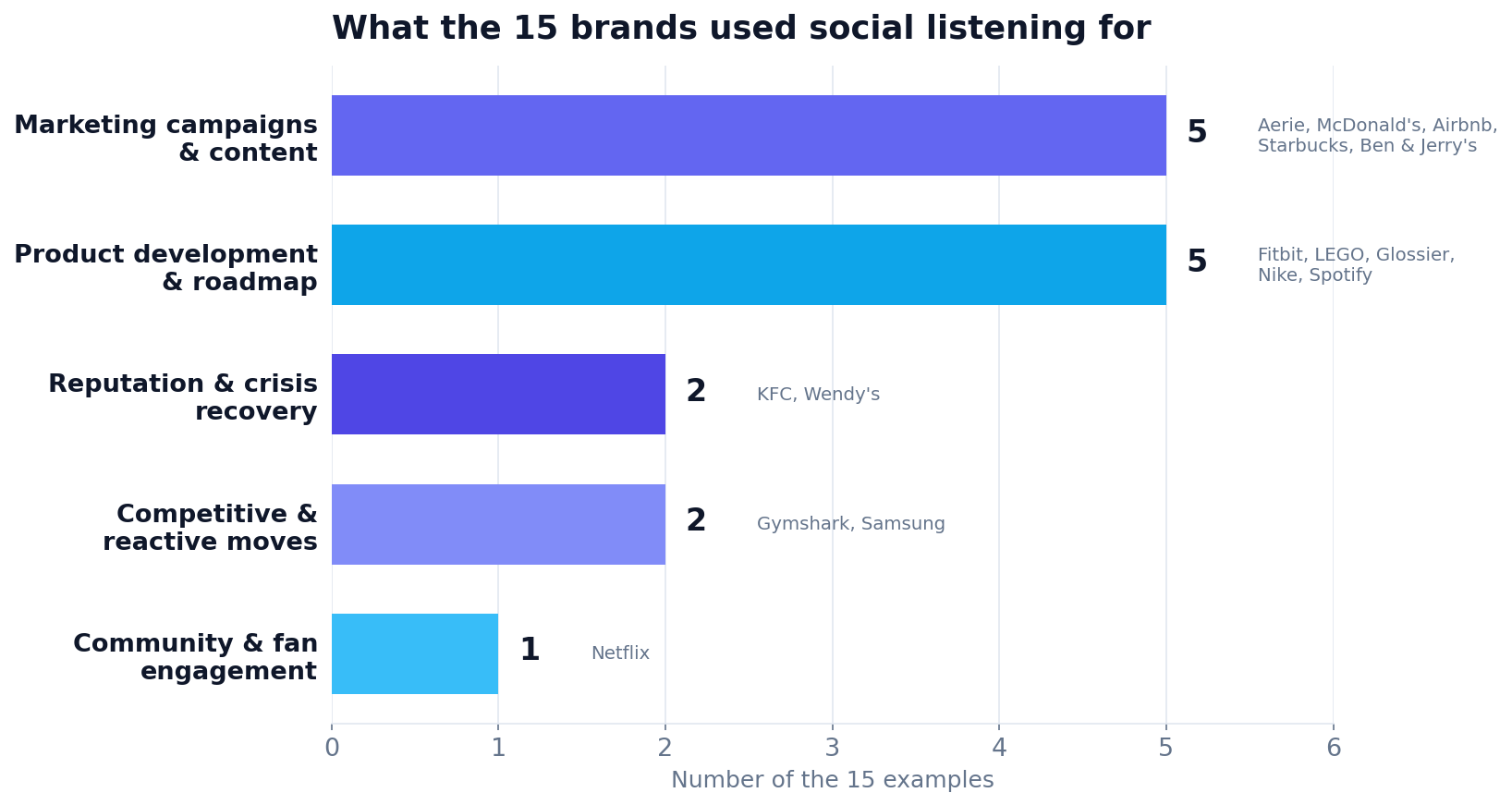
That skew matters for where you point your own program. If you are standing up listening to 'improve social,' the data says the payoff usually lands in product or campaign work, not in a vanity mention count. It lines up with the market too, where brands acting on social insights report up to 25% higher campaign ROI and detect trends 3x faster (Influencer Marketing Hub). For the definition and mechanics behind all of this, we wrote a separate guide on what social listening is. Here we stay on the examples.
Product and roadmap decisions (1-5)
The strongest listening examples are the quietest ones: a feature that shipped because the pattern in the mentions was loud enough to override the roadmap. These five changed a product.
1. Fitbit built 'Reminders to Move' from feature requests. Fitbit tracks support forums and social conversation for recurring product asks, and one theme kept surfacing: people wanted a mid-day nudge to stand up during long sedentary stretches, beyond the end-of-day step count. That pattern became the Reminders to Move feature (Rival IQ). The lesson is boring and it works: twelve similar requests inside a few days is a roadmap input, not a support ticket.
2. LEGO turned listening into a product pipeline with LEGO Ideas. Rather than guess at new sets, LEGO built LEGO Ideas (Influencer Marketing Hub), a platform where fans submit and vote on concepts. It is social listening formalized into a funnel: the conversation is the product research, and the vote count is the demand signal before a single mold gets cut.
3. Glossier's Boy Brow came out of Instagram and Reddit threads. Glossier reads customer discourse on Instagram and Reddit to find product gaps, and its most loved product, Boy Brow, traces directly to that customer conversation (Phyllo). We keep coming back to Reddit for a reason: it is where people are honest about what they wish existed, and we broke down why in our Reddit statistics analysis.
4. Nike uses listening as ongoing market research. Nike monitors conversation to spot which sports and activities are gaining heat with its audience, then feeds that into product development. It is less a single campaign than a standing trend-detection habit (Influencer Marketing Hub) that keeps the roadmap pointed at where demand is moving, not where it was last season.
5. Spotify markets with its audience, not at it. Spotify treats listening as a two-way input, spotlighting the exact user posts that sparked features and campaigns like Wrapped and its AI DJ rollout. The pattern, per Sprinklr, is that individually trivial requests matter enormously at scale, and the brands that aggregate them ship the thing everyone quietly wanted.
Marketing campaigns built from listening (6-10)
The second cluster is campaigns that would not exist without a listening signal. These five read the conversation, then built the marketing around what was already being said.
6. Aerie's #AerieREAL rode a body-positivity conversation. Aerie leaned into an unretouched, body-positive message its audience was already asking for, and the content traveled. One TikTok video in the campaign pulled 4.8 million views and more than 55,000 engagements (Influencer Marketing Hub). The signal came first; the campaign followed it.
7. McDonald's brought back Szechuan sauce because the internet demanded it. After a Rick and Morty reference set off a wave of requests, McDonald's revived the Szechuan sauce (Brand24). The first drop was a single day, and demand so badly outstripped supply that the relaunch became its own news cycle. A listening win with a supply-chain lesson attached: catch the signal, then stock for it.
8. Airbnb shapes content around the experiences people talk about. Airbnb monitors which trips, stays, and activities its audience discusses, then builds content and campaigns around those specific experiences (Influencer Marketing Hub). It is a straightforward loop, and it keeps the marketing anchored to real demand rather than a brand planning offsite.
9. Starbucks turns user conversation into seasonal moments. Starbucks reads the social reaction around its limited runs, the Unicorn Frappuccino being the loudest, and feeds the user-generated buzz back into the next launch. The conversation is the campaign engine (Talkwalker), and the seasonal drops are tuned to it.
10. Ben & Jerry's found a season in its own ad data. Ben & Jerry's looked past traditional monitoring and straight at ad engagement, and found more people were clicking its social ads in winter. So it shifted spend toward the winter window (Influencer Marketing Hub). Not every listening signal is a viral thread; sometimes it is a quiet pattern in your own numbers that reprices a media plan.
Reputation and crisis recovery (11-12)
The third cluster is where listening earns its keep under pressure. Two brands caught a reputation problem in the conversation and moved fast enough to change the story.
11. KFC UK turned a chicken shortage into 'FCK.' When KFC ran out of chicken across UK stores, the backlash was immediate and public. KFC tracked it, then ran a print and social apology rearranging its own logo to spell FCK (Sprinklr). The humor and speed, both guided by what people were saying in the moment, turned a supply failure into one of the more admired crisis responses of the decade.
12. Wendy's built a whole brand voice on listening. Wendy's reads the conversation closely enough to reply in real time with the sharp, roasting tone it is now known for, which keeps its reputation and engagement high (Rival IQ). The voice looks spontaneous. It runs on watching the timeline and knowing exactly when to jump in, and just as importantly, when not to.
Competitive and reactive moves (13-14)
The fourth cluster uses listening to watch rivals and the wider category, then move. One is a long game. One took a day.
13. Gymshark out-listened the entire active-apparel category. This is the most data-rich example in the set. A social listening analysis by Maybe* (Maybe*) found Gymshark commands 43% of influencer share of voice in its category and pulls double the organic mentions of its closest rival, Lululemon, with an average of 16,600 engagements per post. That did not happen by accident; it came from watching what its audience responded to and building the program around it.
14. Samsung answered Apple's 'Crush' ad within a day. When Apple's iPad ad, which crushed creative tools in a hydraulic press, drew a wave of negative reaction, Samsung was listening. It shipped a response film celebrating creative tools instead, and the timing made the point. Watching the backlash in real time (Talkwalker) is what let Samsung position itself as the brand that got it, while the conversation was still hot.
Community and fan-driven wins (15)
15. Netflix revived Lucifer because fans would not let it go. After Fox canceled Lucifer, fans organized around #SaveLucifer across X and Reddit. Netflix, watching the volume and sentiment on that tag rather than dismissing it, picked the show up (Mention). It went on to become one of the platform's most-watched originals, and as brand conversation moves into AI answers, the same instinct now extends to tracking AI brand visibility. The decision started as a listening signal, not a pitch deck, and it is the cleanest example of the whole set: the audience told the brand what to make, loudly, and the brand listened.
The timeline: when these wins happened
One more angle worth seeing. Plotting the 15 examples by year shows social listening maturing from a marketing curiosity into a standing capability, with wins landing across every category rather than clustering in one era.
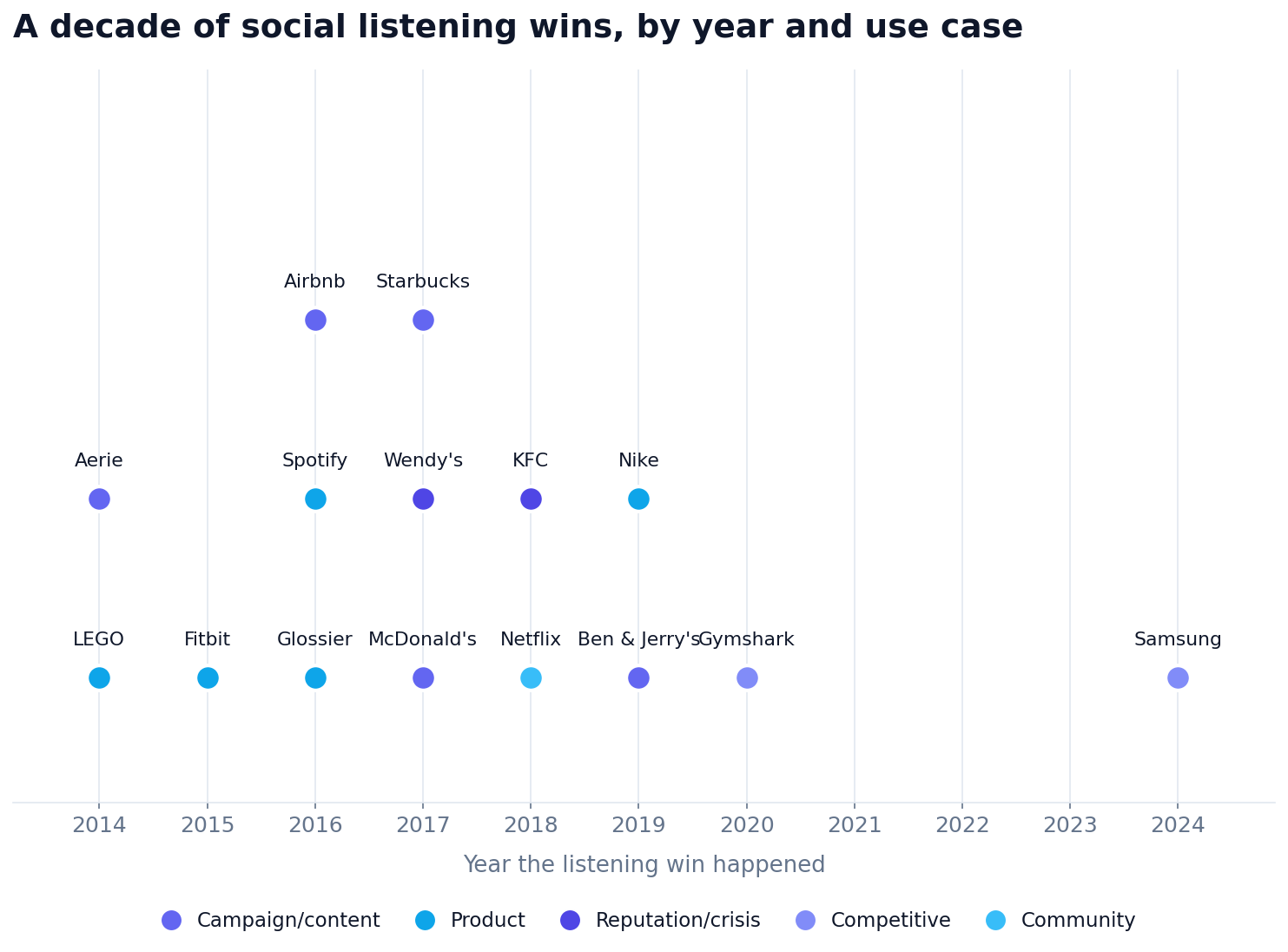
The spread is the point. These are not all vintage 2017 Twitter stunts. They run from community platforms in the mid-2010s to real-time competitive responses in 2024, which tells you the discipline keeps finding new places to pay off.
What you can copy from these examples
Strip the brand names off and the same four moves show up in almost every example. This is the part you can run.
| Move | What the brands did | Your version |
|---|---|---|
| Watch beyond @mentions | Glossier and Netflix caught signals in Reddit and hashtag threads that never tagged them | Track category and unbranded terms, beyond your handle |
| Aggregate the small stuff | Spotify and Fitbit acted on requests that were trivial alone, loud at scale | Tag by theme and watch cluster volume, not single posts |
| Move while it is hot | KFC and Samsung responded in days, not weeks | Set a real-time alert loop for time-sensitive signals |
| Close the loop to a change | Every example ended in a shipped product, ad, or reply | Log each insight that changed a decision, review quarterly |
None of this needs a fifteen-person team. It needs coverage that includes the places your customers really talk, a habit of reading clusters instead of chasing single posts, and the discipline to route a signal to whoever can act on it. Purpose-built brand monitoring handles the coverage and alerting; the judgment about what to do with the signal is still yours. If you want the numbers behind the category, we keep a running set of brand monitoring statistics alongside these examples.
Frequently asked questions
What is an example of social listening?
Netflix reviving Lucifer is a clean one. Fans campaigned with #SaveLucifer across X and Reddit after the show was canceled, Netflix tracked the volume and sentiment on that hashtag, and picked the show up. The listening signal, not a programming meeting, drove the decision, and it became one of the platform's most-watched originals.
What are the main types of social listening examples?
They sort by what the listening changed. Across the 15 brands here, the categories are product and roadmap decisions (Fitbit, LEGO, Glossier, Nike, Spotify), marketing campaigns (Aerie, McDonald's, Airbnb, Starbucks, Ben & Jerry's), reputation and crisis recovery (KFC, Wendy's), competitive moves (Gymshark, Samsung), and community wins (Netflix). Product and campaign decisions were the two biggest buckets.
How do brands use social listening for product development?
They read recurring requests and complaints, then ship against the pattern. Fitbit's Reminders to Move came straight from feature requests. Glossier's Boy Brow came out of Instagram and Reddit discussion. LEGO formalized it into LEGO Ideas, where fan votes act as demand signals before a product is built.
What is the difference between social listening and social monitoring?
Monitoring is reactive: it flags a mention so you can respond. Listening is analytical: it looks at the pattern underneath a batch of mentions and feeds it into a decision. Most of the examples here are listening, because they end in a change to a product or campaign rather than a reply to one post.
Does social listening deliver measurable results?
Yes, when brands act on it. Gymshark's listening-led program produced 43% of influencer share of voice in active apparel and double the organic mentions of its closest rival. More broadly, brands that act on social insights report up to 25% higher campaign ROI. The measurable part depends on closing the loop from insight to action.